Cite this as: Fadioui, A. 2026 Building Data Models for Archaeology: The case of the TETRARCHs Storytelling Data Model, Internet Archaeology 71. https://doi.org/10.11141/ia.71.1
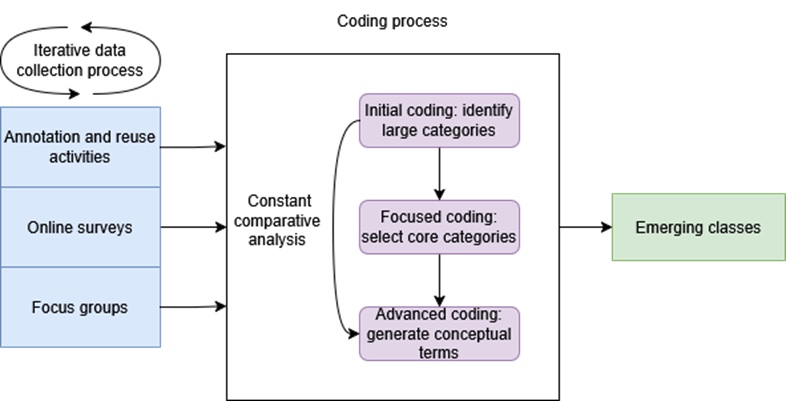
This article presents a methodology rooted in grounded theory which was developed through the crafting of a 'Storytelling Data Model' for the Transforming data rE-use in ARCHaeology project (TETRARCHs). This model aims to support the reuse of archaeological data for storytelling purposes across diverse audiences, be it archaeology professionals, creative practitioners, or partners from memory institutions, organisations, and platforms. In the context of TETRARCHs, storytelling is conceived as not just a means of supporting and reimagining data reuse, but simultaneously as a practice of interpretation and meaning-making. This article further discusses the representational implications of data modelling practices in archaeology and how the TETRARCHs Storytelling Data Model has sought to engage with and address these challenges.
Corresponding author: Aida Fadioui
[email protected]
University of Antwerp
Table 1: Illustration of selected competency questions capturing the intended use of the model
Alexander, C. 2009 'Stuart Hall and 'race'', Cultural Studies 23(4), 457–482. https://doi.org/10.1080/09502380902950914
Bartalesi, V., Meghini, C., Metilli, D. and Benedetti, F. 2019 'Introducing narratives in Europeana: A case study', International Journal of Applied Mathematics and Computer Science 29. https://doi.org/10.2478/amcs-2019-0001
Bakhtin, M. 1984 Problems of Dostoevsky's Poetics, University of Minnesota Press. https://doi.org/10.5749/j.ctt22727z1
Batist, Z. 2024 'On the Value of Informal Communication in Archaeological Data Work', Open Archaeology 10(1). https://doi.org/10.1515/opar-2024-0014
Batist, Z. and Roe, J. 2023 'Open-archaeo: A Resource for Documenting Archaeological Software Development Practices', Journal of Open Archaeology Data 11. https://doi.org/10.5334/joad.111
Batist, Z. and Roe, J. 2024 'Open Archaeology, Open Source? Collaborative practices in an emerging community of archaeological software engineers', Internet Archaeology 67. https://doi.org/10.11141/ia.67.13
Birks, M. and Mills, J. 2015 Grounded theory: A practical guide, 2nd edition, SAGE.
Bokulich, A. and Parker, W. 2021 'Data models, representation and adequacy-for-purpose', European Journal for Philosophy of Science 11(1), 31. https://doi.org/10.1007/s13194-020-00345-2
Bowker, G. C. and Star, S. L. 1999 Sorting things out: Classification and its consequences, MIT press. https://doi.org/10.7551/mitpress/6352.001.0001
Bria, R. E. and Vasquez, E. C. 2022 'Digital Archaeology and Storytelling as a Toolkit for Community-Engaged Archaeology' in K. Garstki (ed) Critical Archaeology in the Digital Age: Proceedings of the 12th IEMA Visiting Scholar's Conference (Vol. 2, pp. 49–66). Cotsen Institute of Archaeology Press at UCLA. https://doi.org/10.2307/j.ctv2fcctzd
Brockmeier, J. and Meretoja, H. 2014 'Understanding Narrative Hermeneutics', Storyworlds: A Journal of Narrative Studies 6. https://doi.org/10.5250/storyworlds.6.2.0001
Bruseker, G., Carboni, N. and Guillem, A. 2017 'Cultural Heritage Data Management: The Role of Formal Ontology and CIDOC CRM' in M. L. Vincent, V. M. López-Menchero Bendicho, M. Ioannides and T. E. Levy (eds) Heritage and Archaeology in the DigitalAge, Springer International Publishing. 93–131. https://doi.org/10.1007/978-3-319-65370-9_6
Butler, J. 1993 Bodies that matter: On the discursive limits of 'sex', Taylor and Francis.
Byrne, S. 2012 'Community Archaeology as Knowledge Management: Reflections from Uneapa Island, Papua New Guinea', Public Archaeology 11(1), 26–52. https://doi.org/10.1179/175355312X13311392295513
Canning, E., Brown, S., Roger, S. and Martin, K. 2022 'The Power to Structure: Making Meaning from Metadata Through Ontologies', KULA: Knowledge Creation, Dissemination and Preservation Studies 6(3), Article 3. https://doi.org/10.18357/kula.169
Charmaz, K. 2014 Constructing Grounded Theory, SAGE Publications Ltd.
Chun Tie, Y., Birks, M. and Francis, K. 2019 'Grounded theory research: A design framework for novice researchers', SAGE Open Medicine 7, 2050312118822927. https://doi.org/10.1177/2050312118822927
Ezzy, D. 1998 'Theorizing Narrative Identity: Symbolic Interactionism and Hermeneutics', The Sociological Quarterly 39(2), 239–252. https://doi.org/10.1111/j.1533-8525.1998.tb00502.x
Fadioui, A. and Giovannetti, C. in prep 'Weaving voices into the record: the Sley data model for the integration of senses and sensitivities'
Faniel, I. M., Austin, A., Kansa, E., Kansa, S. W., France, P., Jacobs, J., Boytner, R. and Yakel, E. 2018 'Beyond the Archive: Bridging Data Creation and Reuse in Archaeology', Advances in Archaeological Practice 6(2), 105–116. https://doi.org/10.1017/aap.2018.2
Fennelly, K. 2023 'Archaeology, Emotional Storytelling and Performance', Public Archaeology 21(1-4), 108–122. https://doi.org/10.1080/14655187.2022.2149683
Flanders, J. 2018 'Building Otherwise' in E. Losh and J. Wernimont (eds) Bodies of Information, University of Minnesota Press. 289–304. https://doi.org/10.5749/j.ctv9hj9r9.19
Glaser, B. and Strauss, A. 2017 Discovery of Grounded Theory: Strategies for Qualitative Research, Routledge. https://doi.org/10.4324/9780203793206
Habermas, T. (ed) 2018 'How narratives evoke emotions' in T. Habermas Emotion and Narrative: Perspectives in Autobiographical Storytelling, Studies in Emotion and Social Interaction, Cambridge University Press. 93–176. https://doi.org/10.1017/9781139424615
Hacıgüzeller, P., Taylor, J. S. and Perry, S. 2021 'On the Emerging Supremacy of Structured Digital Data in Archaeology: A Preliminary Assessment of Information, Knowledge and Wisdom Left Behind', Open Archaeology 7(1), 1709–1730. https://doi.org/10.1515/opar-2020-0220
Hagedoorn, B. and Sauer, S. 2018 'The Researcher as Storyteller: Using Digital Tools for Search and Storytelling with Audio-Visual Materials', View 7(14/2018), Article 14. http://dx.doi.org/10.18146/2213-0969.2018.jethc159
Hall, S. 1997a Race, The Floating Signifier [Lecture transcript]. https://www.mediaed.org/transcripts/Stuart-Hall-Race-the-Floating-Signifier-Transcript.pdf [Last accessed: 2 Feb 2026]
Hall, S. 1997b Representation: Cultural Representations and Signifying Practices, SAGE.
Helden, D. van and Witcher, R. 2019 'Historical fiction and archaeological interpretation: Introduction' in D. van Helden and R. Witcher (eds) Researching the Archaeological Past through Imagined Narratives, Routledge.
Huggett, J. 2018 'Reuse Remix Recycle: Repurposing Archaeological Digital Data', Advances in Archaeological Practice 6(2), 93–104. https://doi.org/10.1017/aap.2018.1
Huvila, I., Andersson, L. and Sköld, O. 2024 'Patterns in paradata preferences among the makers and reusers of archaeological data', Data and Information Management 8(4), 100077. https://doi.org/10.1016/j.dim.2024.100077
Huvila, I., Börjesson, L. and Sköld, O. 2022 'Archaeological information-making activities according to field reports', Library and Information Science Research 44(3), 101171. https://doi.org/10.1016/j.lisr.2022.101171
Huvila, I. and Ekman, S. 2024 'Documentation of data making, processing and use facilitates future reuse of research data: The CAPTURE project' in l. Volodina, G. Bouma, M. Forsberg, D. Kokkinakis, D. Alfter, M. Fridlund, C. Horn, L. Ahrenberg and A. Blåder (eds) Proceedings of the Huminfra Conference (HiC 2024), 10-11 January, 2024, Gothenburg, Sweden, Swedish Research Council. 26-30. https://doi.org/10.3384/ecp205004
Hyvönen, E. 2012 Publishing and Using Cultural Heritage Linked Data on the Semantic Web, Springer International Publishing. https://doi.org/10.1007/978-3-031-79438-4
Kansa, E., Kansa, S. and Arbuckle, B. 2014 'Publishing and Pushing: Mixing Models for Communicating Research Data in Archaeology', International Journal of Digital Curation 9. https://doi.org/10.2218/ijdc.v9i1.301
Katsianis, M., Uleberg, E., Opitz, R., Derudas, P., Ore, C.-E., Hiebel, G., Hivert, F., Marlet, O., Nenova, D., and Bruseker, G. 2023 'Semantic Modelling of Archaeological Excavation Data. A review of the current state of the art and a roadmap of activities', Internet Archaeology 64. https://doi.org/10.11141/ia.64.12
Krmpotich, C. and Somerville, A. 2016 'Affective Presence: The Metonymical Catalogue', Museum Anthropology 39(2), 178–191. https://doi.org/10.1111/muan.12123
Laužikas, R., Dallas, C., Thomas, S., Kelpšienė, I., Huvila, I., Luengo, P., Nobre, H., Toumpouri, M. and Vaitkevičius, V. 2018 'Archaeological Knowledge Production and Global Communities: Boundaries and Structure of the Field', Open Archaeology 4(1), 350–364. https://doi.org/10.1515/opar-2018-0022
Lisena, P., Schwabe, D., van Erp, M., Troncy, R., Tullett, W., Leemans, I., Marx, L. and Ehrich, S. C. 2022 'Capturing the Semantics of Smell: The Odeuropa Data Model for Olfactory Heritage Information' in P. Groth, M.-E. Vidal, F. Suchanek, P. Szekley, P. Kapanipathi, C. Pesquita, H. Skaf-Molli and M. Tamper (eds) The Semantic Web, Springer International Publishing. 387–405. https://doi.org/10.1007/978-3-031-06981-9_23
Mead, G. H. and Morris, C. W. 1934 Mind, self and society: From the standpoint of a social behaviorist (Facsim. ed.), University of Chicago press.
Meghini, C., Bartalesi, V. and Metilli, D. 2021 'Representing narratives in digital libraries: The narrative ontology', Semantic Web 12(2), 241–264. https://doi.org/10.3233/SW-200421
Meretoja, H. 2018 The ethics of storytelling: Narrative hermeneutics, history and the possible, Oxford university press.
Mickel, A. 2015 ''Archaeology's Epic Battles with Storytelling and Stereotypes', Norwegian Archaeological Review 48, 1–4. https://doi.org/10.1080/00293652.2015.1051581
Morgan, C. 2025 'Archaeology as Worldbuilding', Cambridge Archaeological Journal 2025:1-10. https://doi.org/10.1017/S0959774325100164
Neller, A., Heckman, J., Bollwerk, E., Myers, K. N. and Wells, J. 2024 'Making Archaeological Collections More Findable and Accessible through Increased Coordination', Advances in Archaeological Practice 12(1), 34–42. https://doi.org/10.1017/aap.2023.31
Nicholson, C., Kansa, S., Gupta, N. and Fernandez, R. 2023 'Will It Ever Be FAIR?: Making Archaeological Data Findable, Accessible, Interoperable and Reusable', Advances in Archaeological Practice 11, 63–75. https://doi.org/10.1017/aap.2022.40
Perry, S., Simandiraki-Grimshaw, A., Morgan, C., Taylor, J. S., Fadioui, A., Foket, L., Hacıgüzeller, P., Sampatakou, D. V., Derudas, P., Wright, H. and Clough, A. 2025 'Towards New Futures for Archaeological Data Production: Challenging Archaeonormativity through Storytelling', Journal of Field Archaeology 50(8), 796-815. https://doi.org/10.1080/00934690.2025.2504235
Pluciennik, M. 1999 'Archaeological Narratives and Other Ways of Telling' Current Anthropology 40(5), 653–678. https://doi.org/10.1086/300085
Praetzellis, A. 2014 'Narrative and Storytelling for Archaeological Education' in C. Smith (ed) Encyclopedia of Global Archaeology, Springer. 5135–5138. https://doi.org/10.1007/978-1-4419-0465-2_2095
Rabinowitz, A. 2022 'Metadata for the Masses: Facilitating Discoverability and Access in Digital Archaeological Archives' in L. Goldstein and E. Watrall (eds) Digital Heritage and Archaeology in Practice: Presentation, Teaching and Engagement, 1st edition, University Press of Florida. 61–84. https://doi.org/10.2307/j.ctv2pfq2jj.8
Radford, J. and Joseph, K. 2020 'Theory In, Theory Out: The Uses of Social Theory in Machine Learning for Social Science', Frontiers in Big Data 3, 18. https://doi.org/10.3389/fdata.2020.00018
Ratcliff, C. and Sun, Y. 2020 'Overcoming Resistance Through Narratives: Findings from a Meta-Analytic Review', Human Communication Research 46. https://doi.org/10.1093/hcr/hqz017
Ren, Y., Parvizi, A., Mellish, C., Pan, J. Z., van Deemter, K. and Stevens, R. 2014 'Towards Competency Question-Driven Ontology Authoring', in V. Presutti, C. d'Amato, F. Gandon, M. d'Aquin, S. Staab and A. Tordai (eds) The Semantic Web: Trends and Challenge, Springer International Publishing. 752–767. https://doi.org/10.1007/978-3-319-07443-6_50
Seaton, K.-L. and Lauzikas, R. 2023 'Digital Archiving Best Practice and Future Challenges', Internet Archaeology 63. https://doi.org/10.11141/ia.63.8
Swenson, E. and Cipolla, C. N. 2020 'Representation and materiality in archaeology: A semiotic reconciliation', World Archaeology 52(3), 313–329. https://doi.org/10.1080/00438243.2021.1925582
Terrell, J. 1990 'Storytelling and Prehistory', Archaeological Method and Theory 2, 1–29. https://www.jstor.org/stable/20170203 [Last accessed: 2 Feb 2026]
Thomas, J. T. 2015 'The Archaeologist as Writer', in R. M. Van Dyke and R. Bernbeck (eds) Subjects and Narratives in Archaeology, University Press of Colorado. 169–187. https://doi.org/10.5876/9781607323815.c008
Tringham, R. 2020 'Closely Observed Layers: Storytelling and the Heart' in K. Supernant, J. E. Baxter, N. Lyons, and S. Atalay (eds) Archaeologies of the Heart, Springer International Publishing. 239–252. https://doi.org/10.1007/978-3-030-36350-5_15
van Erp, M., Tullett, W., Christlein, V., Ehrhart, T., Hürriyetoğlu, A., Leemans, I., Lisena, P., Menini, S., Schwabe, D., Tonelli, S., Troncy, R. and Zinnen, M. 2023 'More than the Name of the Rose: How to Make Computers Read, See and Organize Smells', The American Historical Review 128(1), 335–369. https://doi.org/10.1093/ahr/rhad141
Whitelaw, M. 2015 'Generous Interfaces for Digital Cultural Collections', Digital Humanities Quarterly 9(1). https://dhq.digitalhumanities.org/vol/9/1/000205/000205.html [Last accessed: 2 Feb 2026]
Wilkinson, M. D., Dumontier, M., Aalbersberg, Ij. J., Appleton, G., Axton, M., Baak, A., Blomberg, N., Boiten, J.-W., da Silva Santos, L. B., Bourne, P. E., Bouwman, J., Brookes, A. J., Clark, T., Crosas, M., Dillo, I., Dumon, O., Edmunds, S., Evelo, C. T., Finkers, R., … Mons, B. 2016 'The FAIR Guiding Principles for scientific data management and stewardship', Scientific Data 3(1), 160018. https://doi.org/10.1038/sdata.2016.18
Wright, H. 2021 'Archaeology and the FAIR Principles. A case study from the Archaeology Data Service ', [Slideshow presentation] Archaeology Data Service. https://archaeologydataservice.ac.uk/app/uploads/2022/08/SSHOC_ArchaeologyFAIR.pdf [Last accessed: 2 Feb 2026]
Wylie, A. 2017 'How Archaeological Evidence Bites Back: Strategies for Putting Old Data to Work in New Ways', Science, Technology and Human Values 42(2), 203–225.
Yakel, E., Faniel, I. M. and Robert Jr, L. P. 2024 'An empirical examination of data reuser trust in a digital repository', Journal of the Association for Information Science and Technology 75(8), 898–915. https://doi.org/10.1002/asi.24933
Yarrow, T. 2008 'In Context: Meaning, Materiality and Agency in the Process of Archaeological Recording' in C. Knappett and L. Malafouris (eds) Material Agency: Towards a Non-Anthropocentric Approach, Springer US. 121–137. https://doi.org/10.1007/978-0-387-74711-8_7
Internet Archaeology is an open access journal based in the Department of Archaeology, University of York. Except where otherwise noted, content from this work may be used under the terms of the Creative Commons Attribution 3.0 (CC BY) Unported licence, which permits unrestricted use, distribution, and reproduction in any medium, provided that attribution to the author(s), the title of the work, the Internet Archaeology journal and the relevant URL/DOI are given.
Terms and Conditions | Legal Statements | Privacy Policy | Cookies Policy | Citing Internet Archaeology
Internet Archaeology content is preserved for the long term with the Archaeology Data Service (ROR). Help sustain and support open access publication by donating to our Open Access Archaeology Fund.
 Home
Home