Cite this as: Sofaer, J., D'Cruz, L., Zaboloteanu, O., Whitmarsh, B., Maguire, N., Sadler, J. and Chauhan, A. 2026 Wellbeing Through Heritage for NHS Staff. Heritage Engagement and Participant Choice in the HerWellNHS Project, Internet Archaeology 73. https://doi.org/10.11141/ia.73.7
Poor staff wellbeing has been described as an 'extraordinarily dangerous risk to the future functioning of the health and social care services' (House of Commons Health and Social Care Committee 2021). NHS staff face significant challenges to their mental health and wellbeing in the wake of the COVID-19 pandemic (NHS Providers 2020; Palmer and Rolewicz 2023). Even before the pandemic, responses to a British Medical Journal survey indicate that one third of doctors were burned out (McKinley et al. 2020). Workforce burnout is the highest in the history of the NHS and care systems and is a key factor in staff leaving or reducing hours (Warren 2022). More than half of NHS leavers are voluntary resignations, the top two reasons being to improve work-life balance and for health issues, and the number leaving for these reasons has more than doubled since 2013/14 (Warren 2022).
The NHS Workforce Plan (NHS England 2023) sets out proposals for increased workforce supply but little to tackle the crisis in workforce retention and wellbeing (Walshe et al. 2024). Healthcare workers identify measures to support their health and wellbeing as vital (Chatfield et al. 2023) but there has been a lack of research in this area (Walshe et al. 2024). Existing wellbeing packages include support helplines, wellbeing guidance, bereavement resources, a bespoke package of support for registered managers, and investment in occupational health (Department of Health and Social Care 2021). However, much of this provision comes too late for NHS staff. There is an urgent need for innovative solutions that promote resilience in order to prevent poor wellbeing, support work engagement and improve staff retention. Such solutions need to be delivered at scale to support the 1.4 million NHS workforce (NHS Digital 2023). This requires the maximisation of the use of existing resources and the promotion of self-help solutions (Campion et al. 2020).
Heritage sites are one such resource. Ninety-nine percent of people in England live less than one mile from a listed heritage asset (Historic England 2020). In addition, local authority Historic Environment Records (HERs) and the Heritage Gateway identify hundreds of thousands of locally designated and undesignated heritage assets of all periods including historic buildings, parks and gardens, archaeological findspots and historic places commemorating events and people (Historic England 2019). Heritage sites, including 'heritage on the doorstep', are therefore a large and accessible asset base. There is growing understanding of the therapeutic benefits of heritage visits for people with diagnosed conditions in the context of social prescribing (Gradinarova 2022; Mughal et al. 2022). However, facilitated visits are resource-intensive and challenging to deliver at scale (Husk et al. 2020). They have limited capacity and rely upon the continued provision of funding. They do not meet the needs of shift workers nor of time-poor NHS staff (Sofaer et al. in press).
Self-guided participation is less resource intensive, more sustainable, and can be delivered at scale. It is also better suited to the shift patterns of NHS staff (Sofaer et al. in press). However, less attention has been paid to the potential benefits of self-directed visits to heritage sites. Recent work indicates their role in supporting wellbeing during periods of crisis (Sofaer et al. 2021). Furthermore, health and wellbeing benefits are accrued from the historic environment and day-to-day encounters with heritage, including higher life satisfaction through the close proximity to everyday local heritage, even without engagement in heritage activities (Collwill 2024; Reilly et al. 2018). The affordances (qualities) of different types of site speak to different wellbeing needs (Gallou et al. 2022). Wellbeing is understood as 'how people feel and how they function, both on a personal and a social level, and how they evaluate their lives as a whole' (Michaelson et al. 2012, 6). Wellbeing measures offer a more holistic approach than traditionally narrower concepts of health and illness and are situated within a prevention-orientated public health approach (Farrier et al. 2017). Self-directed visits within a wellbeing framework may therefore have potential as a sustainable intervention for NHS staff.
Yet, we have little understanding of whether and how NHS staff may engage with heritage to support their wellbeing. We do not know what choices NHS staff may make in a self-directed context, including sites and their characteristics, and how these align with their self-described wellbeing needs. Existing data on visitor decision-making sits largely within tourism and destination management and tends to focus on factors affecting holiday preferences, consumer demand and the design of visitor experience (e.g. Jia 2025; Davies and Prentice 1995; Uysal et al. 2025). Although visitor numbers and demographics are collected routinely collected for UK heritage attractions there is little data for heritage on the doorstep. Nor do we have data for at-risk groups or those with low levels of previous heritage engagement.
The Heritage and Wellbeing for NHS Staff pilot and feasibility project (HerWellNHS) investigated the potential of self-directed (or unguided) visits to heritage sites as a sustainable approach to supporting the short and medium-term wellbeing and work engagement of NHS staff who do not yet meet clinical thresholds for formal support. Feasibility studies involve understanding the parameters necessary for successful development of an intervention (Bond et al. 2023). This paper focuses on HerWellNHS participant choices in visits to heritage sites and their characteristics as an essential pre-requisite to sustainable heritage intervention design.
Data for HerWellNHS participant choice are discussed at a series of different scales. First, overall heritage engagement within the project. Second, participant choices in respect of engagement with heritage with a green component, urban built heritage and online. This includes the novel application of a machine learning model to extract predictors for participant visits to heritage with a green component versus urban built heritage. Third, the conversion of intended to actual visits is examined at the scale of site type in order to reveal potential barriers to heritage engagement. Fourth, motivations for individual site choice are explored in relation to participants' self-identified well-being need. This includes notions of psychological distance (Liberman 2007) and the alignment of motivations for participant choice of site with the Five Ways of Wellbeing (Michaelson et al. 2012). Data for other aspects of the study are reported elsewhere.
Funded by Historic England, the HerWellNHS Study was a collaboration between the University of Southampton, Portsmouth Hospitals University NHS Trust (PHU) and Historic England, with the support of national and regional heritage partners. The project obtained National Institute of Health and Social Care Research portfolio adoption status. Research took place in 2023 in Portsmouth with a patient and public involvement (PPI) phase in 2021-22. The PPI phase was critical in understanding opportunities and barriers to participation and resulted in co-design with NHS staff of a mixed methods study (Sofaer et al. in press).
On entry to the study, participants took a series of validated baseline questionnaires aimed at measuring wellbeing (Tennant et al. 2007), life satisfaction (Diener et al. 1985), compassion (Hwang et al. 2008), work engagement (Schaufeli et al. 2017), and physical activity (Gill et al. 2012). In addition, they provided data on feelings, demographic information and pre-study levels of heritage engagement. Participants were invited to visit (and return to) as many heritage sites as they liked over a 5-month heritage intervention period. After each visit they were asked to complete a short questionnaire reporting on who they went with, visit duration, mode of transport, amount of exercise, feelings and qualitative feedback. Baseline questions were reapplied at the end of the heritage intervention period and post-intervention qualitative responses to the participation were obtained. All participants were followed up at 4-6 weeks post-intervention with reapplication of baseline and qualitative feedback to monitor wellbeing and continued heritage engagement.
Lack of awareness of heritage sites and the cost of visits were identified as important potential barriers to participant engagement in the PPI phase (Sofaer et al. in press). Although there was widespread awareness of the wellbeing benefits of green spaces, there was uncertainty as to what heritage is and what a heritage offer might look like, particularly in terms of local heritage on the doorstep. HerwellNHS participants were therefore given access to an interactive map on the designated study portal used for all data submission and interaction with the project. It included free places to visit in all wards of the city, to which participants could walk or take public transport. A photograph, a short narrative and links to further information were provided for each site in order to assist participants in choosing places to visit and to support their heritage understanding. Participants were also able to add their own suggestions to the map and share their own places to go with the PHU participant community. By the end of the project, the map contained 155 heritage sites in Portsmouth and the surrounding area as suggestions of places to visit, of which 133 were provided by the project and 23 were added by participants. Project partners provided all participants with free entry to pay-to-enter heritage attractions including all National Trust properties, Portsmouth Historic Dockyard (National Museum of the Royal Navy), The Mary Rose Museum, and Portchester Castle (English Heritage). This supported equity of access and acted as an incentive for study participation. All tickets allowed participants to visit with friends and family, thereby supporting social connectedness. Links to digital heritage were provided in order to facilitate free online visits.
Participants were encouraged to browse the project's interactive map throughout the heritage intervention period. They selected sites they wanted to visit and added these intended visits to a personal list of activities ('My Activities'). Having made a visit, participants returned to their activity list, clicked on the site, and completed a post-visit questionnaire. The research team was therefore able to track intended visits as measure of interest, to identify actual visits made, and to examine conversion from intended to actual visits in order to explore participant choices and their characteristics.
Portsmouth is a heritage-rich, island port city with an equally rich hinterland. It is well-known for its naval and maritime history, as well as being a late Georgian and Victorian seaside resort (Portsmouth City Council 2024). As elsewhere, its heritage is relational and contested and is both 'top-down' and 'bottom-up' (Harrison 2010, 8). In order to ensure that opportunities for heritage engagement were relevant to the diverse staff base at PHU, sites were selected to represent the breadth of heritage in and around Portsmouth with support from Portsmouth City Council (Portsmouth City Council 2024, 30-31). The sites embrace the city's past and present class, ethnic, religious and gender diversity from listed heritage, such as forts, castles, stately homes and archaeological sites, to everyday heritage including pubs, former factories and unofficial local heritage. Care was taken to ensure an even geographic distribution across the city's wards.
In order to assess the choices and visit characteristics of participants, and to identify whether potential participant bias towards the known wellbeing benefits of nature engagement influenced participant choices, each individual site was classified as belonging to one of 3 broad categories: urban built heritage (N= 92 sites); heritage with a green component (including parks) (N=55 sites); digital heritage (N= 8 sites). For analytical purposes sites were further divided into 20 sub-categories: Business (e.g. the former IBM Head Office, now a listed building), Castle (e.g. Portchester Castle), Cemetery (e.g. Polish Memorial in Kingston Cemetery), Civic (e.g. Portsmouth Guildhall), Education (e.g. Craneswater Junior School), Faith (e.g. Hafiziah Madrasah), Health (e.g. St James Hospital Chapel), Housing (including stately homes), Industry (e.g. former Marina Corset Factory), Leisure (including Fratton Park home of Portsmouth Football Club, Hilsea Lido and other recreation facilities), Literature (e.g. The Ocean and the End of the Lane named after Neil Gaiman's novel), Military (including sites still in use by the Royal Navy, Portsmouth Historic Dockyard and nineteenth century Palmerston Forts), Museums (e.g. Portsmouth Museum and Art Gallery), Natural Heritage (e.g. Selborne Common), Parks and Gardens (e.g. Baffins Pond), Person (e.g. Charles Dicken's birthplace), Transport (e.g. tram tracks on Rugby Road), World War II (including defences such as listed anti-tank defences at Eastney Beach and monuments), Online Heritage Visit, Other. This enabled consideration of participant choices.
HerWellNHS participants were 300 high-risk members of staff working at Portsmouth Hospitals University NHS Trust (PHU) over the age of 18 who do not yet meet clinical thresholds for mental health intervention (not diagnosed or received treatment for a mental health condition in the last 12 months). They self-referred to the project. The Trust's NHS Staff Survey results are in line with the national average, suggesting high levels of stress likely to result in poor wellbeing (Portsmouth Hospitals University NHS Trust 2022).
Eighty-nine percent of participants identified as female and eleven percent as male. This broadly reflects the predominantly female nature of the PHU workforce (74% female and 26% male) and the greater willingness of women to participate in social research (Korpela et al. 2008). The job roles of participants were: 33% nursing, 24% admin/clerical, 19% other, 12% Allied Health Professionals (AHP), 8% Healthcare Support Workers (HSP), 5% medical. The ethnicities of participants were: 76% White British, 7% White European, 4% South Asian, 4% other Asian, 2% Asian British, 2% Any Other White Background, 2% Black African/Caribbean, 3% Prefer Not To Say, Black British and Any Other Mixed Background each <1%. All participants were aged between 18 and 65.
Participants reported low annual heritage engagement prior to the study (Mean = 2.36 heritage visits per year; Standard Deviation (SD)= 0.93).
Quantitative data were explored through descriptive statistics and machine learning. Machine learning is useful for complex large data sets that would otherwise be difficult to analyse. Previous applications in archaeology and cultural heritage include remote sensing to detect sites, classification of sites, objects and environmental data, and prediction of the functional life of heritage buildings (Fiorucci et al. 2020). Here we use machine learning to identify predictors for participant visits to heritage with a green component versus urban built heritage.
The HerWellNHS data was fitted to an Extra-Trees model, an ensemble learning method that builds multiple decision trees and averages their predictions to improve accuracy and control and limit overfitting. Extra-Trees works by randomly selecting features and thresholds to split the data, thus making it robust against noise and reducing variance (Geurts et al. 2006). Following fitting of the model, permutation importance was applied in scikit-learn to evaluate the significance of each feature. Permutation importance is a model-agnostic method used to estimate the importance of features in a machine learning model (Muschalik et al. 2022). It works by randomly shuffling the values of each feature and measuring the resulting decrease in model performance, helping rank features based on their contribution to the prediction. If a feature is important, shuffling its values should significantly degrade the model's performance. Conversely, if a feature is not important, shuffling its values will have little effect on the model's performance (Molnar 2019). Shuffling each feature's values one by one shows the range of importance scores from -1 to 1: positive scores (0 to 1) ranging from low to high importance, while negative scores (-1 to 0) also indicate importance from low to high but additionally suggesting that a variable has a negative correlation with the predictive performance of the model.
Qualitative data were analysed using thematic analysis, following Braun and Clarke ( 2006).
During the five months of the heritage intervention 140 participants reported 844 intended visits to 155 sites and 91 participants reported 263 actual visits to 97 sites. Thus, intended visits were reported to all sites on the interactive project map. Actual visits were made to two thirds (63%) of sites.
Participants reporting actual visits showed strong heritage engagement. They made an average of 2.92 visits (SD 2.71) during the five months of the heritage intervention (greater than the baseline annual mean number of visits). 41.76% of participants (N= 38) made 3 or more visits, whilst 20.88% of participants (N=19) made 5 or more visits (compared to 1% making 5 annual visits pre-intervention). 4.4% were heritage 'super users' who made more than 10 visits during the study (Figure 1).
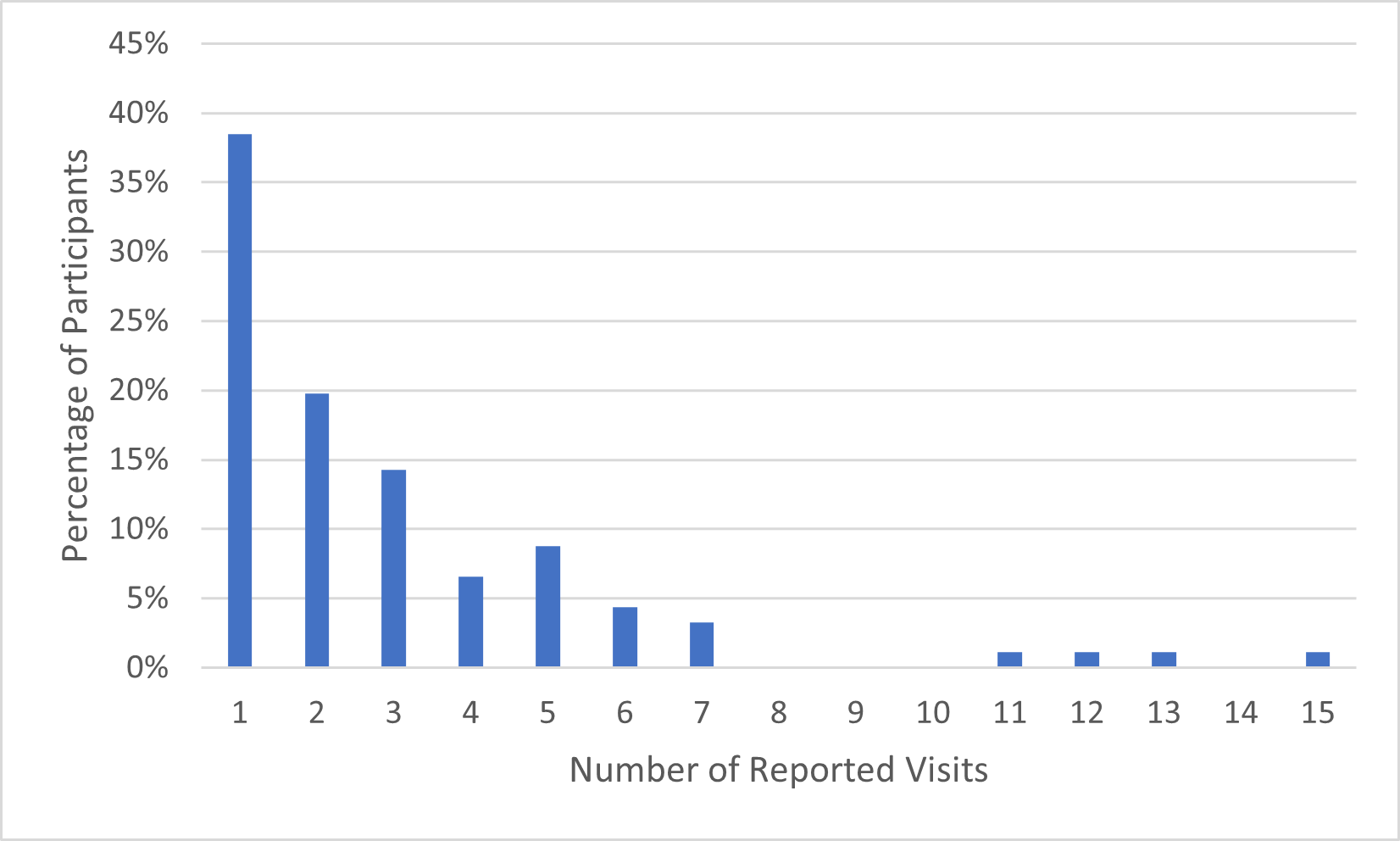
Time constraints, including challenges around balancing work commitments, family obligations, and other activities, were cited as the most significant barriers to visiting heritage sites. Participants also commented on unfavourable weather and the relatively short duration of the period of heritage intervention, making it difficult to fit in as many visits in as they would have wanted.
'Working 6 days a week makes things tricky but it's quality rather than quantity'
'Extended time/more time to use tickets would have been great as winter months the weather is not great.'
The proportion of actual visits differed significantly across the 3 place categories of heritage with a green component, urban built heritage and online visits (χ²(2, N = 844) = 6.22, p = .045). Z-tests to compare the proportions of visits between each pair of place categories reveal a statistically significant difference between visits to urban and online settings (p = 0.005), a borderline significant difference between green and online settings (p = 0.059), and no significant difference between green and urban settings (p-value = 0.101). Participants demonstrated a preference for in person visits to heritage over online visits but there was no preference for visits to either heritage with a green component or to urban built heritage.
Thematic analysis of the participant responses reveals that the preference for in person visits can be attributed to the importance of embodied experience, as well as the challenges and limitations of online visits. In particular, participants identified the latter as having limited potential to impact their wellbeing. Online heritage engagement is a solitary experience and does not have the companionship or change of scene that participants seek as part of a wellbeing experience.
'On screen you might as well be watching a documentary or movie. Being there fills all five senses and you have a tangible authentic experience of the place and the moment.'
Nonetheless, some participants acknowledged logistical benefits to visiting historic places online in terms of convenience and cost-saving,
'Working full time means I wouldn't have been able to visit the sites that are open Monday - Friday 9.00 - 5.00 PM.'
Machine learning was used to identify predictive features for participant choice of in person visits to heritage with a green component versus urban built heritage.
The Extra-Trees model yielded an accuracy score of 0.78, indicating that the model correctly predicts likelihood of choice that a person would choose to visit heritage with a green component versus urban built heritage in 78.05% of cases.
Permutation importance analysis revealed that out of 101 features entered into the model, 5 are positively associated with choice of green sites (and thus negatively associated with choice of brown / urban sites). Fourteen features are negatively associated with choice of green sites (and thus positively associated with choice of brown / urban sites) (Table 1). Positive predictive features for visiting heritage in green settings include being accompanied on a visit, higher baseline exercise levels, longer visit duration, female gender and feeling greater post-visit vitality. The link between exercise, nature engagement and vitality is well-known (Loureiro and Veloso 2017), supporting this complex of predictive features.
Negative predictors are more complex. Not only are there more of them but they include a range of psychological features linked to measures of life satisfaction, compassion, work engagement and wellbeing, feelings (vitality, inspiration, optimism and nostalgia), as well features linked to time spent at work, the number of people accompanying participants during a visit, mode of travel and time taken to report a visit to the study. Visits to urban built heritage tended to be closer to home and more amenable to short visits accessed by public transport. They were preferred by participants with low baseline exercise levels and those who worked longer hours. This suggests the importance of proximity to heritage on the doorstep for time-poor groups. Although visitors to urban built heritage were more inclined to go alone, those who did go with others tended to go in larger groups than those choosing heritage with a green component. Urban visits may offer a different social dynamic when groups are involved as they may offer more opportunities for socialising, including to everyday heritage on the doorstep such as pubs, restaurants and leisure heritage. Participants choosing visits to urban built heritage further had lower end of study life satisfaction, and end of study and baseline Warwick Edinburgh Mental Wellbeing Scale (WEMWBS) scores for specific questions. However, they also had higher baseline, post-visit and end of study feelings, compassion and work engagement scores for some questions. Thus while visits to urban heritage sites may have less of an overall effect on wellbeing, they do respond to a particular need for emotional nourishment, also reflected in lower baseline scores for inspiration and higher scores for nostalgia. Visits to urban sites may have the effect of generating greater post-visit optimism and compassion.
The standard deviation measures in the permutation importance analysis reveal distinct variability in feature importance, particularly for several negatively associated predictors for green heritage site choices. Features with higher standard deviations, such as 'Work engagement: I am enthusiastic about my job (baseline)' and 'Means of travel', suggest that their impact on predicting site choice varies significantly among participants. Thus, while these features are relevant, they imply that specific psychological and lifestyle factors linked to personal context and individual differences may play a crucial role in shaping heritage site preferences and their influence may be context-dependent
Conversely, features with lower standard deviations, such as 'Accompanied on visit (yes/no)', show a more consistent association with preferences for heritage with a green component, highlighting a stable predictor across the sample.
| Feature | Mean Importance | Standard Deviation Importance | Heritage With A Green Component | Built Urban Heritage |
|---|---|---|---|---|
| Accompanied on visit (yes/no) (post-visit) | 0.014634 | 0.011949 | Yes | No |
| Exercise level (baseline) | 0.002439 | 0.007317 | Higher | Lower |
| Visit duration (post-visit) | 0.002439 | 0.007317 | Longer | Shorter |
| Gender | 0.002439 | 0.007317 | Female | Male |
| Vitality (post-visit) | 0.002439 | 0.007317 | More | Less |
| Vitality (baseline) | -0.002439 | 0.007317 | Less | More |
| Average hours worked per week | -0.002439 | 0.007317 | Less | More |
| Life satisfaction: In most ways my life is close to my ideal (end of study) | -0.002439 | 0.007317 | Strongly agree | Strongly disagree |
| Compassion: I would rather engage in actions that help others, even though they are strangers, than engage in actions that would help me (end of study) | -0.002439 | 0.007317 | Less | More |
| Inspiration (baseline) | -0.002439 | 0.007317 | Less | More |
| Optimism (post-visit) | -0.002439 | 0.007317 | Less | More |
| Work engagement: I am enthusiastic about my job (baseline) | -0.00487 | 0.009756 | Less | More |
| If you went with people, how many dd you go with - Accompanied on visit (number of people) (post-visit) | -0.007317 | 0.011177 | Less | More |
| Means of travel (post-visit) | -0.007317 | 0.011177 | Walking (2) driving (3) | Cycling (4) Public transport (5) |
| Work engagement: At my work I feel bursting with energy (baseline) | -0.007317 | 0.011177 | Less | More |
| WEMWBS: I have been dealing with problems well (end of study) | -0.007317 | 0.011177 | More | Less |
| WEMWBS: I have been feeling useful (baseline) | -0.012195 | 0.012195 | More | Less |
| Nostalgia (baseline) | -0.014634 | 0.011949 | Less | More |
| Length of time between visit and reporting to study (post-visit) | -0.017073 | 0.011177 | Shorter | Longer |
The number of intended versus actual visits for each sub-category of site are presented in Table 2. The five most popular categories of intended places to visit are military, housing, faith, online and leisure of which military and housing are the two stand out most popular categories. In terms of visit frequency, they are also the most popular for actual visits. The emphasis on military sites reflects the specific history of Portsmouth, whilst that on housing largely reflects visits to stately homes. Participants were pleasantly surprised by the range and quantity of heritage sites.
'I didn't realise how much heritage there is across our city and in places I hadn't been to before.'
Across all site types, the mean conversion of intended to actual visits is 33% (SD = 11.156). Notably, the sites with the highest intended and actual visit numbers are not those with the strongest conversion. Business, other and transport each have conversion rates of 50% indicating strong motivation to visit and low barriers to access. Sites with less than 25% conversion include housing and nature (both 24%), World War II (20%), online (18%) and health and literature (both 17%), indicating weak motivation and high barriers to access. Housing and nature are both popular visit categories but for these site types participants reported particular barriers, including the cost of getting to places and distance. A lack of comparative data means that it is not easy to further interpret the data. Nonetheless, across site types, motivation to visit was affected by the weather, limited attractions, parking charges, the price of refreshments, crowded spaces, lack of accessibility, personal preferences and physical discomfort linked to walking. This multiplicity of factors indicates the complexity of participant decision-making. For online visits, there were no barriers to access. In this case, poor conversion can be ascribed to their inability to meet participants' wellbeing needs, as described above.
| Site Type | Number of Intended Visits | Number of Actual Visits | Percentage Conversion of Intended to Actual Visits |
|---|---|---|---|
| Military | 183 | 61 | 33 |
| Housing | 129 | 31 | 24 |
| Faith | 81 | 24 | 30 |
| Online visit | 68 | 12 | 18 |
| Leisure | 67 | 30 | 45 |
| Parks and Gardens | 58 | 25 | 43 |
| Castle | 55 | 15 | 27 |
| Nature | 49 | 12 | 24 |
| Education | 18 | 8 | 44 |
| Civic | 17 | 6 | 35 |
| Museum | 17 | 5 | 29 |
| Person | 17 | 6 | 35 |
| Industry | 14 | 4 | 29 |
| Business | 12 | 6 | 50 |
| Health | 12 | 2 | 17 |
| Literature | 12 | 2 | 17 |
| Other | 12 | 6 | 50 |
| World War II | 10 | 2 | 20 |
| Cemetery | 7 | 3 | 43 |
| Transport | 6 | 3 | 50 |
| Total | 844 | 263 | 31 |
The top 5 sites visited by participants are all well-known pay-to-enter heritage attractions in Portsmouth and the surrounding area. (Table 3). They comprise almost a third (32%, N=84) of all visits during the study. The provision of free tickets successfully reduced barriers and incentivised visits to pay-to enter places that participants might otherwise not have tried, either because they were not sure if a visit was worth the money or because they were not able to afford it.
'It is something that would usually be out of my price range, so excellent to be able to attend.'
'[I enjoyed] Taking my husband to see the Mary Rose. He only agreed to come as I had the tickets which were about to expire - and he really loved it!'
The other 92 sites visited in the study all received 10 or less visits. There is thus a long tail in the distribution of visits. In the period of the intervention participants only made a total of 6 repeat visits (2% of total visits). These were to sites in the top 5 most visited.
| Site | Number of Actual Visits | Average Distance travelled (miles) | Range of Distance Travelled (miles) |
|---|---|---|---|
| Portsmouth Historic Dockyard | 30 | 8.56 | 1.25 - 30.88 |
| Mary Rose Museum | 18 | 9.17 | 2.40 - 31.2 |
| Mottisfont | 13 | 29.61 | 24.12 - 34.98 |
| Hinton Ampner | 12 | 20.53 | 11.54 - 27.43 |
| Portchester Castle | 11 | 7.03 | 3.48 - 14.72 |
Participants were willing to travel some distance to visit each of the top five sites (Table 3). In some cases, distance was an important element of the experience.
'I prefer to visit places at least half an hour away. I want to drive for some time before reaching the place.'
Spatial distance is an important component of psychological distance (psychological escape from everyday life) (Liberman 2007) and can provide a positive behavioural adaptation for healthier coping at times of stress (Bowen 2021). It provides a framework for understanding the effects of heritage tourism (Scarpi and Raggiotto 2023) and for the self-described wellbeing effects of visits to heritage sites (Sofaer 2024). However heritage sites may also support other aspects of psychological distance including temporal distance (objects or events that belong to the past or the future), social distance (the experiences of other people) and experiential distance (what could or might have been but never actually happened) (Liberman 2007; Sofaer 2024). These aspects might also be supported by heritage on the doorstep. Thus, the extent to which physically distant sites were preferred by HerWellNHS participants in order to maximise personal psychological benefit, raises questions about the calculations and trade-offs that people make in choosing places to visit to support their wellbeing. In particular, how they balance perceived benefits and disadvantages of a visit, including practicalities of accessibility, cost and time.
In addition to distance, thematic analysis reveals four key reasons for participant choice of site. Each refers to a self-identified wellbeing need:
'I can spend a good time with my family with low impact on my budget.'
'I love imagining the lives of the people who lived in the historic houses and the lives of the servants they had.'
'In person visit is best because it gets you out of the house, it is an opportunity to interact with others and walk/be active.'
'I sometimes feel that I need to be amongst the trees and just be.'
The Five Ways of Wellbeing is an established, evidenced framework used within public health to improve personal wellbeing (Aked and Thompson 2011). Although participants were not exposed to the framework, their motivations align closely with four out of its five elements: 'Connect' (with family/friends/colleagues/neighbours), 'Keep Learning' (for enjoyment and increased confidence), 'Be Active' (with physical and/or other activities), 'Take Notice' (be aware of the world around you and reflect on experiences). The fifth element in the framework 'Give' (creating rewarding community connections) was not referenced by participants in relation to choice of site, although it was sometimes implied in comments about being able to give experiences to others either via the friends and family tickets or in the context of future visits.
'How I'd love to take other family members there when they visit.'
Thus, although heritage sites are places in which there is 'a complex cultural interaction between people, place and memory' (Smith 2006, 272), and individual sites may provoke specific experiences, the Five Ways to Wellbeing may be a useful and accessible overarching framework for supporting both self-awareness of wellbeing need amongst NHS staff and action-orientated, self-directed, heritage engagement.
There is a strong likelihood that the data presented here under-report the true number of visits made by HerWellNHS participants. Although participants were sent regular email reminders to enter data to the portal, participation was voluntary. Improved monitoring of reporting and implementation of reporting incentives may be useful in future research.
The availability of funding limited the heritage intervention phase to five months. The study also coincided with a period of strikes in the NHS and critical incidents at PHU. This may have affected study adherence. Participants expressed the desire for a longer study period in order to allow more time for visits and to take advantage of better weather.
HerWellNHS takes a novel, sustainable approach to wellbeing for NHS staff. It operates upstream from social prescribing and features self-direction and prevention using existing heritage assets. This paper contributes to understanding participant choices in visits to heritage sites and their characteristics as an essential prerequisite to sustainable heritage intervention design. The focus on choice, rather than experience of sites, also starts to fill a gap in understanding the potential for visits to heritage on the doorstep.
Participants using the HerWellNHS portal with low levels of pre-study heritage engagement showed strong heritage engagement over the five-month duration of the intervention, thereby building agency and choice in wellbeing. Participants indicated a strong preference for in person visits to heritage sites to meet their wellbeing needs. There was no overall preference for visits to either heritage with a green component or to urban built heritage. However, application of permutation importance analysis to an Extra-Trees model of participant choices revealed contrasting suites of predictors for visits to these site categories. Heritage with a green component was more likely to be chosen by women seeking activity and vitality whereas urban built heritage was more likely to be chosen by men seeking emotional and intellectual nourishment close to home. The permutation importance analysis thus highlights a subtle interpretation of participants' choices of heritage sites which are influenced not only by lifestyle and social factors but also by deeper psychological and emotional needs. Participants used different forms of heritage to respond to these. Further work with a larger data set is necessary to better identity predictors across subgroups with differing work-life conditions and to apply these to more different types of site beyond a 'green' versus 'urban' distinction. Such observations will be invaluable to managers of heritage sites to tailor or modify the visitor-experiences at the sites to accommodate the needs of diverse visitor profiles as identified in this study.
Lack of comparative data for visit conversion rates makes interpretation of these data difficult. Nonetheless, they hint at the multi-faceted nature of decision-making and the important role of logistical and financial obstacles to prioritising self-care over other life challenges. Measures to monitor and to improve conversion ought to be incorporated into future work. Provision of free tickets to pay-to-enter destinations was particularly successful in reducing barriers, allowing people to focus on positive action to support their wellbeing. This should be included in future intervention design.
HerWellNHS participants demonstrated good self-awareness of their wellbeing needs, expressed in their motivations to visit and reported choosing sites with the perceived qualities to match these needs. Self-awareness of need is a vital first step in developing agency. Our results thus suggest strong potential for NHS staff to make use of heritage as a self-directed wellbeing intervention. However, further work is needed to understand the role of psychological distance and its different components in relation to site choices and their impact on wellbeing. In particular, given the preference shown by some participants to visit physically distant sites, but also the barriers to access posed by time and distance for these same locations, to embed sustainability future work should consider how heritage on the doorstep can best be harnessed, or function differently, to give people the beneficial effects of psychological distance.
Future heritage intervention design may also benefit from the close alignment between participant reasons for site choice and the Five Ways to Wellbeing identified in this study. Although the 'Five Ways to Wellbeing' has previously been suggested as a framework to support heritage engagement (e.g. Holloway 2023; Sayer 2024), the extent to which NHS staff identify with the framework is striking. Thus, not only may the Five Ways of Wellbeing be useful in helping NHS staff to validate and self-identify needs, but our data provide the first evidence that they may also be helpful in structuring future heritage engagement by NHS staff. Elsewhere it has been suggested that visits to sites with different qualities might be directed towards different wellbeing needs (Gallou et al. 2022; Gallou 2022). Future provision of site-specific information might therefore be usefully targeted to the Five Ways to facilitate site choices that support self-identified needs.
The results reported here provide important insights into the feasibility of self-directed heritage visits as a scalable and sustainable public health intervention to support the wellbeing of NHS staff. They point to choice to access a wide variety of heritage as vital in enabling NHS staff to use heritage to build agency in meeting their self-identified wellbeing needs in ways that respond to individual circumstances. They also provide insights into the development of strategies to support agency and independence, including removing barriers and providing positive opportunities as part of future intervention design. These insights may also have relevance beyond the immediate study for other high-risk occupation groups who may also benefit from being more self-reliant and pro-active in self-care through heritage engagement.
This project was funded by Historic England (Project 9111) and Southampton Institute for Arts and Humanities. We also wish to acknowledge the substantial in-kind contributions of project partners The National Trust, Portsmouth Historic Dockyard (National Museum of the Royal Navy), Mary Rose Museum, Portchester Castle (English Heritage), ArtasMedia, Wessex Archaeology and Portsmouth City Council without whom this work could not have happened.
We thank all the staff who gave their time to participate in the PPI sessions and who participated in the HerWellNHS project.
Internet Archaeology is an open access journal based in the Department of Archaeology, University of York. Except where otherwise noted, content from this work may be used under the terms of the Creative Commons Attribution 3.0 (CC BY) Unported licence, which permits unrestricted use, distribution, and reproduction in any medium, provided that attribution to the author(s), the title of the work, the Internet Archaeology journal and the relevant URL/DOI are given.
Terms and Conditions | Legal Statements | Privacy Policy | Cookies Policy | Citing Internet Archaeology
Internet Archaeology content is preserved for the long term with the Archaeology Data Service (ROR). Help sustain and support open access publication by donating to our Open Access Archaeology Fund.
 Home
Home