Cite this as: Laužikas, R., Jovaišaitė-Blaževičienė, I., Kelpšienė, I. and Šuminas, A. 2026 Digital Archaeological Data in the Creative Industries: access, barriers, and the potential for inspiration, Internet Archaeology 71. https://doi.org/10.11141/ia.71.2
This paper explores how creative professionals—such as artists, writers, and architects—engage with digital archaeological and heritage data. Through a quality-in-use framework, the study examines the motivations, access methods, and barriers encountered by non-archaeology professionals' audiences. The research combined interviews, eye-tracking experiments, and post-experiment questionnaires. Findings reveal three levels of interest in archaeological data within the creative industries: inspiration, improvisation, and reconstruction—each requiring varying information behaviour and degrees of data accuracy. At the heart of the study is the inspirational use of data, highlighting how non-specialists seek archaeological resources for creative purposes. Creative industries professionals were chosen as the study group because understanding their methods of accessing digital archaeological data and the barriers they face is not only relevant to the creative industries but also contributes to broader knowledge about how non-archaeology professionals engage with data and information produced by professional archaeologists in archaeology data archives, and how such data can be understood and accessed by broader audiences. The study identifies four key barriers: (i) professional archaeological terminology, (ii) search behaviours shaped by simple keyword search, (iii) lack of interpretive context, and (iv) a predominance of text over visuals—factors that limit the reuse of archaeological data in creative and public-facing contexts. These challenges limit the accessibility and creative reuse of archaeological data. The research emphasises the need for more user-friendly, visually-rich, and interpretative resources to foster engagement between archaeology and broader creative communities. This research was conducted as part of the TETRARCHs (Transforming Data Re-use in Archaeology) project.
Corresponding author: Rimvydas Laužikas
[email protected]
Vilnius University
Indrė Jovaišaitė-Blaževičienė
[email protected]
Vilnius University
Ingrida Kelpšienė
[email protected]
Vilnius University
Andrius Šuminas
[email protected]
Vilnius University
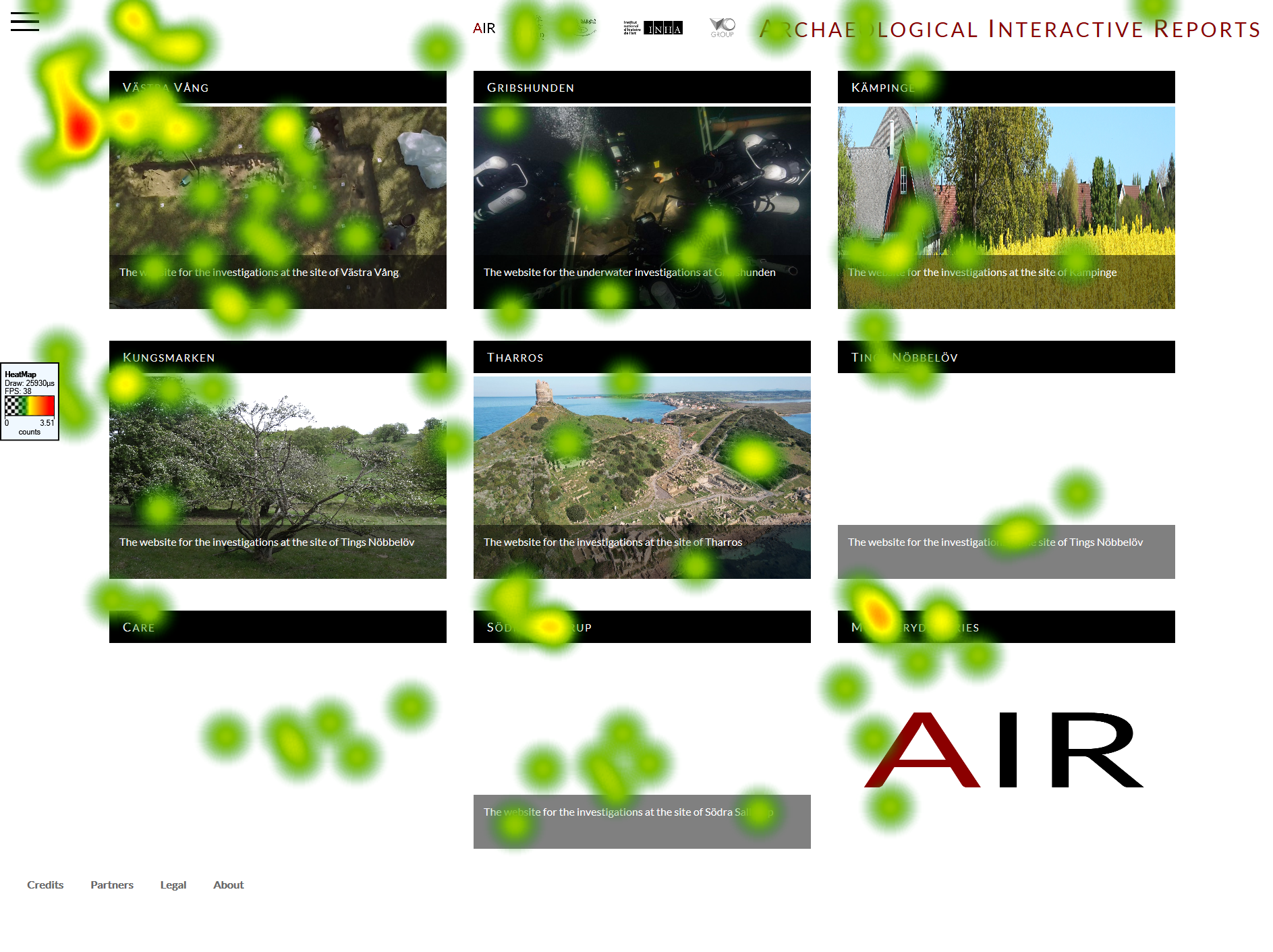
Figure 1: Heat map depicting search activity on the Archaeological Interactive Reports platform Home page.
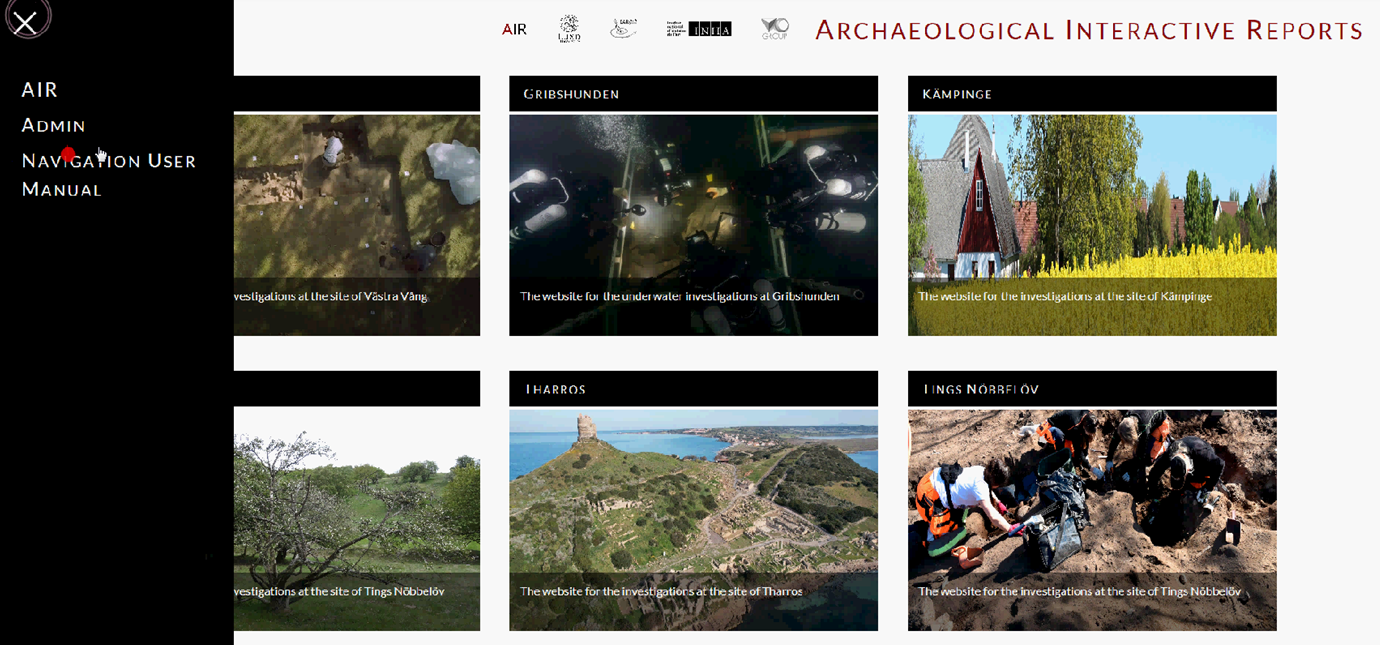
Figure 2: Searching for a word search option on the Archaeological Interactive Reports platform Home page.
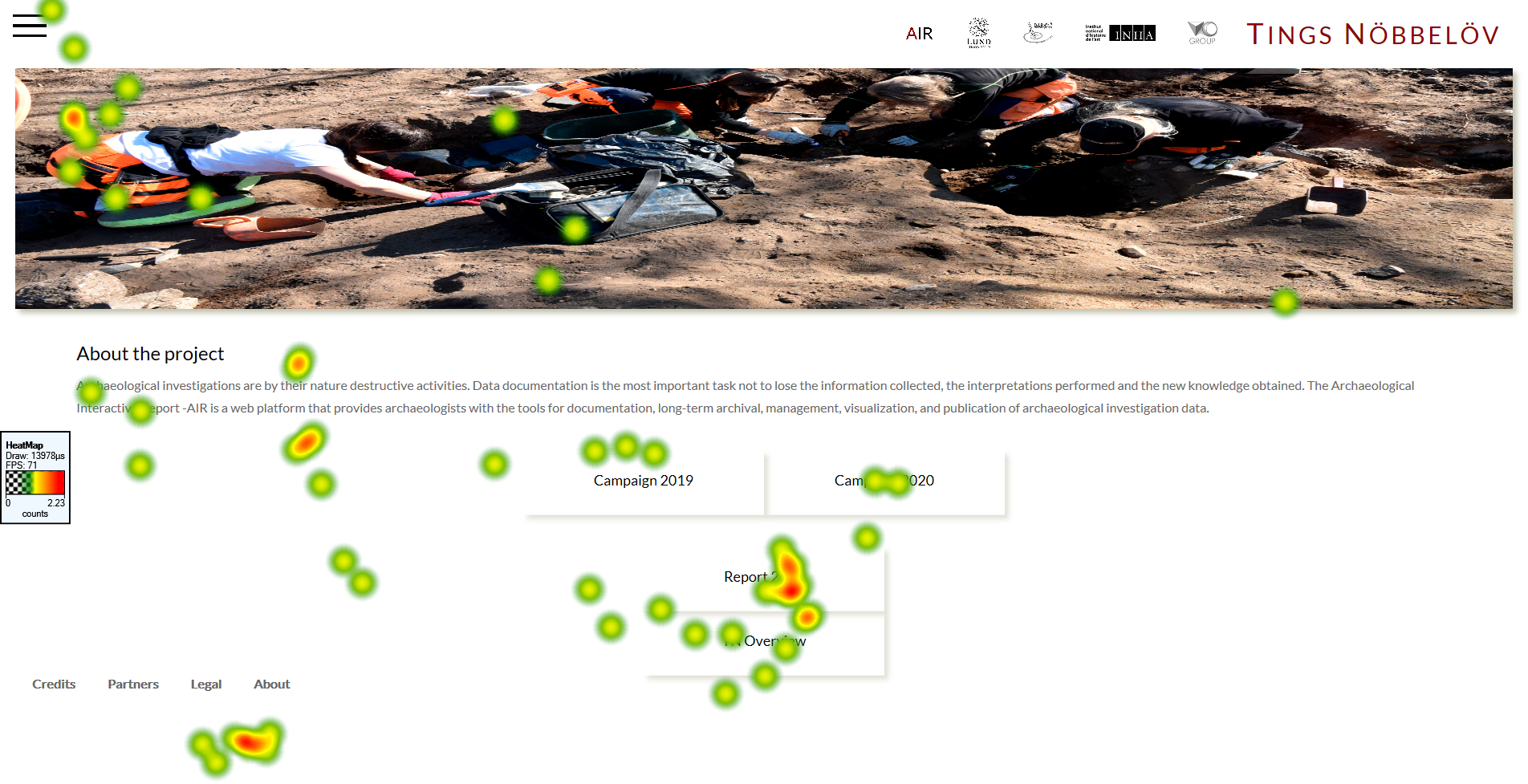
Figure 3: Heat map depicting search activity on the Archaeological Interactive Reports platform second level (archaeology site) page.
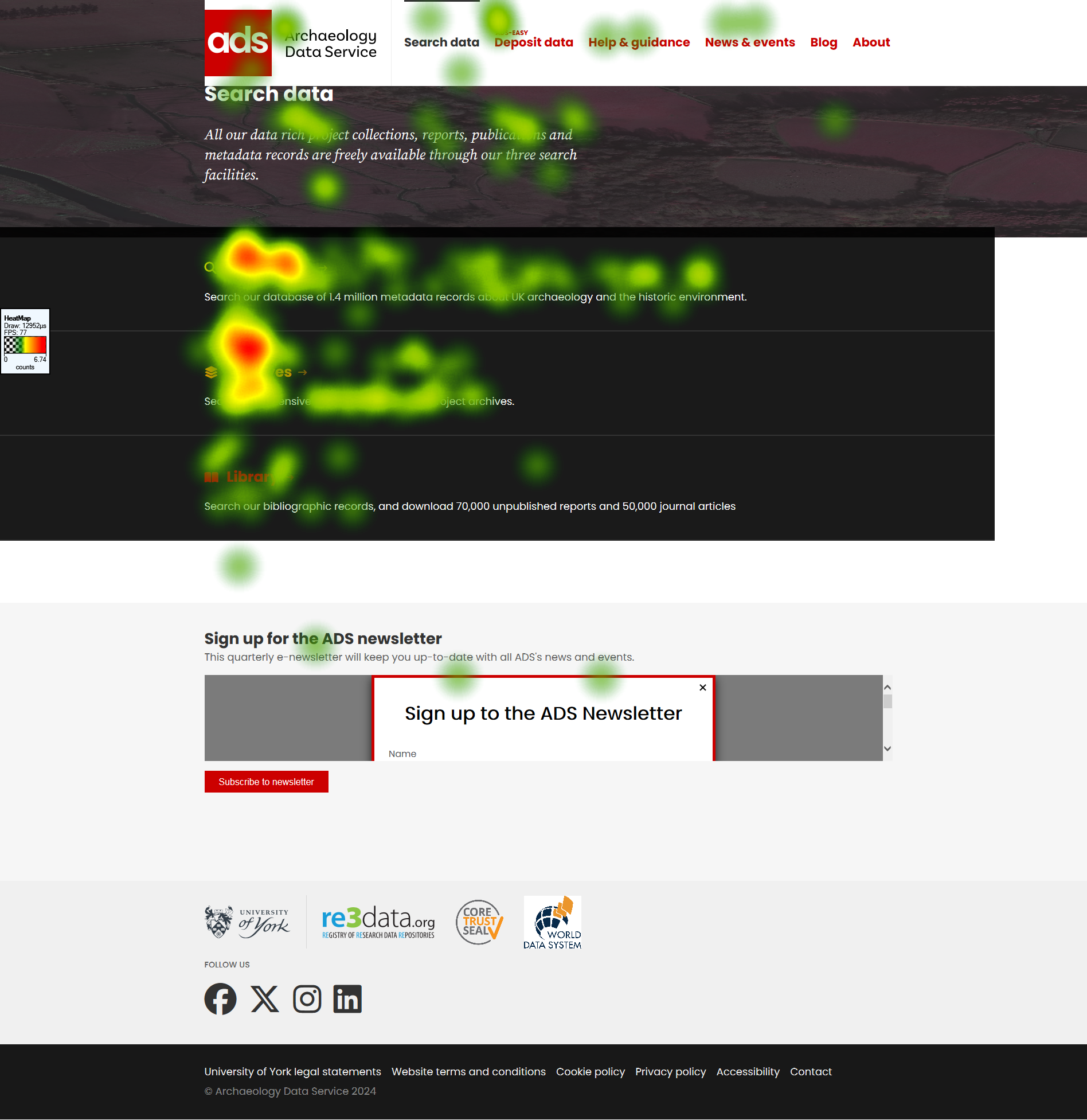
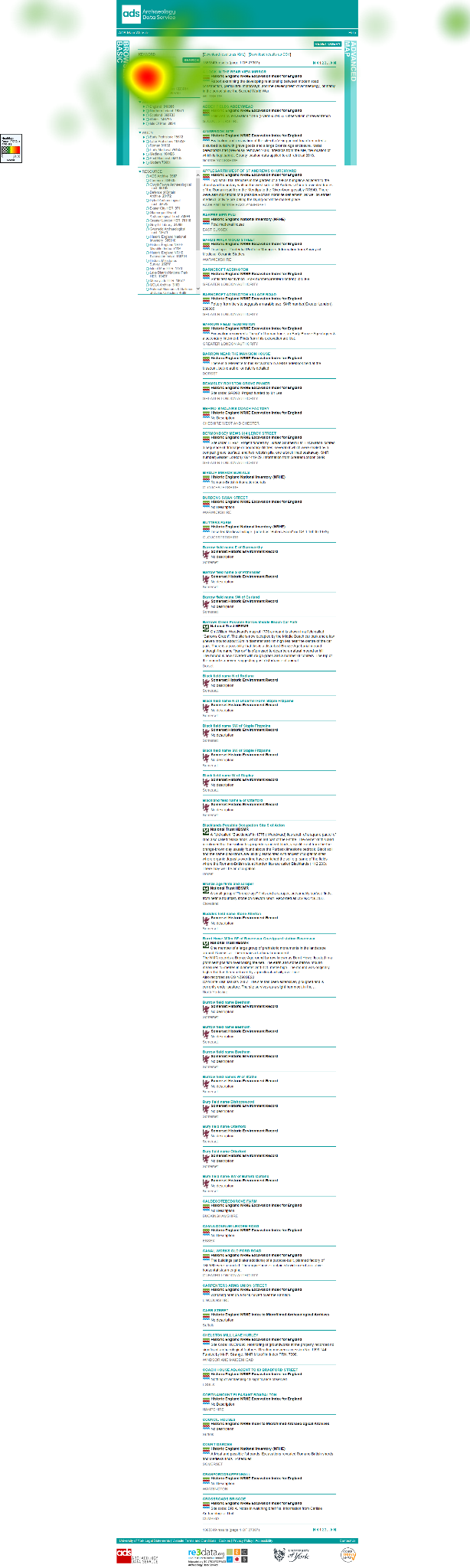
Figure 4: Heat map depicting the ADS platform Home page search activity.
Figure 5: Heat map depicting search activity on the ADS platform second-level page.
Table 1: Non-archaeology professional archaeology data users, users' needs and behaviours
Borgman, C.L., Scharnhorst, A. and Golshan, M.S. 2019 'Digital data archives as knowledge infrastructures: mediating data sharing and reuse', Journal of the Association for Information Science and Technology 70, 888–904. https://doi.org/10.1002/asi.24172
Börjesson, L. 2021 'Legacy in the Making – A Knowledge Infrastructural Perspective on Systems for Archeological Information Sharing', Open Archaeology 7(1), 1636-1647. https://doi.org/10.1515/opar-2020-0213
Castells, M. 2009 The Power of Identity: The Information Age: Economy, Society, and Culture, Oxford: John Wiley and Sons.
Cullipher, S., Hansen, S.J.R. and Vanden Plas, J.R. 2018 'Eye tracking as a research tool: an introduction' in J.R. VandenPlas, S.J.R. Hansen and S. Cullipher (eds) Eye Tracking for the Chemistry Education Researcher, Washington, DC: ACS. 1–9. https://doi.org/10.1021/bk-2018-1292.ch001
Dijk van, J. 2005 The Network Society: Social Aspects of New Media, Thousand Oaks: SAGE.
Duchowski, A.T. 2017 Eye Tracking Methodology: Theory and Practice, London: Springer. https://doi.org/10.1007/978-3-319-57883-5
Garvin, D.A. 1984 'What does “product quality” really mean?', Sloan Management Review 26(1), 25–43.
Heilen, M. and Manney, S.A. 2023 'Refining Archaeological Data Collection and Management', Advances in Archaeological Practice 11(1), 1-10. https://doi.org/10.1017/aap.2022.41
Huggett, J. 2018 'Reuse Remix Recycle: Repurposing Archaeological Digital Data', Advances in Archaeological Practice 6(2), 93-104. https://doi.org/10.1017/aap.2018.1
Huggett, J. 2022 'Data Legacies, Epistemic Anxieties, and Digital Imaginaries in Archaeology',Digital 2(2), 267-295. https://doi.org/10.3390/digital2020016
Huvila, I. (ed) 2018 Archaeology and Archaeological Information in the Digital Society, London: Routledge. https://doi.org/10.4324/9781315225272
International Organization for Standardisation 2016 ISO/IEC 25022:2016 Systems and software engineering — Systems and software quality requirements and evaluation (SQuaRE) — Measurement of quality in use. https://www.iso.org/standard/35746.html [Last accessed: 21 February 2023]
International Organization for Standardisation 2019 ISO/IEC 25030:2019 Systems and software engineering — Systems and software quality requirements and evaluation (SQuaRE) — Quality requirements framework. https://www.iso.org/standard/72117.html [Last accessed: 12 February 2026].
Kansa, E.C., Kansa, S.W. and Benjamin, A. 2014 'Publishing and pushing: mixing models for communicating research data in archaeology', International Journal of Digital Curation 9(1), 57–70. https://doi.org/10.2218/ijdc.v9i1.301
Laužikas, R., Dallas, C., Thomas, S., Kelpšienė, I., Huvila, I., Luengo, P., Nobre, H., Toumpouri, M. and Vaitkevičius, V. 2018 'Archaeological knowledge production and global communities: boundaries and structure of the field', Open Archaeology 4(1), 350–364. https://doi.org/10.1515/opar-2018-0022
Lotman, J. 2001 Universe of the Mind: A semiotic theory of culture, London: I.B. Tauris. https://doi.org/10.2979/3231.0
Morgan, C. 2019 'Avatars, Monsters, and Machines: A Cyborg Archaeology', European Journal of Archaeology 22(3), 324-337. https://doi.org/10.1017/eaa.2019.22
Morgan, C. 2025 'Archaeology as Worldbuilding', Cambridge Archaeological Journal 36(1), 92-101. https://doi.org/10.1017/S0959774325100164
Morgan, C. 2014 'Archaeology and the Moving Image', Public Archaeology 13(4), 323–344. https://doi.org/10.1179/1465518715Z.00000000077
Moshenska, G. (ed) 2017 Key Concepts in Public Archaeology, London: UCL Press. https://doi.org/10.2307/j.ctt1vxm8r7
Neller, A., Heckman, J., Bollwerk, E., Noack Myers, K. and Wells, J. 2024 'Making archaeological collections more findable and accessible through increased coordination', Advances in Archaeological Practice 12(1), 34–42. https://doi.org/10.1017/aap.2023.31
Oksanen, E., Knuutinen, T., Thomas, S. and Wessman, A. 2025 'Engaging with archaeological citizen scientists' in T. Heinonen, F. Ehrnsten, J. Harjula, T. Knuutinen, T. Ratilainen, E. Terävä, S. Tuomenoja and J. Haarala (eds) Shattered and Scattered Pasts: Festschrift for Professor Georg Haggrén, Turku: Society for Medieval Archaeology in Finland. 328-338.
Perry, S. 2018 'Why Are Heritage Interpreters Voiceless at the Trowel's Edge? A Plea for Rewriting the Archaeological Workflow', Advances in Archaeological Practice 6(3), 212-227. https://doi.org/10.1017/aap.2018.21
Perry, S., Simandiraki-Grimshaw, A., Morgan, C., Taylor, J. S., Fadioui, A., Foket, L., Hacıgüzeller, P., Sampatakou, D.V., Derudas, P., Wright, H. and Clough, A. 2025 'Towards New Futures for Archaeological Data Production: Challenging Archaeonormativity through Storytelling', Journal of Field Archaeology 50(8), 796–815. https://doi.org/10.1080/00934690.2025.2504235
Reilly, P., Callery, S., Dawson, I. and Gant, S. 2021 'Provenance Illusions and Elusive Paradata: When Archaeology and Art/Archaeological Practice Meets the Phygital', Open Archaeology 7(1), 454-481. https://doi.org/10.1515/opar-2020-0143
Richardson, L-J., Reinhard, A., and Smith, N. (eds) 2024 The Routledge Handbook of Archaeology and the Media in the 21st Century, 1st editon, Routledge. https://doi.org/10.4324/9781003216155
Seaton, K-L., Laužikas, R., McKeague, P., Moitinho de Almeida, V., May, K. and Wright, H. 2023 'Understanding Data Reuse and Barriers to Reuse of Archaeological Data. A quality-in-use methodological approach', Internet Archaeology 63. https://doi.org/10.11141/ia.63.8
Sinclair, A. 2022 'Archaeological research 2014 to 2021: an examination of its intellectual base, collaborative networks and conceptual language using science maps', Internet Archaeology 59. https://doi.org/10.11141/ia.59.10
Sobotkova, A. 2018 'Sociotechnical obstacles to archaeological data reuse', Advances in Archaeological Practice 6(2), 117–124. https://doi.org/10.1017/aap.2017.37
TETRARCHs Audience Map 2023 TETRARCHs deliverable D2.2.
Tully, G., Anés, L.D., Thomas, S., Olivier, A., Benetti, F., Mena, A.C., Rizner, M., Möller, K. , Karl, R., Matsuda, A., Martín Civantos, J.M., Brogiolo, G.P., Corpas Cívicos, N., Ripanti. F., Sarabia Bautista, J. and Schivo, S. 2022 'Evaluating Participatory Practice in Archaeology: Proposal for a standardized approach', Journal of Community Archaeology and Heritage 9(2), 103–119. https://doi.org/10.1080/20518196.2021.2013067
Wilson, T.D. 2000 'Informing science', The International Journal of an Emerging Transdiscipline 3, 49–56. https://doi.org/10.28945/576
Archaeology Data Service (ADS) n.d. 'FAIR data', Help & guidance, Data access and reuse, Archaeology Data Service [website]. https://archaeologydataservice.ac.uk/help-guidance/data-reuse/fair-data/ [Last accessed: 15 August 2023]
Internet Archaeology is an open access journal based in the Department of Archaeology, University of York. Except where otherwise noted, content from this work may be used under the terms of the Creative Commons Attribution 3.0 (CC BY) Unported licence, which permits unrestricted use, distribution, and reproduction in any medium, provided that attribution to the author(s), the title of the work, the Internet Archaeology journal and the relevant URL/DOI are given.
Terms and Conditions | Legal Statements | Privacy Policy | Cookies Policy | Citing Internet Archaeology
Internet Archaeology content is preserved for the long term with the Archaeology Data Service (ROR). Help sustain and support open access publication by donating to our Open Access Archaeology Fund.
 Home
Home