Cite this as: Derudas, P., Dell'Unto, N., Berggren, A., Campanaro, D.M., Svensson, A., Fauvelle, M., Larsson, J. and Dininno, D. 2026 Observing Reuse of 3D Data in Archaeological Excavations, Internet Archaeology 71. https://doi.org/10.11141/ia.71.5
This study focuses on understanding how archaeologists interact with and reuse 3D data during excavation, drawing on an ad-hoc experiment and a discourse analysis approach taken from socio-linguistic disciplines.
The experiment, conducted during the excavation of an Iron Age ‘central place’ in Sweden, reveals the multifaceted utility of 3D models in archaeological discussions. Our analysis shows that these models function as effective tools for visualisation and measurement, and they support interpretation, decision-making, and knowledge production in the field. The results demonstrate that when appropriate tools are available for accessing and working with digital data, including 3D models, instances of reuse increase significantly, improving communication, knowledge exchange, and interpretive reasoning during excavation.
These findings highlight the importance of continuing to explore how 3D models are reused within archaeological workflows, particularly to facilitate collaborative interpretation and field-based decision-making.
Corresponding author: Paola Derudas
[email protected]
Lund University
Nicolò Dell’Unto
Lund University
Åsa Berggren
Lund University
Danilo Marco Campanaro
Lund University
Andreas Svensson
Lund University, Sydvensk Arkeologi AB
Mikael Fauvelle
Lund University
Jens Larsson
Lund University
Domenica Dininno
Italian National Research Council
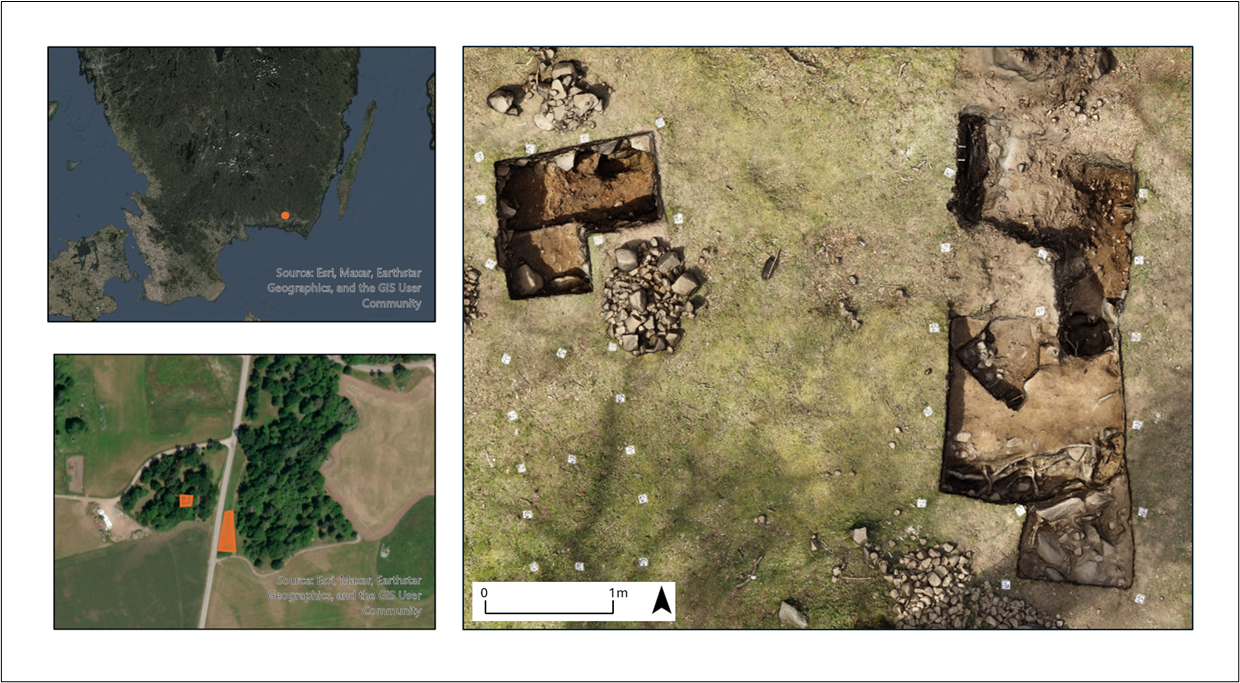
Figure 1: Map of Västra Vång displaying the location of the site in Southeastern Sweden (top-left), the areas investigated across the years (bottom-left), Trenches A (right) and B (left) excavated in 2023. Map by Paola Derudas and Danilo M. Campanaro, reproduced with permission.
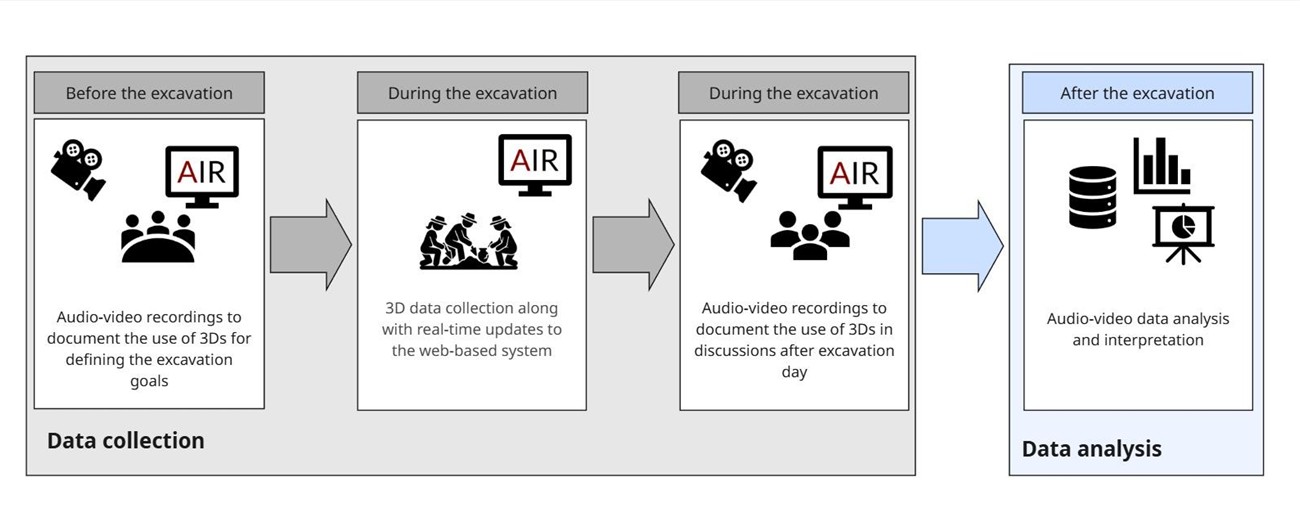
Figure 2: Workflow of the 3D data reuse experiment. Data collection through audio-video recordings conducted before and after the field investigation to capture team discussions and the use of 3D data in interpretation. These recordings were later analysed to support the review and interpretation of results.
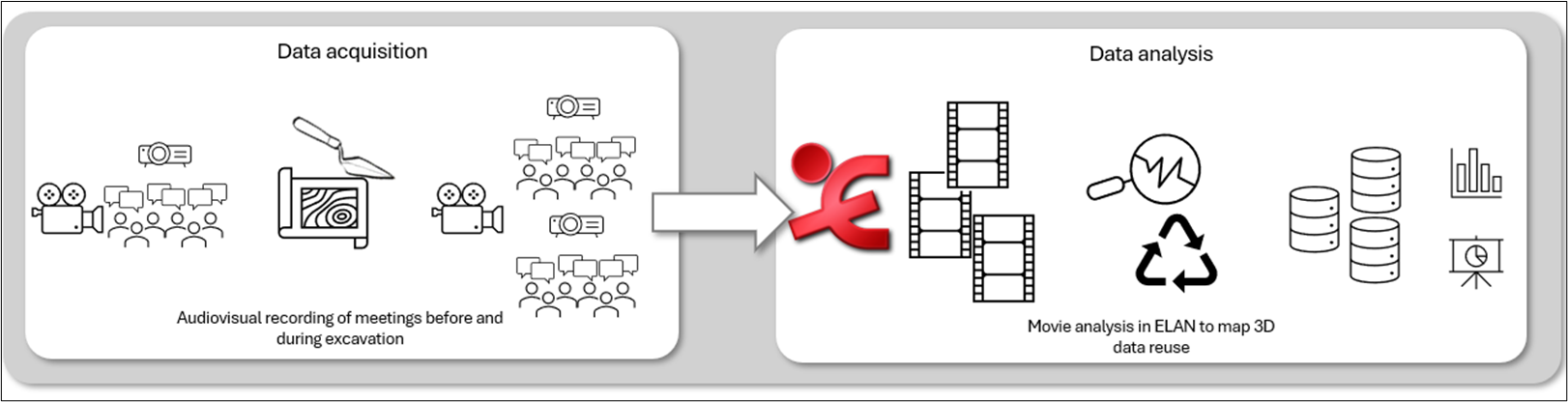
Figure 3: Summary of video acquisition (before and during the excavation) and analysis. The process involved reviewing recorded meetings, using ELAN to annotate conversations, and categorising them into distinct communicative functions. Verbal and non-verbal elements were aligned with 3D models, enabling a detailed analysis of the interactions and genres within the archaeological discussions. Courtesy of Paola Derudas.
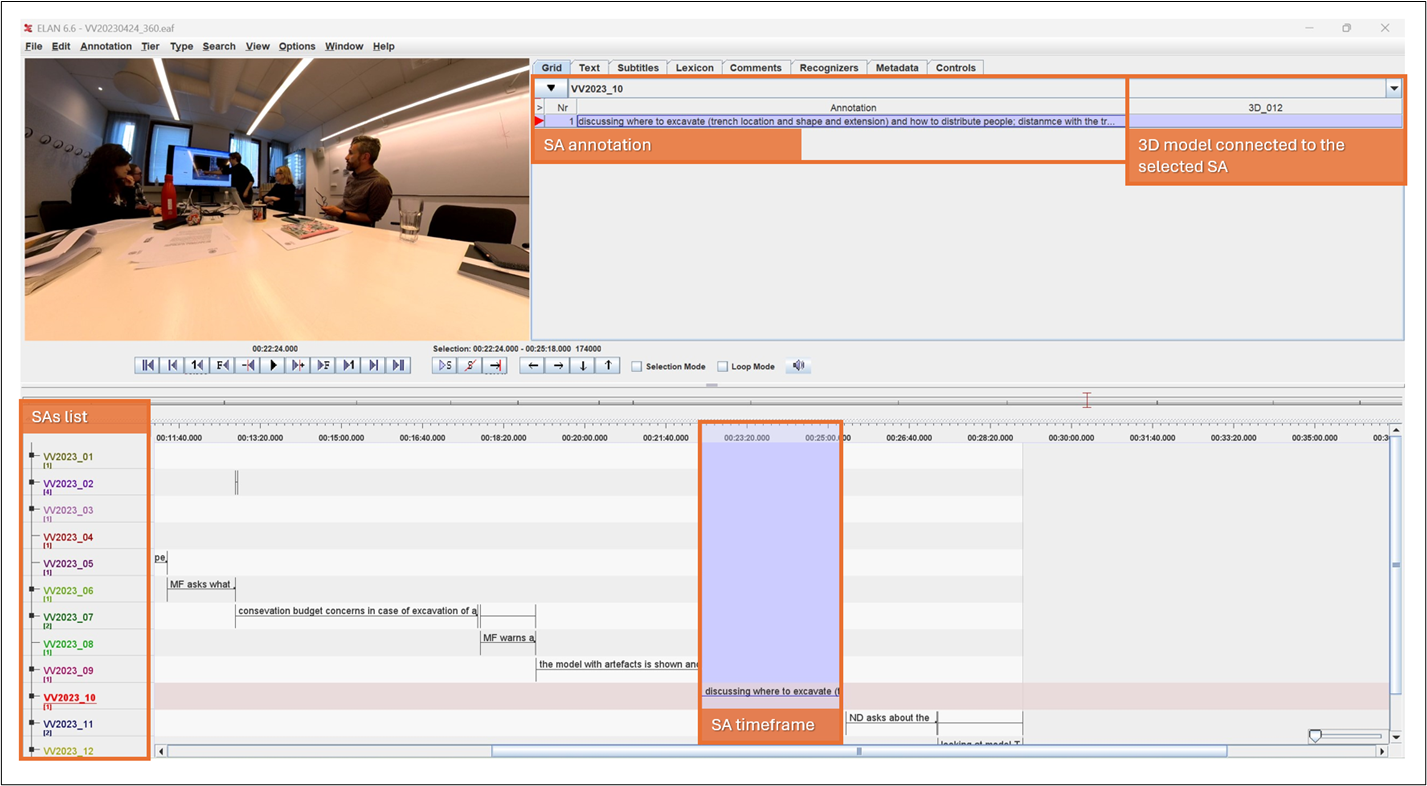
Figure 4: The ELAN layout: on the top left is the movie frame, and on the top right is the annotation list. Here, an SA annotation and the linked 3D models are highlighted. At the bottom, there is the annotation panel, where it is possible to visualise the SA timeframe. Courtesy of Paola Derudas.
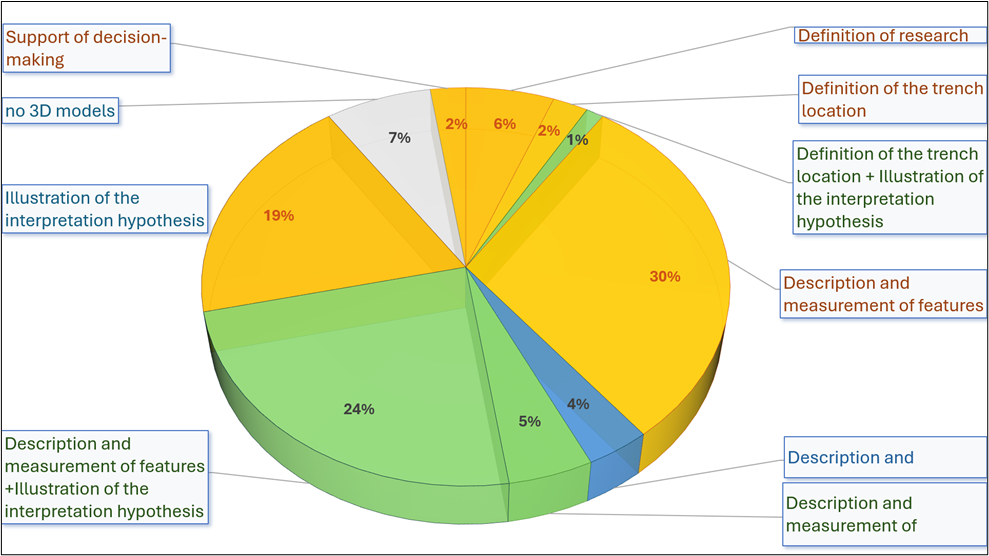
Figure 5: The chart shows SA genres in which archaeologists used and reused 3D models. The different colours are associated with the SA’s genres as described above (yellow for one-genre SA, green for two-genre SA, for three-genres SA, and grey for SAs with no use of 3D models)
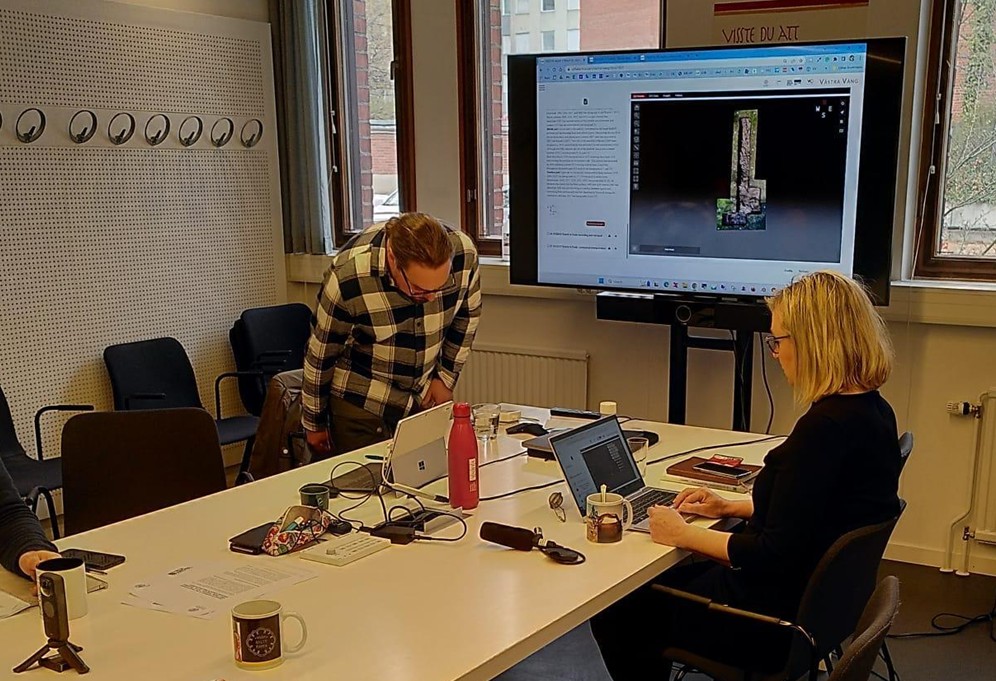
Figure 6: The pre-excavation meeting. Participants could carry out their conversation either using the 3D models either on the big screen or using their personal laptops. Photo credit by Nicolò Dell’Unto
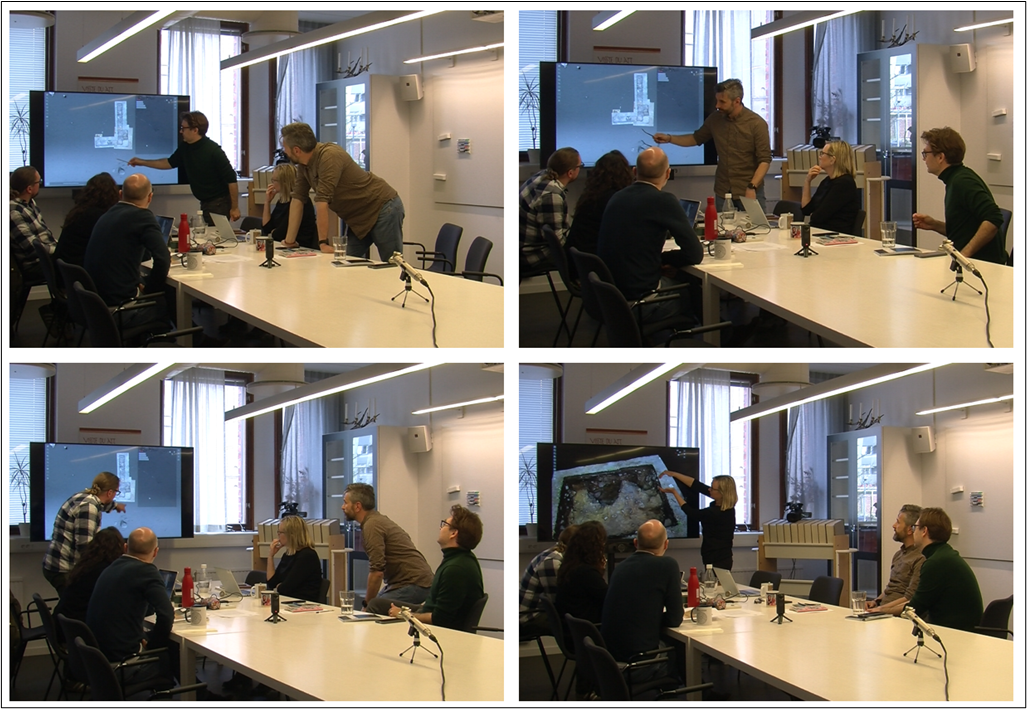
Figure 7: During the pre-excavation meeting, participants utilise 3D models to visually enhance their arguments by changing perspectives and zooming in.
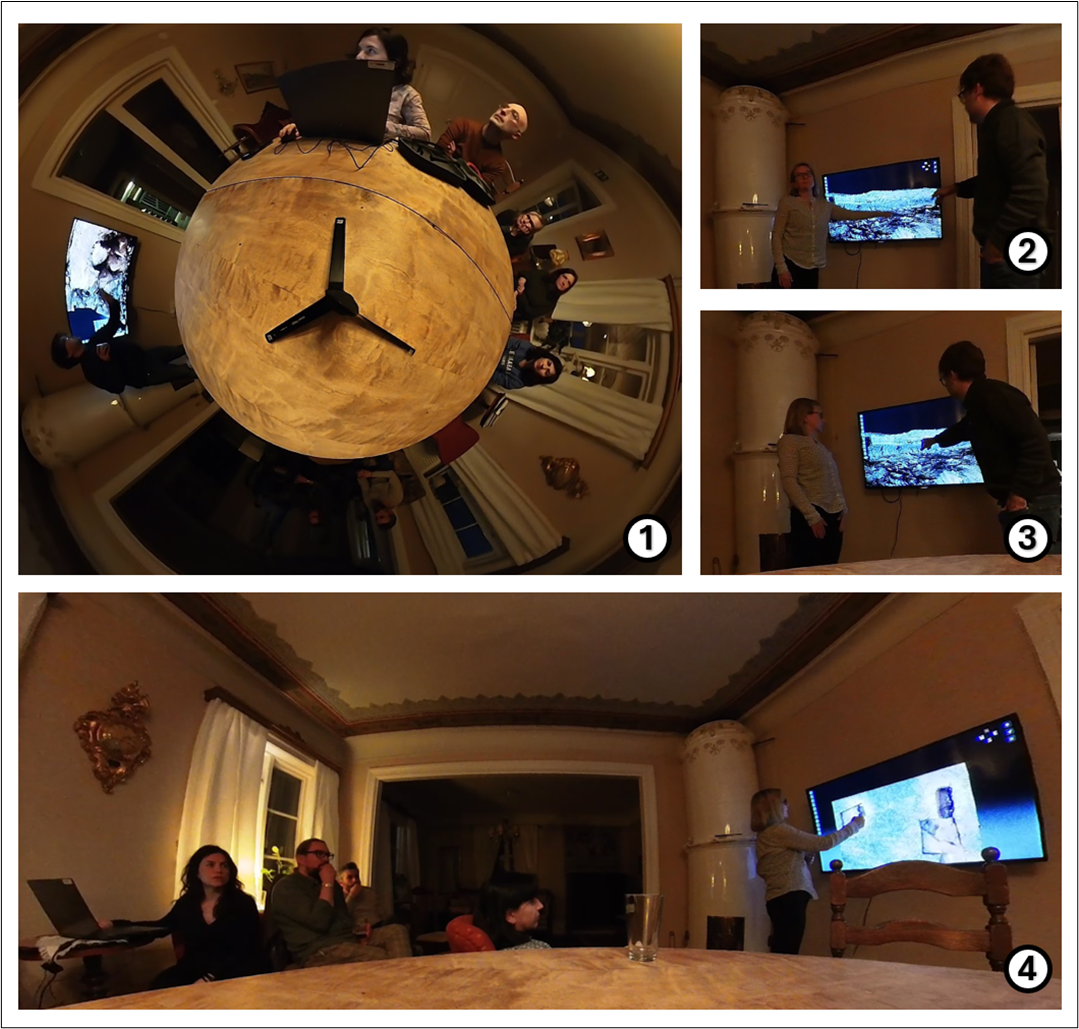
Figure 8: In the after-dinner meeting, the participants engage in their conversations by taking advantage of the 3D models from the AIR platform: (1) the fish-eye view from the 360-degree camera encompasses all participants, where the operator handles the data in the laptop and the colleague point to the screen while describing the day excavation activities. (2-5) Various participants by the wall screen use 3D models in their speeches.
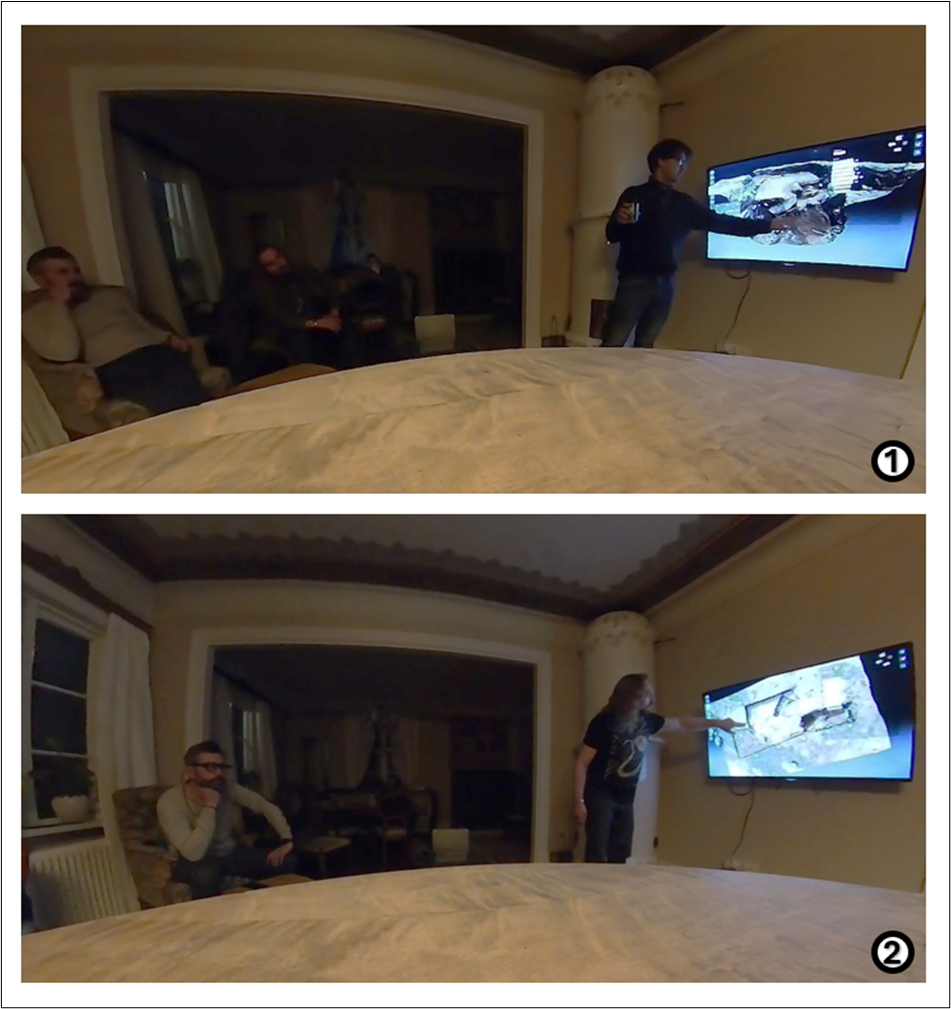
Figure 9: During the after-dinner meeting, archaeologists from Trench B (1) and Trench A (2) use 3D models on AIR to illustrate the excavation activities conducted during the day, convey interpretive hypotheses visually, and collaboratively decide how to proceed the next day.
Table 1: All SA genres identified in conversation analysis. Several conversations were characterised by more than one genre, and we represented them using colours: yellow represents one-genre SA, green represents two-genre SA, blue represents three-genres SA; and in white, the SA in which archaeologists did not use 3D models
Table 2: Analytical representation of archaeologists' reuse of 3D data in the pre-ex-conversations during the meeting held on 2023-04-24. The different colours (yellow, green, blue, and white) represent the frequency of the different genres used in the SA. The SA in yellow is a unique genre; in green the two-genre SA; in blue, the three-genre SA; and in white, the SA in which archaeologists did not use 3D models.
Table 3: Analytical representation of archaeologists' reuse of 3D data in the post-ex conversations during the meeting held on 2023-05-02
Table 4: Analytical representation of archaeologists' reuse of 3D data in the post-ex conversation during the meeting held on 2023-05-03
Berggren, Å., Burenhult, N., Campanaro, D., Dell'Unto, N., Derudas, P., Fauvelle, M., Kruspe, N., Larsson, J. and Svensson, A. in prep 'Decisions at the trowel's edge: digital recording and annotation methods in support of archaeological documentation and interpretation'.
Berggren, Å. 2002 'Reflexivitet inom arkeologin' in Å. Berggren and M. Burström (eds) Reflexiv fältarkeologi. Återsken av ett seminarium, Riksantikvarieämbetet and Malmö Kulturmiljö. 19-28.
Berggren, Å, Dell'Unto, N., Forte, M., Haddow, S., Hodder, I., Issavi, J., Lercari, N., Mazzucato, C., Mickel, A., and Taylor, J.S. 2015 'Revisiting Reflexive Archaeology at Çatalhöyük: Integrating Digital and 3D Technologies at the Trowel's Edge', Antiquity 89(344): 433–448. https://doi.org/10.15184/aqy.2014.43
Borgman, C.L. 2012 'The conundrum of sharing research data', Journal of the American Society for Information Science and Technology 63(6), 1059-1078. https://doi.org/10.1002/asi.22634
Boyd, M., Campbell, R., Doonan, R., Douglas, C., Gavalas, G., Gkouma, M., Halley, C., Hartzler, B., Herbst, J., Indgjerd, H., Krijnen, A., Legaki, I., Margaritis, E., Meyer, N., Moutafi, I., Iliou, N., Wylie, D., Renfrew, C. 2021 'Open Area, Open Data: Advances in Reflexive Archaeological Practice', Journal of Field Archaeology 46. 1-19. https://doi.org/10.1080/00934690.2020.1859780
Börjesson, L. 2015 'Grey literature – grey sources? Nuancing the view on professional documentation: The case of Swedish archaeology', Journal of Documentation 71(6), 1158–1182. https://doi.org/10.1108/JD-09-2014-0137
Börjesson, L. 2017 Resources for scholarly documentation in professional service organizations: A study of Swedish development-led archaeology report writing, Uppsala: Department of ALM, Uppsala University. http://urn.kb.se/resolve?urn=urn:nbn:se:uu:diva-306157
Campana, S. 2014 '3D Modeling in Archaeology and Cultural Heritage' in F. Remondino and S. Campana 3D Recording and Modelling in Archaeology and Cultural Heritage. Theory and Best Practices, BAR international series 2598, Oxford.
Cignoni, P. and Scopigno, R. 2008 'Sampled 3D models for CH applications: A viable and enabling new medium or just a technological exercise?', Journal on Computing and Cultural Heritage 1(1), Article 2 (June 2008). https://doi.org/10.1145/1367080.1367082
Cook, G. 1989 Discourse, Oxford: Oxford University Press.
Dell'Unto, N. 2016 'Using 3D GIS Platforms to Analyse and Interpret the Past' in M. Forte and S. Campana (eds) Quantitative Methods in the Humanities and Social Sciences, Cham: Springer. 305–322. https://doi.org/10.1007/978-3-319-40658-9_14
Dell'Unto, N. 2018 '3D Models and Knowledge Production' in I. Huvila (ed) Archaeology and Archaeological Information in the Digital Society, Routledge. 54–69. https://doi.org/10.4324/9781315225272-4
Derudas, P. 2021 'Archaeological Publication Systems: Which route to take? A compass for addressing future development' in F. Ganovelli, C. Mc Donald, F. Banterle, M. Potenziani, M. Callieri, and Y. Jung (eds) Web3D '21: The 26th International Conference on 3D Web Technology, Association for Computing Machinery (ACM). https://doi.org/10.1145/3485444.3487648
Derudas, P. 2023 Documenting, Interpreting, Publishing, and Reusing: Linking archaeological reports and excavation archives in the virtual space, PhD Thesis, Archaeology. Lund University.
Derudas, P., Nurra, F. and Svensson, A. 2023 'New AIR for the Archaeological Process? The use of 3D web Semantic for Publishing Archaeological Reports', Journal on Computing and Cultural Heritage 16(3), Article no. 57. https://doi.org/10.1145/3594722
Faniel, I. Kansa, E., Whitcher Kansa, S., Barrera-Gomez, J. and Yakel, E. 2013 'The Challenges of Digging Data: A Study of Context in Archaeological Data Reuse' in Proceedings of the 13th ACM/IEEE-CS Joint Conference on Digital Libraries (JCDL '13), ACM, New York. 295–304. https://doi.org/10.1145/2467696.2467712
Garstki, K. 2022 'Teaching for Data Reuse and Working toward Digital Literacy in Archaeology', Advances in Archaeological Practice 10(2), 177–186. https://doi.org/10.1017/aap.2022.3
Gee, J.P. 2014 'Tools of inquiry and discourses' in A. Jaworski and N. Coupland (eds) The Discourse Reader, London: Routledge. 142-153.
Gumperz, J.J. 1982 Discourse Strategies, Cambridge: Cambridge University Press. https://doi.org/10.1017/CBO9780511611834
Hedeager, L. 2002 ''Scandinavia 'Central Places' in a Cosmological setting' in B. Hårdh and L. Larsson (eds) Central Places in the Migration and Merovingian Periods. Papers from the 52nd Sachsensymposium Lund, August 2001, Uppåkrastudier 6, Almqvist & Wiksell International. 3-18. https://portal.research.lu.se/en/publications/central-places-in-the-migration-and-merovingian-periods-papers-fr/
Helgesson, B. and Svensson, A. 2024 'Knowledge from fragmented Bronzes. Complexity and Potential' in M. Henriksson (ed) Västra Vång. Iron Age Settlement in Central Blekinge, Sweden, Blekinge Museum. 140-167.
Henriksson, M. (ed) 2024 Västra Vång. Iron Age Settlement in Central Blekinge, Sweden, Blekinge Museum.
Hodder. I. 1999 The Archaeological Process. An Introduction, Oxford: Blackwell.
Huggett, J. 2015 'A Manifesto for an Introspective Digital Archaeology', Open Archaeology 1(1). https://doi.org/10.1515/opar-2015-0002
Huggett, J. 2018 'Reuse Remix Recycle: Repurposing Archaeological Digital Data', Advances in Archaeological Practice 6(2), 9–104. https://doi.org/10.1017/aap.2018.1
Huvila, I. 2022 'Improving the usefulness of research data with better paradata'. Open Information Science 6(1), 28–48. https://doi.org/10.1515/opis-2022-0129
Jaworski, A. and Coupland, N. (eds) 2014 The Discourse Reader, London: Routledge
Jensen, P. 2018 'Semantically Enhanced 3D: A Web-based Platform for Spatial Integration of Excavation Documentation at Alken Enge, Denmark', Journal of Field Archaeology 43(sup1), S31–S44. https://doi.org/10.1080/00934690.2018.1510299
Kansa, E.C. 2022 'On Infrastructure, Accountability, and Governance in Digital Archaeology' in K. Garstki (ed) Critical Archaeology in the Digital Age: Proceedings of the 12th IEMA Visiting Scholar's Conference, Los Angeles: UCLA Cotsen Institute of Archaeology Press. 141-152. https://doi.org/10.2307/j.ctv2fcctzd.16
Larsson, Å.M., and Löwenborg, D. 2020 'The Digital Future of the Past: Research Potential with Increasingly FAIR Archaeological Data' in C. Hillerdal and K. Ilves, K. (eds) Re-imagining Periphery: Archaeology and Text in Northern Europe from Iron Age to Viking and Early Medieval Periods, Oxford: Oxbow Books. 61-70. http://urn.kb.se/resolve?urn=urn:nbn:se:uu:diva-429482
Lucas, G. 2012 Understanding the archaeological record, Cambridge University Press. https://doi.org/10.1017/CBO9780511845772
Machin, D. and van Leeuwen, T. 2014 'Genre media analysis in discourse' in A. Jaworski and N. Coupland (eds) The Discourse Reader, London: Routledge.
Norris, S. 2004 Analyzing Multimodal Interaction: A Methodological Framework, London: Routledge. https://doi.org/10.4324/9780203379493
Opitz, R., Richards-Rissetto, H., Dalziel, K.; Dussault, J. and Tunink, G. 2022 'Exploring 3D Data Reuse and Repurposing through Procedural Modeling' in K. Garstki (ed) Critical Archaeology in the Digital Age, Costen Institute Press. 123-139. https://digitalcommons.unl.edu/anthropologyfacpub/190
Pasquetto, I. V., Borgman, C. L., and Wofford, M. F. 2019 'Uses and Reuses of Scientific Data: The Data Creators' Advantage', Harvard Data Science Review 1(2). https://doi.org/10.1162/99608f92.fc14bf2d
Pasquetto, I. V., Randles, B. M., and Borgman, C. L. 2017 'On the Reuse of Scientific Data', Data Science Journal 16. https://doi.org/10.5334/dsj-2017-008
Pendić, J. and Molloy, B. 2024 'The Use of 3D Documentation for Investigating Archaeological Artefacts', in M. Hostettler, A. Buhlke, C. Drummer, L. Emmenegger, J. Reich and C. Stäheli (eds) The 3 Dimensions of Digitalised Archaeology, Cham: Springer. https://doi.org/10.1007/978-3-031-53032-6_2
Perry S., and Taylor, J.S. 2018 'Theorising the Digital: A Call to Action for the Archaeological Community' in M. Matsumoto and E. Uleberg (eds) CAA2016: Oceans of Data: Proceedings of the 44th Conference on Computer Applications and Quantitative Methods in Archaeology, Archaeopress. 11–22. https://doi.org/10.2307/jj.15135958.5
Potenziani, M., Callieri, M., Dellepiane, M., Corsini, M., Ponchio, F. and Scopigno, R. 2015 '3DHOP: 3D Heritage Online Presenter', Computers and Graphics 52, 129–141. https://doi.org/10.1016/j.cag.2015.07.001
Richards, J. D., Jakobsson, U., Novák, D., Štular, B., and Wright, H. 2021 'Digital Archiving in Archaeology: The State of the Art. Introduction', Internet Archaeology 58. https://doi.org/10.11141/ia.58.23
Richards, J.D. 2023 'Joined up Thinking: Aggregating archaeological datasets at an international scale', Internet Archaeology 64. https://doi.org/10.11141/ia.64.3
Richards-Rissetto, H. 2022 'Technological Challenges to Practicing 3D Ethics in Archaeology', in E. Watrall and L. Goldstein (eds) Digital Heritage and Archaeology in Practice: Data, Ethics, and Professionalism, Gainesville. https://doi.org/10.5744/florida/9780813069302.003.0009
Richards-Rissetto, H., and von Schwerin, J. 2017 'A Catch 22 of 3D Data Sustainability: Lessons in 3D Archaeological Data Management and Accessibility', Digital Applications in Archaeology and Cultural Heritage 6, 38–48.
Seaton, K-L., Laužikas, R., McKeague, P., Moitinho de Almeida, V., May, K. and Wright, H. 2023 'Understanding Data Reuse and Barriers to Reuse of Archaeological Data. A quality-in-use methodological approach', Internet Archaeology 63. https://doi.org/10.11141/ia.63.8
Sloetjes, H. and Seibert, O. 2016 'Measuring by marking: The multimedia annotation tool ELAN', in A. Spink, G. Riedel, L. Zhou, L. Teekens, R. Albatal, and C. Gurrin (eds) Proceedings of Measuring Behavior 2016, Dublin City University. 492–495. https://archive.measuringbehavior.org/mb2016/files/2016/MB2016_Proceedings.pdf
Sobotkova, A. 2018 'Sociotechnical Obstacles to Archaeological Data Reuse', Advances in Archaeological Practice 6(2), 117–124. https://doi.org/10.1017/aap.2017.37
Svensson, A. and Derudas, P. 2024 'A View from the Hill. Stratigraphic Account and Chronological Interpretation' in M. Henriksson (ed) Västra Vång. Iron Age Settlement in Central Blekinge, Sweden, Blekinge Museum. 59-87.
Uildriks, M. 2016 'iDig - Recording Archaeology: a review', Internet Archaeology 42. https://doi.org/10.11141/ia.42.13
Waagen, J. 2019 'New technology and archaeological practice. Improving the primary archaeological recording process in excavation by means of UAS photogrammetry', Journal of Archaeological Science 101, 11-20. https://doi.org/10.1016/j.jas.2018.10.011
Wilkinson, M. D., Dumontier, M., Aalbersberg, I.J.J., Appleton, G., Axton, M., Baak, A., Blomberg, N., Boiten, J.W., da Silva Santos, L.B., Bourne, P.E., Bouwman, J., Brookes, A.J., Clark, T., Crosas, M., Dillo, I., Dumon, O., Edmunds, S., Evelo, C.T., Finkers, R., ... Mons, B. 2016 'Principles for scientific data management and stewardship', Scientific Data 3, 160018. https://doi.org/10.1038/sdata.2016.18
von Schwerin J., Richards-Rissetto H., Remondino F., Agugiaro G., Forte M. and Maqueda R. 2011 'The MayaArch3D Project; Digital Technologies for Research in Maya Archaeology', Final Performance Report and White Paper for NEH Digital Humanities Level II Start- Up Grant.
Internet Archaeology is an open access journal based in the Department of Archaeology, University of York. Except where otherwise noted, content from this work may be used under the terms of the Creative Commons Attribution 3.0 (CC BY) Unported licence, which permits unrestricted use, distribution, and reproduction in any medium, provided that attribution to the author(s), the title of the work, the Internet Archaeology journal and the relevant URL/DOI are given.
Terms and Conditions | Legal Statements | Privacy Policy | Cookies Policy | Citing Internet Archaeology
Internet Archaeology content is preserved for the long term with the Archaeology Data Service (ROR). Help sustain and support open access publication by donating to our Open Access Archaeology Fund.
 Home
Home