Cite this as: Savine, B. et al. 2026 Roman Occupation in the Extramural Settlement South-west of the colonia: Archaeological investigations at York Station Gateway, Queen Street, York, Internet Archaeology 71. https://doi.org/10.11141/ia.71.7
An archaeological watching brief was conducted between 12 January and 1 March 2022 by York Archaeology (YA) during the course of works carried out by Openreach at York Station Gateway, Queen Street (Figure 1). The works involved monitoring the excavation of two trenches (Latitude, Longitude: 53.955734, -1.0917980 and 53.957765, -1.0919099), designed for the installation of telecommunication maintenance chambers, with each measuring 3 × 2m in plan and extending to a depth of approximately 3m. A sequence of stratified archaeological deposits and features was encountered in Trench 1, necessitating hand excavation under archaeological conditions.
Investigation of this site has revealed evidence for occupation close to the route of the main south-western approach road to Roman York during the 2nd to 4th centuries CE, adding further information to our understanding of the Roman extramural settlement in the Blossom Street area, immediately south-west of the colonia. Evidence for two phases of domestic rubbish disposal was identified, between which dumping, likely related to development within the colonia during the 2nd and 3rd centuries CE, was found. Later activity, in the form of hardstanding and possible structural evidence, hints at occupation at the site continuing into the late 3rd or 4th century CE.
Occupation on the site appears to have come to an end in the 4th century CE with agricultural soils next forming across the location of Trench 1. The findings from Trench 2 provided some evidence of the impact construction of railway infrastructure had on the Railway Cemetery in the 19th century.
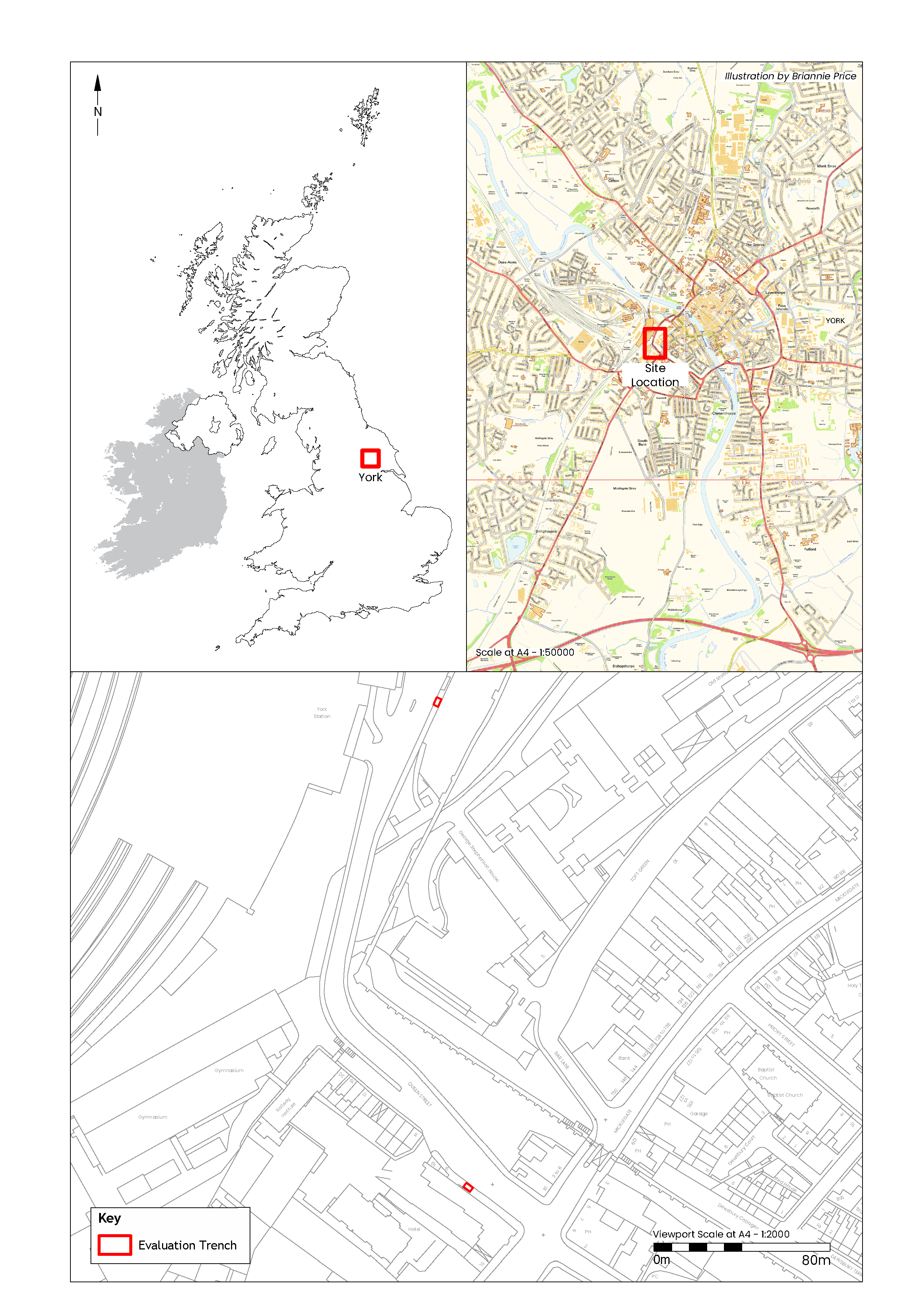
The site is located on the York Moraine south-west of the River Ouse, and Queen Street skirts the western exterior of York's medieval defences south-west of the River Ouse, linking Station Road to the north with the Blossom Street/Nunnery Lane junction outside Micklegate Bar, to the south-east. The York Moraine is an area of raised ground comprising sand, clay and gravel, deposited as ice sheets receded at the end of the last Ice Age (BGS, viewed on 17 January 24), providing a natural vantage point that offers an elevated passage through the lower lying landscape of the Vale of York.
The York Moraine seems to have provided an important communication route across the low-lying waterlogged areas within the Vale of York, providing a link between the foothills of the Pennines and the Yorkshire Wolds, both of which were important areas of prehistoric activity in Britain (VCH 1961, 322).
A number of stray finds of prehistoric date are known from the vicinity, including a group of Neolithic to Early Bronze Age implements including flaked stone axes, backed knives, arrowheads and scrapers, known as the 'York Hoard', which were found in 1868 (Loffman and Slater 2018, 11; Reeves 2020, 7). Well-preserved peat deposits located in kettle holes were present at St Paul's Green; these yielded artefacts including a stone axe and late Neolithic/Early Bronze Age pottery and pot boilers (Antoni and Hunter-Mann 1999).
It was Roman practice to bury the dead outside the limits of any settlements and particularly alongside major roadways. The line of the principal route into the city from the south-west, designated as Road 10 by the Royal Commission (RCHME 1962, 3), runs near to the site at a point close to Trench 1 (Ottaway 2011b, fig. 194, 274). Evidence for roadside occupation, including buildings, surfaces, pits and industrial activity has been found to the rear of properties along the north-west side of Blossom Street (Jackson-Slater 2020, 2), in close proximity to the site. Further evidence for local population growth in this part of the extramural settlement is provided by the Blossom Street cemetery, parts of which have been seen at 35–41 and 28–40 Blossom Street. These sites demonstrated that funerary activity was prevalent in the area during the 2nd to 4th centuries CE (Milsted 2011, 6–9; Ottaway 2011b, 291–308). Further to the north, in the vicinity of Trench 2, York Station is the site of a richly furnished Roman cemetery, located to the west of the colonia. Portions of this cemetery were uncovered in the 19th century during the construction of the present railway station. The remains at the site included inhumation burials, some of which were in stone sarcophagi or tile-lined graves, and a wide range of funerary artefacts including glass vessels, funerary urns, jewellery and pottery vessels are detailed by the Royal Commission (1962, 76–92).
The only evidence of this date recovered in the vicinity is the stray find of a carved jet pendant discovered at the Railway Station in 1877 (Loffman and Slater 2018, 13).
Micklegate Bar, the south-eastern entrance to the city since the early 12th century, lies immediately adjacent to the site at the north-east end of Blossom Street, at a point approximately 40m south-west of the Roman road (RCHME 1972, 95). A point of defence, control and taxation, the gateway also has significance as the processional portal for Royal visits to York. Historical documentation from the mid-13th century makes reference to extensive land clearance near Micklegate Bar in 1240, both within and outside the city walls, including the demolition of houses in preparation for improvements to the city's southern defences (Palliser 2014, 178).
Further to the west, the area now occupied by York Station, known throughout the medieval period as the Bishop's Fields, was an endowment of land made to the archbishop by King Edwin in the 7th century (VCH 1961, 4). The area was used for agricultural purposes during this time.
The Bishop's Fields remained agricultural land throughout the post-medieval period (Loffman and Slater 2018, 13–14). In 1640 the Royal army camped on Bishop's Field for several weeks (VCH 1961, 187). York was besieged by Parliamentary forces during the English Civil War in 1644, at which time artillery batteries were erected at Bishop's Field to fire upon the City Walls (VCH 1961, 190). For the remainder of the post-medieval period York functioned as a provincial town and a resort for the gentry. Historic maps suggest that the Bishop's Fields remained in use as agricultural land throughout this period.
The development of the railways led to significant growth in York in the later 19th century. The initial railway buildings, begun in 1839, were located immediately inside the City Walls to the east of the present station (Loffman and Slater 2018, 14–15). An additional railway line connecting York to Darlington was constructed across the Bishop's Fields in 1841 (VCH 1961, 478). A further short line was added to this track later in 1846, creating a railway junction known as the 'York Triangle', and from the mid-19th century further tracks were constructed across Bishop's Fields (Loffman and Slater 2018, 14–15).
Pressure of space led to the construction of a new railway station, together with Station Road, outside the City Walls in 1877 (VCH 1961, 472). The remains of the Roman cemetery in the area were uncovered during the construction works.
The aim of the fieldwork was to establish the presence, date, nature, extent and condition of any archaeological deposits, features or structures present and to preserve by record the archaeological remains likely to be disturbed by development of the site. This was to enable the site to be contextualised within its surroundings in reference to other sites in the Blossom Street area south-west of the colonia and other relevant Roman extramural areas.
The general objective of the fieldwork can be summarised as the monitoring of site stripping, ground reduction operations and any other intrusive groundworks associated with the project and to identify any areas where further mitigation was necessary. This was done in order to identify, investigate and record any archaeological deposits, structures or features that were at risk of being impacted by the construction program, thereby enabling an appropriate level of preservation by record.
The following research questions were identified as being of relevance to the site:
The work was carried out in response to an Operations Notice submitted to City of York Council (CYC) by Openreach. As the site was within the extent of the central zone of York's Area of Archaeological Importance (AAI), the investigating authority, YA, determined that a programme of monitoring and recording would be required to fulfil the relevant stipulations laid out in part 2 of the Ancient Monuments and Archaeological Areas Act 1979.
Archaeological supervision comprised comprehensive monitoring of the excavation of two trenches, each measuring 2 × 3m and extending approximately 3m in depth. A 4-ton rubber-tracked excavator equipped with either a 0.3m or 0.5m wide flat-bladed ditching bucket was utilised for the excavation of both trenches and supplemented with hand excavation where necessary.
Significant archaeological deposits and features were encountered early in the excavation of Trench 1. As soon as these were recognised the watching brief in Trench 1 was escalated to full archaeological excavation with a strategy of single context excavation and recording implemented. In this circumstance all archaeological deposits, features and structures were excavated and recorded as per the standard YA single context recording system (YAT 2009).
The character of deposits observed in Trench 2 only necessitated maintenance of a comprehensive watching brief on all excavation carried out there.
The earliest deposit encountered was (1051), a firm, mid/pale yellowish-brown clayey sand, part of superficial geological deposition, which at its highest point extended to between 9.18m and 9.34m Above Ordnance Datum (AOD).
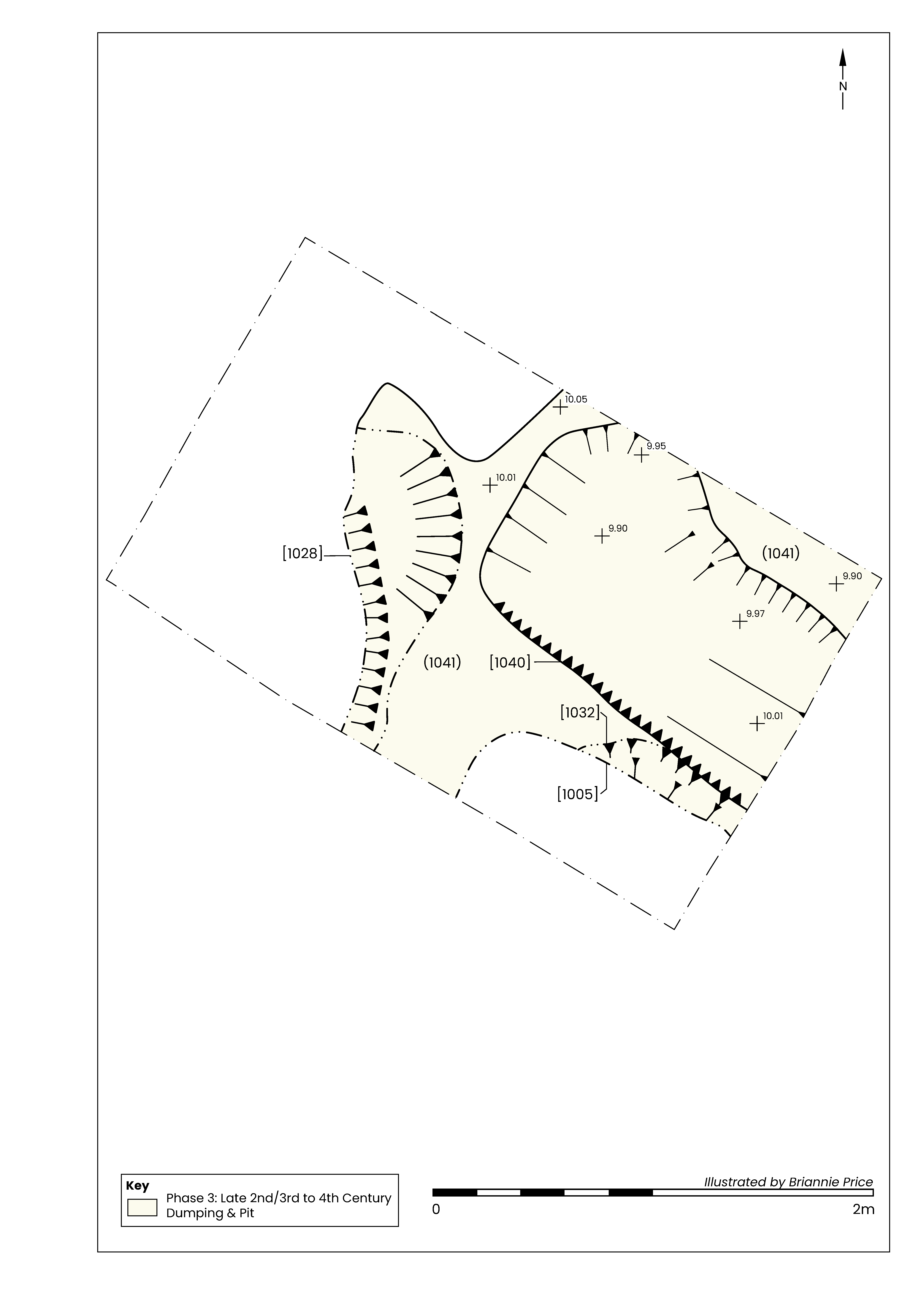
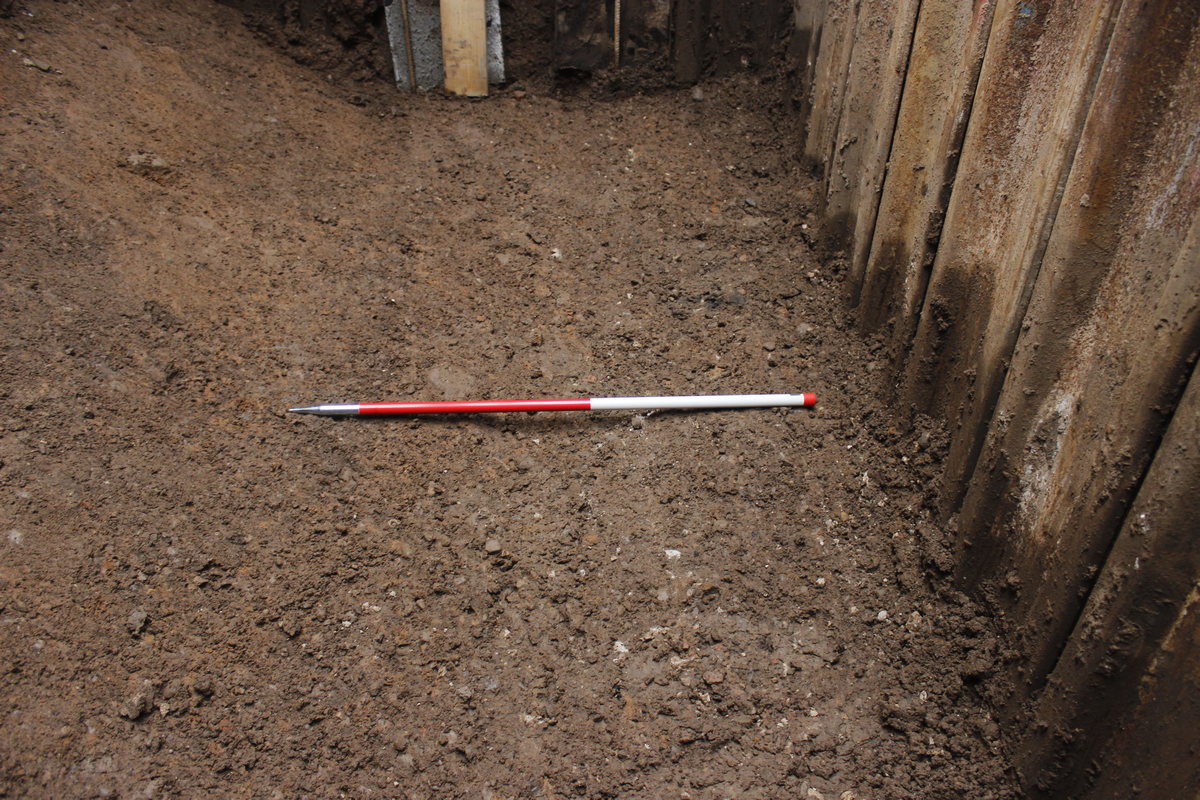
Cutting the natural geology were three 2nd century CE pits, but owing to their proximity to the formation depth, only the top 50–100mm of each pit could be excavated (Figure 2). Pits [1046] and [1047] were semi-circular in plan and extended beyond the limit of excavation. Pit [1046] was filled by (1048), a mixed dark greyish-brown sandy silt from which five sherds of 2nd century CE pottery were recovered. Pit [1047] was filled by (1044), a firm yellowish-brown sandy silt containing 2nd century CE pottery; both were truncated by a sub-oval pit [1049], filled by (1050), a dark greyish-brown sandy silt, from which more 2nd century CE pottery was recovered.
![Trench 1, Phases 1 naturally occurring deposits, Phase 2 pits and Phase 4 pit
[1028]](images/figure2.png)
Dumping
Overlying the early pits to a height of 9.41m AOD was (1043), a homogeneous layer of dark greyish-brown clayey silt with occasional patches of sand and small stones. This deposit was quite organic in nature and contained animal bone and pottery. Most of the pottery was 2nd to 3rd century CE in date, although a small quantity of late 3rd to 4th century CE Crambeck reduced ware and Crambeck white ware flagon, dating to the 4th century CE, were also present. However, these later fragments are though likely to be intrusive (Griffiths, section 6.1.4).
Deposit (1043) was overlain by deposit (1042), a mixed greyish-brown clayey silt with moderate charcoal inclusions, which extended to a maximum height of 9.91m AOD. Recovered pottery sherds mostly dated to the 2nd and 3rd century CE, while some, such as Dales-type ware and reduced burnished wares, originating from East Yorkshire, have production dates spanning the 2nd to 4th century CE. Animal bone was also recovered from this layer. The next layer in the sequence was (1041), a mottled yellowish-grey sandy silt with occasional small sub-rounded stones and frequent charcoal flecks and animal bone. The pottery recovered from (1041) suggests that deposition occurred in the late 2nd to 3rd century CE (Figure 3).
Pit
Deposit (1041) was cut by pit [1040] (Figure 3). The pit was sub-rectangular in plan and filled by (1022), a soft to friable mid-dark greyish-brown clayey silt with small to medium sub-angular stones and patches of clay. Fill (1022) contained large amounts of animal bone including a partial horse skeleton, comprising left and right mandibles, a number of vertebrae and ribs (see Poole, section 6.2). Fill (1022) also contained oyster shell and a range of pottery, largely 2nd century CE in date, but with small quantities of material, such as East Yorkshire reduced ware and Crambeck reduced ware, that hint at a probable late 2nd to 3rd century CE date of deposition, although intrusion of the later wares is possible. The feature was interpreted as a rubbish pit.
Possible landscaping or dumping
Overlying (1022) was deposit (1020)/(1021), a light greyish-brown clayey silt with occasional charcoal flecks, oyster shell and small sub-rounded stones. Animal bone and pottery largely dating from the late 2nd to 3rd century was recovered, along with a small assemblage of 3rd to 4th century CE pottery. Sealing (1020)/(1021) was (1018), a mid-greyish brown silt with a large component of ash and charcoal, from which animal bone and a small quantity of 3rd to 4th century CE pottery was recovered (Figure 4).
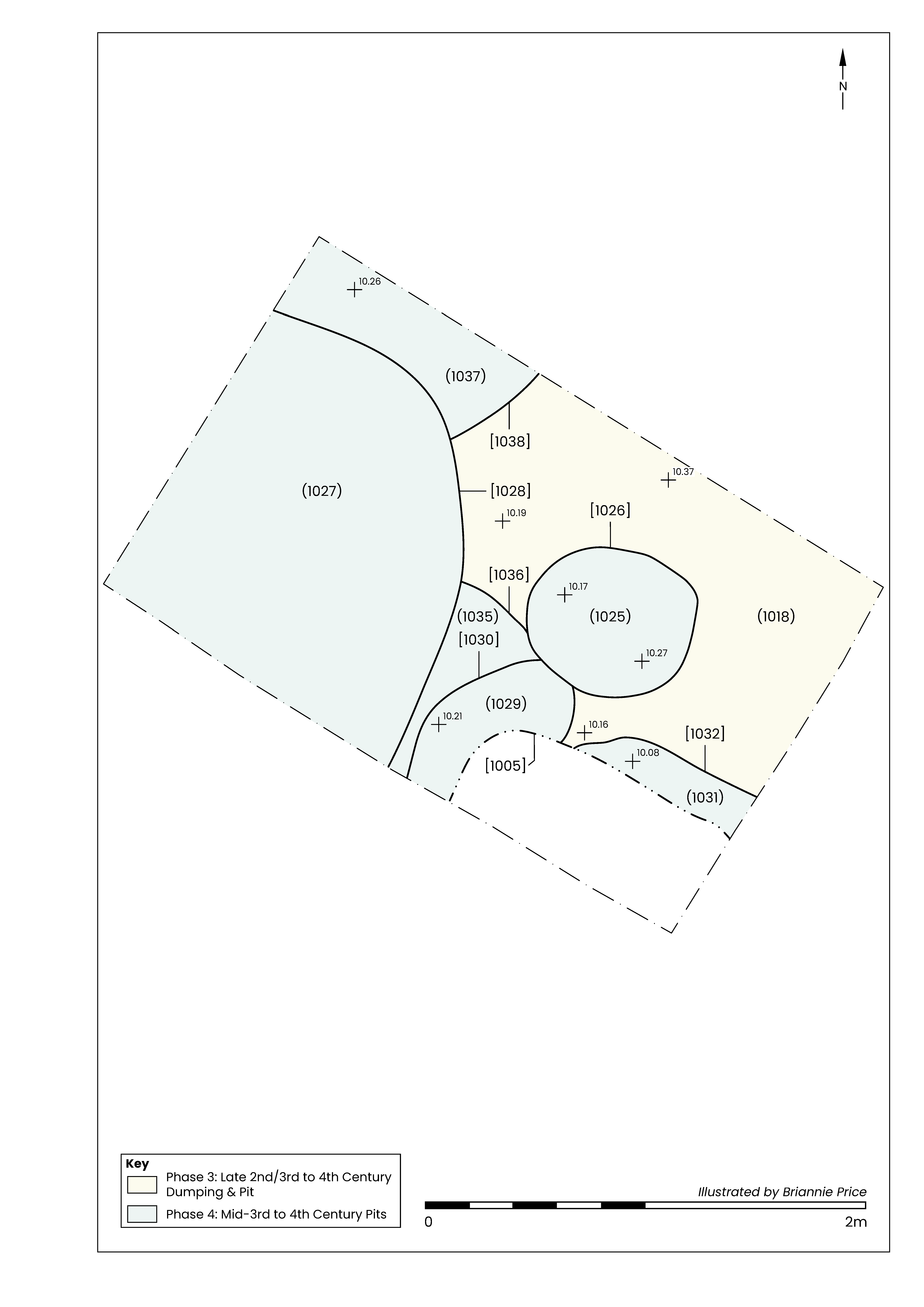
Truncating (1018) was a series of intercutting pits (Figure 4), the earliest of which were pits [1036] and [1038]. Pit [1036] had suffered extensive truncation from later neighbouring pits, but the surviving sides were observed to be moderately steep and it had a concave base. The feature was filled with (1035), a mid-greyish brown clayey silt with occasional small stones and charcoal flecks, that contained animal bone, ceramic building material (CBM) and a pottery assemblage mostly comprising 2nd century CE material, but which also included two sherds of East Yorkshire reduced burnished wares dating to the late 2nd/early 3rd century CE or later (Griffiths, section 6.1.4). Pit [1038] was sub-oval with steep sides and a concave base. It was filled by (1037), a mid-greyish brown silty clay with occasional small to medium sub-rounded stones and charcoal inclusions. Finds present in (1037) included CBM and animal bone. Again, the pottery mostly dated to the 2nd century CE; however, pottery types that remained in production into the 3rd century CE were also present.
Only a thin sliver of pit [1032] had survived truncation from a large medieval pit in the south corner of the trench. What remained of the north-east side of the pit was sub-oval in plan with a gradually sloping side and flat base (Figure 4). The pit had been filled by (1031) which was a light yellowish grey-brown clayey silt with occasional small angular stones. No dateable finds were recovered from the fill. However, as it also cut into layer (1018) and was sealed below layer (1024) it has been added to this grouping.
The sequence of pit digging continued with [1030], found close to the south-west side of the trench, where it cut into pit [1036] (Figure 4; Figure 5). Despite extensive truncation to the south-east by medieval pit [1005], it appears originally to have been oval in plan; the remaining sides were steep and concave in profile. It was filled by (1029), which comprised light greyish-brown clayey silt containing occasional small angular stones, animal bone and a small assemblage of pottery, mostly dating to the 2nd century CE. The pottery included a single sherd of East Yorkshire reduced burnished ware dating to the later 2nd/3rd to 4th century CE. The northern edge of pit [1030] was truncated to the north-east by pit [1026], one of the latest features in this grouping. Pit [1026] had a circular shape in plan and a steep-sided concave profile that broke gradually to a shallow concave base (Figure 4; Figure 6). A single fill (1025), consisting of mid-grey clayey silt with occasional small sub-rounded stones and charcoal, was present within the pit along with a range of artefacts, including animal bone, shell, CBM, and an iron object (SF25). Again, mostly 2nd century CE pottery was present alongside a few sherds dating to the 3rd century CE and late 3rd to 4th century CE.
![Pit [1030], looking north-west. 0.1m scale units](images/figure5.png)
![Pit [1026], looking north. 0.1m scale units](images/figure6.png)
By far the largest pit in this grouping was [1028] (Figure 4). Pit [1028] occupied much of the north-west end of the trench, extending beyond the north-west and south-west limit of excavation. It cut both pit [1036] and pit [1038]. In profile it had a flat step close to the top on its east side, but otherwise had steep concave sides. Unfortunately, the base lay below the maximum depth of the trench and was not exposed. Within the pit was a single fill (1027), comprising dark to mid-grey-brown silty clay with occasional charcoal inclusions and a large quantity of finds. Animal bone, shell, CBM, glass fragments (including SF42, a fragment of a frit melon bead), a copper-alloy riveted plate (SF4), iron and lead objects were recovered from (1027). The 203 sherds of pottery found presented a wide range of wares and span of dates. Late 1st century CE southern Spanish amphorae were among the earliest, fine wares included mid-2nd to mid-3rd century CE East Gaulish samian, and coarse wares included Crambeck reduced ware dating to the late 3rd to 4th century CE.
Surface
Overlying the Period 4 pits was deposit (1024), a mid-greyish brown friable silty clay with moderate charcoal inclusions and small to medium sub-rounded stones. This deposit extended to a maximum height of 10.37m AOD and occupied the full extent of the trench, except the south corner where it was truncated by a medieval pit [1005] (Figure 7). The pottery mostly dated to the 2nd and early 3rd century CE, but two sherds of Crambeck wares potentially push dating into the 4th century CE. Animal bone, oyster shell, CBM, glass, a quern stone fragment (SF47), and metal objects were also recovered from this layer. It appears likely that (1024) formed a bedding for cobbled layer (1017), which extended to a height of 10.54m AOD (Figure 8; Figure 9).
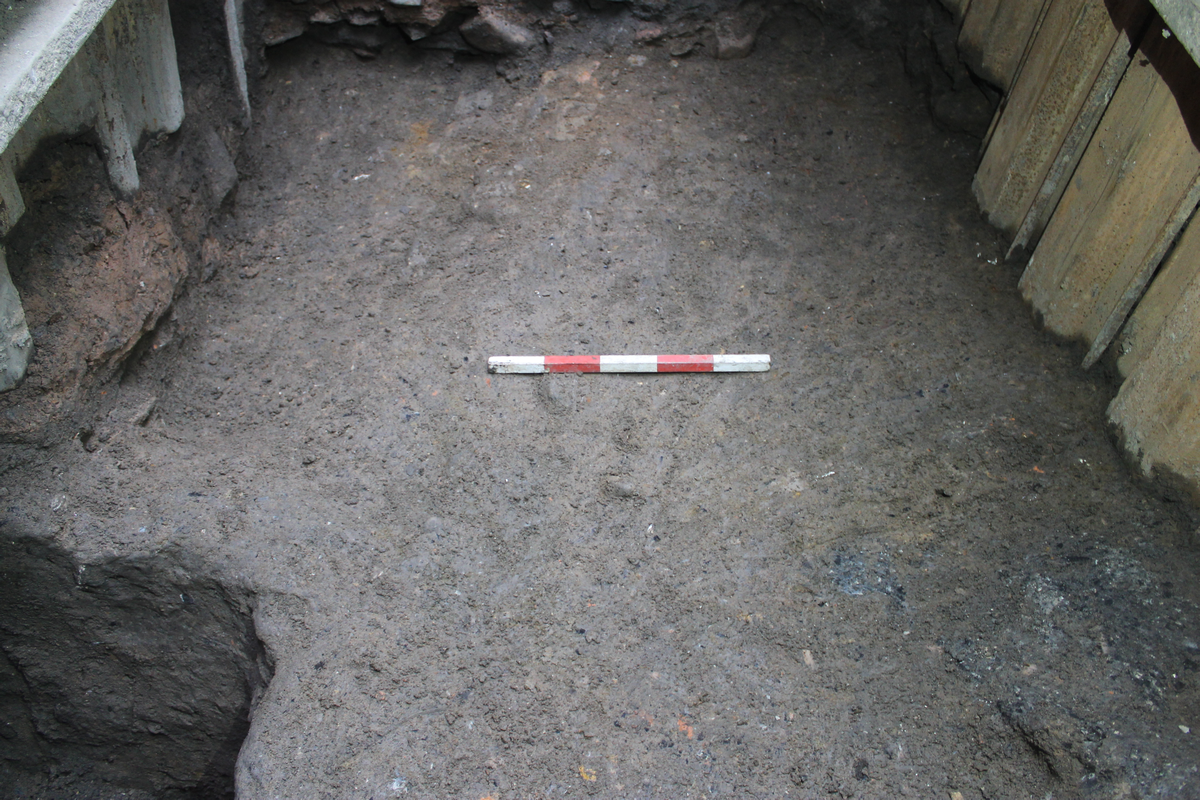
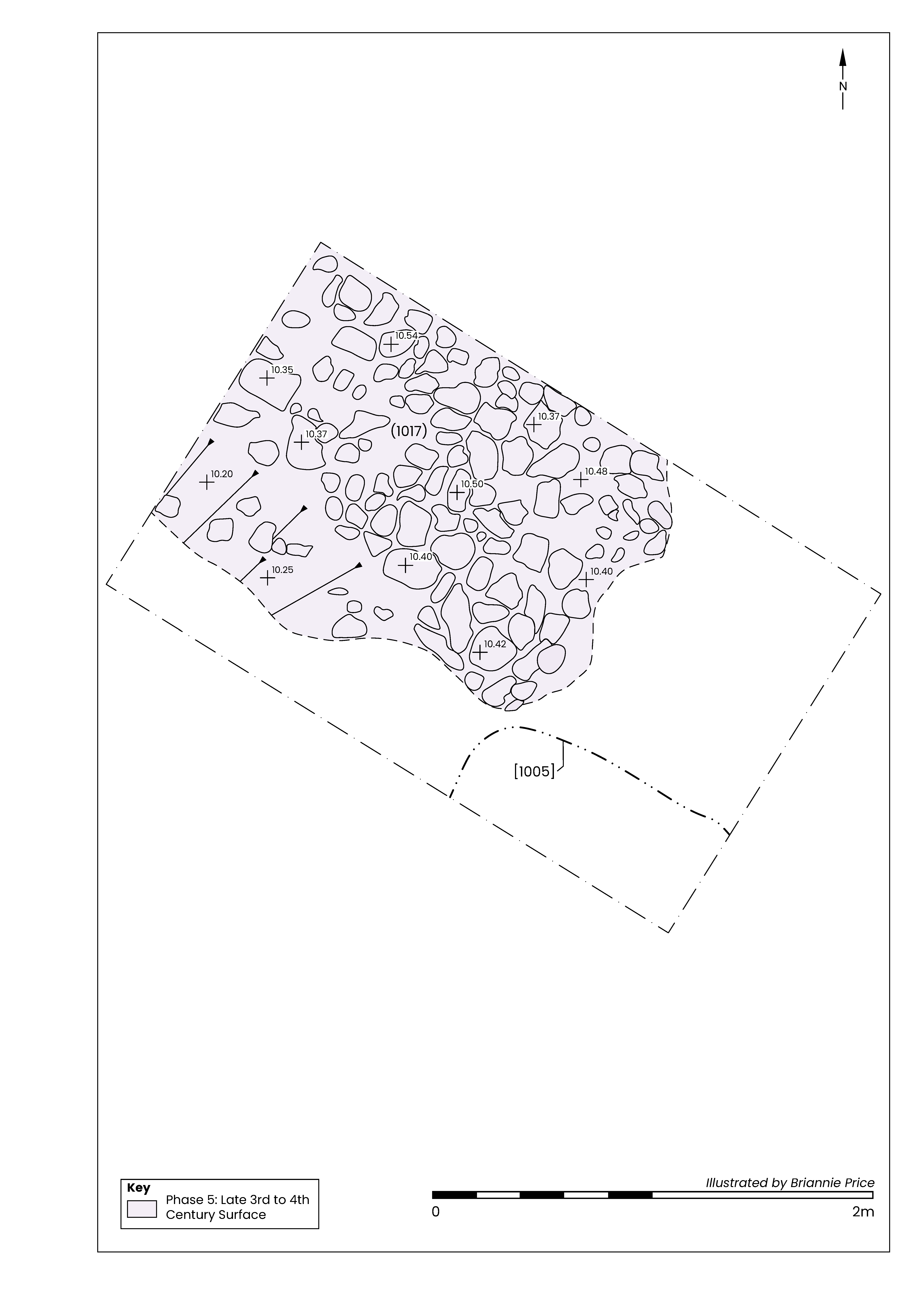
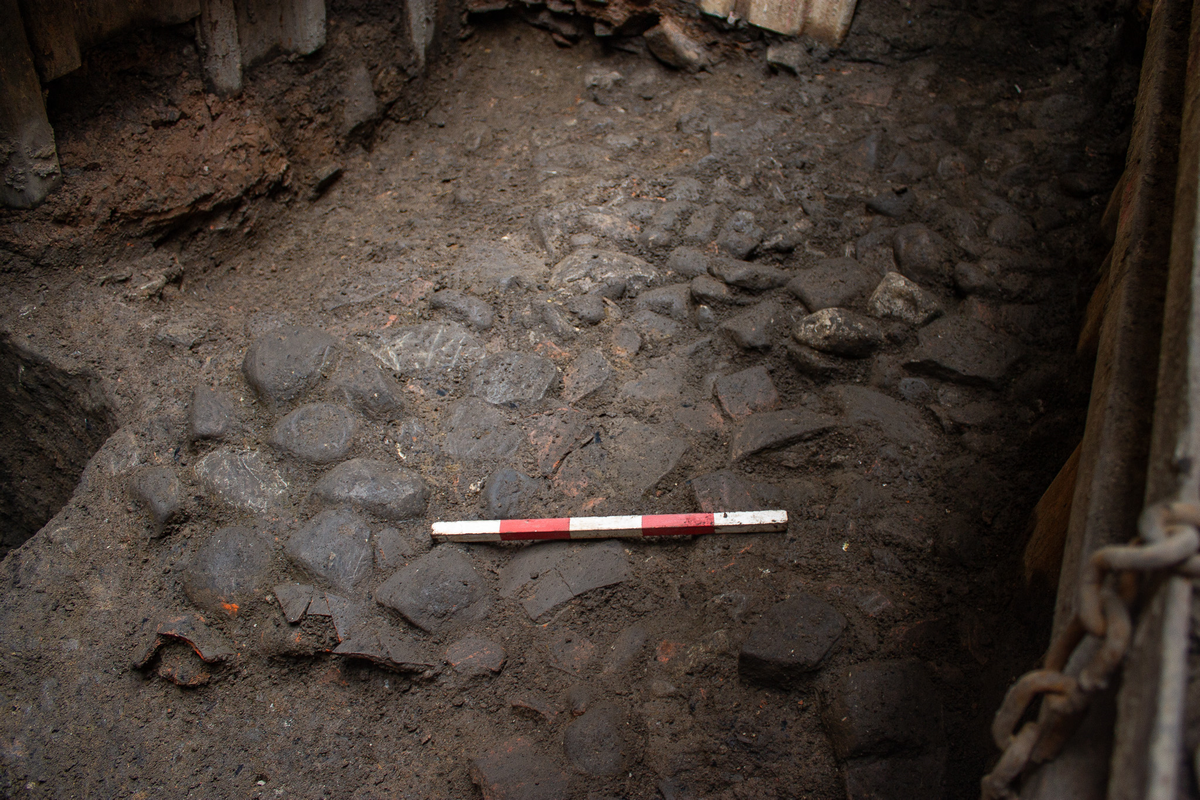
Cobble surface (1017) comprised a mix of sub-rounded and sub-angular stones in a range of sizes supplemented with a large quantity of ceramic building debris, including imbrex, tegula and brick. At less than 0.2m thick and quite crude in form, with no clear structural placement noted, this material was most likely laid as hardstanding, perhaps a yard, rather than as part of a road. Animal bone, oyster shell, glass and iron objects were also mixed in with the cobbles and CBM. The pottery assemblage recovered from this feature comprised 111 sherds, most dating to the 2nd to 3rd century CE, but included 25 sherds of 1st century CE amphorae and a small quantity of 2nd to 4th century CE ware types (Griffiths, section 6.1.4). In addition, the remains of two possible hobnailed shoes were present on top of the surface.
Silting, ground consolidation and possible posthole
The relationships between some of the deposits and features laid down next to and above the cobbled surface was indistinct. Silting was present above the surface, while deposits of stony clay, with a possible posthole set into or cutting though the silts and clay, were present immediately to the south-west of the cobble surface. On balance the following sequence seems most likely.
In the west corner of the trench was (1014), a firm light orangey-brown silty clay with frequent sub-angular stones, it overlapped the south-western edge of surface (1017), raising the ground level there to 10.6m AOD (Figure 10). More 1st century CE amphorae, likely belonging to the same vessels present in (1017), was found here, otherwise pottery dates (1014) to the late 3rd to 4th century CE.
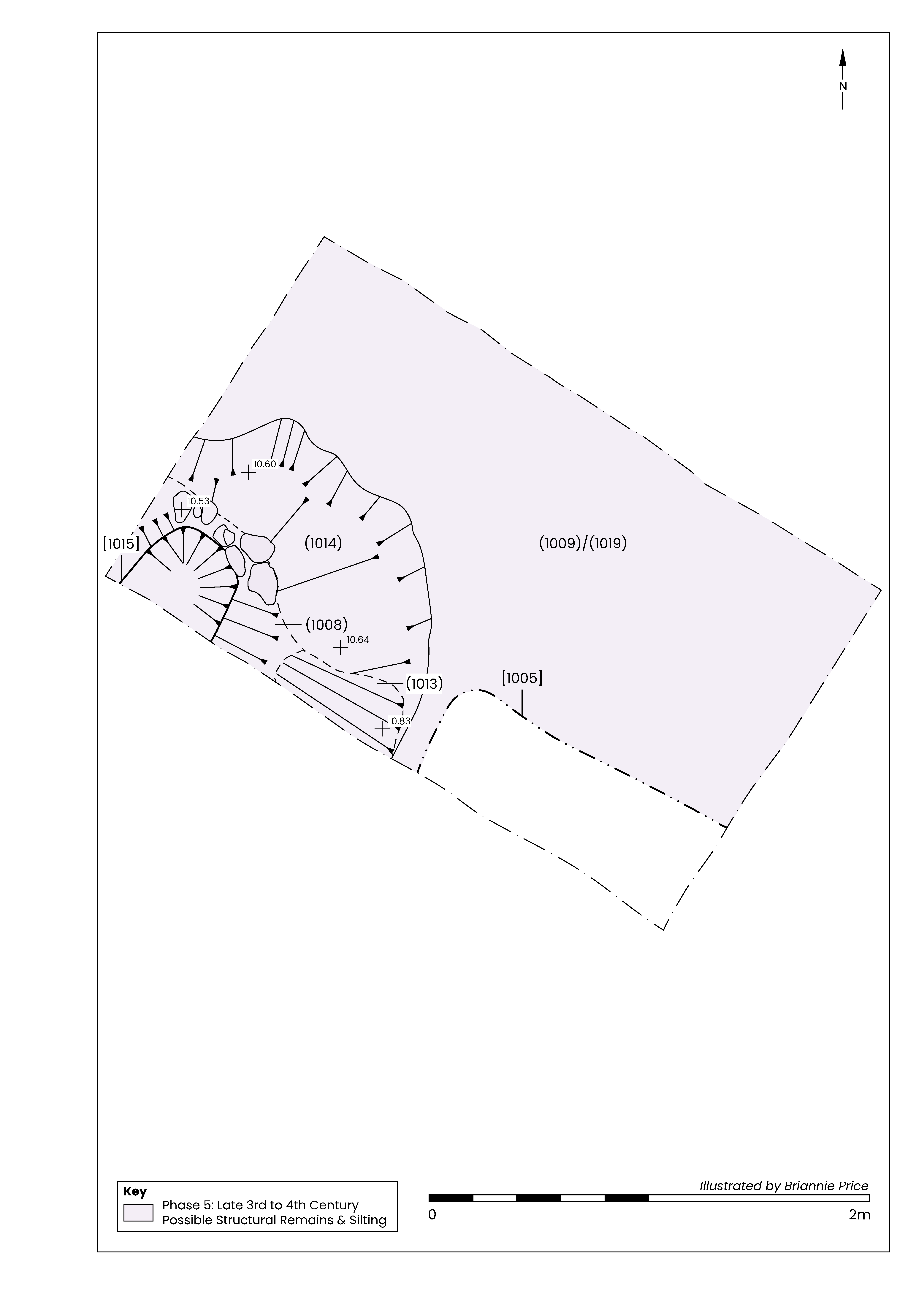
Silty clays (1009) and (1019) next accumulated across the extent of Trench 1 (Figure 10). These deposits covered the cobble surface (1017), extending beyond it to the south-east and to the south-west, here also interleaving with the edge of (1014). Very little difference was apparent in the composition of (1009) and (1019); both comprised friable light greyish-yellow silty clay with moderate charcoal inclusions, but a slightly greater concentration of small sub-rounded stones was present in (1019). Animal bone, oyster shell, CBM, a stone quern fragment (SF48), and metal objects were recovered from (1019), as was a large quantity of pottery, totalling 264 sherds, producing dates ranging from the 1st to late 3rd/4th century CE.
Above the western extent of (1009) and (1019) were stony clay deposits, similar in make-up and content to (1014). Raising the ground level along the south-west edge of Trench 1 to 10.83m AOD was (1013), a mixed greyish-brown silty clay with occasional charcoal inclusions and occasional small to medium sub-rounded stones (Figure 10). Overlapping the north edge of (1013) was (1008), comprising light orangey-brown sandy clay and cobbles. The stony clay deposits (1008), (1013) and (1014) occupied the extent of pit [1028] and were perhaps intended to consolidate the ground in the area adjacent to the cobble surface (1017).
Cutting through the stony clays was [1015], a small steep-sided pit, or possibly a large posthole (Figure 10). However, only part of this feature projected into the trench, and it is difficult to be certain of its function.
The possible structural elements and silting covering the surface in Phase 5 was then sealed below (1007), a soft mid-brown sandy silt with occasional sub-rounded stones and occasional charcoal inclusions (Figure 11). The loose structure of this material leads towards an interpretation of agricultural soil, and finds recovered from it include animal bone, oyster shell, CBM and pottery including three sherds of a Dales Shelly ware jar, dating from the end of the 2nd to the 4th century CE.
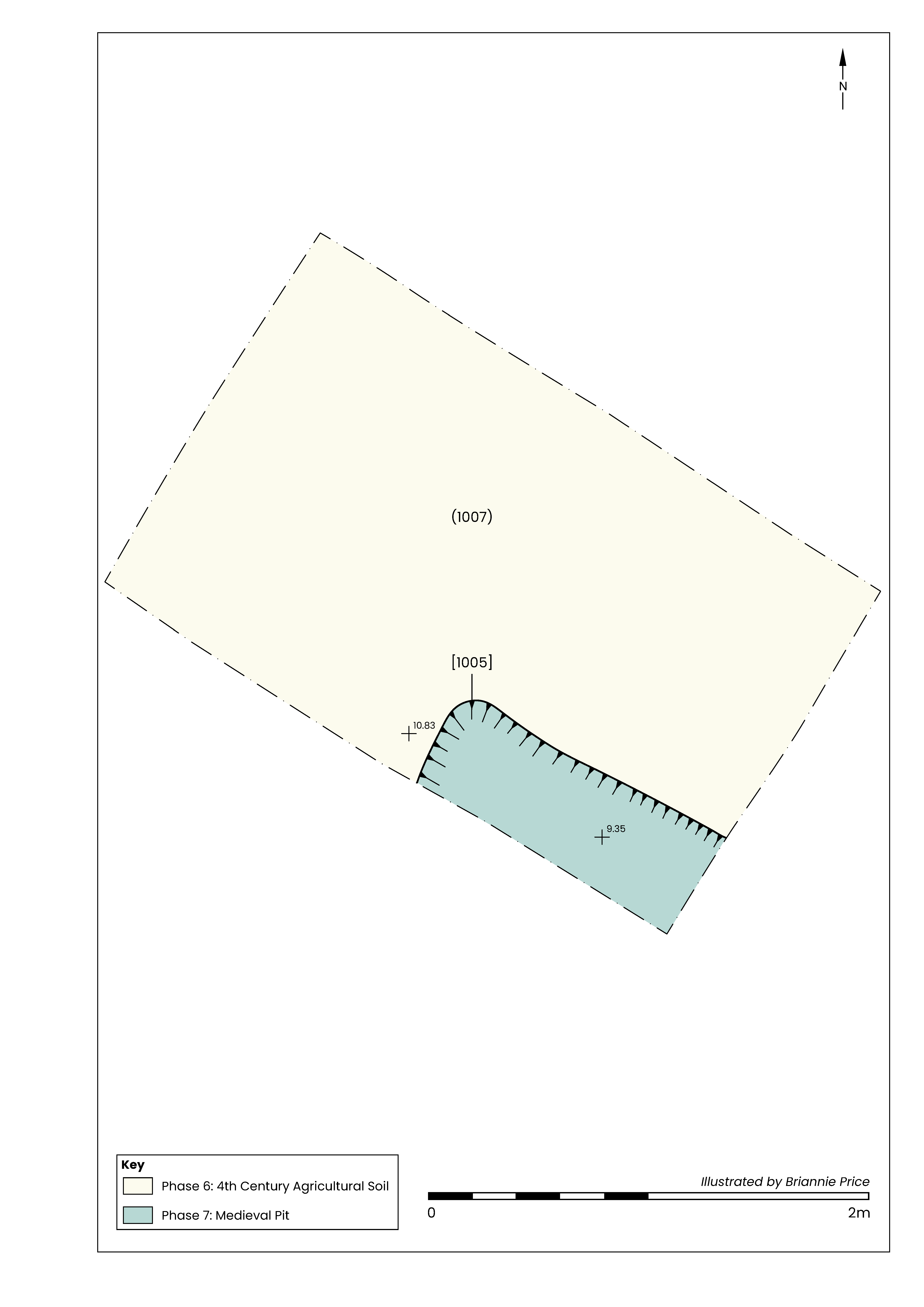
In the south corner of the trench and cutting through the Phase 6 ploughsoil was a large deep pit. Where it extended into the trench, pit (1005) was rectangular in plan with a rounded north-west corner, vertical sides and a flat base (Figure 11; Figure 12). Its lower fill (1010), was a soft dark greyish-brown silty clay with occasional charcoal inclusions and small angular stones. Animal bone, marine shell, CBM and pottery dating to the 11th to 13th century were recovered from it. The upper fill was (1004), comprising soft dark brown silt with occasional small sub-angular stone, large sub-rounded stones and charcoal inclusions. Animal bone, oyster shell, CBM, iron objects and a mix of 3rd to 4th century CE and medieval pottery were present within it.
![Phase 7 pit [1005], looking south-west. 0.1m scale units](images/figure12.png)
Trench 1
Approximately the top 1.75m of deposition was either directly related to modern services running on a north-east/south-west axis through the trench or had been severely impacted by them. The deepest one was in service trench cut [1002], which cut into the top of ploughsoil (1007). It also disturbed a deposit of clay-bonded cobbles (1003), observed at 1.28m BGL in the north-east side of the trench near its north corner. The cobbles were situated above ploughsoil (1007), but no dateable material was recovered from this deposit.
Trench 2
Trench 2 was situated approximately 200m north of Trench 1, over which distance the character of archaeological deposition and the effect of later intrusive activity presented a completely different sequence of deposits.
Only the top 0.4m of the earliest deposit encountered could be excavated before the maximum depth of the trench was reached at 3m BGL. Deposit (2004) was a soft mid-orangey brown clayey silt interpreted as made ground (Figure 13). Next was (2003), which was 1.2m thick and extended to 1.4m BGL. It was clearly also redeposited material, which in this case consisted of soft mid-greyish brown clayey silt with occasional small to medium sub-rounded stones. A range of artefact types were recovered from (2003), the most significant being 18th–19th century pottery and a small selection of disarticulated human bone. More redeposited material followed. Deposit (2002) was a mottled light greyish-brown clayey silt with occasional small sub-rounded and angular stones that extended to 0.4m BGL. A variety of artefact types, were present within (2003), including more disarticulated human bone and 2nd to early 3rd century CE pottery. Modern service backfill (2001) and paving occupied the top 0.4m of the trench.
In total, 1585 sherds of pottery weighing c. 48kg (Table 1), were recovered. The assemblage contained material of predominantly Romano-British date (1548 sherds), with small quantities of medieval (34 sherds) and post-medieval pottery (3 sherds).
| Ware | Count | % of count | Weight (g) | % of weight | EVEs | % of EVEs |
|---|---|---|---|---|---|---|
| Amphorae | 333 | 21.0% | 26339.9 | 54.9% | 51 | 2.1% |
| Mortaria | 301 | 19.0% | 3448.8 | 7.2% | 1611.5 | 66.5% |
| Fine ware | 36 | 2.3% | 2388.3 | 5.0% | 607 | 21.5% |
| Coarse ware | 878 | 55.4% | 15018.6 | 31.3% | 0.0% | |
| Medieval | 34 | 2.1% | 787 | 1.6% | 152.5 | 6.3% |
| Post-medieval | 3 | 0.2% | 36.2 | 0.1% | 0.0% | |
| Grand Total | 1585 | 100.0% | 48018.8 | 100.0% | 2422 | 100.0% |
| Ware and Class | Count | % of count | Weight (g) | % of weight | EVEs | % of EVEs |
|---|---|---|---|---|---|---|
| Amphora | 333 | 21.0% | 26339.9 | 54.9% | 51 | 2.1% |
| Baetican amphorae | 25 | 1.6% | 2835.5 | 5.9% | 5 | 0.2% |
| Baetican? Amphorae | 27 | 1.7% | 3139.3 | 6.5% | 0.0% | |
| Campanian amphorae | 246 | 15.5% | 17594.5 | 36.6% | 21 | 0.9% |
| Gaulish amphorae | 25 | 1.6% | 1251.3 | 2.6% | 0.0% | |
| Gaulish? Amphorae | 2 | 0.1% | 533.8 | 1.1% | 0.0% | |
| North African amphorae | 1 | 0.1% | 35.8 | 0.1% | 0.0% | |
| Southern Spanish | 1 | 0.1% | 230.3 | 0.5% | 25 | 1.0% |
| Unidentified | 6 | 0.4% | 719.4 | 1.5% | 0.0% | |
| Fine ware | 301 | 19.0% | 3448.8 | 7.2% | 607 | 25.1% |
| Samian - South Gaulish | 32 | 2.0% | 374.2 | 0.8% | 39 | 1.6% |
| Samian - Central Gaulish | 109 | 6.9% | 1400.6 | 2.9% | 279.5 | 11.5% |
| Samian - East Gaulish | 48 | 3.0% | 659.7 | 1.4% | 91.5 | 3.8% |
| Marbled ware - Gaulish | 1 | 0.1% | 27.6 | 0.1% | 16 | 0.7% |
| Gaulish Colour-coated ware | 1 | 0.1% | 0.9 | 0.0% | 0.0% | |
| Central Gaulish Black-slipped ware | 1 | 0.1% | 1.3 | 0.0% | 0.0% | |
| Cologne Colour-coated ware | 4 | 0.3% | 14.8 | 0.0% | 0.0% | |
| Cologne Roughcast Colour-coated ware | 1 | 0.1% | 19 | 0.0% | 0.0% | |
| Moselkeramik Black-slipped ware | 2 | 0.1% | 5.1 | 0.0% | 7 | 0.3% |
| Rhineland Roughcast Colour-coated ware | 1 | 0.1% | 3 | 0.0% | 0.0% | |
| Lower Nene Valley Colour-coated ware | 92 | 5.8% | 876.1 | 1.8% | 109 | 4.5% |
| Colour-coated ware | 2 | 0.1% | 16.2 | 0.0% | 0.0% | |
| Reduced ware/Burnished reduced | 1 | 0.1% | 11.7 | 0.0% | 27.5 | 1.1% |
| Roughcast Colour-coated ware | 4 | 0.3% | 26.9 | 0.1% | 32.5 | 1.3% |
| White ware | 2 | 0.1% | 11.7 | 0.0% | 5 | 0.2% |
| Mortaria | 36 | 2.3% | 2388.3 | 5.0% | 152.5 | 6.3% |
| Cantley White-slipped ware | 1 | 0.1% | 13.5 | 0.0% | 0.0% | |
| Cantley/Swanpool/Catterick vicinity | 1 | 0.1% | 12.2 | 0.0% | 0.0% | |
| Catterick Vicinity White-slipped ware | 8 | 0.5% | 970.6 | 2.0% | 87 | 3.6% |
| Ebor ware | 5 | 0.3% | 724.3 | 1.5% | 39 | 1.6% |
| Mancetter-Hartshill White ware | 6 | 0.4% | 278.2 | 0.6% | 9 | 0.4% |
| Verulamium Region White ware | 8 | 0.5% | 184.2 | 0.4% | 1 | 0.0% |
| North Gaulish White ware | 2 | 0.1% | 57.1 | 0.1% | 0.0% | |
| Samian - Central Gaulish | 3 | 0.2% | 44.1 | 0.1% | 7 | 0.3% |
| Samian - East Gaulish | 2 | 0.1% | 104.1 | 0.2% | 9.5 | 0.4% |
| Coarse ware | 878 | 55.4% | 15018.6 | 31.3% | 1611.5 | 66.5% |
| Oxidised Ebor ware | 257 | 16.2% | 4011.6 | 8.4% | 361 | 14.9% |
| Oxidised ware | 11 | 0.7% | 334 | 0.7% | 22 | 0.9% |
| Oxidised ware/White-slipped Ebor ware | 103 | 6.5% | 1790.8 | 3.7% | 263.5 | 10.9% |
| Oxidised White-slipped ware | 1 | 0.1% | 4.2 | 0.0% | 0.0% | |
| Ebor Red-painted ware | 5 | 0.3% | 63.7 | 0.1% | 20.5 | 0.8% |
| African-style coarse ware | 1 | 0.1% | 15.6 | 0.0% | 0.0% | |
| African-style, Ebor coarse ware | 2 | 0.1% | 50.8 | 0.1% | 0.0% | |
| Reduced Ebor ware | 125 | 7.9% | 2139.1 | 4.5% | 307 | 12.7% |
| Reduced Ebor ware/Rusticated ware | 2 | 0.1% | 32 | 0.1% | 0.0% | |
| Reduced ware | 30 | 1.9% | 501.7 | 1.0% | 76 | 3.1% |
| Reduced ware/Burnished and rusticated | 1 | 0.1% | 4.9 | 0.0% | 0.0% | |
| Reduced ware/Burnished reduced | 93 | 5.9% | 1621.7 | 3.4% | 163.5 | 6.8% |
| Reduced ware/Rusticated | 28 | 1.8% | 443.5 | 0.9% | 19.5 | 0.8% |
| Crambeck Reduced ware | 12 | 0.8% | 127.7 | 0.3% | 25 | 1.0% |
| Black-burnished ware | 144 | 9.1% | 2293.3 | 4.8% | 273 | 11.3% |
| Calcite-gritted ware | 1 | 0.1% | 42.5 | 0.1% | 11 | 0.5% |
| East Yorkshire Calcite-gritted ware | 4 | 0.3% | 95.1 | 0.2% | 19 | 0.8% |
| Derbyshire Coarse ware | 3 | 0.2% | 52.8 | 0.1% | 0.0% | |
| Derbyshire-type coarse ware | 10 | 0.6% | 481.2 | 1.0% | 0.0% | |
| Dales Shelly ware | 4 | 0.3% | 45.6 | 0.1% | 14 | 0.6% |
| Dales-Type ware | 5 | 0.3% | 107.9 | 0.2% | 18.5 | 0.8% |
| Shelly ware | 9 | 0.6% | 290.1 | 0.6% | 13 | 0.5% |
| Crambeck Parchment ware | 2 | 0.1% | 26.7 | 0.1% | 5 | 0.2% |
| Crambeck White ware | 6 | 0.4% | 109.1 | 0.2% | 0.0% | |
| White ware | 16 | 1.0% | 278.3 | 0.6% | 0.0% | |
| Cream ware | 2 | 0.1% | 49.2 | 0.1% | 0.0% | |
| Mica-dusted ware | 1 | 0.1% | 5.5 | 0.0% | 0.0% | |
| Medieval | 34 | 2.1% | 787 | 1.6% | 0.0% | |
| Gritty ware | 2 | 0.1% | 46 | 0.1% | 0.0% | |
| Medieval | 21 | 1.3% | 629.5 | 1.3% | 0.0% | |
| Northern gritty ware | 6 | 0.4% | 50.8 | 0.1% | 0.0% | |
| Reduced gritty ware | 2 | 0.1% | 21.7 | 0.0% | 0.0% | |
| Redware | 1 | 0.1% | 14.9 | 0.0% | 0.0% | |
| Stoneware | 2 | 0.1% | 24.1 | 0.1% | 0.0% | |
| Post-Medieval | 3 | 0.2% | 36.2 | 0.1% | 0.0% | |
| Slipware | 1 | 0.1% | 5 | 0.0% | 0.0% | |
| White ware | 2 | 0.1% | 31.2 | 0.1% | 0.0% | |
| Total | 1585 | 100.0% | 48018.8 | 100.0% | 2422 | 100.0% |
Amphorae
In total, 333 sherds of amphorae weighing c. 26.3kg were recovered (Table 1; Table 2). Most of the sherds, some 246, were of Southern Italian, specifically, Campanian, origin and in Dressel 2–4 forms (University of Southampton 2014). These types mostly carried wine and were produced from c. 70 BCE until the early 3rd century CE, with the main production coming prior to the end of the 1st century CE, soon after the major disruption caused by the eruption of Vesuvius in 79 CE. While Campanian amphorae formed the largest component of the amphorae assemblage, most of the sherds originally formed parts of only two vessels, one in a 'black sand' fabric (ID48, Figure 20, CAM AM1; Tomber and Dore 1998, 88), the other in a Northern Campanian fabric (ID39, Figure 21, CAM AM2; Tomber and Dore 1998, 89).
Fifty-three amphorae sherds were of Baetican and/or southern Spanish origin, most likely Dressel 20 forms (originally used for transporting olive oil to Britain from the 1st to mid-3rd century CE); however, there was only a single rim fragment (ID96, Figure 20, 3rd century CE) that provided more precise dating, while the body sherds could only be assigned to more broad date ranges. A large rim and neck fragment of a Dressel 7 type (ID989, Figure 18), of southern Spanish origin, dated to the final quarter of the 1st century CE (Williams pers. comm.). The study of tituli picti suggests the original contents of southern Spanish Dressel 7 types were fish-based products (Lagóstena in University of Southampton 2014).
Twenty-seven sherds of Gaulish and possible Gaulish amphorae (c. 2kg) were recovered; almost all were body sherds in GAL AM fabrics (Tomber and Dore 1998, 93), and originally used to transport wine. The exception within the Gaulish amphorae assemblage was a part of a Dressel 2–4 foot (ID1024, Figure 20), possibly produced in Lyon in the 1st century CE (Dressel 2–4, perhaps Lyon 2 fabric (e.g. Desbat 2003), and whose original contents were wine (University of Southampon 2014).
A single fragment (35.8g) of North African amphorae was recovered from context (1042). These types were produced and used to transport olive oil and fish-based products from the North African region to the north-west provinces from the 2nd to 5th centuries CE (Tyers 1996, section 2.16).
The quantities and range of amphorae recovered from Queen Street is not unusual for York and is broadly characteristic of military and closely associated urban settlements. The results indicate continued supply of continental commodities including olive oil, wine, and potentially fish-based products.
Fine wares
In total, 301 sherds of fine table wares weighing 3448.8g were recovered, forming 19.0% of the overall pottery assemblage by count, 7.2% by weight, and 25.1% by EVEs (Table 1; Table 2).
| Fine wares by class | Count | % of count | Weight | % of weight | EVEs | % of EVEs |
|---|---|---|---|---|---|---|
| Samian - Central Gaulish | 109 | 36.2% | 1400.6 | 40.6% | 279.5 | 46.0% |
| Samian - East Gaulish | 48 | 15.9% | 659.7 | 19.1% | 91.5 | 15.1% |
| Samian - South Gaulish | 32 | 10.6% | 374.2 | 10.9% | 39 | 6.4% |
| Marbled ware - Gaulish | 1 | 0.3% | 27.6 | 0.8% | 16 | 2.6% |
| Gaulish Colour-coated ware | 1 | 0.3% | 0.9 | 0.0% | 0.0% | |
| Central Gaulish Black-slipped ware | 1 | 0.3% | 1.3 | 0.0% | 0.0% | |
| Cologne Colour-coated ware | 4 | 1.3% | 14.8 | 0.4% | 0.0% | |
| Cologne Roughcast Colour-coated ware | 1 | 0.3% | 19 | 0.6% | 0.0% | |
| Moselkeramik Black-slipped ware | 2 | 0.7% | 5.1 | 0.1% | 7 | 1.2% |
| Rhineland Roughcast Colour-coated ware | 1 | 0.3% | 3 | 0.1% | 0.0% | |
| Lower Nene Valley Colour-coated ware | 92 | 30.6% | 876.1 | 25.4% | 109 | 18.0% |
| Colour-coated ware | 2 | 0.7% | 16.2 | 0.5% | 0.0% | |
| Reduced ware/Burnished reduced | 1 | 0.3% | 11.7 | 0.3% | 27.5 | 4.5% |
| Roughcast Colour-coated ware | 4 | 1.3% | 26.9 | 0.8% | 32.5 | 5.4% |
| White ware | 2 | 0.7% | 11.7 | 0.3% | 5 | 0.8% |
| Total | 301 | 100.0% | 3448.8 | 100.0% | 607 | 100.0% |
Samian ware
Samian ware formed one of the largest relative proportions of the overall pottery assemblage (Table 2) at 11.9% by count (189 sherds), 5.1% by weight, and 16.9% by EVEs. However, they also formed the largest relative proportion of fine table wares when these are considered as a distinct group, at 62.8% by count, 70.6% by weight, and 67.5% by EVEs (Table 3). Five sherds of Samian ware mortaria were also recovered and are counted separately and considered in detail with the other mortaria, below (section 6.1.2). The bulk of the samian wares were of central and east Gaulish origin (broadly 2nd to mid-3rd century CE), with smaller quantities of south Gaulish samian dating from the late 1st to early 2nd century CE (Table 3). Vessel forms were predominantly bowls and dishes, cups, and beakers (Table 4). The Samian sherds are presented by source and vessel form in Table 7, with quantification by maximum number of vessels (MNV).
| Function | EVEs | % of EVEs | MNVs | MNV |
|---|---|---|---|---|
| Bowl | 168 | 39.4% | 61 | 33.5% |
| Bowl/dish | 11 | 2.6% | 2 | 1.1% |
| Dish | 48 | 11.3% | 20 | 11.0% |
| Dish/bowl | 32 | 7.5% | 10 | 5.5% |
| Dish/platter | 0 | 0.0% | 1 | 0.5% |
| Mortaria | 16.5 | 3.9% | 5 | 2.7% |
| Uncertain | 1 | 0.2% | 49 | 26.9% |
| Total | 426.5 | 100.0% | 182 | 100.0% |
In total, 32 sherds weighing 374.2g of South Gaulish origin were recovered, forming 16.95% of the samian ware assemblage by count, 14.5% by weight, 9.1% by EVEs, and 16.5% by MNV (Table 6). The sherds were generally in good condition, indicating limited post-deposition disturbance. The relative proportion of South Gaulish material in the assemblage indicates an early supply, consumption, and disposal of fine table wares during the late 1st and early 2nd centuries CE (Tables 5–6). The sources of this pottery were the kiln sites around La Graufesenque (LGF SA, Tomber and Dore 1998, 28); vessel forms included cups (Dr27 and Dr33 forms), bowls, mostly decorated (including form Dr37) and undecorated vessels, and dishes, including forms Dr15/17, Dr18/18R, and Dr18/31. Other sherds were unidentifiable to specific forms (Table 5; Table 6).
| Function | Form and code | South Gaulish | Central Gaulish | East Gaulish | ||||||
|---|---|---|---|---|---|---|---|---|---|---|
| LGF SA | SAM CG | LEZ SA | LMV SA | SAM EG | TRI SA | HGB SA | RHZ SA | Sub-totals | ||
| Cup | Cup | 9 | 2 | 9 | 2 | 7 | 1 | 1 | 31 | |
| DR27 | 7 | 2 | 2 | 11 | ||||||
| DR27g | 1 | 1 | ||||||||
| DR33 | 1 | 2 | 6 | 2 | 1 | 1 | 13 | |||
| Uncertain | 3 | 3 | 6 | |||||||
| Cup/bowl | Cup/Bowl | 1 | 1 | |||||||
| Uncertain | 1 | 1 | ||||||||
| Beaker | Beaker | 1 | 1 | 2 | ||||||
| Uncertain | 1 | 1 | 2 | |||||||
| Bowl | Bowl | 10 | 3 | 22 | 4 | 9 | 6 | 1 | 4 | 59 |
| Bowl - plain | CU11/DR38 | 1 | 1 | |||||||
| DR31R | 2 | 6 | 1 | 4 | 3 | 2 | 18 | |||
| DR38 | 1 | 1 | ||||||||
| Uncertain | 1 | 4 | 2 | 4 | 2 | 1 | 14 | |||
| Bowl - decorated | DR30 | 1 | 1 | |||||||
| DR30/R? | 1 | 1 | ||||||||
| DR37 | 2 | 6 | 1 | 1 | 1 | 11 | ||||
| DR37c | 1 | 1 | ||||||||
| Uncertain | 6 | 5 | 11 | |||||||
| Bowl/dish | Bowl/Dish | 2 | 2 | |||||||
| CU11/DR36 | 2 | 2 | ||||||||
| Dish | Dish | 4 | 2 | 9 | 3 | 2 | 1 | 1 | 22 | |
| Dr15/17 | 1 | 1 | ||||||||
| DR18/31 | 1 | 2 | 2 | 5 | ||||||
| DR18/31R | 1 | 1 | 2 | |||||||
| Dr18/Dr18R | 1 | 1 | ||||||||
| DR31 | 4 | 1 | 1 | 6 | ||||||
| DR36 | 1 | 1 | 1 | 3 | ||||||
| Uncertain | 1 | 1 | 1 | 1 | 4 | |||||
| Dish/bowl | Dish/bowl | 3 | 2 | 5 | 10 | |||||
| DR31/DR31R | 1 | 1 | ||||||||
| Uncertain | 3 | 2 | 4 | 9 | ||||||
| Dish/platter | Dish/platter | 1 | 1 | |||||||
| Uncertain | 1 | 1 | ||||||||
| Mortaria | Mortaria | 1 | 2 | 1 | 1 | 5 | ||||
| DR43 | 1 | 1 | ||||||||
| DR43/45 | 1 | 1 | ||||||||
| DR45 | 2 | 2 | ||||||||
| Uncertain | 1 | 1 | ||||||||
| Uncertain | Uncertain | 2 | 7 | 23 | 3 | 8 | 4 | 2 | 49 | |
| Decorated | 1 | 1 | ||||||||
| Uncertain | 2 | 7 | 23 | 3 | 7 | 4 | 2 | 48 | ||
| Total | 30 | 17 | 73 | 12 | 28 | 12 | 4 | 6 | 182 | |
| Source | Count | % of count | Weight | % of weight | EVEs | % of EVEs | MNVs | % of MNVs |
|---|---|---|---|---|---|---|---|---|
| Central Gaulish | 112 | 57.7% | 1444.7 | 55.9% | 286.5 | 67.2% | 102 | 56.0% |
| East Gaulish | 50 | 25.8% | 763.8 | 29.6% | 101 | 23.7% | 50 | 27.5% |
| South Gaulish | 32 | 16.5% | 374.2 | 14.5% | 39 | 9.1% | 30 | 16.5% |
| Total | 194 | 100.0% | 2582.7 | 100.0% | 426.5 | 100.0% | 182 | 100.0% |
In total, 112 sherds weighing 1444.7g of Central Gaulish origin were recovered, forming 57.7% of the samian ware assemblage by count, 55.9% by weight, 67.2% by EVEs, and 56.0% by MNV (Table 6). The sherds were generally in good condition, indicating limited post-depositional disturbance. Samian ware of Central Gaulish origin formed the largest component of the samian ware assemblage, indicating continued and relatively abundant supply of fine table wares during the 2nd century CE and perhaps into the early 3rd century CE (Table 6). The identified sources of this material were the kiln sites of Lezoux (LEZ SA, Tomber and Dore 1998, 31–2) and Les Martres-de-Veyre (LMV SA, Tomber and Dore 1998, 30), with others from uncertain Central Gaulish sources; vessel forms included cups (Dr27 and Dr33 forms) and a beaker; bowls, including decorated Dr37s and a Dr30, and plain types including Cu11/Dr38 and Dr38s, and Dr31Rs; dishes, including Dr18/31 and Dr18/31R, Dr31 and Dr36; and three sherds of mortaria (Dr45 and uncertain form). Other sherds were unidentifiable to specific forms (Table 5; Table 6).
A total of 50 sherds weighing 763.8g of East Gaulish origin were recovered, forming 25.8% of the samian ware assemblage by count, 29.6% by weight, 23.7% by EVEs, and 27.5% by MNVs (Table 6). The sherds were generally in very good condition, indicating limited post-deposition disturbance. The quantities of samian ware of East Gaulish origin were significantly lower than Central Gaulish material, but greater than South Gaulish pottery (Table 5; Table 6). The sources of this material were the kiln sites of Heiligenberg (HGB SA, Tomber and Dore 1998, 37), Rheinzabern (RHZ SA, Tomber and Dore 1998, 39), and Trier (TRI SA, Tomber and Dore 1998, 41); vessel forms included cups (Dr27 and Dr33 forms), a beaker, bowls including a small quantity of decorated types (Dr37 and Dr30), but mostly plain Dr31Rs, dishes including Dr31 and Dr36, and two mortaria (Dr43 and Dr43/45 forms). Other sherds were unidentifiable to specific forms (Table 5; Table 6).
Bowls formed the largest proportion of samian forms, at 42.0% by EVEs and 34.6% by MNV, with a slightly lower relative proportion of cups, at 35.2% by EVEs but a much lower figure by MNV, with 17.5% (Table 4). Dishes, dish/bowl, and dish/platter were present at lower relative proportions of 18.8% by EVEs and 17.0% by MNV. Two beaker sherds were recovered (1.1% by MNVs), along with five sherds of mortaria, which formed 3.9% of the samian assemblage by EVEs, and 2.7% by MNVs.
None of the 194 sherds recovered showed evidence of repair, which may be chronologically significant or, perhaps, that there was a constant supply of samian vessels and whoever was using these were able to acquire new items as pots broke and were discarded.
Seven of the samian vessels had potter's stamps, and 31 sherds bore moulded decoration.
Other fine wares
Other fine, table wares included continental imports, nationally traded wares, and local/regional products (Table 3). Imported fine wares included two sherds of Moselkeramik (Trier) Black-slipped ware beakers (180–250 CE), a Rhineland roughcast beaker (2nd century CE), three Cologne roughcast beakers, a single base sherd of a Cologne Colour-coated ware beaker (late 2nd century CE), a Gaulish Colour-coated ware cup (possibly early Roman), and a Central Gaulish Black-slipped ware beaker (late 2nd century CE). In addition, there was a rare, marbled ware bowl, an imitation of the samian ware Dr44 form (ID504, Figure 22, 4th century CE), in Céramique à l'éponge Marbled ware (Tomber and Dore 1998, 56, EPO MA).
Nationally traded fine wares were mostly Lower Nene Valley Colour-coated wares, which formed the second largest proportion of fine wares at 30.6% by count (92 sherds), 25.4% by weight, and 18.0% by EVEs (Table 3). Vessel forms included a 'Hunt Cup' (160–220 CE), a range of beakers including plain rimmed (late 2nd to early mid-3rd century CE), cornice rimmed (mid-2nd to early 3rd century CE), funnel necked (3rd century CE), and indented (late 2nd to 3rd century CE). In addition, one or possibly two sherds of Castor box types were recovered (late 2nd to 4th century CE).
Other fine wares included a beaker and bowl (ID1044, Figure 15) in white wares, and a reduced ware poppy-head type beaker/small jar (ID820, Figure 19, 2nd to early 3rd century CE); all were unsourced. Also, the remains of two roughcast beakers that were likely of local/regional origin (IDs 809, Figure 15), and dated to the first half of the 2nd century CE.
Mortaria
In total, 36 sherds of mortaria weighing c. 2.3kg were recovered forming 2.3% of the overall pottery assemblage by count, 5.0% by weight, and 6.3% by EVEs (Table 1; Table 2). The bulk of the mortaria was of late 1st to 2nd century CE date, and included eight sherds of Verulamium Region White wares (late 1st to early 2nd century CE, Tomber and Dore 1998, 154), eight sherds (from three vessels) of Catterick Vicinity White wares (2nd century CE, Tomber and Dore 1998, 195), five sherds (from four vessels) in Ebor wares (late 1st to 2nd century CE, Tomber and Dore 1998, 200), two sherds of North Gaulish White ware (early to mid-Roman, NOG WH4, Tomber and Dore 1998, 75). In addition, mortaria dating from the middle of the 2nd to 3rd/4th centuries CE was present in Mancetter-Hartshill fabrics (six sherds), and five sherds of samian ware mortaria (c. late 2nd to early mid-3rd century CE, in both Central and East Gaulish fabrics (Table 3). One of the Catterick vicinity mortaria (ID855, Figure 16) was marked with a potter's stamp, produced in the first half of the 2nd century CE. The stamp reads: EIFECIT? Or possibly, E Fecit?.
Coarse wares
In total, 36 sherds of mortaria weighing c. 2.3kg were recovered forming 2.3% of the overall pottery assemblage by count, 31.3% by weight, and 66.5% by EVEs (Table 1; Table 2). Oxidised wares formed the largest group, with 380 sherds, forming 24.0% of the overall assemblage by count, 13.1% by weight, and 27.5% by EVEs (Table 2). Most oxidised wares, 367 sherds, were Ebor products (including red painted ware and 'African'-style), of which 103 sherds were oxidised with a white-slip (mostly flagons, but also a jar), dating to the 2nd century CE. The Ebor oxidised wares included a range of sub-fabrics, including red-painted decorated types, which were mostly bowls. The remaining oxidised wares were of unknown source, but likely of local or regional origin. The Ebor wares date broadly from the end of the 1st century CE until the early 3rd century CE, and may have continued until the middle and later 3rd century CE (Monaghan 1997, 869), with flagons generally restricted to the 2nd century CE. Vessel forms for oxidised wares included beakers, flagons, bowls (mostly hemispherical BH1 types; Monaghan BH1, 1997, 1004, which was a coarse ware imitation of samian Dr37 forms); additional bowl forms included a carinated bowl (Monaghan BB, 1997, 1000), a flanged bowl (Monaghan BF2, 1997, 1002), and a miniature bowl with a beaded rim (Monaghan BZ, 1997, 1009). Within the coarse wares were the remains of 'African'-style dishes/platters dating from the late 2nd to the 3rd century CE; these types were imitations of Hayes type 27 (1972, 49–51), with at least one produced in an Ebor-type fabric; however, one vessel may be of African source.
Reduced (grey) wares formed the second largest group, with 291 sherds, forming 18.4% of the overall assemblage by count, 10.1% by weight, and 24.4% by EVEs. As with the oxidised wares, most reduced wares were Ebor products (127 sherds), dating from the late 1st to early 3rd centuries CE, and possibly into the middle and later part of the century (Monaghan 1997, 869). The reduced wares consisted of vessels with plain, burnished and rusticated surfaces; however, most were plain. Small quantities (30 sherds) of reduced rusticated ware jars were present within the reduced wares group, dating from the late 1st to early 2nd century CE at York (Monaghan 1997, 989, type JR). Other known sources of reduced wares were from East Yorkshire, specifically the kilns in the region of Holme-on-Spalding Moor (Tomber and Dore 1998, HSM RE), broadly dating from the end of the 2nd century CE, and those from South Yorkshire (e.g. Monaghan's fabrics G7 and B7 (black-burnished wares), 1997, 893); other unidentified sources were present and likely unidentified local and regional kilns.
Other reduced wares included a small quantity of Crambeck Reduced ware, dating from the late 3rd to 4th century CE; most were body sherds but there were two bowls and a jar.
As Monaghan notes (1997, 900–1), identifying the sources for reduced and reduced/grey-burnished wares is difficult, especially when considering that the East and South Yorkshire sand tempered wares are similar, and distinguishing between East Yorkshire grey wares and 'York' products can be problematic. While production and pottery of Holme-on-Spalding Moor region is well-studied (e.g. Creighton 1999; Evans and Creighton 1999; Evans 2006), the sherds from Queen Street that have been associated with these kilns, were mostly body sherds and dating is tentative without key diagnostic features; for dating they are best considered alongside other, well-dated pottery types present in deposits.
Vessel forms for reduced (grey) wares included small quantities of beakers/small jars; bowls (Monaghan type DP ('pie' dish), BC (carinated, legionary-style) and BD (carinated, post-legionary style), BA ('African'-style), and a single deep-bowl/jar (BT, Throlam type); bowl/dish forms DF (flanged) and DP; dishes, forms DD ('Dog dish'), DG (grooved), and DP. Jars formed the largest group within the reduced wares and included a wide-range of forms from early Legionary-types (form JA), and forms JC, JE (everted rim), JI (indented), JN (narrow-mouthed), JP (beaded or slightly everted rim), JR (rusticated), JT (handled jar), and JZ (miniature jar). Other reduced ware forms were lids, including form LA, LC, and LD.
In total, 144 sherds of black-burnished wares were recovered, both BB1 and BB1-types (82 sherds) and BB2 and BB2-type (62 sherds) wares were present (Table 1; Table 2). The bulk of the black-burnished wares were from known sources in south-west and south-east England; however, many were 'imitations', and some sources may have been in the Yorkshire region (e.g. Doncaster, Castleford and Aldborough (Monaghan 1997, 900). The black-burnished ware 1 mostly came from south-west England, predominantly Dorset Black-burnished 1 (60 sherds, DOR BB1, Tomber and Dore 1998, 127) and South-West Black-burnished ware 1 (two sherds, SOW BB1, Tomber and Dore 1998, 129); other wares were black-burnished 1-types of unknown sources. Vessel forms included a beaker (form KT1), bowls and dishes (mostly DP 'pie dish' types but also one DF (flanged) and one DG (grooved)), and jars (mostly JC types).
Black-burnished ware 2 material included a single sherd from south-east England (fabric COO BB2, Tomber and Dore 1998, 166); other wares were black-burnished 2-types of unknown sources, but likely from the Yorkshire region. Vessel forms included a beaker/small jar (form JZ), bowls including an 'African'-tyle bowl, but mostly DP forms ('pie-dish'), and jars, including a legionary-type, but mostly everted-rim types.
Other coarse wares were present in small quantities, including Derbyshire Coarse ware jars (13 sherds, DER CO, Tomber and Dore 1998, 125) dating from the mid-2nd to mid-3rd century CE; Dales Shelly (four sherds, DAL SH, Tomber and Dore 1998, 157) and Dales-Type ware jars (five sherds) dating to the 3rd and 4th centuries CE; other unsourced shelly ware (nine sherds), perhaps from Lincolnshire, East Yorkshire Calcite-gritted ware jars (four sherds) and other calcite-gritted ware (one sherd), of late 3rd to 4th century CE and later. Other coarse wares included a single sherd of mica-dusted ware of unknown form.
White/cream wares were present in small quantities, 26 sherds in total, including two sherds of Crambeck Parchment ware (CRA PA) and Crambeck or possible Crambeck White ware (CRA WH,Tomber and Dore 1998, 197). Other white/cream wares were from uncertain sources. Vessel forms were mostly flagons, and also a jar, a bowl/dish, and a possible candlestick (3rd to 4th century CE).
Specialist material included a fragment of a candlestick (Monaghan type YS, 1997, 1022) in a cream ware, dating to the 3rd or 4th century CE, and fragments of three tazze (type TA/TB, Monaghan 1997, 1020–1) in Ebor fabrics and dating approximately to the 2nd century CE.
In summary, the bulk of the Roman-period coarse wares from Queen Street dated to the 2nd and 3rd/4th centuries CE, with small quantities of late 3rd to 4th century CE products. While many of the coarse wares, especially the Ebor wares, date to the 2nd to early 3rd centuries CE (and perhaps later), there was some later 3rd to 4th century CE (and later) material; these included Crambeck products (parchment, white, and reduced wares, Tomber and Dore 1998, 196–8), East Yorkshire Calcite-gritted (e.g. Huntcliff-type wares, Tomber and Dore 1998, 201), Dales Shelly (DAL SH, Tomber and Dore 1998, 157) and other shelly wares, and Derbyshire Coarse wares dating from the middle of the 2nd century and potentially up to the mid-4th century CE (DER CO, Tomber and Dore 1998, 125). Coarse ware vessel forms were predominantly utilitarian and included large quantities of jars and flagons, bowls and dishes, with smaller quantities of lids, beakers, and platters; other items were specialist wares included five fragments of tazze (incense burners) and a single fragment of a candlestick (lighting equipment).
In total, 34 sherds weighing c. 0.8kg of medieval and three sherds of post-medieval pottery (36.2g) were recovered (Table 1; Table 2). These were considered by Jenner in the assessment report and are not discussed further in this report (Jenner 2023, 15–22).
Only pottery from secure stratified deposits relating to the Romano-British phases of activity is considered in the analyses below, with five distinct phases of Romano-British period activity recognised at the site (Phases 2–6) (Table 7).
| Download table: XLSX | CSV |
Three pits were the only features associated with this phase of activity; however, these were left largely unexcavated owing to their proximity to the maximum depth of excavation required for the telecommunication maintenance chamber (Badger and Savine 2023, 8). The pottery from all three pits dated to the 2nd century CE.
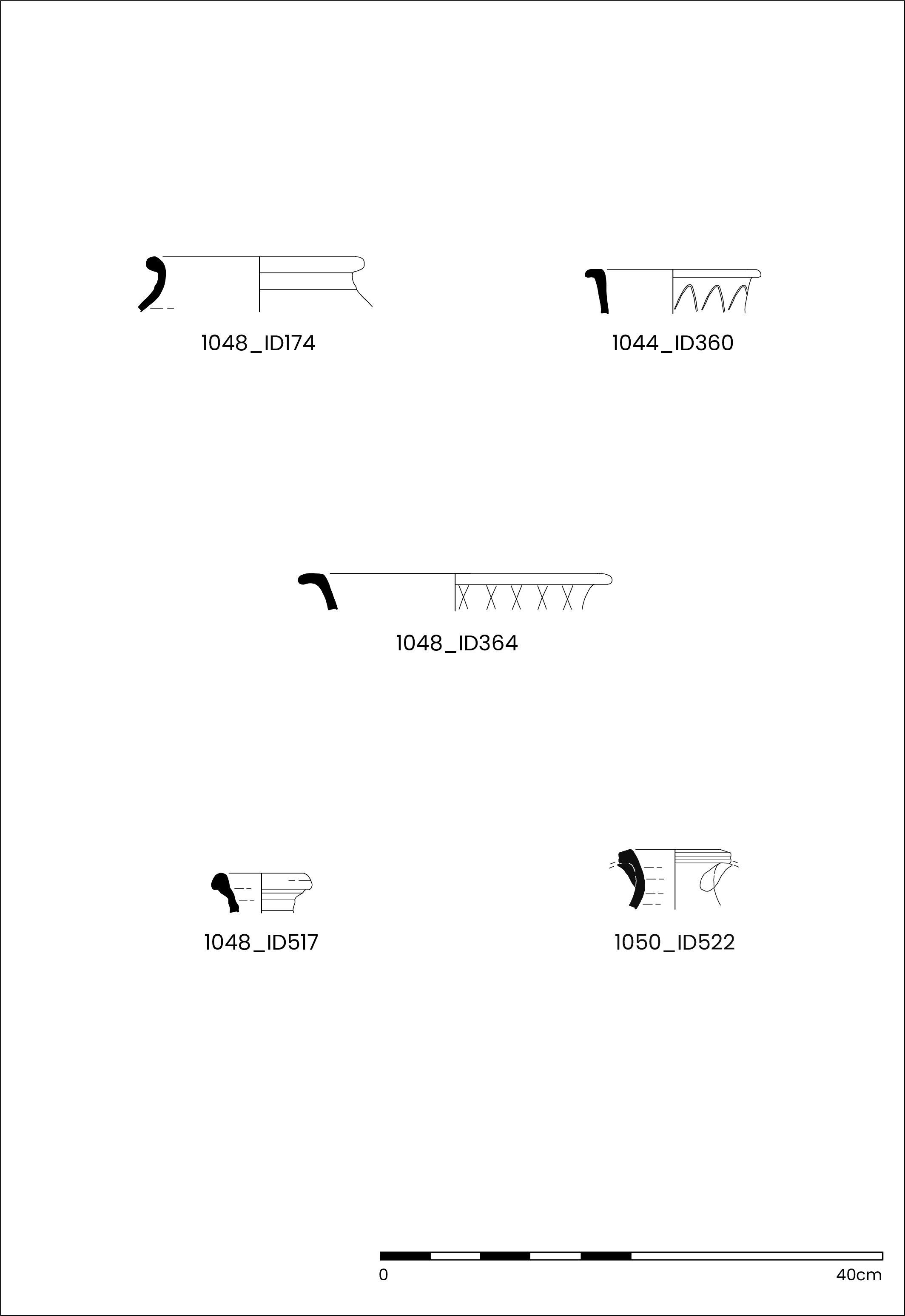
Pit [1046] contained a small quantity of pottery, five sherds in total. All the pottery were coarse wares and dated to the 2nd century CE. Vessel forms included an Ebor white-slipped flagon and flat-rimmed black-burnished ware dish (ID360, Figure 14) c. 120–200 CE).
Pit [1047] contained 15 sherds of pottery; these included two sherds of mortaria, one of which was an Ebor white-slipped vessel dating to the 2nd century CE, 13 sherds of coarse wares, mostly oxidised and reduced wares of 2nd century CE date, including two flagons and one jar. Three sherds of Derbyshire-type coarse ware jar were present, dating from approximately the middle of the 2nd century CE and later. A single sherd of an East Yorkshire reduced burnished ware was present, dating to the later 2nd century CE; however, dating is not fully understood for these wares (see above and Monaghan 1997, 900–1). Other coarse wares included a black-burnished ware 1 plain rimmed bowl (ID364, Figure 14, 2nd century CE), and a white ware flagon.
Pit [1049] contained seven sherds of pottery; these included a large fragment (368g) of a Catterick vicinity mortarium (c. 130–180 CE), two sherds of Gaulish amphorae, an Ebor ware flagon (2nd century CE), a reduced ware jar, and a sherd of a rusticated jar of late 1st to early 2nd century CE date.
This group of features and deposits relates to dumping deposits (1043), (1042), and (1041) and the cutting of pit [1040]. The deposits were laid down in order: (1043), (1042), and (1041), with pit [1040] cut through (1041) (Badger and Savine 2023, 8).
Clay deposit (1043) — Pottery date range: mostly 2nd to 3rd century CE, but some intrusive late 3rd, 4th century CE, plus one medieval sherd
A large group of pottery was recovered from this deposit, consisting of 155 sherds of mostly 2nd to 3rd century CE pottery, with small quantities of possibly intrusive late 3rd to 4th (Crambeck reduced ware) and 4th century CE material (Crambeck white ware flagons), and a single sherd dating to the medieval period. The assemblage contained four body sherds of Baetican amphorae. In addition, there were 11 sherds of mortaria (Verulamium region, Catterick vicinity, and Ebor fabrics), none of which dated later than the end of the 2nd century CE. Twenty-four sherds of fine table wares were recovered, most of which were samian wares (South, Central and East Gaulish fabrics), and a single sherd of white ware. The samian wares were mostly of South Gaulish origin, in a range of forms including cups, bowls, and dishes, mostly dating no later than the early 2nd century CE but there were two vessels (Dr27g cup and Dr15/17 dish) that may be earlier, as the types tend not to date later than around 90 CE. In addition to the South Gaulish samian, there were two sherds of Central Gaulish origin dating to the 2nd century CE, and three sherds of East Gaulish origin, which included a cup, and a Dr31R bowl, dating from around 160 CE to the middle of the 3rd century CE. The bulk of the assemblage from this deposit consisted of coarse wares, most dating to the 2nd/early 3rd century CE, and included hemispherical bowls (form BH1), dishes, white-slipped ware flagons, and jars.
Silt deposit (1042) — Pottery date range: 2nd to 3rd century CE; likely date of deposition late 2nd to 3rd century CE
In total, 139 sherds of pottery were recovered from this deposit, mostly dating to the 2nd and 3rd centuries CE, with many vessels dating from the mid-2nd century CE. The latest material included Dales-Type ware dating from the end of the 2nd century until the 4th century CE and reduced burnished wares of East Yorkshire origin (e.g. the Holme-on-Spalding Moor region), of late 2nd to 4th century CE date. There were two sherds of amphorae, one of unidentified source, the other produced in North Africa; vessels in these (North African) fabrics were used to transport a variety of commodities, including olive oil (Bonifay in University of Southampton 2014), and perhaps wine and fish-based products (Bonifay and Keay in University of Southampton 2014) from the middle of the 2nd century CE. The remains of two mortaria were also recovered from this deposit, both produced in the Verulamium region in the 1st and 2nd centuries CE. Twenty-eight sherds of fine table wares were recovered, most of which were samian wares (South, Central and East Gaulish fabrics), along with the remains of two beakers in Lower Nene Valley colour-coated wares, one base sherd of mid-2nd to 4th century CE date, the other with a cornice rim (form KC) dating from the late 2nd to early 3rd century CE. The samian wares consisted of five sherds of South Gaulish origin (late 1st to early 2nd century CE) but were mostly of Central Gaulish origin (16 sherds), in a range of forms including a cup, bowls, and dishes, dating to the 2nd century CE, many from the middle of the century. Other samian ware included five sherds of East Gaulish origin, including a cup, a bowl, and two dishes, mostly of mid-2nd to mid-3rd century CE date. However, overall, the majority of the assemblage from this deposit consisted of coarse wares, most dating to the 2nd/early 3rd century CE, which included hemispherical bowls (form BH1), dishes, white-slipped ware flagons, and jars.
Silt deposit (1041) — Pottery date range 2nd and 3rd century CE; likely date of deposition late 2nd to 3rd century CE
In total, 70 sherds were recovered from this deposit, mostly dating to the 2nd century CE, but with some late 1st to early 2nd century CE rusticated wares and a legionary-type jar. Pottery dating from the later 2nd and 3rd centuries CE consisted of a samian ware bowl (Dr31R type), an oxidised ware beaker (KA2 type), and East Yorkshire reduced wares from the Holme-on-Spalding Moor region including a Throlam-type deep bowl/jar dating to the 3rd century CE. There were two sherds of Baetican olive oil amphorae and a single sherd of a mortarium from the Verulamium region. Ten sherds of fine wares were recovered, mostly samian ware (seven sherds), including a single sherd of South Gaulish ware (residual in this phase), four sherds of Central Gaulish ware, including two bowls and a dish, and two sherds of East Gaulish material, including a Dr31R bowl. The remaining fine wares were three sherds of a roughcast colour-coated beaker of unknown source, likely dating to the first half of the 2nd century CE. Coarse wares formed the bulk of this group of pottery, including black-burnished ware bowls (2nd century CE) and a jar, oxidised wares, including a red painted bowl (2nd century CE), a beaker, two lids, and at least six oxidised white-slipped flagons dating to the 2nd century CE. The reduced wares were mostly jars, as well as a 3rd century CE Throlam-type bowl (Monaghan 1997, 1007).
Pit [1040] — Pottery date range: mostly 2nd and 3rd century CE; likely date of deposition late 2nd to 3rd century CE
In total, 63 sherds were recovered from this feature, dating throughout the Romano-British period. Pottery dating from the late 1st century CE and into the first half of the 2nd century CE included a South Gaulish samian cup (Dr27) and two rusticated ware jars. The bulk of the pottery dated to the 2nd century CE and were mostly Ebor coarse wares, but also included four sherds of Central Gaulish samian ware and two other beakers that were continental imports, one in a Cologne roughcast colour-coated ware and the other in a Rhineland roughcast colour-coated beaker. East Yorkshire reduced ware dating from the late 2nd/early 3rd century CE was present, albeit in small quantities (three sherds), and material dating from the late 3rd to 4th century CE, namely Crambeck reduced wares, was present (three sherds), but likely intrusive from later phases of activity.
Dump deposit (1020)/(1021), possible landscaping or dumping — Pottery date range: Late 2nd to 3rd century CE
In total, 66 sherds were recovered from this feature, mostly dating to the 2nd century CE but with small quantities of 3rd century CE material. One body sherd of a Baetican olive oil amphora was recovered, along with eight sherds of samian ware, six from Central Gaul (2nd century CE) and two from Eastern Gaul (mid-2nd to mid-3rd century CE). Other fine wares included a 2nd century CE Cologne roughcast beaker and a Lower Nene Valley colour-coated ware 'hunt cup', dating from the late 2nd to early 3rd century CE. Coarse ware pottery formed the bulk of this group, mostly jars, flagons and bowls (including a red painted ware bowl dating to the 2nd century CE). The later 2nd/3rd century CE coarse wares included a small quantity (three sherds) of East York burnished wares.
Pits [1036] and [1038]
The earliest pits were [1036] and [1038]. Ten sherds of pottery were recovered from pit [1036], most of which dated to the 2nd century CE; however, there were two sherds of late 2nd/early 3rd century CE or later East Yorkshire reduced burnished wares, including a jar (Leary 2021, 64, type JC9), which dated to the 3rd century CE. In total, 42 sherds were recovered from the fill of pit [1038], consisting of two sherds of Gaulish wine amphorae, two sherds of mortaria, one from the Verulamium region of late 1st to 2nd century CE date, the other a sherd produced in the Mancetter-Harshill kilns between the middle of the 2nd and end of the 3rd century CE. The bulk of the coarse wares were in Ebor fabrics and mostly 2nd century CE; however, there were also four body sherds of black-burnished ware 2-types, which date up to the middle of the 3rd century CE. In addition, there was the rim of a black-burnished ware 1 (DOR BB 1, Tomber and Dore 1998, 127) dish or bowl, a type that dates from the mid-2nd until the late 3rd century CE. Other late 2nd/3rd century CE pottery included three sherds of East Yorkshire reduced burnished wares.
Pit [1030]
Nine sherds were recovered from the fill of pit [1030], eight of which dated to the 2nd century CE and one East Yorkshire reduced burnished sherd of a later 2nd/3rd to 4th centuries CE date.
Pit [1026]
Sixteen sherds were recovered from the fill of pit [1026], including two sherds of Baetican olive oil amphorae, two sherds of fine ware including a sherd of a 2nd century CE Central Gaulish samian ware dish (Dr18/31R), a sherd of Lower Nene Valley colour-coated ware (mid-2nd to 4th century CE). There were 12 sherds of coarse wares, mostly 2nd century CE material; however, also present were a rim of a 3rd century CE handled jar and a body sherd of Crambeck Reduced ware dating from the late 3rd to 4th century CE.
Pit [1028] — cuts both pits [1036] and [1038]
Pit [1028] was the largest pit excavated and contained the greatest assemblage of pottery from the Phase 4 pits, a total of 203 sherds. The pottery recovered included four body sherds of Baetican olive oil amphorae, five sherds of Gaulish amphorae, mostly for transporting wine, and a large rim and neck sherd of a Dressel 7 type of southern Spanish origin (Williams pers. comm.), dating to the final quarter of the 1st century CE. In addition, five sherds of mortaria were recovered from sources including the Verulamium region, Mancetter-Hartshill and Cantley, plus two sherds of Central Gaulish samian ware mortaria (Dr45), dating from approximately 170 CE into the early 3rd century CE. There was a relatively large assemblage of fine wares, 39 sherds, of which 31 were samian wares. There were three sherds of South Gaulish samian, including two cups and a dish; these were residual in this deposit. In addition, there were 16 sherds of Central Gaulish origin, including bowls (Dr30, Dr37, Dr38, and Dr31R), a cup of uncertain form, and a dish and dish/bowls of uncertain forms; these were mostly of 2nd century CE date, with the Dr31R type dating from the middle of the century. There were 12 sherds of East Gaulish samian, including bowls (Dr30 and Dr31R, both mid-2nd to mid-3rd century CE in date), two Dr33 cups and a Dr31 dish, all dating from the mid-2nd to mid-3rd centuries CE. Other fine wares included six sherds (body and base) of Lower Nene Valley colour-coated ware beakers, dating from the mid-2nd to 4th centuries CE, a white ware beaker of uncertain source and date, and an early 2nd century CE roughcast colour-coated beaker. Coarse wares formed the largest component within this deposit, including a range of 2nd century CE Ebor products. Also recovered were black-burnished ware 2-types, dating from the mid-2nd to mid-3rd century CE, black-burnished ware 1 types including a beaker/small jar dating from the late 2nd to early 3rd century CE, and bowls including a type DG1 (2nd century CE), 'pie dish' types DP1 (2nd century CE) and DP5s (mid-2nd to late 3rd century CE date), and everted rim jars. Other coarse ware types of note were two 'African'-style dishes dating from the mid-2nd to the late 3rd century CE, two Dales-type jars of late 2nd to late 4th century CE date, and East Yorkshire reduced burnished ware dish, bowl, and jar remains of 3rd century CE and later date, and three body sherds of Crambeck Reduced ware dating from the late 3rd to 4th century CE. Also found in this pit were four sherds of medieval pottery, likely intrusive in the deposit from later activity/disturbance.
Silty deposit (1024)
The earliest context in this phase contained 20 sherds of pottery, including small quantities of amphorae (Campanian and Baetican), samian ware, a single sherd of Lower Nene Valley colour-coated ware, and coarse wares. The pottery mostly dated to the 2nd and early 3rd centuries CE, but also included a body sherd of Crambeck reduced ware (270–400 CE), and Crambeck white ware beaker or small jar (4th century CE). The deposit was truncated by a medieval pit in the south corner of Trench 1.
Cobble layer/deposit (1017)
Cobble layer/deposit (1017) overlay (1024), and 111 sherds were recovered, along with Roman period ceramic building material including brick, tegula, and imbrex. The pottery recovered was a relatively large group, and included 25 sherds of amphorae, including Baetican (two sherds), Gaulish (four sherds), and 17 sherds of Campanian 'black sand' amphorae, used to transport wine and dating no later than the end of the 1st century CE. Two sherds of unidentified amphorae were also recovered. Fine wares included nine sherds of samian ware: one sherd from South Gaul (residual in this deposit), seven sherds of Central Gaulish material (2nd century CE), and one sherd of an East Gaulish samian beaker (2nd to mid-3rd century CE). Other fine wares included Lower Nene Valley colour-coated ware (11 sherds), mostly beaker sherds dating from the middle of the 2nd to the 4th century CE. Four sherds of mortaria were recovered, including two in North Gaulish ware (early Roman) and two from the Mancetter-Hartshill region (2nd to 4th century CE). Coarse wares formed the largest proportion of pottery and mostly consisted of 2nd to 3rd century CE material, including a black-burnished ware 2-type dish (DP5, mid-2nd to 3rd century CE) and reduced ware bowl/dish (DP5, mid-2nd to 3rd century CE), and a reduced burnished ware jar of similar date. Other coarse wares included late 2nd/3rd century CE and later East Yorkshire reduced burnished ware body sherds. In addition, there was a single sherd of medieval pottery, indicating later disturbance in this part of the site.
Silty clay deposit (1014)
In total, 60 sherds of pottery were recovered from this deposit. The pottery consisted of large quantities of amphorae, including 46 sherds of Campanian Dressel 2–4 wine amphorae, 43 sherds of CAM AM1 ('Black sand', Tomber and Dore 1998, 88) and three sherds of CAM AM2 (Northern Campanian; Tomber and Dore 1998, 89), parts of two vessels; these types of amphorae date to the 1st century CE and were residual in this phase. Other amphorae included one sherd of Baetican and one sherd of Gaulish origin. A single sherd of a samian mortarium was recovered, of Central Gaulish origin and dating from the late 2nd to early 3rd century CE. A small quantity of fine wares was recovered, including six body sherds of Lower Nene Valley colour-coated ware dating from the mid-2nd to 4th centuries CE; a single body sherd of an East Gaulish bowl was also recovered. Only four sherds of coarse wares were recovered, including two reduced wares and two black-burnished ware 2-type.
Clay deposit (1019)
A large group of pottery was recovered from this deposit, comprising some 264 sherds. This was a large group with pottery from the 1st to late 3rd/4th century CE. There was a large quantity of amphorae, some 205 sherds, including two sherds of Baetican (BAT AM 1, Tomber and Dore 1998, 84), and 24 body sherds (3022.9g) of a single vessel in a finer Baetican fabric (BAT AM2, Tomber and Dore 1998, 85), dating from the 2nd to early 3rd century CE; in addition, there were seven sherds (parts of two vessels) of Gaulish wine amphorae. Of particular interest was the large quantity of 1st century CE Campanian wine amphorae, some 172 sherds weighing 12807.2g, the remains of two vessels of Dressel 2–4 type (CAM AM1 and CAM AM2 fabrics), likely parts of the same vessels recovered from deposit C1014, directly below this deposit. Twenty-six sherds of fine wares were recovered, including nine sherds of Central Gaulish samian dating to the 2nd century CE, and residual in this phase, and seven sherds of East Gaulish samian, mostly dating from the mid-2nd to mid-3rd centuries CE. Other fine wares included 10 sherds of Lower Nene Valley colour-coated wares, including beakers and a Castor box, all dating from the middle of the 2nd century CE. The coarse wares formed a small proportion of this group of pottery, with only 32 sherds, and included 2nd to 3rd century CE material (including a black-burnished ware 1 bowl and jar, both dating to the 3rd century CE); later dating material included a single sherd of East Yorkshire calcite-gritted ware of 3rd to 4th century CE date (and later), and two body sherds of Crambeck reduced ware dating from the late 3rd to 4th century CE.
Ploughsoil (1006)/(1007)
The final deposits relating to 4th century CE activity were (1006) and (1007). In total, 52 sherds were recovered, 42 from (1006) and 10 from (1007). The 42 sherds recovered from (1006) included numerous residual sherds and two intrusive medieval sherds; residual sherds included South, Central, and East Gaulish samian ware bowls and dishes of late 1st to 2nd century CE date, and black-burnished and reduced ware jars of a similar date range. Other wares included Baetican and Campanian amphorae, all residual; the remains of three samian ware vessels, two bowls and a mortarium, all dating up to the middle of the 3rd century CE. Other fine wares included numerous Lower Nene Valley Colour-coated ware beakers, some potentially dating to the 4th century CE. Coarse wares included reduced table wares dating as late as the 3rd century CE, and undiagnostic black-burnished wares from south-west England that date as late as the 4th century CE. Finally, the latest dating vessel was a proto-Huntcliff jar dating to the 4th century CE. The 10 sherds recovered from (1007) included two sherds of Central Gaulish samian, dating to the second half of the 2nd century CE (residual in this phase), two sherds of Lower Nene Valley colour-coated ware including two beaker sherds, one of which was the rim of a beaker dating to the 3rd century CE. In addition, there were three sherds of black-burnished ware dating to the 2nd century CE (residual in phase), and three sherds of a Dales Shelly ware jar, dating from the end of the 2nd to the 4th century CE.
Functional analysis was undertaken (Table 8) following Evans (1993), with phase/chronological results compared with other sites in and around the centre of York, consisting of those considered by Monaghan (1993, 696; 1997, 855–9) and the more recent analysis of pottery from Guildhall (Griffiths and Britton 2023, table 17) of a comparable phase/period to Queen Street, which includes 35–41 Blossom Street, 1–9 Micklegate, Guildhall, 9 Blake Street (Monaghan 1993), 16–22 Coppergate, and Swinegate/Back Swinegate.
The results are presented by stratigraphic phase and broad chronological groups. Residual sherds were removed from the data for each phase prior to analysis, i.e. sherds considered intrusive in a phase were also removed. The assemblage quantification is based on EVEs (the sum of rim percentage values) and the relative proportions of each form (e.g. bowls, flagons etc) during each phase. The amphorae data has been removed owing to often limited quantities of rims compared to body sherds of the vessel type, and the vessel's function primarily as transportation for commodities. Where vessels of note were present, but no part of a rim was preserved, they are marked as '0.0%' in Table 8.
| Form | Phase 2 | Phase 3 | Phase 4 | P3/P4 combined | Phase 5 | Phase 6 |
|---|---|---|---|---|---|---|
| Cup | 8.4% | 1.7% | 6.5% | 0.7% | ||
| Beaker | 6.2% | 9.3% | 7.1% | 0.0% | 50.0% | |
| Beaker/Jar | 0.0% | 0.0% | 0.0% | |||
| Beaker/Small Jar | 0.6% | 0.4% | 10.5% | |||
| Bowl | 17.7% | 23.3% | 16.4% | 21.4% | 9.4% | 9.7% |
| Bowl/Dish | 12.9% | 14.6% | ||||
| Dish | 3.5% | 4.4% | 3.8% | 15.0% | 5.3% | |
| Dish/Bowl | ||||||
| Platter | 4.6% | 1.3% | ||||
| Flagon | 33.6% | 17.4% | 28.6% | 20.6% | 15.3% | |
| Jar/Flask | 2.4% | 1.7% | ||||
| Pitcher/Flask | ||||||
| Jar | 0.9% | 22.5% | 29.9% | 24.6% | 28.5% | 11.2% |
| Mortaria | 47.8% | 7.5% | 2.0% | 5.9% | 0.0% | 9.2% |
| Lid | 8.3% | 3.1% | 6.8% | 3.5% | ||
| Lid/Counter | ||||||
| Castor box | 4.2% | |||||
| Tazze | 0.0% | 0.0% | ||||
| Candlestick | 0.0% | |||||
| Uncertain | 0.1% | 0.1% | 0.0% | |||
| Grand Total | 100.0% | 100.0% | 100.0% | 100.0% | 100.0% | 100.0% |
| Grand Total (EVEs) | 113 | 883.5 | 350 | 1233.5 | 143.5 | 103 |
While there were significant quantities of late 1st to early 2nd century material present in the overall pottery assemblage, many of these early types, such as South Gaulish samian ware and large amounts of Italian and southern Spanish Dressel 2–4 amphorae sherds, were residual and redeposited in features associated with later phases of activity, dating from the later 2nd through to the 3rd and 4th centuries CE (Phases 3 to 6), and later Modern phases and within unstratified groups; few were present in Phase 2.
As is clear in Table 7, the stratified assemblage for Phase 2 was small (113 EVEs), therefore conclusions drawn from this analysis are tentative. Mortaria formed the greatest relative proportion at 47.8%; however, this was based on only three rim sherds. Flagons formed 33.6% of the assemblage, a relatively large proportion and similar to other sites in York, for example Micklegate, Phase 1 (29.0%), Guildhall, Period 2 (27.5%), Blake Street, Phase 2 (26.0%), and Swinegate Phases 3 (36.0%) and 4 (26.0%), but greater than Blossom Street, Phases 1 (18.0%) and 2 (16.0%). Bowls formed 17.7% of the assemblage – again, similar to some nearby sites, such as Micklegate, Phase 1 (15.0%) and Blake Street, Phase 3 (17.0%), but lower relative proportions than Blossom Street Phases 1 (25.0%) and 2 (22.0%), Guildhall, Phase 1 (20.4%), and Swinegate Phases 2 and 3, both with 28.0%. Jars formed 0.9% of the Queen Street assemblage, a very low level resulting from the very small assemblage size. Drinking vessels were absent in this phase, which was unusual as these types are often common in early Roman military settlements. However, there were quantities of early Roman drinking vessels residual in later phases.
The data for Queen Street Phases 3 and 4 are presented individually for each phase and also combined (Table 8). It was clear during analysis that the long date range for the pottery recovered from features associated with each phase, and the relatively small assemblage size for Phase 4, may influence (and bias) the data; all data for Phases 3 and 4 are presented individually for completeness, but then combined for use in this comparison.
At Queen Street (based on 1233.5 EVEs, Table 8), jars formed the largest relative proportion of vessels with 24.6%, with flagons forming 22.3%, bowls 21.4%, and dish/platters forming 5.1%; other forms included cups and beakers at 6.5% and 7.5% respectively, with lids forming 6.8% of the assemblage. Mortaria formed 5.9% of the assemblage. The relative proportion of drinking vessels (14.0%, cups and beakers) from this phase was mostly closely comparable with Micklegate Phase 3 (15.0%), but slightly lower than Phase 2 Micklegate (19.9%), and lower than at Guildhall Period 3 (19.8%). However, the proportion was greater than at the other sites considered. The proportion of flagons was relatively high at 20.6% when compared to the other sites in question, with only Guildhall Phase 3 having a higher figure of 31.1%. The proportion of bowls/dishes was slightly lower than at most other sites mentioned here, with Phases 2, 3 and 4 at Guildhall having 33.5%, 29.1% and 37.1% respectively, 33.0% at Blake Street, 31.0% at Coppergate, and 35.0% and 42.0% at Micklegate Phases 2 and 3 respectively; the proportion of bowls/dishes was greater than at nearby Blossom Street Phase 3, with 22.4%. The relative proportion of mortaria was 5.9% at Queen Street for this phase, slightly more than at most other sites considered, but similar to Micklegate Phase 2 with 5.7%.
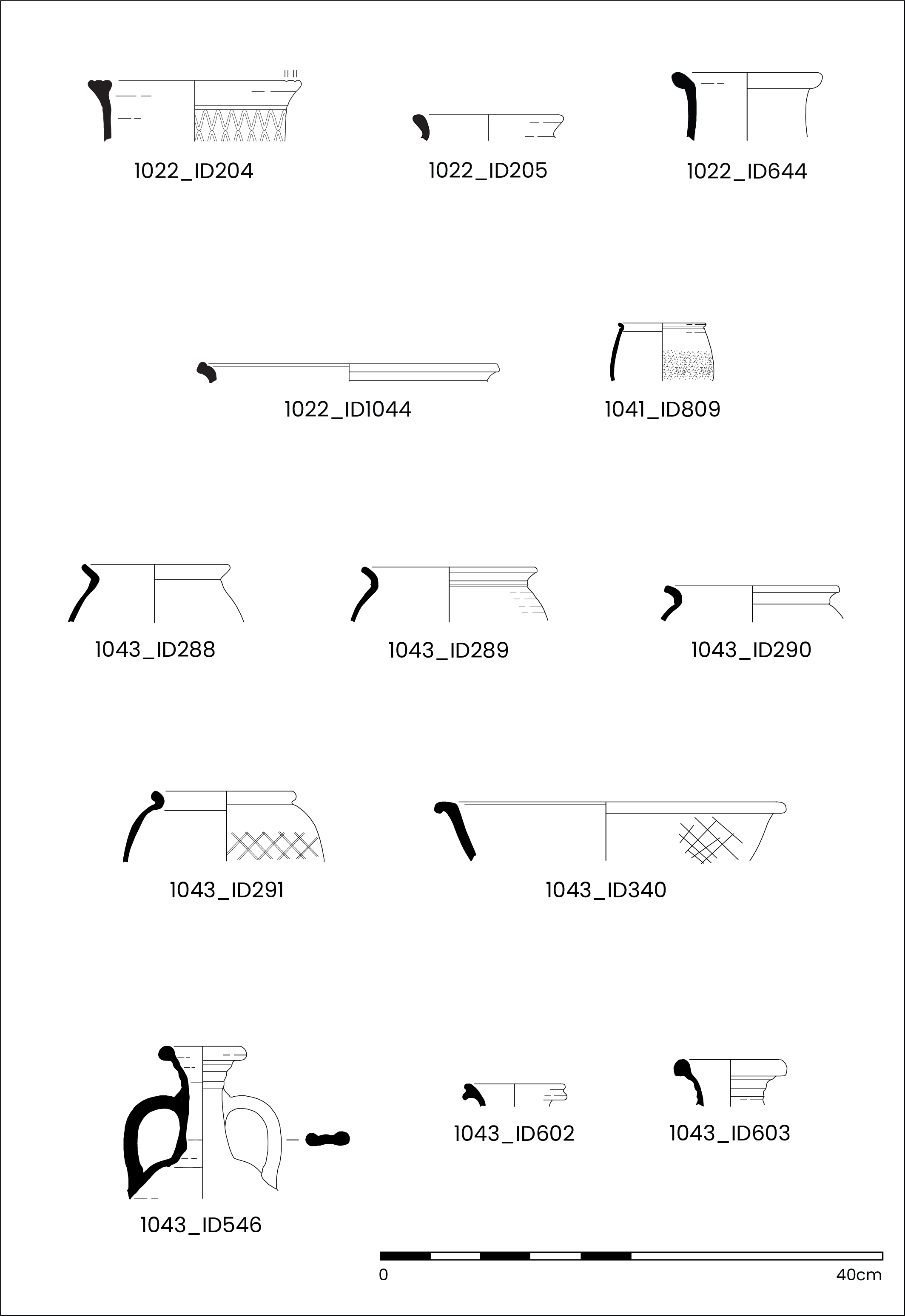
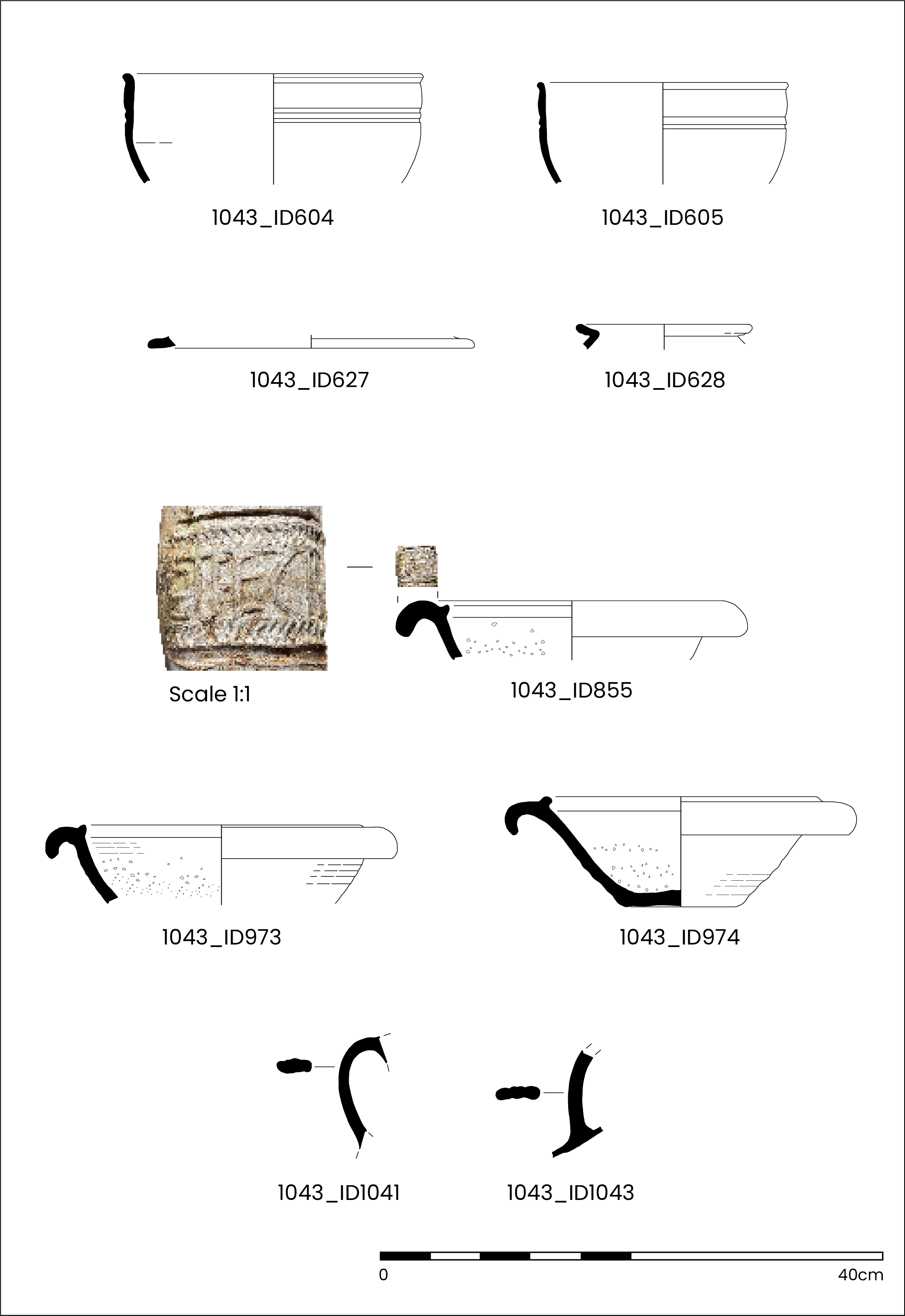
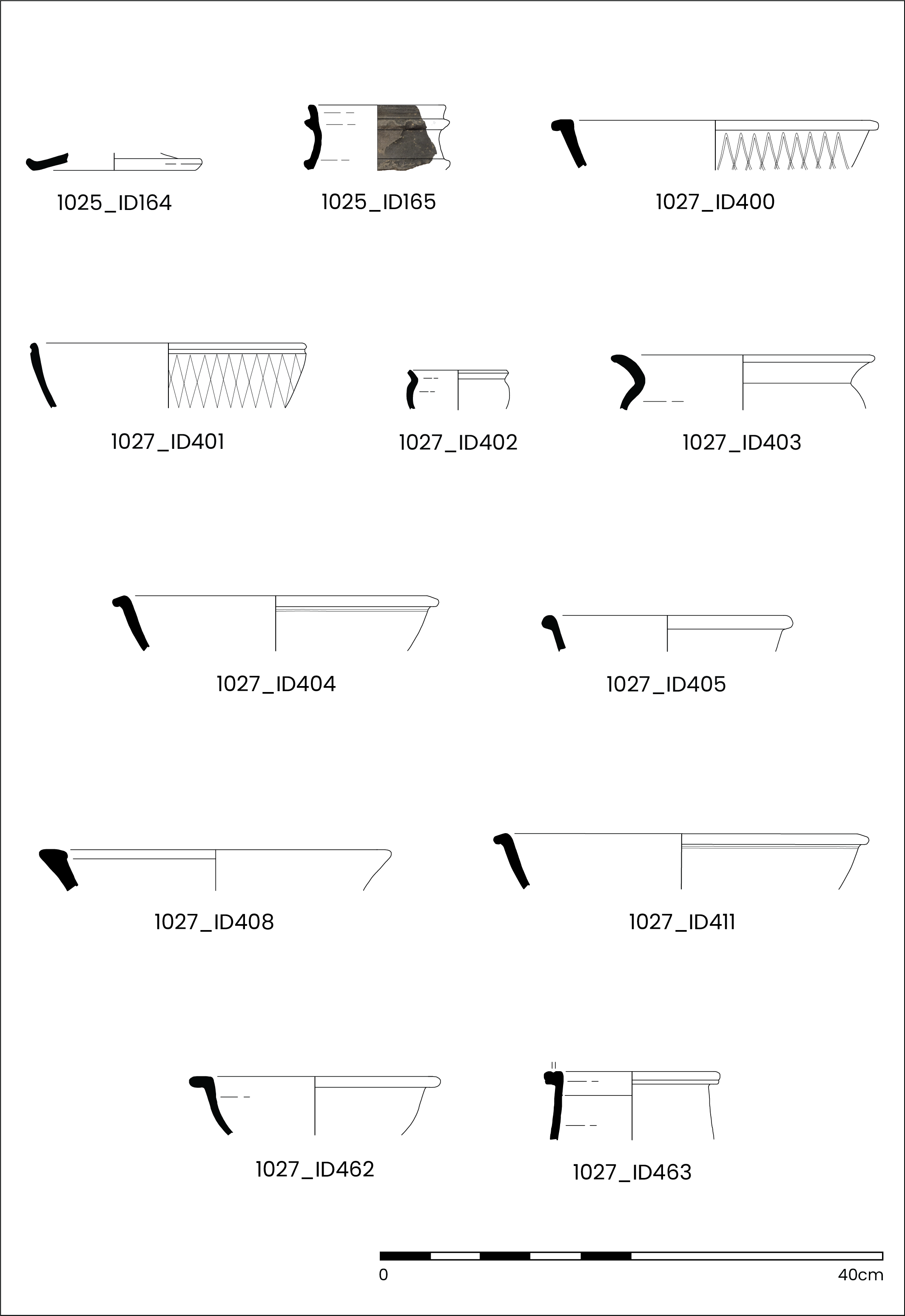
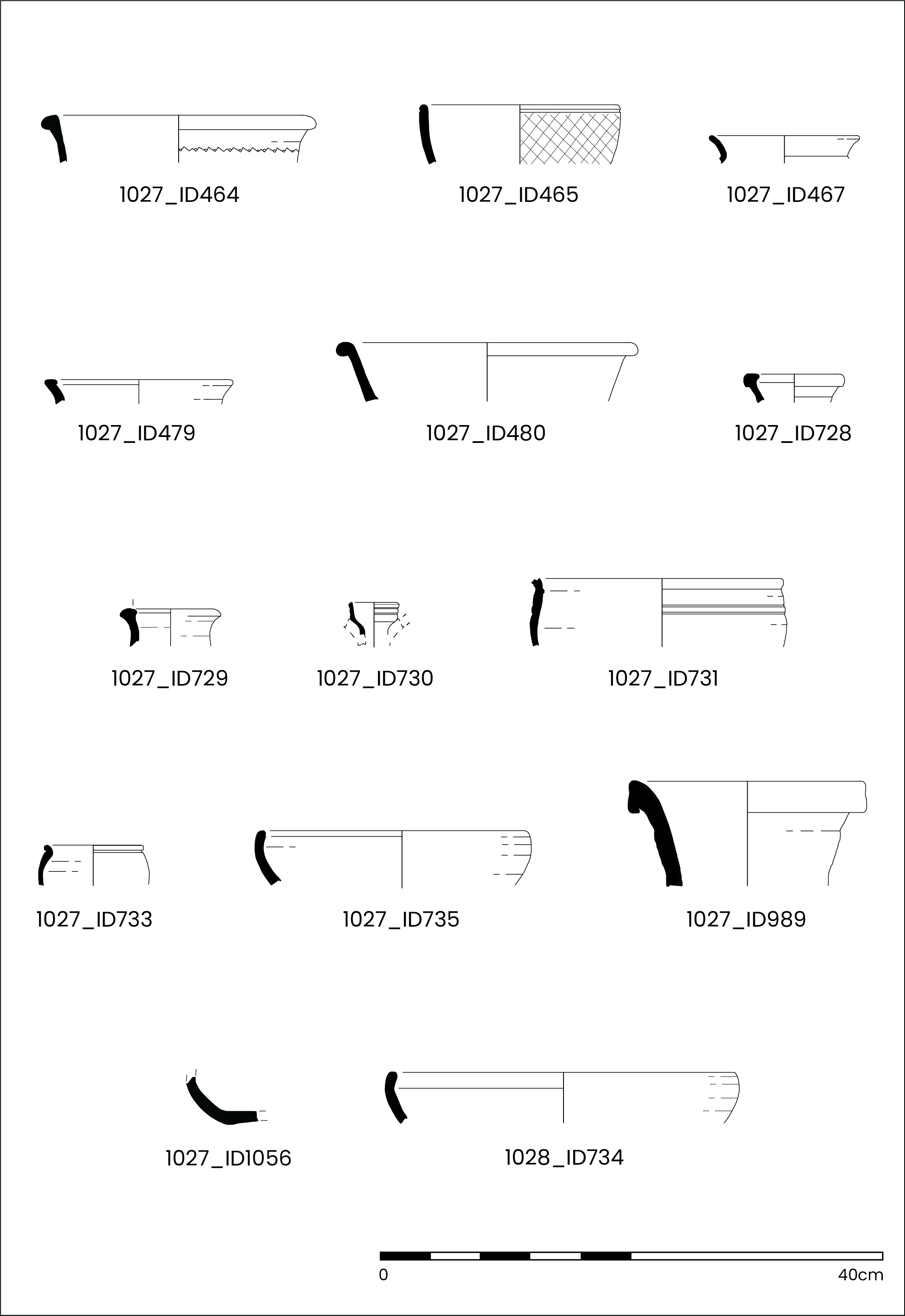
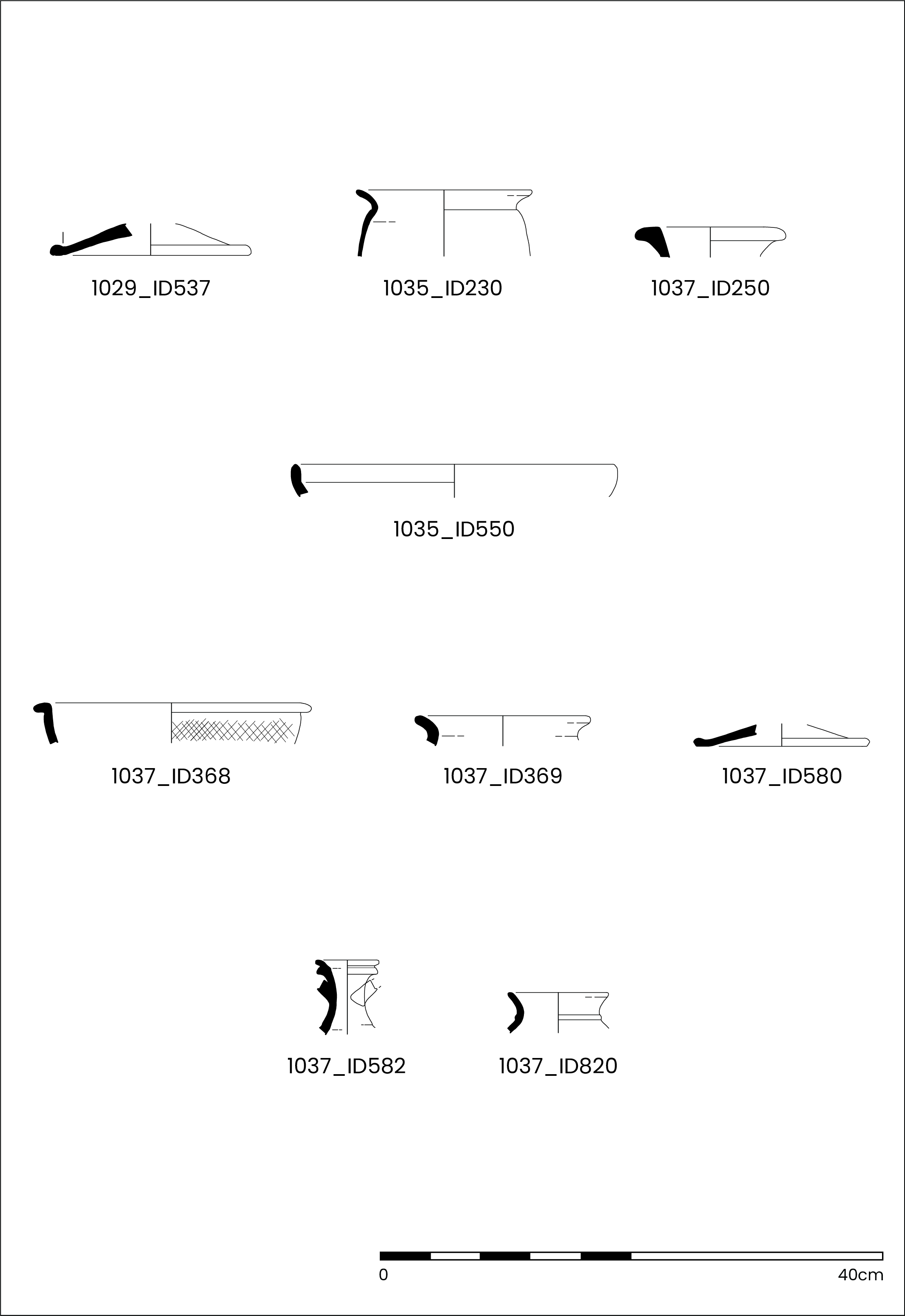
As with the data for the previous phase, the date range for the pottery assemblage was quite long and mostly dated to the 3rd century CE, with smaller quantities of later 3rd and 4th century CE material. In addition, the size of the assemblage considered for functional analysis was relatively small, 143.5 EVEs (Table 8). Jars formed the greatest proportion during this phase, with 28.5%, which was a relatively low level compare with Blake Street Phase 4b with 39.0%, Coppergate Phase 1/4 38.0%, Blossom Street Phase 4 with 25.0%, and Micklegate Phase 4 with 19.0%. The relative proportion of drinking vessels, cups and beakers, was 11.2%, mostly represented by vessels produced in the Lower Nene Valley region, but also including a 4th century CE Crambeck White ware beaker, which may or may not be contemporary with the Nene Valley wares in this phase. The relative proportion of drinking vessels at Queen Street was similar to the other sites considered here, with Micklegate Phase 4 having slightly more at 16.5%, Coppergate, Phase 1/4 at 11.9%, Blake Street Phase 4b at 8.0%, and Blossom Street with a much lower proportion at 3.4%. The level of flagons at Queen Street in this phase, at 15.3%, was slightly greater than at some other sites considered here; Blake Street Phase 4b with 12.0%, Coppergate Phase 1/4 with 11.0%, Micklegate, Phase 4 with 10.0%, but much lower than the high proportion of flagons at Blossom Street, Period 4, with 34.0%. The relative proportion of bowls/dishes at Queen Street, 37.3% was broadly comparable with Blake Street, Phase 4b at 32.0%, but slightly lower than the 44.0% at Micklegate Phase 4, and higher than Blossom Street Phase 4 with 25.3% and Coppergate Phase 1/4 with 23.0%. While there were sherds of mortaria recovered from this phase, no rims were preserved.
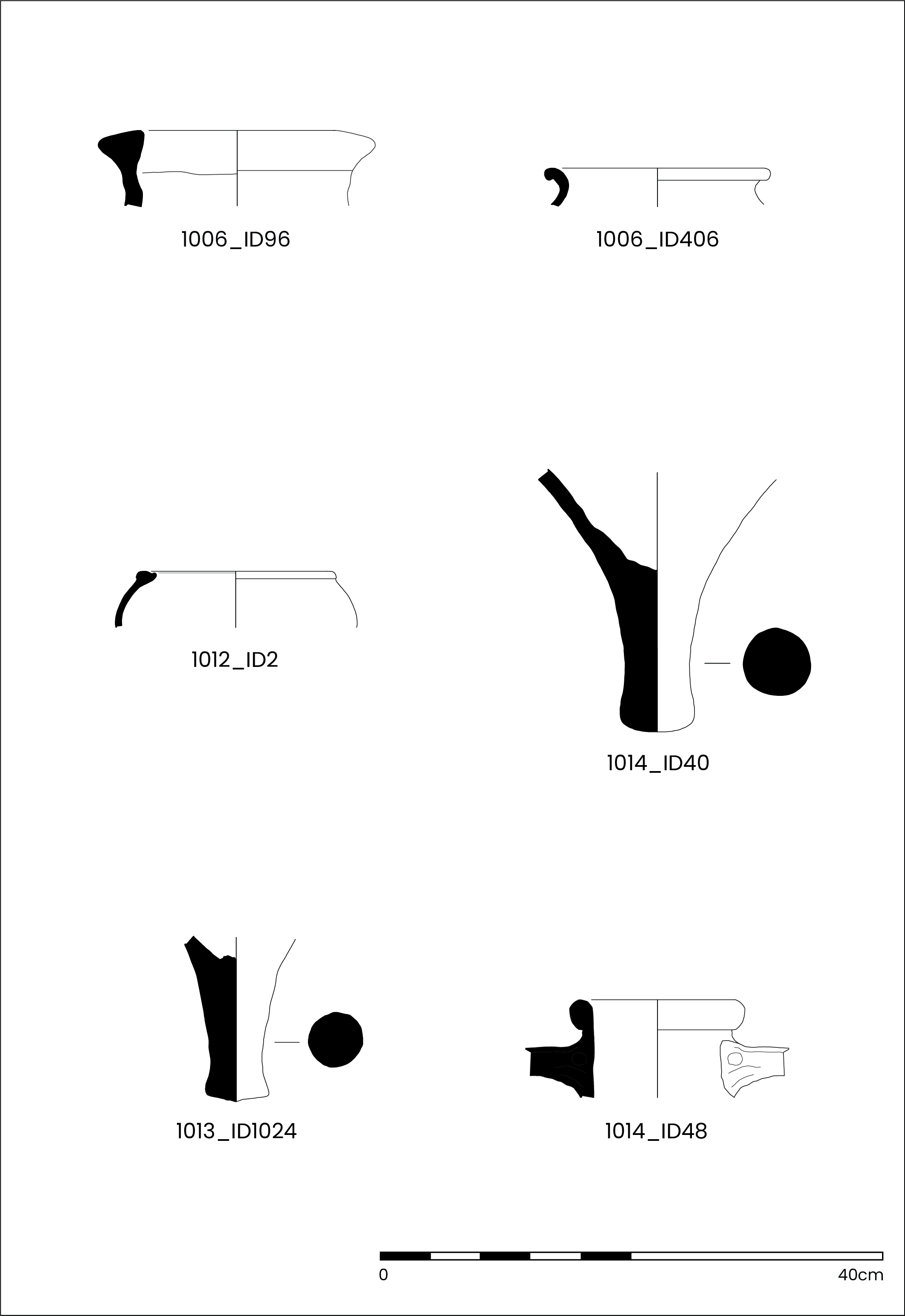
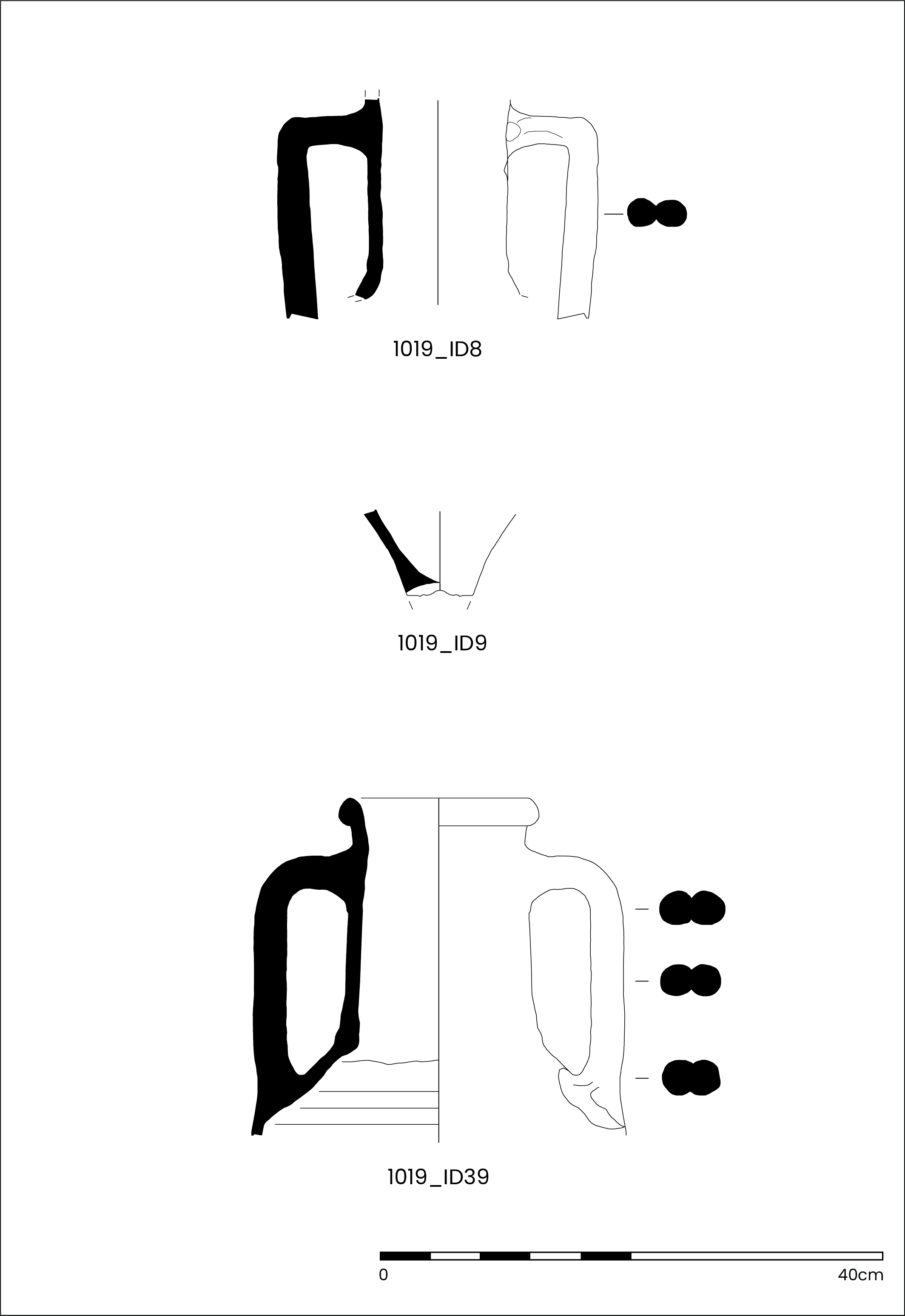
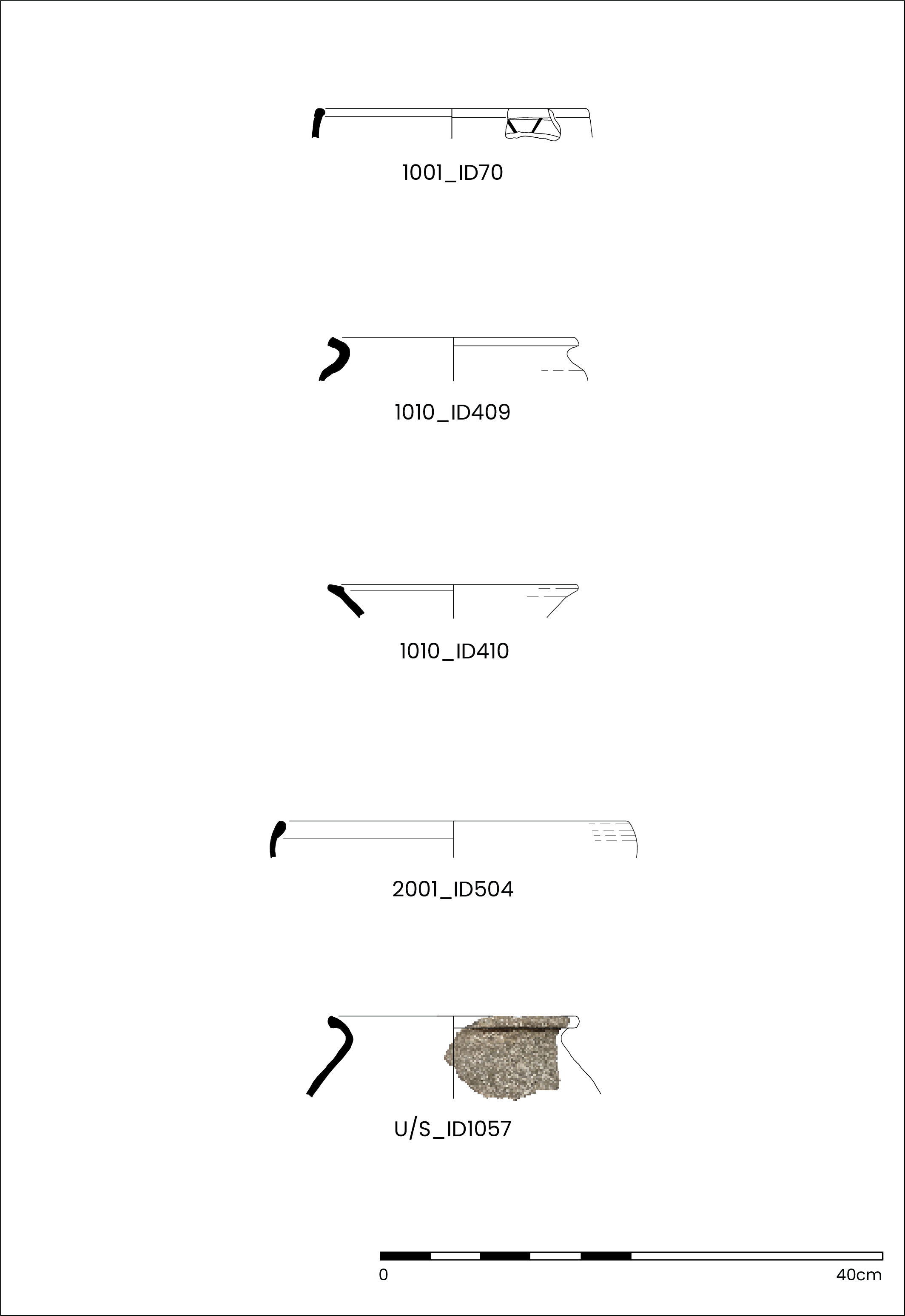
As for Phase 4, above, the date range for the pottery assemblage was quite long and included 2nd and 3rd century CE material, with smaller quantities of later 3rd and 4th century CE pottery. In addition, the size of the assemblage considered for functional analysis was small, 103.0 EVEs (Table 8), and any conclusions are limited. Jars formed a relatively small proportion during this phase, with 11.2%, which was much lower than other sites of similar date (Blake Street Phase 4b with 39.0%, Coppergate Phase 1/4 38.0%, Blossom Street Phase 4 with 25.0%, and Micklegate Phase 4 with 19.0%). The relative proportion of drinking vessels, cups and beakers, was high at 50.0%, and all vessels were made in the Lower Nene Valley region. The relative proportion of drinking vessels at Queen Street was greater than at other sites considered here, however, this was due to the small sample size, with Micklegate Phase 4 having 16.5%, Coppergate, Phase 1/4 at 11.9%, Blake Street Phase 4b at 8.0%, and Blossom Street with a much lower proportion at 3.4%. There were no flagons present in this phase. The relative proportion of bowls/dishes at Queen Street, 29.6% was broadly comparable with Blake Street, Phase 4b at 32.0%, but slightly lower than the 44.0% at Micklegate Phase 4, and higher than Blossom Street Phase 4 with 25.3% and Coppergate Phase 1/4 with 23.0%. The relative proportion of mortaria was 9.2%, more than at similarly dated deposits from Blake Street Phase 4b with 3.0%, Micklegate Phase 4 with 2.4%, Coppergate Phase 1/4 with 5.9%, and Blossom Street Phase 4 with 2.7%.
The pottery assemblage recovered from Queen Street had been heavily disturbed over the past two millennia, with high levels of residuality, for example the occurrence of many sherds of pottery vessels dating to the late 1st century CE, such as South Gaulish samian ware (and some early types of Central Gaulish products) and grey rusticated wares of late 1st to early 2nd century CE, present in later phases of activity. Given the high levels of disturbance and heavily mixed pottery spread throughout the phases of activity at Queen Street, detailed analysis by phase would not prove fruitful. However, the pottery assemblage is considered as a whole and discussed in general terms of chronological periods of production and supply to the site, but without statistical analysis for specific wares by phase.
The pottery assemblage of the late 1st to early 2nd century CE (at least 323 sherds) formed around one fifth of the overall assemblage. The bulk of this pottery consisted of 248 amphorae sherds, and all but two of these were Dressel 2–4 types of Campanian origin, and these sherds probably came from just two vessels (two fabrics were recovered, BAT AM1 ('black sand') and BAT AM2 (Northern Campanian)). Other early Roman amphorae included one fragment of Dressel 2–4 type of uncertain source, but possibly from Gaul; these types were used to transport wine and likely date to the 1st century CE (University of Southampton 2014). Finally, the remaining amphorae vessel was a Dressel 7 type of southern Spanish origin, and of later 1st century CE date, originally used to transport fish-sauce or salted fish (Martin-Kilcher 2003, fig. 1a; Lagóstena in University of Southampton 2014; Gonzalez Cesteros and de Almeida 2017). The original contents of these amphorae were high-value and exotic foodstuffs in the 1st century and early 2nd century CE and reflect the major military and civilian settlement at York during this period. The early Roman fine wares consisted predominantly of South Gaulish samian ware, including drinking vessels, mostly cups, bowls (decorated and undecorated), and dishes. Early 2nd century CE samian ware included small quantities (three sherds) of Central Gaulish samian (a dish and a bowl). Where it was possible to identify reliable early Roman dates for coarse ware types (i.e., production of Ebor wares likely began quickly after the establishment of the military centre at York), most were rusticated jars, with small quantities of legionary-type jars, an early oxidised ware flagon, and a reduced ware legionary style reeded rim bowl. Finally, there were two sherds of likely early Roman period mortaria produced in northern Gaul.
The bulk of the 1st century CE amphorae sherds, some 235 sherds, were found in three deposits, (1014), (1017) and (1019), all associated with Phase 5 activity. The amphorae vessels may have been reused for storage at or near the site, perhaps over many decades, and once broken may have been used as hard-core (along with other material) to form a levelling layer. While there was late 1st to early 2nd century CE pottery present in the assemblage, the number of vessels represented was small when considering that 246 sherds of amphorae were likely from only two vessels. There were more, fine table wares present than coarse wares, with only very small quantities of early Roman period legionary types (e.g. jars and reeded rim bowls). Owing to the small assemblage and high levels of residuality, it was difficult to consider the wealth and social status of the individuals who lived and worked at or nearby the site, and/or the range of activities and function of site or immediate area, beyond the use of the area for rubbish disposal. However, there is clear evidence for high status supply of exotic foodstuffs transported by amphorae, and dining, with the use of fine, glossy samian table wares.
This was the largest group of pottery with many wares and forms having long date ranges, and difficult to group into phases given the heavily disturbed nature of the deposits at the site. The amphorae dating to this period included mostly Baetican Dressel 20s body sherds and Gaulish body sherds, both types dating broadly from the 1st to 3rd century CE; a single body sherd of a North African amphorae was also recovered, which fits into this date range with imports to Britain starting around the middle of the 2nd century CE. Most of the fine table ware types fit into two broad periods, either the 2nd century CE or around the middle of the 2nd to the middle of the 3rd century CE. It seems there was a regular supply of Central Gaulish samian during the 2nd century CE, with small quantities of beakers from the Cologne region, a Rhineland roughcast beaker, and a single sherd of Central Gaulish Black-slipped ware, together with other unsourced vessels in roughcast colour-coated wares and white wares. Mortaria of 2nd century CE were present, including Catterick Vicinity White ware, Ebor ware, and Verulamium region white ware. Second-century CE coarse wares are more problematic, with long date ranges for many of the wares, and an uncertain end-date in the 3rd century CE for the production of Ebor pottery in and around York (which began in the late 1st century CE). However, where form was identified, this allowed for more reliable dating, and there was a large group of vessels dating no later than the end of the 2nd century CE. These included black-burnished ware bowls and dishes dating to the 2nd century CE, and a bowl, beaker/small jar, and jars dating to the second half of the century. Oxidised wares with robust 2nd century CE dating were mostly Ebor types, including a large quantity of white-slipped flagons, hemispherical bowls, both plain and red-painted, beakers, a white-slipped jar, and three tazze. However, it must be noted that some Ebor wares were produced into the 3rd century CE. The quantity of securely dated 2nd century CE reduced wares was small, with some perhaps dating into the early 3rd century CE; vessel forms included a flagon, bowls, a dish, jars, and a lid. As with the oxidised wares, there were relatively large quantities of reduced wares that may have dated well into the 3rd century CE.
Fine wares dating from the mid- to late 2nd to 3rd or 4th century CE formed a large group, including East Gaulish samian ware bowls, dishes and cups, two 'Moselkeramik' (Trier) beakers of late 2nd to mid-3rd century CE date, and a large quantity of Lower Nene Valley colour-coated wares, including vessels of mid-2nd to early 3rd century CE, plain rimmed beakers of c. 170–240 CE, and beakers and unidentified body sherds with potentially long date ranges from the mid-2nd to 4th centuries CE. Mortaria of potential mid- and late 2nd century CE included Cantley or Cantley-type, Mancetter-Hartsill wares, and three samian mortaria. Oxidised wares dating from the middle and later 2nd century CE included Ebor cornice-rimmed beakers, a U-profile bowl (early 3rd century CE), late 2nd to late 3rd century CE platters, and three 'African'-style dishes of similar date. Reduced wares dating from the middle to late 2nd century CE and later form a large proportion of the pottery assemblage, including reduced Ebor wares and East Yorkshire reduced burnished wares (i.e. Holme-on-Spalding Moor region products likely dating from the end of the 2nd into the 3rd and 4th centuries CE). Reduced wares dating from mid-2nd to 3rd century CE include bowls/dishes of DP types, a jar, and a lid. Those types dating from the later 2nd century CE were mostly East Yorkshire reduced burnished wares, including bowls and dishes, a beaker, and everted rim jars. Types dating to the 3rd century CE (and some later) included an 'African'-style bowl, a Throlam-type bowl, flanged bowl/dish, and handled (JT types) and everted rim types. Other coarse wares of mid-2nd to 3rd/4th century CE included small quantities of Derbyshire and Derbyshire-Type ware (c. 140–350 CE), Dales Shelly and Dales-type ware (c. 180/190 to 375 CE), and possibly some calcite-gritted wares. Where white wares were recovered, they were difficult to date as most were body sherds.
While there were wares produced into the later 3rd and 4th centuries CE discussed above, this section includes only those produced from the later 3rd and 4th centuries CE. The only fine ware whose earliest date was in the 4th century CE was a singled Marbled ware bowl (Ceramique a l'eponge, possibly from south-west Gaul, fabric EPO MA, Tomber and Dore 1998, 56). All of the other late 3rd to 4th century CE pottery were coarse wares, mostly Crambeck products (reduced, white, and parchment wares), including a bowl, bowl/dish, flagons, and a beaker/jar. Other wares of similar date included a lid-seated jar in calcite-gritted ware (unsourced), a proto-Huntcliff-type jar with hooked rim in East Yorkshire calcite-gritted ware, and small quantities of shell-tempered ware, including a lid-seated jar.
The analysis of the Romano-British pottery from excavations at the site provides insights into many aspects of daily life close to the centre of York during the Roman period. While there was limited evidence for structures at the site that might aid in the understating of site function and status, the pottery was consistent with that expected for an urban civilian settlement with a strong military connection. The pottery from Queen Street comprised relatively high proportions of amphorae, some 21.0% by count and 54.9% by weight ( Table 1), which contrasts with the assemblage from Guildhall, located close by, across the River Ouse (Griffiths and Britton 2023, table 1), which had only 5.2% amphorae by count and 25.6% by weight. However, the high proportion of amphorae at Queen Street was influenced by two fragmentary but near-complete Italian Dressel 2–4s. When the amphorae data were excluded, the relative proportions for coarse wares, fine wares (samian and other), and mortaria from Queen Street compared closely with those seen at Guildhall (Table 9). Coarse wares formed the largest proportions of pottery at both sites and by both weight and EVEs, at over 70%; however, there were more fine wares, both samian and non-samian products, at Queen Street than at Guildhall (Table 9).
| Wares | Weight | EVEs | Weight | EVEs |
|---|---|---|---|---|
| Queen Street | Guildhall | |||
| Coarse wares | 72.9% | 70.0% | 77.5% | 76.0% |
| Fine wares - samian | 12.0% | 16.6% | 8.9% | 15.4% |
| Fine wares - other | 3.0% | 6.6% | 1.1% | 3.4% |
| Mortaria | 12.2% | 6.9% | 12.5% | 5.2% |
| Grand total | 100.0% | 100.0% | 100.0% | 100.0% |
The pottery assemblage from Queen Street included a wide range of types dating predominantly from the 1st to 4th centuries CE (i.e., spanning the entire Roman period in Britain). The deposits and phases often contained material of mixed date and as such there were few well-dated pottery groups. However, we can still learn much from the assemblage with regard to information about local/regional pottery production and supply, the supply of nationally distributed products, and the supply and consumption of commodities (i.e. foodstuffs) and pottery from the Continent.
The results of the analysis of the Romano-British pottery from Queen Street provided evidence for pottery purchased and used to prepare, cook, and serve food and drink, and the types of imported food and drink available, brought from the Continent in amphorae to those who missed the tastes of home or those adapted to the changes in diet that the Romans brought to Britain. The presence of nationally traded pottery from the Nene Valley and black-burnished wares from southern England, as well as those international products from Gaul and Germania (e.g. Trier), and food and drink supplied in amphora from Italy, Spain, Gaul, and North Africa, demonstrates that there were clear and established trade connections with southern Britain and the Continent, consistent with findings from previous excavations in Roman York (Monaghan 1997). We can also start to visualise the shop shelves, the dinner table, the contents of storage vessels and cupboards, and people eating and drinking from dishes, bowls, and cups. Not only does analysis of the pots provide insights into the local daily life in York, it informs on the large-scale networks of trade and exchange throughout Britain and the wider Empire, with specific types of pottery vessels, food and drink desired by those living and working in this major centre in northern Britain.
A total of 861 fragments of animal bone recovered from the excavation at Queen Street, York, were analysed for this report, of which 360 fragments (Table 10) were recovered by hand collection and 501 fragments were retrieved from environmental residues (Table 11). The bones were recovered from a sequence of features and deposits, mostly dating to the 3rd to 4th centuries CE, but with a small number from 2nd century CE contexts. As a whole, the assemblage was in good condition, with moderate proportions of gnawing. Burnt bones were largely limited to tiny fragments from the environmental residues. The remains are discussed below following this sequence, before an overview and discussion of the assemblage is presented at the end of this report.
|
Phase - Activity/Date |
Context | Cattle | Sheep/Goat | Sheep | Pig | Horse | Dog | Chicken | Goose | Snipe | Large mammal | Medium mammal | Bird | Unidentified | TOTAL |
|---|---|---|---|---|---|---|---|---|---|---|---|---|---|---|---|
| Phase 2 – 2nd c. pits | (1044) | 1 | 1 | 1 | 3 | ||||||||||
| (1048) | 3 | 3 | |||||||||||||
| Total | 3 | 1 | 1 | 1 | 6 | ||||||||||
| Phase 3 - 3rd-4th c. dumping and pit | (1022) | 4 | 2 | 1 | 1 | 1 | 9 | ||||||||
| (1041) | 6 | 7 | 2 | 1 | 6 | 4 | 26 | ||||||||
| (1042) | 13 | 10 | 4 | 1 | 1 | 11 | 5 | 4 | 49 | ||||||
| (1043) | 18 | 7 | 2 | 5 | 4 | 3 | 39 | ||||||||
| Total | 41 | 26 | 8 | 5 | 1 | 2 | 2 | 21 | 13 | 4 | 123 | ||||
| Phase 3 - 3rd-4th c. landscaping/ dumping | (1020) | 3 | 3 | ||||||||||||
| (1021) | 5 | 4 | 1 | 1 | 1 | 3 | 1 | 4 | 20 | ||||||
| Total | 8 | 4 | 1 | 1 | 1 | 3 | 1 | 4 | 23 | ||||||
| Phase 4 - 3rd- mid-4th c. pits | (1025) | 2 | 1 | 2 | 1 | 1 | 7 | ||||||||
| (1027) | 27 | 10 | 1 | 8 | 2 | 5 | 1 | 12 | 14 | 1 | 3 | 84 | |||
| (1029) | 2 | 3 | 5 | ||||||||||||
| (1035) | 2 | 2 | |||||||||||||
| (1037) | 6 | 2 | 1 | 1 | 3 | 13 | |||||||||
| Total | 35 | 15 | 1 | 11 | 2 | 5 | 1 | 19 | 18 | 1 | 3 | 111 | |||
| Phase 5 - Surface & structure | (1008) | 2 | 1 | 3 | |||||||||||
| (1009) | 2 | 1 | 2 | 1 | 6 | ||||||||||
| (1012) | 1 | 1 | 1 | 3 | |||||||||||
| (1014) | 2 | 1 | 4 | 7 | |||||||||||
| (1017) | 8 | 6 | 1 | 3 | 7 | 2 | 5 | 32 | |||||||
| (1018) | 1 | 1 | |||||||||||||
| (1019) | 6 | 6 | 1 | 1 | 1 | 4 | 1 | 20 | |||||||
| (1024) | 3 | 1 | 1 | 5 | |||||||||||
| Total | 24 | 12 | 4 | 1 | 1 | 2 | 3 | 18 | 5 | 7 | 77 | ||||
| Phase 6 - 4th c. Ploughsoil | (1006) | 1 | 2 | 4 | 2 | 9 | |||||||||
| (1007) | 2 | 2 | 1 | 2 | 2 | 2 | 11 | ||||||||
| TOTAL | 1 | 2 | 4 | 1 | 6 | 2 | 2 | 2 | 20 | ||||||
| Overall Total | 112 | 59 | 10 | 25 | 2 | 6 | 9 | 4 | 1 | 68 | 40 | 3 | 21 | 360 | |
| Context | Cattle | Sheep/goat | Sheep | House Mouse | Large mammal | Medium mammal | Unidentified | TOTAL |
| (1018) | 1 | 1 | 125 | 127 | ||||
| (1022) | 1 | 106 | 107 | |||||
| (1031) | 2 | 1 | 3 | 2 | 36 | 44 | ||
| (1043) | 1 | 222 | 223 | |||||
| Total | 1 | 4 | 1 | 1 | 3 | 2 | 489 | 501 |
Phase 2: 2nd century CE pit digging
A small assemblage, comprising two cattle mandibles, a metacarpal, a large mammal long bone fragment, a medium mammal rib and an unidentifiable fragment were recovered from pits [1046] and [1047]. The cattle mandibles were from the left- and right-hand sides and may have come from the same individual, with similar wear stages on the teeth indicating an animal that was senile at death.
Phase 3: Late 2nd/3rd–4th century CE dumping and pit
This phase of activity produced the largest quantity of animal bone. Overall, cattle were the most common species, followed by sheep, pig and other domestic species. Table 12 sets out the elements present and bone fusion data for cattle, sheep/goat and pigs.
| Context | Cattle | Sheep/Goat | Pig |
|---|---|---|---|
| (1022) | Head: HC; Foot: PH1, 2, 3 (all fused) | Front leg: HUM (F @ D), Back leg: FEM (F @ D); Foot: MP (from sample) | |
| (1041) | Front leg: ULN (F @ P); Feet: MC (F @ D); MT (F @ D); PH1, 2 x PH2 (all fused) | Head: HC; MAN; Front leg: 2 x SCA (1 F @ P); RAD (F @ P, UF @ D); Back leg: TIB (F @ D); Feet: MC (UF @ D); MT | |
| (1042) | Head: MAX, LM1, MAN, Spine: AXI, Front leg: SCA, ULN (F) Back leg: PEL (F), FEM, TIB; Feet: PH1 (F), PH3 (F) | Head: MAX, 4 x MAN, LM2, LM3, Front leg: HUM (F @ D), Back leg: PEL, FEM, TIB; Feet: MC, 2 x MT (U @ D) | |
| (1043) | Head: SKF, 3 x MAN; Spine: AXI, Front leg: 2 x SCA (both F), Back leg: PEL, 3 x FEM (1 F @ D), CAL (F); Feet: 3 x MT (1 UF @ D), PH1 (F), PH3 (F) | Head: MAN, Front leg: 2 x HUM (F @ D), RAD (F @ P, UF @ D), Back leg: PEL (F) |
Three cattle mandibles could be aged, all from pit [1043], with two from old adults (although these were left and right mandibles and probably from the same individual) and one was senile. Fusion data for cattle in these contexts also suggested most epiphyses were fused, although one distal metatarsal was unfused. By contrast, six sheep mandibles (the presence and morphology of the lower deciduous 4th premolar allowing these to be positively identified as sheep, as opposed to goat) indicated three mandibles from sheep aged 6–12 months old at death and three from those aged 1–2 years old at death. However, four of these mandibles, all from pit [1042], may represent just two individuals, and the totals may more accurately be two at 6–12 months and two at 1–2 years. Sheep/goat epiphyses showed a mixture of fused and unfused elements, although those that were fused were those considered early or middle fusing epiphyses, and they need not have been particularly old. A pig mandible from pit C1043 was from an individual aged approximately 7–14 months old at death.
Variability is evident between the different contexts in terms of body-part patterns. In pit [1041], for example, the cattle remains are almost exclusively from the feet, whereas in pits [1042] and [1043] there are increased proportions of head and limb bones alongside foot elements. By contrast, sheep/goat elements in pits [1041] and [1042] are from across the body. The numbers of bones are too low to attempt to attribute these patterns to specific activities, but they do at least suggest some differences in the origins of the material, with some dumps containing proportionately more butchery waste than others. Nonetheless, in general, the elements present suggest that bones from these contexts include waste from both primary and secondary stages of butchery, with no evidence for specialised processing or industry.
Butchery marks associated with carcass division are present. For cattle, these marks included evidence for carcass division, using chopping tools, some processing for marrow (as suggested by axial splitting of some limb bones), deboning of meat (shave marks along limb bone shafts), and evidence of preserved meat, with two scapula showing signs of trimming of the spine and glenoid cavity. One of the scapulae also had a meat hook mark through the blade. A sheep horn core had been chopped from the skull and a pig humerus had a cut mark, likely from carcass division. Perhaps the most interesting butchery evidence was a dog humerus with two small cut marks at the distal end. There is no suggestion that this was for consumption, and it is possibly the result of skinning or dismemberment of a carcass for disposal.
The horse remains consisted of a partial skeleton (Associated Bone Group, or ABG), represented by left and right mandibles, a number of vertebrae (thoracic and lumbar, with no cervical vertebrae present) and ribs. Butchery marks were not noted on the bones, but the absence of neck bones, skull and limb bones suggest the carcass had been at least partly processed prior to deposition. This may have been to assist with disposal of the carcass and/or use may have been made of the long bones for bone working. The presence of canine teeth indicated that this horse was a male, and measurement of the crown height of its lower first molar suggests that it was 10–11 years old at death.
A partial skeleton of a house mouse was also recovered from pit [1043].
Only a very small number of bones were retrieved from contexts (1020)/(1021). Of the bones identifiable to species, (1020) contained a cattle femur (fused at distal), a lower 2nd molar and a metatarsal. Context (1021) has a cattle occipital bone, mandible, lower 2nd molar, humerus (fused at proximal), radius (fused at distal), femur (fused at distal) and metatarsal, alongside sheep/goat scapula (one fused), ulna, tibia and two metatarsals (one fused at distal), a pig metatarsal (unfused at distal) and a snipe femur.
Phase 4: Mid-3rd to 4th century CE pits
Relatively few identifiable bones were recovered from these pits (Table 13), with the exception of fill (1027) in pit [1028]. Cattle bones were most frequent, with sheep/goat, pig, dog, chicken and goose bones all present. Apart from one sheep mandible (6–12m old), all ageing data were derived from fusion data alone.
For cattle, almost all epiphyses were fused, although these were all early or middle fusing elements; the only unfused epiphyses was a distal femur, which is one of the later fusing epiphyses. Only two sheep bones could be assessed for fusion, both of which were fused, by contrast to three pig epiphyses, none of which were fused.
A range of body parts, from the head, limbs, spine and feet were present for cattle, sheep/goat and pig, with no clear patterning, although that is at least in part probably owing to the small number of bones. Similar types of butchery to that seen in Phase 3 were also seen on the bones from these later pits, with heavy chopping tools generally being used for carcass division at limb ends, although with some use of knives, and shave marks on some long bones suggesting some deboning of meat. Bones of chicken comprised leg and wing elements, most of which were fused.
In pit fill (1027), dog was represented by two ABGs, one formed of a mandible with juvenile teeth present, and an unfused left humerus and unfused right tibia; the other, formed of paired tibiae.
| Context | Cattle | Sheep/Goat | Pig |
|---|---|---|---|
| (1025) | Rear leg: AST, Foot: PH2 (F) | Head: MAX | Head: Occipital; Spine (Axis) |
| (1027) | Head: SKF, MAN, Front leg: SCA, 3 x HUM, 2 x RAD (1 F @ P) Rear leg: 6 x FEM (2 F @ P, 1 F @ D, 1 UF @ D), 2 x TIB (1 F @ D); Foot: MC, 4 x PH1 (all F), 3 X PH2 (all F), 2 x PH3 (all F) | Head: UM, MAN, LM2; Front leg: 3 x RAD (1 F @ P); Back leg: 2 X TIB; Foot: MT, 2 x PH1 (F) | Head: FRO, MAX, LWI; Front leg: RAD, ULN; Back leg: TIB (UF @ D); Foot: MC3 (UF), MT4 (UF) |
| (1029) | Spine: ATL; Feet: MT | ||
| (1037) | Head: MAN, Back leg: PEL, FEM, CAL; Foot: MC (F @ D), PH3 (F) | Front leg: SCA; Foot: MT. |
| Element | Code |
| Horn core | HC |
| Skull/skull fragments | SKL/SKF |
| Maxilla | MAX |
| Mandible | MAN |
| Atlas | ATL |
| Axis | AXI |
| Scapula | SCA |
| Humerus | HUM |
| Radius | RAD |
| Ulna | ULN |
| Metacarpal | MC |
| Pelvis | PEL |
| Femur | FEM |
| Tibia | TIB |
| Fibula | FIB |
| Calcaneus | CAL |
| Astragalus | AST |
| Metatarsal | MT |
| Metapodial | MP |
| Phalanx | PH |
| Lower molar | LM |
| Upper molar | UM |
Phase 5: Late 3rd to 4th century CE surface and possible structure
Deposits associated with this phase contained only very small numbers of bones, particularly those that could be identified to species. The largest number of bones was from deposit (1019) and included cattle skull fragments, a lower molar, a pelvis, two femora (one fused at distal), a metacarpal (fused at distal) and a 1st phalanx (fused). Sheep/goat elements were a scapula (fused), a humerus, a radius (fused at proximal), a pelvis, a femur, and a tibia (fused at distal). A pig tibia, chicken synsacrum, horse metacarpal and dog pelvis were also present. Butchery marks associated with carcass division and marrow extraction were present.
Phase 6: 4th century CE ploughsoil
Few bones were recovered from this context, the most notable being the partial skeleton of a neonatal pig, represented by a right-sided scapula, a humerus, a radius and an ulna, ribs and vertebrae. It is unclear if it was deposited without the rest of the skeleton, whether the other bones have been removed by later truncation or if the remainder of the bones lie outside of the excavation area.
As discussed above, variability was evident in proportions of species in different contexts, as well as in the types of elements present, thereby representing the different origins of remains discarded at this location. The assemblage likely reflects both on-site activity and activities carried out elsewhere in the vicinity, particularly in regard of those remains associated with the Phase 3 dumping episodes. Among the larger collections of bones from individual contexts it was apparent that a range of body parts were present for the main domestic species, including head, foot, limb and spine elements. This suggests that in many cases the assemblage reflects primary and later stages of butchery, and the presence of bird remains suggests that at least some of the material was kitchen or table waste. There was no evidence of specialised deposits of cattle remains, as was the case at 24–30 Tanner Row (O'Connor 1988, 82), and although much of the butchery involved use of heavy chopping tools for carcass division, and there was some evidence of marrow exploitation, the levels of bone fragmentation were not as extreme at Queen Street as at 24–30 Tanner Row.
In line with other Roman bone assemblages from York, the Queen Street assemblage as a whole showed a dominance of cattle bones, as opposed to other species (see for example O'Connor 1988; Poole 2023). Although based on the Number of Identified Specimens (NISP), a basic fragment count, which tends to inflate the proportions of larger animals compared to other species, this emphasis on beef in York does seem to be a real pattern (O'Connor 1988, 75). The greater size of cattle will also mean that they contributed a substantial part of the meat component of the diet. At least some of the cattle remains recovered from Queen Street appeared to have derived from animals that lived to particularly old ages (probably dairy and/or traction animals culled at the ends of their useful lives), although some immature cattle were present, suggesting some cattle were used primarily for their meat. At 24–30 Tanner Row, cattle mandibles were skewed towards adult and older animals with few younger individuals present, although the small size of the Queen Street assemblage makes it impossible to determine culling strategies at that site.
A number of young sheep were represented among the mandibles from Queen Street, suggesting an emphasis on sheep for (some of the most tender) meat in contrast to the emphasis on adult sheep at 24–30 Tanner Row. Even so, given the extremely limited ageing data from Queen Street, this material is not necessarily representative of this part of York as a whole. Of the limited pig remains, there was a tendency for immature animals to be present in the Queen Street assemblage, which is unsurprising given their role in the Roman economy primarily as meat animals. The presence of a neonatal pig skeleton is of interest, however, hinting at some level of pig breeding and husbandry in the vicinity of the site. Recovered from the 4th century CE ploughsoil, this may reflect the move towards food production in this part of York at that time (see section 5.6).
A total of three stone artefacts were assessed from three different contexts. All objects are 'foreign' stone and have been brought to the site from other geological regions. Two of the objects can be classified as fragments of Mayen lava milling tools dating to the Roman period. The third object is harder to provenance but is likely to be building material that has been reused for processing activities.
SF47 (1035)
The object consists of a small, rounded fragment of grey vesicular lava with no identifiable typological features. The context of its recovery suggests that it is likely to be Roman and is, therefore, probably a fragment from a Mayen lava milling tool. It is possible that it once belonged to the same quern as SF48, though this cannot be confirmed.
SF48 (1019)
The object is just over a quarter of an incomplete lower rotary lava quernstone of probable Roman date with an estimated diameter of 410mm. It has vertical linear dressing on the straight and vertical sides. There is harped dressing on the grinding surface, which is slightly convex. There is a raised lip around the partial central hole, probably the result of wear. The lower surface has been roughly tooled and is slightly hollowed. These typological characteristics mean that the quernstone could be classified as a Röder type 4, 5 or 6, as the lower stone of a Mayen quern saw little change between these groups (Röder 1955). The thickness at the edge of the quernstone is 60mm. There is nothing to indicate how the fragment was broken, though its thickness suggests that this may have either been a deliberate act or one that involved considerable force.
SF49 (1024)
The object consists of a fine-grained micaceous laminated ferruginous sandstone slab, which may have originally been used as a roof or floor tile. There is one possible worked edge with a rounded corner, while all other edges are irregular. The slab is roughly rectangular in plan, has a flat lower surface, which is coated in a thin ferruginous crust, probably formed post-deposition. Beneath the crust, there are signs that the stone had been split along the bedding plane in order to produce its flattened shape. The upper surface is highest in the centre of the stone, dropping gradually away towards both of the shortest sides. The upper surface is well rounded and has been worn smooth, with some fine linear scratches visible. It may have been reused for processing or sharpening, possibly as a hone. As a hone, the object would be classified as a semi-portable, tabular type according to Allen's (2014) method of hone categorisation. The stone is 220mm long and 18mm wide. Its thickest point measures 30mm, which is in the central part of the stone.
The two fragments of lava recovered from the site at Queen Street are likely to date to the Roman period. Although the fragment from (1035), SF47, retained no typological features, its context of recovery suggests a Roman date for deposition and is, therefore, likely to have been part of a Mayen lava milling tool. Mayen lava milling tools were a popular choice in Roman Britain and were imported into the province in great numbers from the early post-conquest period onwards. Their use gradually increased from the 1st to the 2nd century CE, to peak in the 3rd century CE. The incomplete lower quernstone (SF48) can be more confidently dated to the Roman era owing to the presence of typologically characteristic Roman features. These include the profile of the stone, which is convex, and the presence of harped dressing on the grinding surface (Röder 1955). Although the quernstone could be Röder type 4, 5 or 6, a study completed by Banfield (forthcoming) shows that most of the quernstones imported from Mayen into Roman Britain were of the Röder type 4 variety.
Distribution analysis of lava milling tools in Roman Britain has shown that Mayen lava was most popular in the south-east of Britain, though it was especially prevalent in areas of the province where suitable local stone for milling was less readily available, where the military were active during the 1st and 2nd centuries CE, and where the Roman period infrastructure enabled the movement of imports via the North Sea to coastal and inland areas (Banfield forthcoming). The presence of Mayen lava in Roman York should, therefore, be expected. However, as this has never been studied in detail, it is difficult to establish how typical the lava fragments are with respect to other assemblages from York. The presence of the querns provides evidence for small-scale grain processing. This may relate to domestic processing but could also apply to everyday processing by the military. Mayen querns have been found in both military and domestic contexts, and large-scale redeposition of material in urban environments means that proximity to known military or domestic occupation areas cannot be used as a means to identify context of use.
The diameter of the lower stone at 410mm is highly representative of Romano-British lava quern sizes. Of 553 measurable Romano-British lava querns from sites across the province, 50% of the querns had a diameter between 400–420mm. The high level of standardisation is because Mayen lava querns were centrally produced and may have been subject to imperial oversight (Banfield forthcoming). The presence of the harped dressing is also highly typical of Mayen lava milling tools, and evidence suggests that this was the preferred dressing for this type of quern. The dressing cannot be related to manufacture of the quern as a stone can be redressed multiple times during its use life. It does, however, indicate that experienced stone workers were available in York to re-dress stones with the more complex style of harping.
The thickness of the stone was measured as 60mm at the edge, which means that it is highly likely that the stone was deposited before its full use had been met. When compared with lower lava quernstones from across the province, this is a relatively high figure. Of 138 lower lava quernstones that were measured for thickness at the edge of the stone, 50% of the dataset fell within a range between 30–62mm. The results showed that thickest lower lava quernstones were most likely to be recovered from the north-east region of England and were also more prevalent at military sites (Banfield forthcoming). The reason for this probably relates to the movement of troops and the premature dumping of military equipment, including milling tools, before they had been fully used. Sites that had good access to replacement imported goods, especially urban sites, also showed a tendency towards thicker quernstones at the point of deposition, though were less likely to present examples as thick as this one. However, deliberate breakage and deposition of quernstones is a phenomenon that is well attested in prehistory (Watts 2014) and there is evidence to suggest that it may have continued into the Roman period.
The other stone object (SF49) is probably a recycled stone roof or floor tile that has been reused for processing activities. The precise nature of any such activity cannot be fully confirmed, but the presence of linear scratch marks and the smooth upper surface indicates that it was used as a hone for sharpening. Reuse of building material or stone objects as hones is common in urban environments where local suitable stone is not readily available. For example, the hone assemblage from Roman London (Banfield 2024) and the one from Silchester (Allen 2014) both show this to be the case. As sharpening activities may have taken place across many archaeological periods and because worked building stone may have been present in York from the Roman period onwards, it is not possible to identify when the stone was used for this purpose. The fact that the hone is semi-portable suggests that it was used as a bench tool, and the wear patterns across only one surface of the stone support this idea. The size of the stone would have enabled a variety of different sized blades to be sharpened and the hone may have been used in a workshop or other similar craftworking context.
The worked stone assemblage from Queen Street is indicative of the types of past activity that took place in York. The lava milling tools show that small-scale food processing occurred in or close to the city during the Roman period, and that York was well connected to the North Sea trade routes that brought Mayen lava from Germany into Britain. Alternatively, lava querns may have entered York via the movement of troops or by piggybacking with other military goods. The thickness of the lower quernstone at the point of deposition suggests that it was not fully worn at the time of its disposal. There could be several reasons for this, and these depend on the social context of the quern's use, which cannot be identified. The hone shows that craftworking activities are likely to have taken place in York, though the nature of these activities and the period in which they took place is not certain. However, if this object was repurposed from a stone roof tile a date after the mid- to late 3rd century CE decline of ceramic tile manufacture in York (McComish 2012, 90) would seem probable. Both the presence of the imported quernstones and the hone of reused building stone indicate that the population of York did not have easy access to good-quality stone that was suitable for these purposes.
The Roman CBM accounted for 91.7% of the total volume of CBM from the site (Table 15). The forms present included roof tiles (tegulae and imbrices) and flue tiles, but the majority of the fragments were of indeterminate form, termed Roman brick (Table 16).
Roman tiles and bricks were made using sanded moulds on a sanded workbench and consequently the sides and basal surfaces are coated with fine sand.
Tegulae
Tegulae are flat rectangular tiles with a flange along the upper surface of each longer side and they were laid in columns on a roof. Tegulae have an upper cut-away on the upper surface of the flange at the top end of the tile, and a lower cut-away on the basal surface of the lower end of the flange. The cut-aways of adjacent tegulae were designed to interlock, enabling the tiles to lie flat when placed on the roof.
Tegulae show considerable variation in size nationally. They are usually 20–50mm thick, though a small number of examples are known nationally, including in York, that are 9–19mm thick (Brodribb 1989, 13; Betts 1985, 170; McComish 2012, 222). The range of breadths previously recorded nationally is 270–480mm (Brodribb 1989, 12), while in York the range is 301–392mm (Betts 1985, 171). Previously recorded lengths nationally range from 310-570mm (Brodribb 1989, 12) and in York from 344–555mm (Betts 1985, 171; McComish 2012, 221). Flanges are usually double the thickness of the tegula face, though there is some variation (Brodribb 1989, 13).
The tegulae at the present site ranged from 14–23mm in thickness (50 examples) with flanges 26–52mm thick (45 examples). No other complete original dimensions survived. The tegulae dimensions seen at the present site lie within the ranges previously recorded in York. Tegulae flanges are usually approximately twice the thickness of the tile in height, which was the case for this site.
Tegulae (and imbrices) were smoothed after moulding to increase surface tension thereby making the tiles more water resistant. Smoothing lines were present on 29 tegulae from the site. The smoothing lines are parallel to the flange. The thumb and side of the hand between the thumb and index finger were often run along the flange to smooth it, resulting in pronounced lines drawn by the thumb adjacent to the flange. Such lines were present on six tegulae from the present site.
Upper cut-aways were knife cut, and in the case of this site they were 37–47mm in length (eight examples). Lower cut-aways could be made either by having a specifically shaped block within the mould, or by cutting with a knife; at this site they were knife cut. Lower cut-aways can vary in form and the examples from this site were in shape B6 (following the classification by Warry 2006, 61). Types A2, B6, B62, C4 and C5 have all been recorded in York before, with types B6 and B62 being the most commonly occurring (McComish 2012, 83). In terms of cut-aways the present site therefore conforms to the pattern seen for York as a whole.
Nationally, it is clear that a small number of tegulae had nail holes, usually one hole per tile, placed centrally close to the top of the tile, though there is some variation (Brodribb 1989, 11; McComish 2012, 237). These holes are typically 7mm in diameter (Brodribb 1989, 11). The number of tegulae with nail holes is low; of 615 complete tegulae recorded nationally by Brodribb (1989, 11) only one in five had a nail-hole, giving rise to the suggestion that only certain tiles were nailed in place, probably those on the lowest course above the eaves. The present site adds to this picture yielding two possible tegulae with nail holes that were 7mm in size.
Eight of the tegulae had been reused, having either sooted breaks or breaks covered with mortar.
Imbrices
Imbrices are half cylindrical tiles that taper slightly in width from bottom to top; these were laid over the joints between the columns of tegulae and mortared into place, with the narrow end of one imbrex slotting beneath the wider end of the imbrex above. The imbrices at the present site ranged in thickness from 13–22mm (76 examples). No complete breadths or lengths were preserved. Smoothing lines parallel to the long edge of the tile were present on 45 imbrices from the present site. There were 18 with reduced cores; one had accidental marks on the upper surface and three had sooted breaks indicative of reuse.
Tubuli
Box flue tiles (tubuli) are hollow rectangular or square cross-sectioned tiles, with sanded interior surfaces, and they have vents in two opposing sides, while the other two sides are usually keyed. The keying can be incised, finger drawn, combed, or relief-patterned. Box flues were made by wrapping a slab of clay around a sanded former then joining the edges of the clay together with a single seam, and the vents were cut out after the tile was removed from the former (Rudling et al 1986, 204). Box flues were usually positioned in vertical columns around the sides of a hypocausted room to provide a lining, with the keyed surfaces facing towards and away from the centre of the room and the vents abutting one another, thereby allowing air to circulate through the wall. There is no standard size for box flues nationally, with heights ranging from 155–470mm and breadths/depths ranging from 85–330mm (Brodribb 1989, 74). Six previously recorded complete examples from York range from 131–375mm high, 150–280mm wide and 120–140mm deep (Betts 1985, 181; McComish 2012, 156).
The box-flues from the present site ranged in thickness from 13–19mm (6 examples) but no complete lengths or breadths or heights were preserved. There were two keyed sherds, both of which were combed. The combing was with two different combs as the teeth marks were of different widths on each sherd. The combing was in one direction, but the sherds were small, so it is impossible to know if the combing was in multiple directions on the original entire flue tile. There were no surviving vents.
Bricks
Roman bricks were made in a series of standardised sizes based on a Roman foot. From smallest to largest these were bessales, pedales, lydions, sesquipedales and bipedales. The material recovered from the present site was too fragmented to determine which types of brick were present (termed Roman brick). It is probable that the sherds classified as Roman brick that were 20–30mm thick were portions of tegulae originally.
The brick sherds were 13–54mm thick (104 examples). Thirty-two had smoothing lines in one direction, one had smoothing lines in two directions, and two were smoothed on both the upper and lower surface. One had a knife trimmed arris, 13 sherds had reduced cores and one was blown due to over-firing. Seven had sooting on one original surface, resulting from use. One had an iron object adhering. Nine were reused with sooted breaks and nine were abraded.
| Period | Form | No. of sherds | Weight in grams | % of total weight |
|---|---|---|---|---|
| Roman | Brick | 121 | 23207 | 38.8 |
| Flue | 6 | 680 | 1.1 | |
| Imbrex | 76 | 13277 | 22.2 | |
| Tegula | 61 | 17725 | 29.6 | |
| Medieval | Brick | 1 | 560 | 0.9 |
| Plain | 12 | 1065 | 1.8 | |
| Post-medieval | Brick | 1 | 2525 | 4.2 |
| Pan | 6 | 800 | 1.3 | |
| Modern | Sewer | 1 | 50 | 0.1 |
Stone roofing and flooring
A total of 7.075kg of Roman stone roofing and flooring fragments were examined (47 fragments). The fragments were recovered from 17 contexts, across Phases 3 to 8 and from trenches 1 and 2 (Table 16).
There were 45 fragments of micaceous sandstone, which probably originated from roof flags. Micaceous sandstone roof flags were widely used in Roman York, being sourced from the Elland area near Leeds (Buckland 1976, 36). The use of this stone for roofing became increasingly common in York from the late 2nd century onwards (McComish 2012, 256–8), and some idea of the scale of production is indicated by the widespread nature of such finds, with roofing flags of this type being recovered from Roman sites at Rudston and Harpham in East Yorkshire, and Hibaldstow in North Lincolnshire (Buckland 1978, 41).
There were two fragments of micaceous sandstone present, each with one heavily worn upper surface suggestive of usage in a floor.
| Context | Phase | Dating | Forms present |
|---|---|---|---|
| (1001) | 8 | 1850+ | Box flue, Imbrex, Roman brick, Sewer, Stone peg?, tegula |
| (1004) | 7 | 13-16th | Imbrex, Plain, Roman brick, Stone peg? |
| (1006) | 6 | 1-4th | Roman brick, Stone peg?, Tegula |
| (1007) | 6 | 1-4th | Imbrex, Roman brick, Stone peg? |
| (1008) | 5 | 1-4th | Imbrex, Roman brick, Stone peg?, Tegula |
| (1009) | 5 | 1-4th | Imbrex, Roman brick, Tegula |
| (1010) | 7 | 1-4th | Flue, Imbrex, Roman brick, Stone peg?, Tegula |
| (1013) | 5 | 1-4th | Stone peg? |
| (1014) | 5 | 1-4th | Imbrex, Stone peg? |
| (1017) | 5 | 1-4th | Imbrex, Roman brick, Stone peg?, Tegula |
| (1018) | 1 | 1-4th | Tegula |
| (1019) | 5 | 1-4th | Flue, Imbrex, Roman brick, Stone peg?, Tegula, Tegula? |
| (1020) | 1 | 1-4th | Tegula |
| (1021) | 1 | 1-4th | Imbrex, Roman brick |
| (1024) | 5 | 1-4th | Imbrex, Roman brick, Stone peg?, Tegula |
| (1025) | 1 | 1-4th | Imbrex, Roman brick |
| (1027) | 4 | 1-4th | Flue, Imbrex, Roman brick, Stone floor?, Stone peg?, Tegula |
| (1037) | 1 | 1-4th | Imbrex |
| (1041) | 3 | 1-4th | Roman brick, Stone peg? |
| (1043) | 1 | 1-4th | Roman brick, Tegula |
| (1050) | 1 | 1-4th | Tegula |
| (2001) | 8 | 17th+ | Pan, Plain |
| (2002) | 8 | 17th+ | Pan, Plain, Roman brick, Stone floor?, Stone peg? |
| (2003) | 8 | 17+ | Medieval brick, Pan, Post-medieval brick, Plain, Roman brick, Tegula |
Other building stone
The Romans used three principal buildings stones in York, namely Millstone Grit sourced from outcrops between Leeds and Masham, oolitic limestone from the Whitwell/Malton area north-east of York, and Magnesian Limestone from the Wetherby/Tadcaster/Knaresborough area (Gaunt and Buckland 2002, 135, 138 and 141). In addition, Elland flag, a micaceous sandstone, was widely used for roof and floor flags (Gaunt and Buckland 2002, 135). Magnesian Limestone from the Wetherby/Tadcaster/Knaresborough area was also extensively used in medieval York.
The present site yielded three fragments of oolitic limestone of Roman date, and four fragments of Magnesian Limestone (Table 17). Of these, two could be of Roman or medieval date, and two were medieval on the basis of surviving tool marks. This site also yielded two fragments of chalk, both from Roman contexts.
| Context | Phase | Stone type | Description |
|---|---|---|---|
| (1004) | 7 | MGLS | Two sides at right-angles and a base survive. Other sides broken off. Burnt throughout |
| (1006) | 6 | MGLS | Two opposing flat surfaces, sides broken off |
| (1006) | 6 | OOLS | Roughly dressed corner of a block. Four original surfaces present, block 50mm thick |
| (1007) | 6 | OOLS | No original dressed surfaces survive |
| (1009) | 5 | OOLS | No original dressed surfaces survive |
| (1021) | 1 | Chalk | No original dressed surfaces survive |
| (1043) | 1 | Chalk | Two opposing flat surfaces, sides broken off |
| (2003) | 8 | MGLS | One original roughly dressed surface, medieval |
| (2003) | 8 | MGLS | One original roughly dressed surface, medieval |
The collection of Roman CBM from the site was typical for the periods in question in terms of the forms, fabrics and dimensions present and offers limited potential for further research.
The collection of stone building materials was of very poor quality overall, being badly broken with relatively few closely dateable pieces being present. As such, it can contribute little to the understanding of any specific building.
The assemblage is dominated by iron nails, which form 68% of the overall total, accepting that groups of hobnails have been counted here as single finds. There are 85 nails in total and 10 sets of hobnails. The remaining objects include a glass frit bead, two knives, several fragments of mounts that may have been attached to caskets, fragments of lead and iron sheet, and the socket of a spearhead. Almost all of the objects can be attributed to the mid- or late Roman period.
In broad terms, the Roman material can be separated into mid-Roman and late Roman. The small finds of both periods are dominated by iron nails and hobnails. Twenty-four iron nails came from mid-Roman contexts, 42 from late Roman contexts, four from contexts currently assessed as mid- to late Roman and seven from contexts of Roman or possibly later date. The hobnails mostly survive as accreted lumps of iron and they are largely confined to the mid-Roman period. There are five groups of mid-Roman date, two of mid- to late Roman date and three of late Roman date.
Most of the small finds that are not nails can be attributed to the late Roman period, based on their context dating. Part of a glass frit melon bead (SF42) came from a stratified context (1027) of late Roman date. In this case the bead type occurs across the Roman period, although Guido (1978, 100) felt that they were largely an early Roman form. Earlier discoveries of these beads from York follow Guido's dating but there are several examples from late Roman contexts (Cool et al. 1995, 1603). An incomplete knife (SF13) can be assigned to type and fits reasonably well with the late Roman date of its context (1007), although it is a common type found across the Roman period. Only the blade survives from a second knife (SF19), from a context of the same date (1019), but is of a different type with a much narrower blade, characteristic of the late Roman period.
Several fragments of copper alloy (SF1 and SF4), surviving in poor condition, can be identified as mounts, possibly attached originally to a casket. A larger fragment of iron (SF28) represents part of a corner bracket, which may have been used with a chest or trunk.
Three fragments of lead sheet (SF7) from a late Roman context (1027) have all been folded over.
The socket of a spearhead (SF12) came from a context (1004), the upper fill of a medieval refuse pit that contained a large quantity of residual Roman pottery and CBM. Only the socket survives and unfortunately the blade is missing, so that it cannot be assigned to type. Wood remains are visible at the lower end. Socketed spearheads occur in the Roman period (Manning 1985, 167–70 and plates 76–81) and, given that most of the small finds from the site, and (1004) specifically, are Roman, this may also belong to that period.
It is worth noting the existence of the large quantity of iron nails but no further work on them is envisaged. Hobnails have been extensively discussed recently in the context of burials at Healam (Walton Rogers 2017). Two main types of nail head can be identified, either hemispherical or pyramid-shaped, and it would be possible to analyse the accreted assemblages for the shape and size of the hobnails. However, given that they do not come from burials and their specific patterns on the shoes from which they originate may be very difficult to determine, no further work on them is necessary.
Of the remaining small finds, the melon bead is intriguing because it comes from a late Roman context and, alongside earlier finds from York, it might suggest that this bead form continued well into the Roman period. Socketed spearheads can also be found in the early Roman period but continue into the Late Roman period (Bishop and Coulston 2006, 76, 152–4). This example is likely to be of Roman date but the absence of the blade means that it cannot be identified to type and its original dimensions are unclear. It retains traces of wood within the socket, which could be analysed to determine the wood type. The two iron knives are both well-established forms. Both knives are incomplete, lacking part or all of their tangs, but retaining their blades. Alongside the bead and the spearhead, they are worth noting in terms of future work in this part of York, even though they are relatively common finds on Roman sites.
Bulk finds
The bulk environmental samples contained frequent animal bone, including that of fishbone/microfauna and that which was burnt. Marine mollusc shell was present in substantial quantities in deposit (1043) along with degraded wood fragments. Pottery and metal were present in all samples in low quantities and pit [1040] contained a little glass.
The dry flots from the bulk environmental samples contained frequent roots and fragmented marine mollusc shell, which was particularly abundant in deposit (1043). The deposit also contained worm capsules while CBM was recorded in pit [1040]. Fragmented marine mollusc shell and large faunal remains were recorded in the wet flot from deposit (1043) while pit [1040] contained fishbone/microfauna. CBM was present in both of the wet flots.
Plant macrofossils
Well-preserved charred plant macrofossils were present in the form of two mustard/cabbage (Brassica/Sinapis) seeds in ashy layer (1018) while uncharred seeds were recorded in both the wet and dry flots from deposit (1043). These potentially waterlogged plant macrofossils consisted of elder (Sambucus nigra), sedge (Carex sp.), sheep's sorrel (Rumex acetosella) and seeds of the mint family (Lamiaceae).
Charcoal
The moderately well-preserved charcoal was predominantly of oak (Quercus sp.) accompanied by wood of the apple sub-family (Maloideae) and hazel/alder (Corylus/Alnus). The oak charcoal was a little affected by vitrification, a process often attributed to high burning temperatures (Gale and Cutler 2000; Prior and Alvin 1983, 197–206). The majority of the wood derived from large branch or trunk wood, excepting two roundwood fragments of the apple sub-family from small branches or twigs.
The charred mustard/cabbage seeds in ashy layer (1018) may be present as a foodstuff or may have been growing in the vicinity of the site. The waterlogged plant macrofossils in deposit (1043) were probably growing locally and occur naturally within the deposit. Elder can be consumed and indicates shrubby environs. Sheep's sorrel thrives on sandy acidic soils while sedge is associated with damp or waterlogged conditions. The charcoal indicates the exploitation of shrubby oak woodland, with small branches and twigs possibly harvested from the trees of the apple sub-family or opportunistically collected from the forest floor.
The Royal Commission records a number of 19th and 20th century antiquarian observations of Roman burials, monuments, buildings and roads in the vicinity of Blossom Street, including elements of the main southern approach road to York, designated by the Royal Commission as Road 10 (RCHME 1962, 3). Systematic archaeological investigation of the area around Blossom Street began in 1953 with L.P. Wenham's excavations to the rear of properties fronting onto the north-west side of Blossom Street. Here were revealed sections of Road 10, including its junction with what was interpreted as Road 9, the route to Roman Aldborough (Isurium Brigantum), adjacent to which was a substantial multi-phased building (Wenham 1965, 527). Since the mid-20th century several developer-funded archaeological investigations have taken place just outside the area enclosed by the medieval city walls, including Blossom Street, and now also Queen Street, providing significant detail to our understanding of the character of settlement and landscape use in what has been designated Extramural Zone 6 by Ottaway (2011b, 114, fig. 54 and 272–339).
Queen Street's Trench 1 was excavated the furthest to the north-east, and closest of any recent archaeological works conducted in Extramural Zone 6 to what is recognised as the Roman colonia. The small scale of the excavation constrains development of a comprehensive interpretation and understanding of the deposits, features and structures present. However, the range of Roman pottery, animal bone and other artefacts recovered allow for some parallels to be drawn with other excavations nearby.
The earliest evidence for activity in Queen Street Trench 1 consisted of three refuse pits, cutting directly into naturally occurring deposits. These features contained animal bone and pottery dating to the 2nd century CE and the discard of domestic rubbish hints at occupation nearby.
Other excavations have produced evidence of contemporaneous activity. Approximately 125m to the south of Queen Street Trench 1, on the south-east side of the modern A1036, land enclosure, associated with levelling, was established in the 2nd century CE during Period 1 at 35–41 Blossom Street (Ottaway 2011b, 293–4). Similarly, landscaping and dumping was taking place at 28–40 Blossom Street, approximately 100m south-west of Queen Street Trench 1. There, early/mid-2nd century CE activity included a boundary ditch and a north-east/south-west aligned cobbled lane, running perpendicular to the main road (RCHME 1962, Road 10). The cobbled lane has been interpreted by Milsted (2011, 17) as defining a northern extent of funerary activity at the site during the mid-2nd to early 3rd century CE. North of the lane, 28–40 Blossom Street Phase 3 activity involved dumping of waste material (Milsted 2011, 6). Excavation at 14-20 Blossom Street, approximately 40m south of Queen Street Trench 1, unearthed footings of a building and a minor road or street, comprising cobbles and measuring at least 2.5m wide and 0.75m thick, that ran at right-angles to Road 10. These features are thought likely to date to the late 1st to 2nd century CE (Clarke 1991, 10–11 and Ottaway 2011b, 288–90).
Some uncertainty exists concerning dating of other potentially early Roman activity in the vicinity. Wenham's 1953-4 excavations at 18–22 Blossom Street recorded a multi-phased building north-east of what he identified as the junction of Roads 9 and 10, which lies around 50m south-west of Queen Street Trench 1 (Ottaway 2011b, 274, fig. 194). However, Ottaway (2011b, 336) expresses some uncertainty regarding the 1st to 4th century date range Wenham attributed to phasing of this building. In addition, the Royal Commission references the discovery in 1826 of a Roman building at the north corner of the Blossom Street/Queen Street junction (RCHME 1962, 53), placing it perhaps within 40m or so of the current site. Unfortunately, it is not possible to verify the dating of this structure (Ottaway 2011b, 337).
Evidence of domestic activity at Queen Street Trench 1 fits within a period of developing settlement along the north-east end of the route leading into York, where land division, respecting the line of the main road, was being established, buildings constructed and disposal of everyday waste was taking place. Development of extramural settlement along the main southern approach, in this part of Zone 6, during the 2nd century CE reflects a rapid expansion of the civilian population at this time (Ottaway 2011a, 94).
Despite the presence of a small number of pottery sherds from wares whose production extended into the 4th century CE, it is not unreasonable to view the Phase 3 dumping at Queen Street Trench 1 as correlating with dumped deposits that were accumulating on other sites nearby during the course of the late 2nd and 3rd centuries CE. Dumping and pit digging was taking place during Period 2 at 35–41 Blossom Street, which dates to the late 2nd/early 3rd century CE (Ottaway 2011b, 294–7). Open ground at 28–40 Blossom Street prevailed north of the lane defining the extent of early to mid-3rd century CE funerary activity, which Milsted (2010) suggests as an indication of disuse or relative inactivity during Phase 41. This was later followed (in Phase 42) by large-scale dumping, which may have continued into the latter part of the 3rd century CE (Milsted 2010, 4; 2011, 10). It has been speculated that the dumping occurring in the Blossom Street vicinity might be associated with the developing civilian settlement in what would become the colonia by 237 CE taking advantage of the first available area alongside roads leading outside of it for waste disposal (Milsted 2010, 4; Ottaway 2011b, 337).
It seems as though occupation also continued to develop along the main approach road at this time, for example, a new, much more substantial, structure replaced the Period 1 (late 1st to late 2nd century CE) buildings at 14–22 Blossom Street, probably in the late 2nd or early 3rd century CE, (Ottaway 2011b, 290 and 336). A 3rd century CE date has been attributed to the establishment of a cemetery at 35–41 Blossom Street, which includes a mausoleum (Ottaway 2011b, 297–305).
Evidence of a continuation of occupation at the Queen Street Trench 1 area is suggested by a series of rubbish pits, dug for the disposal of domestic refuse, in the mid-3rd to 4th century CE. A fragment of a milling tool (SF47) was recovered from one of the pits, pointing to small-scale grain processing taking place nearby (Banfield, section 6.3.1). The date of this activity corresponds with rubbish disposal seen at 35–41 Blossom Street (Milsted 2010, 4; Ottaway 2011b, 298–9), and could overlap with construction of a short-lived timber building at 28–40 Blossom Street in the late 3rd century CE, there assigned to Phase 5 (Milsted 2010, 4; 2011, 11–12).
In the light of evidence from other local sites, the Phase 5 remains at Queen Street Trench 1 reflect how occupation along the southern approach road, as it neared the colonia, continued to develop and adapt in the late 3rd and 4th century CE.
The crude surface at Queen Street may have been laid around the same time as the Period 5 timber building was standing at 28–40 Blossom Street. A second fragment of quernstone (SF48) had been incorporated into the surface, again suggesting grain processing on a domestic scale (Banfield, section 6.3.1). It is not possible to determine where in the vicinity materials recycled as building material might have originated. However, Banfield suggests the possibility that both this object and the quern fragment recovered from a Phase 4 pit may have belonged to the same milling tool. Use of the surface appears likely to have continued into the 4th century CE, with the presence of a possible posthole adjacent to it hinting at erection of a timber structure in this location. Admittedly, the structural evidence is very limited, but does offer a tantalising parallel with the Period 6 building and cobble surface unearthed at 28–40 Blossom Street, to which an early 4th century CE date has been attributed (Milsted 2011, 12–13). Changes were also occurring at the 35–41 Blossom Street cemetery at the beginning of the 4th century CE. The mausoleum was demolished in the first quarter of the century, followed by a second phase of inhumations (Ottaway 2011b, 303–8).
Occupation appears to have drawn to a close at Queen Street Trench 1 in the 4th century CE, replaced with activity leading to the formation of an agricultural soil. The soil formation coincides with Period 4 at 35–41 Blossom Street, when the second phase of the cemetery was underway, burial continuing there until around 400 CE (Ottaway 2011b, 293, 305). Agricultural soils are recorded at both 28–40 and 35–41 Blossom Street (Milsted 2011, 14; Ottaway 2011b, 293, 305), but are interpreted as medieval. Only two sherds of medieval pottery, compared to 52 sherds of Roman date, were recovered from Phase 6 at Queen Street, with the later sherds interpreted as residual, but the possibility of accumulation or active use of deposits in this phase during the medieval period cannot be dismissed.
Cutting through the agricultural soil at Queen Street Trench 1 was part of a large pit, dated by pottery to the 11th–13th century. Pits of similar date were encountered at both 28–40 and 35–41 Blossom Street. A re-establishment of managed waste disposal close to the main road in the Norman period suggests a possible shift away from agricultural practice being the sole activity in the area.
It was around the end of this timeframe that Blossom Street, a derivation of Plouswayngate, acquired its name, implying, as Raine states, 'that the street was frequented by farm labourers' (Raine 1955, 312–13; Palliser 1978, 6).
Disturbed Roman funerary remains were encountered in Queen Street Trench 2. The location of this trench falls between Areas A and D of the Railway cemetery as designated by the Royal Commission (RCHME 1962, fig. 62, 78–84). No in situ burials were found, but pottery dating to the 18th–19th century was found in association with a small quantity of fragmentary human bone and 2nd–3rd century CE pottery, indicating that the deposits encountered in this trench derive from landscaping associated with construction of railway infrastructure and buildings in the 19th century.
The scale of the Queen Street excavations was small, placing obvious constraints on drawing definitive conclusions from the archaeological evidence uncovered. Testing the available evidence against that presented by other sites nearby has, however, drawn out some potential parallels, placing the Roman deposits in Trench 1 into a framework of occupation along the main southern approach road to York, spanning the 2nd to 4th centuries CE.
Roman land use and landscape development in this area is covered in detail by both Ottaway (2011b, 335–9) and Milsted (2011, 15–21).The results of the Queen Street excavation enhances these works in a small way, confirming rather than deviating from them.
In summary, no evidence for the early Roman land enclosure and agricultural activity seen at 28–40 and 35–41 Blossom Street was present at Queen Street. Instead, evidence of the earliest activity does not occur until the 2nd century CE when the Phase 2 pits, containing domestic refuse, were dug, the contents of which suggest the presence of nearby occupation from this time. The establishment of settlement is indicated by the construction of minor roads and buildings close by, including the building near the Tadcaster (Calcaria) road and Aldborough (Isurium Brigantum) road junction and the earliest building at 14–22 Blossom Street. No evidence for the main southern approach road was found in Trench 1. The line of this route may project a little to the north-west of Trench 1, and this is certainly suggested by Ottaway (2011b, fig. 194, 274). However, Milsted also speculates that the route of Road 10 lies further to the south-east, under the modern A1036 (2010, 4–5).
The dumping in Phase 3, late 2nd/3rd to 4th century CE, has clear parallels with dumping and levelling seen at other sites. This activity has been linked with development within the neighbouring civilian settlement, which by 237 CE had acquired the status of colonia. The 3rd century CE Blossom Street cemetery, along with rubbish disposal and continuing occupation, as suggested by the construction of a new timber building at 28–40 Blossom Street, is perhaps reflected by the re-establishing of domestic waste disposal at Queen Street in Phase 4. A continuation of occupation is also inferred by the surface and possible structure in Phase 5, the late 3rd or 4th century CE date of which suggests it was contemporary with the early 4th century CE building and surface unearthed at 28–40 Blossom Street.
Occupation at Queen Street appears to have come to an end in the 4th century CE, after which time the area was turned over to agricultural use. This change may have occurred in the late Roman period here; however, at other sites agricultural soils have been dated to the medieval period.
Evidence for the return of rubbish disposal in the 11th/13th century was found at Queen Street. The Phase 7 pit may equate with the Phase 7 and 8 activity recorded at 28–40 Blossom Street, where other, often large, rubbish pits were found to occupy what has been interpreted as an open agricultural landscape (Milsted 2010, 14). The extent of modern disturbance and the small scale of Queen Street Trench 1 make it impossible to verify the character of the medieval landscape in this location, but the presence of domestic refuse could be seen as an indication of occupation returning to this area. However, whether that occupation was along the main road or within the extent of the former colonia is unclear.
York Archaeology thanks Openreach and the City of York Council, including York City Archaeologist Clare MacRae, for their involvement in the work and the on-site construction contractor Vistry Group. Thanks are also extended to Dr David G. Griffiths, Charlotte Britton, Dr David Williams and Dr Lindsay Banfield. Illustrations by B. Price unless otherwise stated.
The following York Archaeology staff contributed to the project: Carmen Dahlke, Alice Hall-Thomas, Stella Hughes, Kris Poole, Ayesha Purcell, Briannie Price, Mathew Reeves, Ben Savine and Kate Allenby.
York Archaeology (2026) Digital Archive from an Archaeological Strip, Investigation and Sample at York Station Gateway, Queen Street, York, January - March 2022 [data-set]. York: Archaeology Data Service [distributor] https://doi.org/10.5284/1139056
Internet Archaeology is an open access journal based in the Department of Archaeology, University of York. Except where otherwise noted, content from this work may be used under the terms of the Creative Commons Attribution 3.0 (CC BY) Unported licence, which permits unrestricted use, distribution, and reproduction in any medium, provided that attribution to the author(s), the title of the work, the Internet Archaeology journal and the relevant URL/DOI are given.
Terms and Conditions | Legal Statements | Privacy Policy | Cookies Policy | Citing Internet Archaeology
Internet Archaeology content is preserved for the long term with the Archaeology Data Service (ROR). Help sustain and support open access publication by donating to our Open Access Archaeology Fund.
 Home
Home