Cite this as: Gaffney, V., Baldwin, E., Allaby, R., Bates, M., Bates, R., Finlay, A., Gaffney, C., Hansford, T., Kinnaird, T., Neubauer, W., Löcker, K., Sparrow, T., Trinks, I., Wallner, M. and Ch’ng, E. 2025 The Perils of Pits: further research at Durrington Walls henge (2021-2025), Internet Archaeology 69. https://doi.org/10.11141/ia.69.19
So ferde another clerk with astromye;
He walked in the feeldes, for to prye
Upon the sterres, what ther sholde bifalle,
Til he was in a marle-pit yfalle;
He saugh nat that.
Geoffrey Chaucer, The Millers Tale
In 2020, an extensive arrangement of large features was identified, arranged in two arcs, to the north and south of Durrington Walls, Wiltshire (Gaffney et al. 2020). Based on geophysical survey and borehole investigation, combined with the results of previous fieldwork, these features were interpreted as massive pits forming a single structure, centred on the Durrington Walls henge. The pit alignment, with a diameter of more than 2km, was interpreted as an elaboration of the Durrington monument complex at a massive, and unexpected, scale. Constructed during the Late Neolithic, the ring of pits was also shown to incorporate the earlier Larkhill causewayed enclosure in a deliberate manner that suggested a cosmological arrangement. The enlarged monument complex at Durrington, which also represents an important addition to the larger Stonehenge landscape was, significantly, only recognised following the application of remote sensing at a landscape level (Gaffney et al. 2012; 2018).
Following publication of the original paper, there has been considerable discussion relating both to the pit structure at Durrington, and also the nature, scale, temporal depth and, perhaps, ubiquity of the practice of pit digging in prehistory (Gaffney et al. 2023). Alongside such considerations, there has also been some debate relating to the origin and nature of the Durrington pit group, as well as detailed aspects of the first publication (John 2020; Leivers 2021; Ruggles and Chadburn 2024). Unfortunately, this discourse has occurred without the benefit of results acquired during a second campaign of geophysical and environmental investigation of the pit alignment. Undertaken in 2021, this work was carried out to provide further detail on the character and context of the Durrington pits. The results, presented here, provide a response to the published critique of the original paper. They are also consistent with the original interpretation and indicate that these features formed part of a large, and currently unique, neolithic pit structure surrounding the Durrington Walls henge.
The geophysical data underpinning this fieldwork was provided as part of the Stonehenge Hidden Landscapes Project. The larger dataset is currently being prepared for publication within a separate volume detailing the results of surveys undertaken primarily between the years 2010–15 (Gaffney et al. 2010; 2012; 2018). In autumn 2019 and spring 2020 a limited round of supplementary fieldwork was carried out, prior to publication, to aid the final interpretation of geophysical anomalies of uncertain origin. The interim results for that work were provided in a report for the National Trust in March 2020 (Baldwin and Gaffney 2020). Full results were published in a peer-reviewed article in June of that year (see Gaffney et al. 2020).
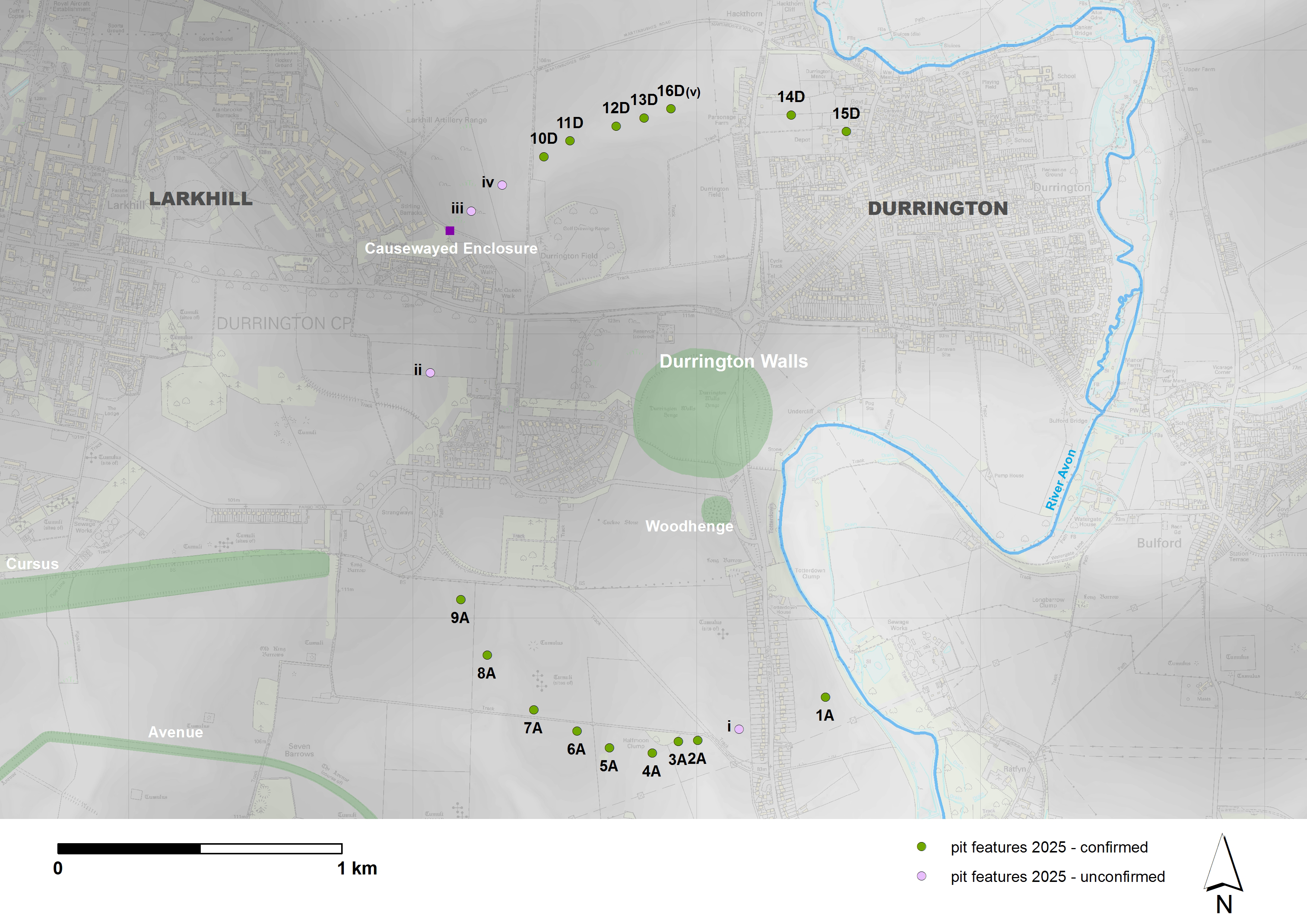
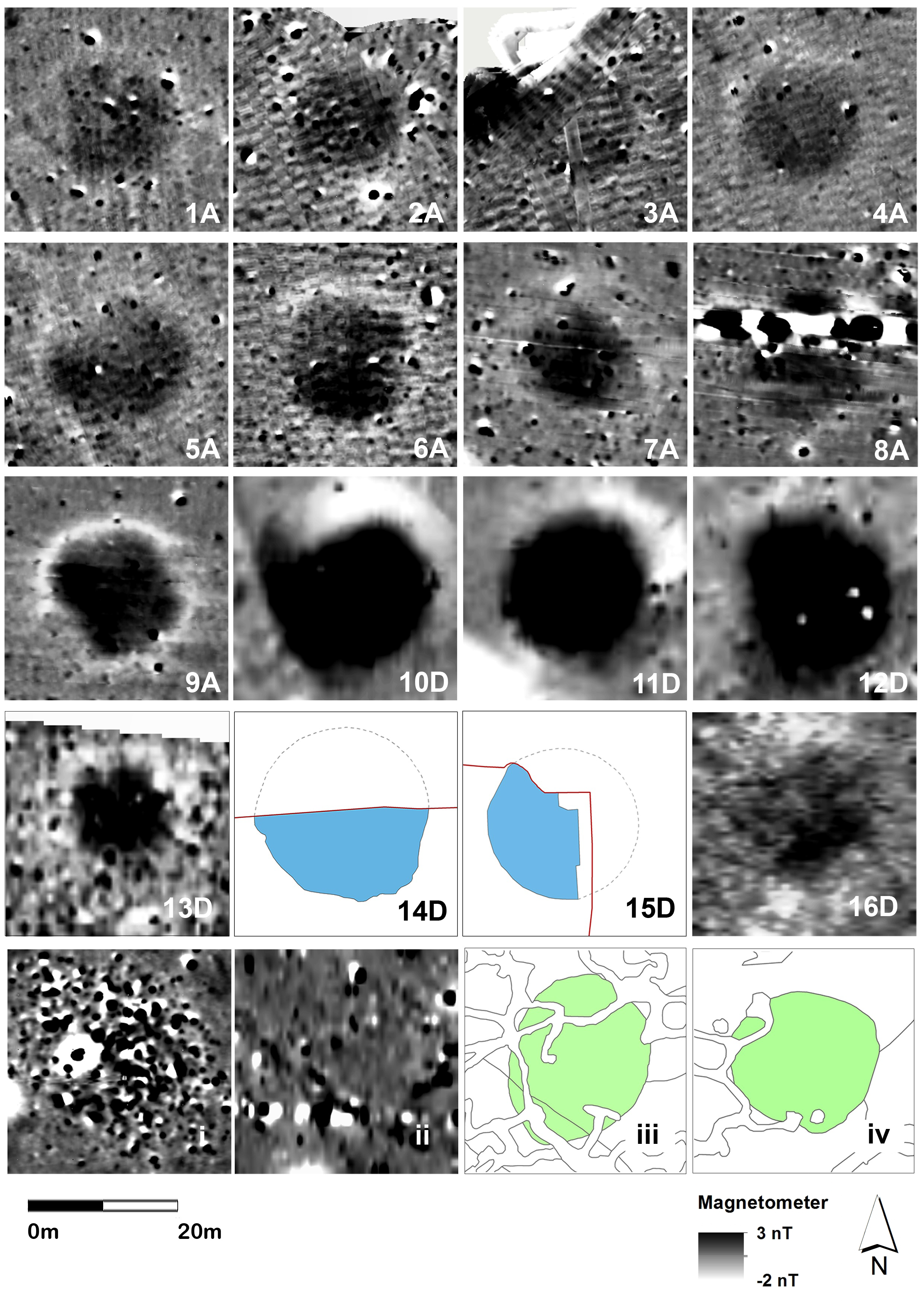
Under investigation in 2019 and 2020 were 15 large, geophysical (pit-like) anomalies; these were identified within the extensive magnetometer data set acquired by the Stonehenge Hidden Landscapes project. These features, numbered 1–15, were apparently aligned in arcs surrounding Durrington Walls henge (see Fig. 1). Anomalies 1–9 have a letter 'A' suffix representing Amesbury parish, while anomalies 10–15 have a letter 'D' suffix representing Durrington parish. Five additional anomalies, tentatively identified from aerial photography, topographic modelling and geophysical survey, were interpreted as possible pit-like features, and were labelled with lower case roman numerals i–v. Investigations in 2019 concluded that anomalies 7A, 8A and 5A were pits and that, by extension, all 15 anomalies were probable pits (Gaffney et al. 2020). In spring 2021, permission was granted by the National Trust and the Ministry of Defence for a second round of fieldwork on ten targeted anomalies (1A–5A, 7A, 8A, 13D, and anomalies ii and v), to consolidate the results of the initial study and aid interpretation of geophysical anomalies before final publication of the Hidden Landscapes project volume. Following the results of survey, and confirmation of anomaly v as a pit made it necessary to rename it 16D, as per the classification outlined above.
Since the initial discovery of these anomalies, by both Wessex Archaeology and the SHLP, six features have been affected by development (iii, iv, 10D, 11D, 14D, 15D). Two of these (iii and 15D) are now totally inaccessible. The other four are now in gardens (iv, 10D), landscaped (11D) or are impacted by new boundaries (14D).
| ID | Parish | Diameter (Upper) | Depth (base) | Dating | Aerial NMP | Geophysics | Borehole | Excavation (partial) | Investigator |
|---|---|---|---|---|---|---|---|---|---|
| Southern 'arc' features | |||||||||
| 1A | Amesbury | c.17m | 4.7m | MN, BA, EMed | - | Y | Y | - | SHLP |
| 2A | Amesbury | c.15m | ≥ 6.7m* | IA | - | Y | Y | - | SHLP |
| 3A | Amesbury | c.17m | 6.9m | - | - | Y | Y | - | SHLP |
| 4A | Amesbury | c.17m | - | - | Y | Y | - | - | SHLP |
| 5A | Amesbury | c.20m | ≥ 7.0m* | MBA | - | Y | Y | - | SHLP |
| 6A | Amesbury | c.19m | - | - | Y | Y | - | - | SHLP |
| 7A | Amesbury | c.15m | 5.0m | LN | Y | Y | Y | - | SHLP |
| 8A | Amesbury | c.18m | 5.0m | LN, MBA, IA | - | Y | Y | - | SHLP |
| 9A | Amesbury | c.19m | - | - | Y | Y | - | - | SHLP |
| Northern 'arc' features | |||||||||
| 10D | Durrington | c.22m | ≥ 2.0m* | MBA | - | Y | - | Y | WA |
| 11D | Durrington | c.18m | ≥ 2.7m* | BA | - | Y | - | Y | WA |
| 12D | Durrington | c.20m | - | - | - | Y | - | - | WA |
| 13D | Durrington | c.15m | 4.7m | EN, LN, EBA, LBA, LBA/IA, IA | Y | Y | Y | - | WA/SHLP |
| 14D | Durrington | c.23m | ≥ 3.1m* | LN, MBA, RB | - | - | - | Y | WA |
| 15D | Durrington | c.20m | ≥ 6.0m* | RB | - | - | Y | Y | WA |
| 16D | Durrington | c.18m | 5.8m | LM/EN, EN, LN, EBA, IA, RB | Y | Y | Y | - | SHLP |
| Potential features | |||||||||
| i | Amesbury | c.20m | - | - | - | Y | - | - | SHLP |
| iii | Durrington | c.19m | - | - | - | Y | - | Y | WA |
| iv | Durrington | c.19m | - | - | - | Y | - | Y | WA |
| Unproven features | |||||||||
| ii | Durrington | c.18m | - | - | Y | Y | - | - | SHLP |
The primary aim of the 2021 fieldwork, and consequent analysis, was to further characterise those features interpreted as large pits and identified through the application of a range of geophysical and environmental techniques, both invasive and non-invasive (Gaffney et al. 2020).
Geophysics objectives:
Environmental and dating analysis objectives:
Ten features were targeted in total. The range of methods applied at each feature in 2021 are summarised in Table 2.
| Feature | ii | 13D | 16D | 1A | 2A | 3A | 4A | 5A | 7A | 8A | |
|---|---|---|---|---|---|---|---|---|---|---|---|
| Method (field) | Primary targets | Secondary targets | |||||||||
| Magnetometer | X | X | X | P | P | P | P | P | P | P | |
| GPR | - | X | X | X | X | X | - | P | P | P | |
| EM | - | X | X | - | - | - | - | - | P | P | |
| ERT | - | X | X | X | X | X | X | X | X | - | |
| Drone | - | X | X | - | - | - | - | - | - | - | |
| Borehole | - | X | X | X | X | X | - | P | P | P | |
| Analysis (laboratory) | |||||||||||
| Core | - | X | X | X | X | X | - | P | P | P | |
| Geochemistry | - | X | X | - | - | - | - | - | - | X | |
| Profiling-OSL | - | X | X | X | X | - | - | X | - | X | |
| Dating-OSL | X | X | X | X | - | - | - | - | |||
| aDNA | - | X | X | X | X | X | - | X | X | X | |
| Confirmed pit (interpretation) | ? | Yes | Yes | Yes | Yes | Yes | Yes | Yes | Yes | Yes | |
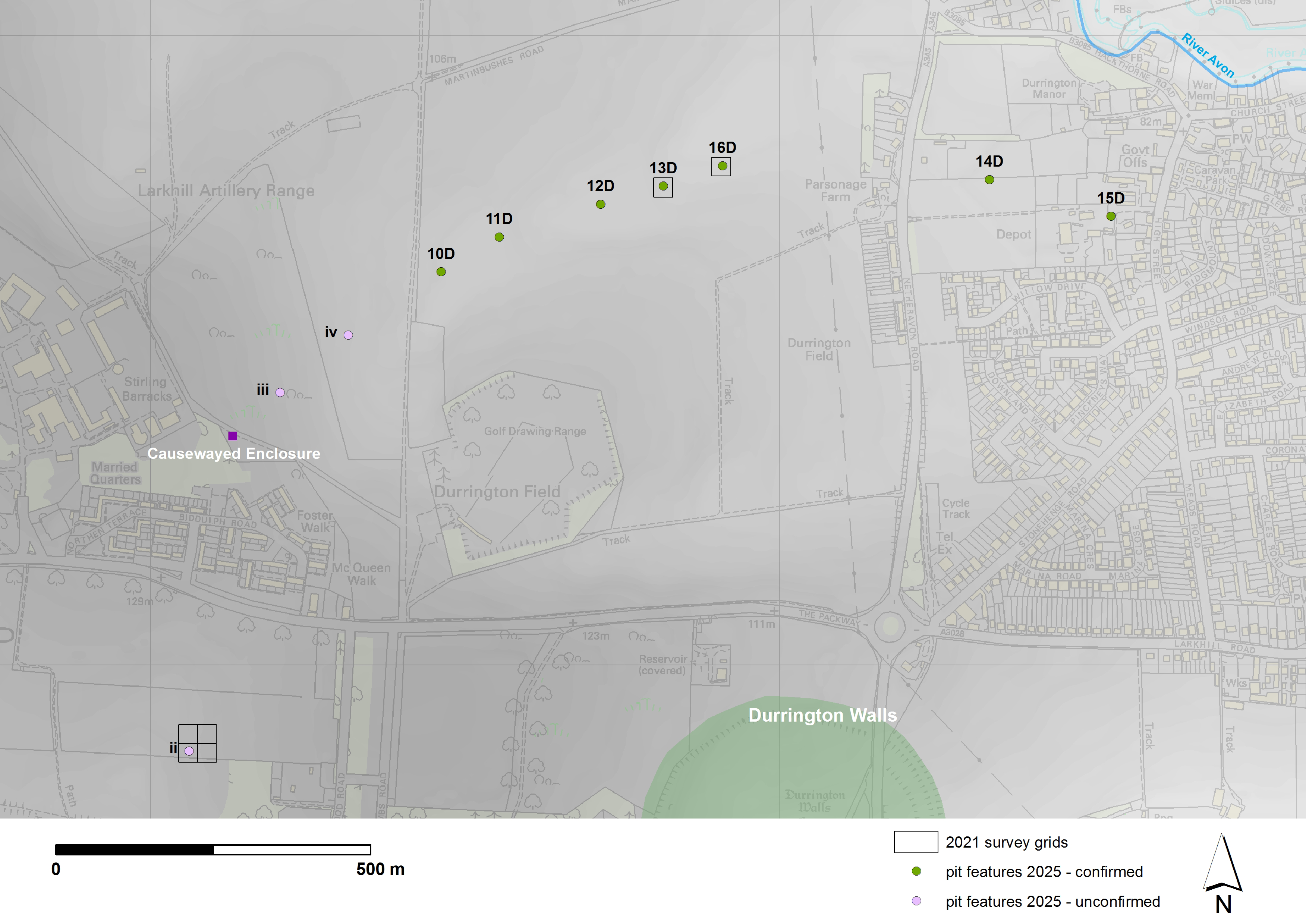
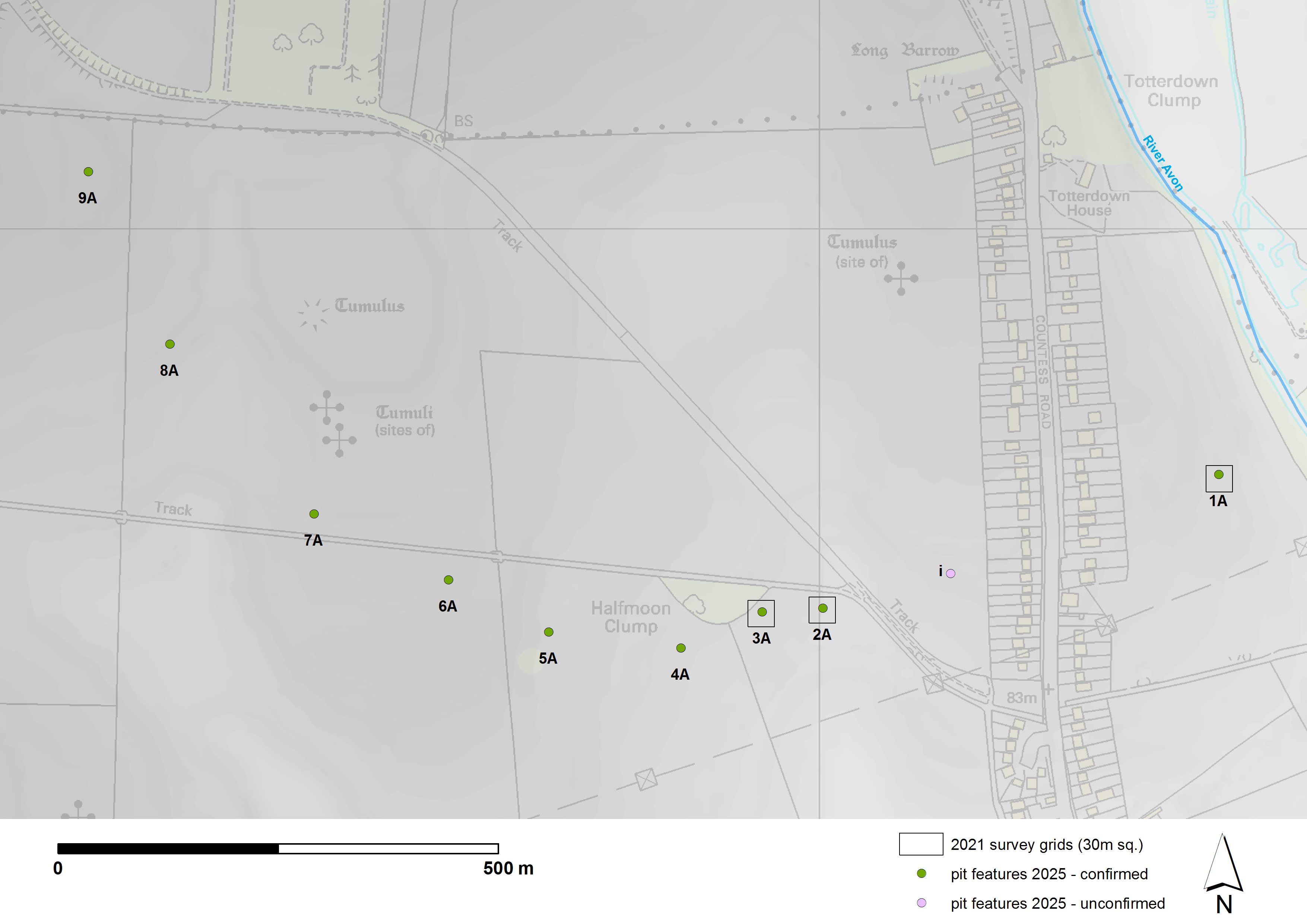
Prior to survey, individual 30m x 30m grids were set out over each target feature with a DGPS unit (Leica GS16 GNSS Rover, Table 3 and Figs 2 and 3). Magnetometry survey within these grids also allowed the accurate targeting of the supporting geophysical and borehole investigations within individual features. Further methodological details (including post-processing) of the magnetometer surveys are provided in supplementary data file 1.
| ID | Survey | Size | Instrument | Transects | Samples | Method |
|---|---|---|---|---|---|---|
| 13D | Area | 30m x 30m | Bartington Grad 601 | 1m | 25cm | Zigzag |
| 16D | Area | 30m x 30m | Bartington Grad 601 | 1m | 25cm | Zigzag |
| ii | Area | 60m x 60m | Bartington Grad 601 | 1m | 25cm | Zigzag |
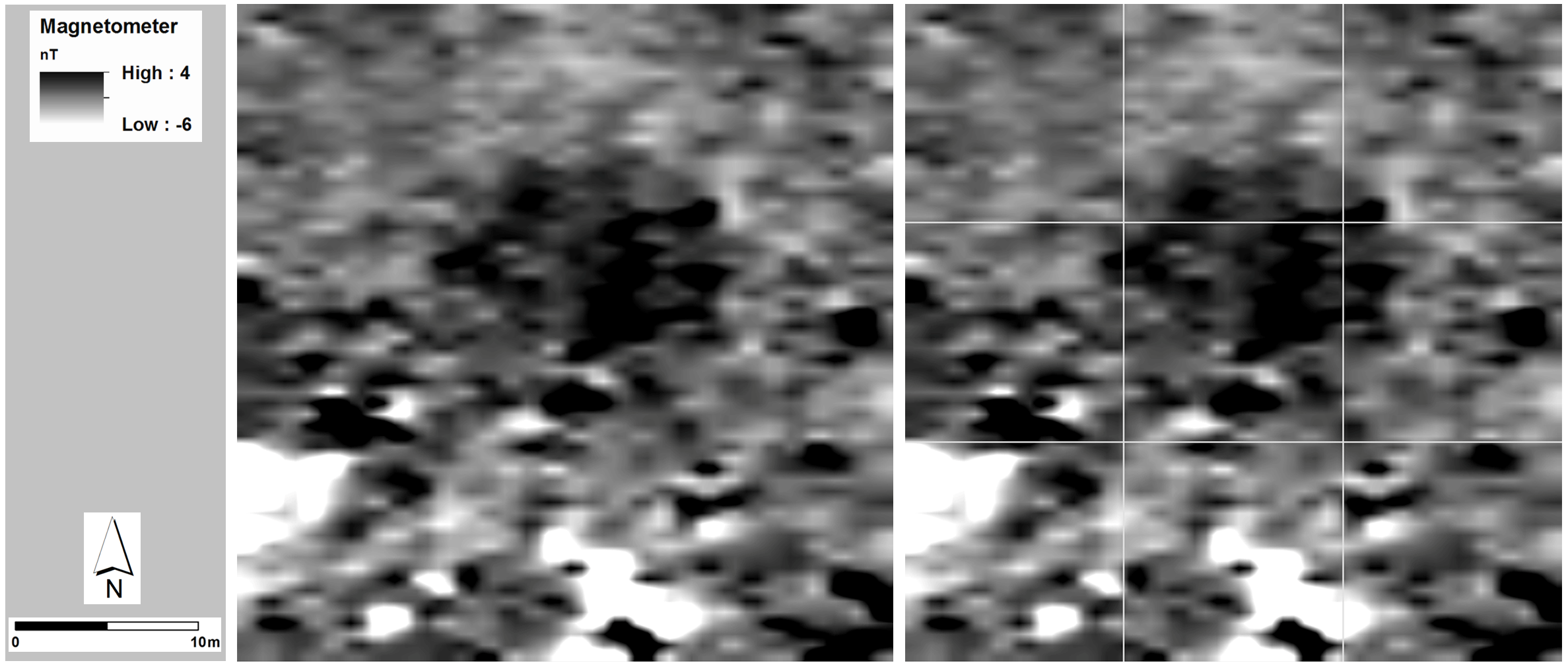
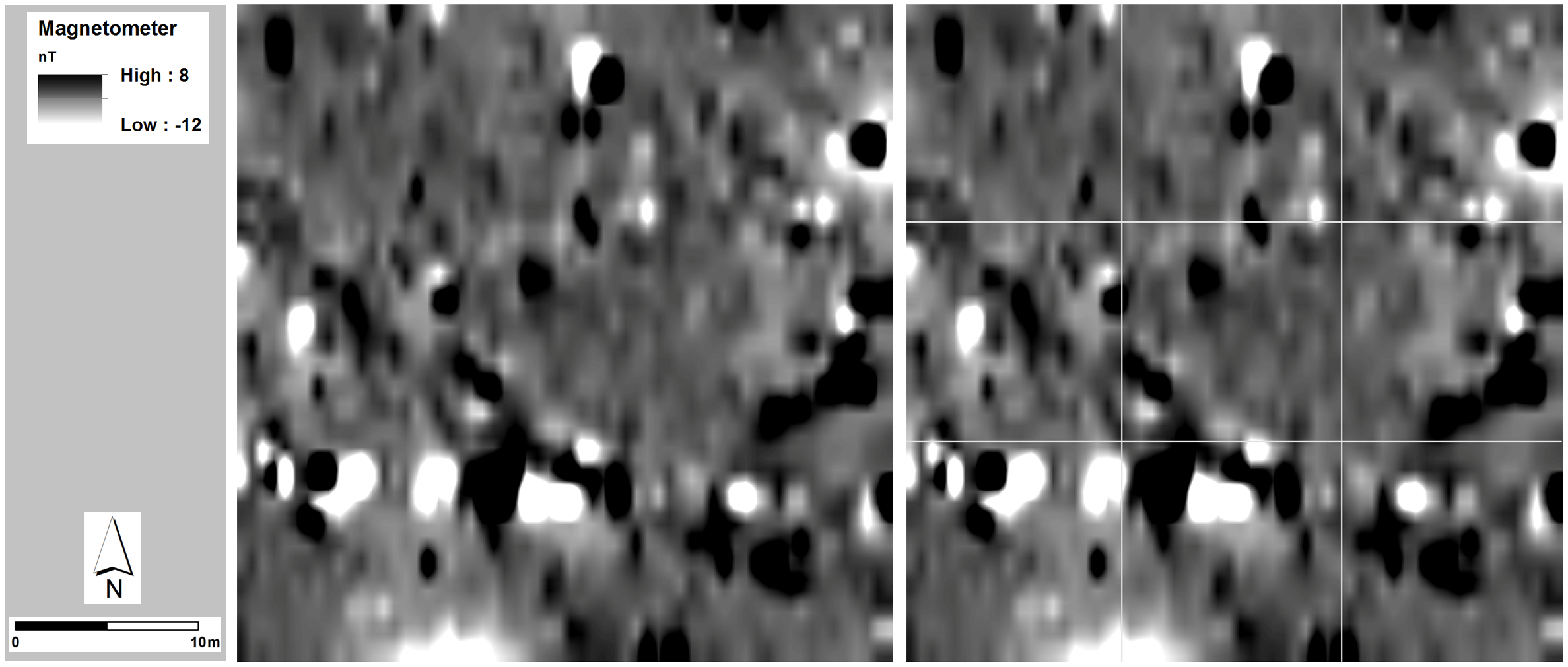
The results of the magnetic survey (Figs 4–6) were successful in locating all three targets (13D, 16D and ii). Moreover, survey demonstrated that the character and size of cropmark 16D's magnetic response were similar to those anomalies previously identified (1A–9A and 10D–13D, Gaffney et al. 2020). Typically, these features are represented by large, sub-circular magnetic anomalies, approximately 18m–20m in diameter. Enhanced, magnetically positive values from within these anomalies suggest structures (natural or anthropogenic) cut into the underlying substrata and then filled with material of a higher magnetic content. Generally, there is a suggestion of a broad 'halo' of less magnetic response surrounding each feature. The results of the magnetic survey brings the sum of probable pit-features to 16 in total.
Following survey, 14 targets, anomalies 1A–9A, 10D–13D, and 16D, have now been identified as pits. primarily based on the consistent character and size of their magnetic response. This interpretation was, in turn, supported by complementary investigations including coring (Gaffney et al. 2020). The remaining two features 14D and 15D were identified as being of a similar nature and size, following excavation for mitigation purposes (Gaffney et al. 2020; Thompson and Powell 2018).
The magnetic response of 13D had initially been characterised following commercial magnetometry survey (Schmidt and Crabb 2017) and this was reported in Gaffney et al. (2020). Reassuringly, the results of the recent survey (albeit at a slightly reduced sample resolution) confirmed the presence of a sub-circular feature c.14m in diameter, as mapped in Schmidt and Crabb 2017 (Fig. 3 and included as 13D shown in composite image Fig. 6). The scar of an archaeological watching brief (reported by Leivers et al. 2020, Fig. 1) is also evident in the data, running approximately E–W through the southern third of the survey area in Figure 4. The strong magnetic response from the investigation and backfill overwhelmed some of the weaker magnetic measurements in this area – although it may be noted that a pair of post holes belonging to a late Neolithic post structure were identified running within 7m–10m of 13D during the reported watching brief (Leivers et al. 2020, Fig. 6, and included in supplementary data file 1, fig. 1.13).
The magnetic survey results from 16D successfully located the target feature and also demonstrated a similarity in magnetic response and size to the 15 other magnetic anomalies previously identified as 'pit-like'. Figure 5 illustrates a large sub-circular anomaly approximately 18–20m in diameter. Enhanced readings from within the anomaly again suggest a feature (natural or anthropogenic) cut into the underlying substrata and since filled with material of a higher magnetic content. There is also a suggestion of a broad 'halo' of less magnetic response surrounding the feature.
Fluxgate gradiometer survey over anomaly ii (Fig. 6) did not, however, detect any magnetic response comparable with other surveyed pit features. Instead, a weakly enhanced rectilinear feature is evident within the survey area. Approximately 15m square, this feature joins, or is cut by, a longer curvilinear feature running through the corner of the survey area NW–SE for over 50m. This feature coincides with the documented line of a perimeter fence that surrounded a WW1 military encampment (Camp 2, see supplementary data file 1, figs 1.5–1.8). Together, these weakly enhanced magnetic responses most probably represent the vestiges of early to mid-20th century military activity. Given the significant disturbance associated with later activity in the area, it was decided that there should be no further investigations at this location. The presence of an earlier feature therefore remains unproven.
The results of the magnetometer survey carried out in 2021 are illustrated in Figure 7, along with plans of other features identified as pits from remote sensing or excavation. The similarity across the group suggested that 13D and 16D should be targeted for further geophysical survey and borehole investigation.
| ID | Survey | Size | MHz | Transects | No. | Sampling |
|---|---|---|---|---|---|---|
| 1A | Area | 30m x 30m | 250 | N–S | 61 | 0.5m x 0.05m |
| 2A | Area | 30m x 30m | 250 | N–S | 120 | 0.25m x 0.05m |
| 3A | Area | 30m x 30m | 250 | N–S | 120 | 0.25m x 0.05m |
| 13D | Area | 30m x 30m | 250 | E–W | 61 | 0.5m x 0.05m |
| 16D | Area | 30m x 30m | 250 | E–W | 61 | 0.5m x 0.05m |
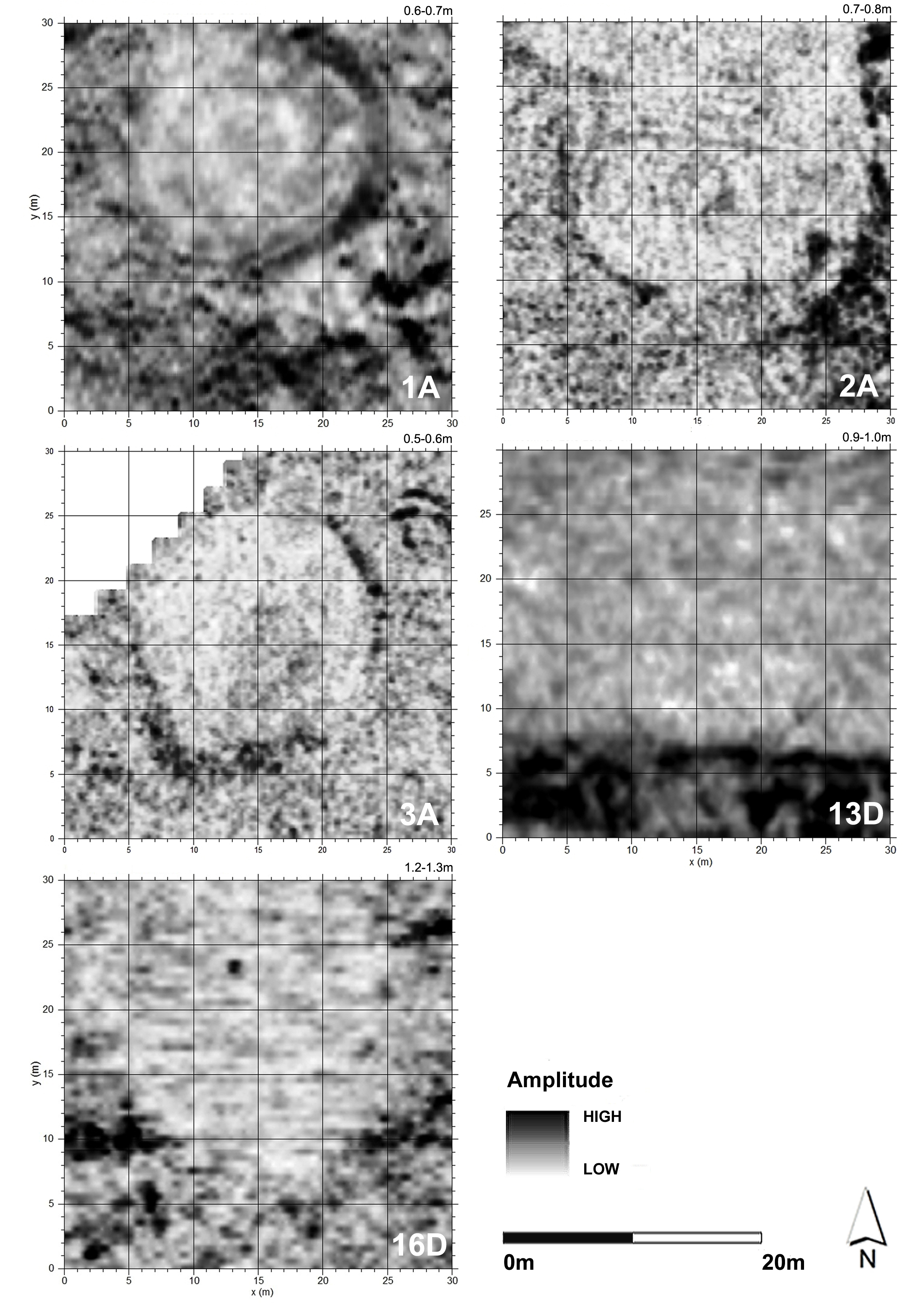
Single-channel GPR surveys using a 250MHz antenna were conducted over 1A, 2A, 3A, 13D, and 16D, not only to locate and describe the features in each area (presented as horizontal time-slices), but also to provide additional depth information in profile (presented as vertical radargrams). A time slice summary for each feature is given in Figure 8. A full range of time slices, at increasing depth, for each survey target, can be viewed in supplementary data file 2, alongside their radargram profiles. As ground surface conditions at 1A, 13D and 16D were poor owing to mud or stoney ground, traverse spacing was limited to 0.5m intervals. Further methodological details of the five single-channel GPR surveys are also provided in the supplementary data file.
Unfortunately, poor weather impacted the GPR survey over 13D and very little subsurface detail was revealed. As a result of near-continuous rain, penetration of the GPR signal was attenuated and it is believed that the imagery reflects the variation in surface covering and not subsurface features. Despite this, the faint (low amplitude) outline of a circular feature, about 25m in diameter, can be seen in the uppermost time slices (Fig. 8, 13D), and there is a hint of a cut into the chalk when viewed in radargram profile 1990 (see supplementary data file 2, fig. 2.3). These data are, however, extremely noisy and, alongside the impact of ploughing, the results may also reflect external electronic interference.
The GPR data over 16D also revealed very little subsurface detail. Once again this resulted from the heavy and continuous rain encountered during survey. However, despite limited penetration, a low-amplitude ovate feature measuring c.20–25m in diameter is discernible against the underlying geological response, at time slice depths of c.0.6 –1.5m (Fig. 8, 16D). This is also traceable in profile, e.g. radargram 2068 in the supplementary data file 2, figure 2.6. Given the size of the anomaly, it is suggested that this may be interpreted as a weathering cone, above a deeper, cut feature. Similar profiles have been suggested for other pits where GPR results were clearer e.g. 8A (Gaffney et al. 2020, table 2.5, supplementary data file 2).
Weather conditions improved considerably during survey over 1A but the soil at this location was stoney and had recently been tilled. Consequently, survey traverse spacing was kept to 0.5m. However, the ground was dry enough to provide a clear GPR signal from survey over the feature.
The time slice in Figure 8 (1A) identifies an elliptical feature directly beneath the topsoil. The GPR data indicate an identifiable weathering cone with a near-circular central feature. Unusually, the near surface plough marks are seen at depth throughout the time slices and presumably are a result of 'ringing' resulting from heavy rain. The presence of a weathering cone and central feature are also discernible in profile (radargram 2130 in the supplementary data file 2, fig. 2.9). A reflective horizontal layer is evident within the weathering cone, effectively 'sealing' the central feature beneath. Deeper again, at c.2m depth, the trace of a central, cut feature, c.11–12m in diameter, can be seen against the geological background. Unfortunately, the bottom of the feature is not identifiable within the data.
Better ground surface conditions (drier, stone free) permitted a survey interval of 0.25m over 2A and 3A. At 2A, the results reveal a slightly irregular elliptical feature, c.20m in diameter and cutting into the underlying geology to an estimated depth between c.0.6m–1.2m (Fig. 8, 2A). This seems to be decreasing in diameter with depth, indicating possible modification or erosion through natural processes (see supplementary data file 2, fig. 2.10).
Although the weather conditions were relatively dry during the survey, a combination of recent rain and the high clay content of the underlying subsoil may have limited the penetration of the radar signal. Radargram profile 8815 indicates a significant interface (change in material causing a highly reflective layer response) within the cut of a central feature at c.2.2–2.8m depth (see supplementary data file 2, fig. 2.12). The time slice data also suggests a disturbance located centrally within the feature at an estimated depth of c.2.2m–2.7m. It is not clear, however, if these responses reflect natural or anthropogenic features. The bottom of the feature is not identifiable in the GPR data or is beyond the limit of detection for the 250MHz antenna.
The results over 3A reveal a distinctly ovate feature (c.20m in diameter) cutting into the underlying geology, to an estimated depth of between c.0.4m–1.3m (Fig. 8, 3A). This feature seems to decrease in diameter with depth, suggesting the presence of an erosion cone. A combination of recent rain and the high clay content of the underlying geology may have limited the penetration of the radar signal. The base of the feature is not identifiable in the data or is beyond the limit of detection for the 250MHz antenna. Nonetheless, radargram 8711, suggests some deeper responses are discernible in the GPR profile down to c.2.5m (supplementary data file 2, fig. 2.15).
In summary, the GPR surveys were successful in providing supporting evidence for all five features surveyed. However, responses were usually limited to a relatively shallow depth (c.0.3m–1.5m depth), and the dimension of the recorded features, c.18–20m in diameter, suggest that the survey results probably represented the weathering cones of deeper features. Where ground and weather conditions were more conducive to survey, as at 1A, 2A, and 3A, the data also indicated the presence of a narrower, central feature with diameter of c.8–12m. Unfortunately, the loss of meaningful response after c.3m meant that the GPR was unable to detect the bottom of any of these features (Table 5).
| Technique | Number Investigated | Avg. diameter upper (m) | Avg. diameter lower (m) | Avg. base depth (m) |
|---|---|---|---|---|
| Magnetometer | 14 | 18 | ||
| EM | 4 | 18 | ||
| GPR | 8 | 21 | 12 | |
| ERT | 7 | 20 | 8 | 5 |
| Bore hole | 9 | 5 | ||
| Excavation (partial) | 4 | 21 | 7 | |
| Avg. Dimensions | 20m | 9m | 5m | |
During 2021, Electromagnetic (EM) ground conductivity measurements were acquired over pits 13D and 16D, using the Geonics EM38 (Table 6). Pits 7A and 8A were surveyed in 2019 using the CMD Explorer. The EM38 was used predominantly in the horizontal mode to record ground conductivity to depths of approximately 0.4m. Further methodological details of all EM surveys are given in supplementary data file 3.
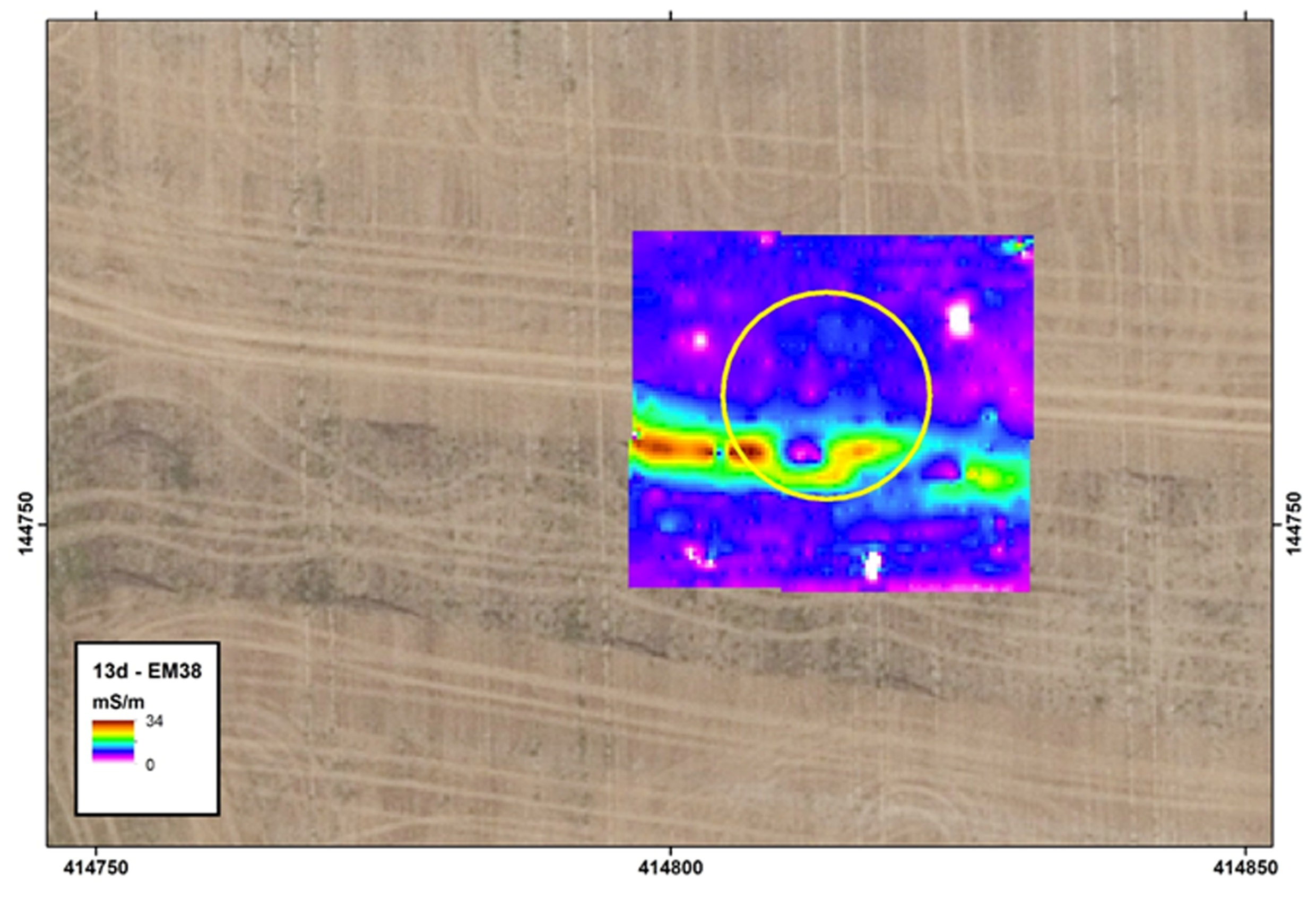
The survey results indicated a variation in conductivity from 2-34mS/m. At 13D (Fig. 9) there were no consistent patterns of conductivity change at the location of the anomaly. Higher values associated with a linear feature crossing the site coincide with a previously unmapped modern feature in the topsoil. This probably relates to recent archaeological investigations (Leivers et al. 2020), and also is noted in the Drone survey (see supplementary data file 5).
| ID | Type | Line spacing | Instrument | Sensors | Frequency | Phase | Depth |
|---|---|---|---|---|---|---|---|
| 13D | Area | 1m | Geonics EM38 | 2 | 0.3hz | quad | c.0.4m |
| 16D | Area | 1m | Geonics EM38 | 2 | 0.3hz | quad | c.0.4m |
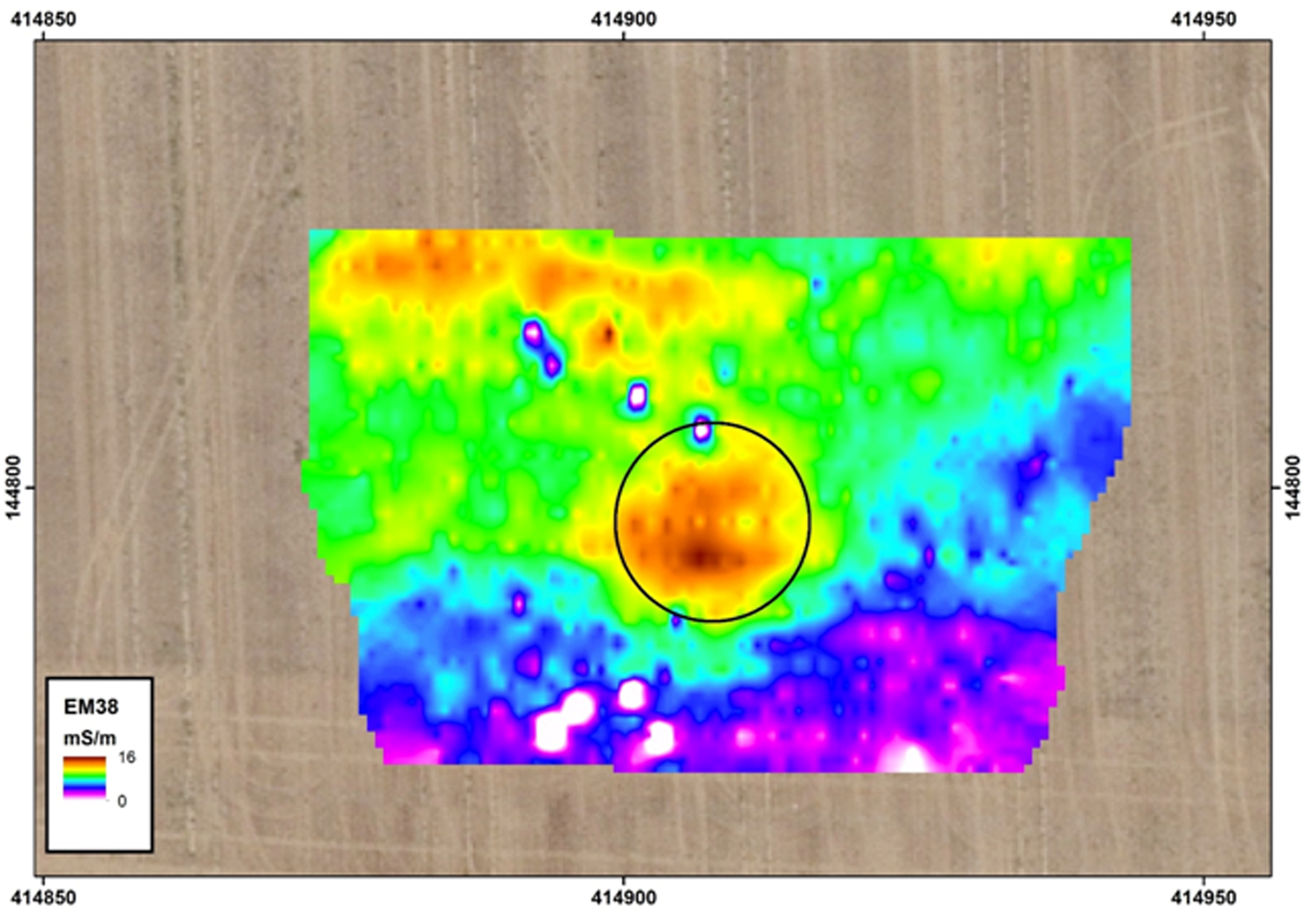
Results at 16D showed a variation in conductivity of 1-16mS/m. Small spot anomalies (less than 1m size) were randomly scattered throughout the area and a zone of higher ground-conductivity (lower resistivity) was observed both to the north of the anomaly and, approximately, over the location of the anomaly itself (Fig. 10).
The CMD Explorer ground conductivity meter was also used in horizontal orientation to record both ground conductivity and inphase (magnetic susceptibility) components of the electromagnetic signatures to a maximum penetration of approximately 4m. The results of the survey are shown in supplementary data file 3. A linear feature at Pit 8A, associated with a known water pipe, manifest as a zone of decreased conductivity running east–west, was noted in all three coil separations (near surface to deep) but no signature was noted that coincided with the location of the magnetometer signal (supplementary data file 3, fig. 3.3). The inphase data also showed no patterns that could be related to the location of the magnetometer anomalies. Similar results were returned from survey over 7A (supplementary data file 3, fig. 3.4).
Electrical Resistance Tomography (ERT) survey was undertaken with the Flash 64 and ABEM SAS4000 Terrameter with variable electrode spacings – 0.5m, 1m, 2m, and 3m as shown in Table 7. Long-line survey lines were extended using a roll-a-long method involving an overlap of measurements, thereby increasing the length of the line. Data were processed with Res2DInv software, allowing the generation of electrical pseudo-section models and the topographic correction of long-line ERT transects. Further methodological details are provided in supplementary data file 4, while the locations of long-line ERT transects in relation to the 16 confirmed pits are illustrated in supplementary data file 4, figure 4.14.
| ID | Type | Instrument | Electrodes | Interval (m) | Line Length (m) | ||
|---|---|---|---|---|---|---|---|
| 13D | Single line | Flash 64 | 64 | 1 | 63 | ||
| 16D | Long line | ABEM SAS4000 | 64 | 3 | 291 | ||
| 1A | Single line | Flash 64 | 64 | 1 | 63 | ||
| 2A | Long line | ABEM SAS4000 | 64 | 1 | 78 | ||
| 5A | Long line | ABEM SAS4000 | 64 | 1 | 78 | ||
| Long line | ABEM SAS4000 | 64 | 2 | 156 | |||
| 7A | Long line | ABEM SAS4000 | 64 | 0.5 | 74 | ||
| Long line | ABEM SAS4000 | 64 | 1 | 77 | |||
| 5A, 4A, 3A, 2A | Long line | ABEM SAS4000 | 64 | 3 | 408 | ||
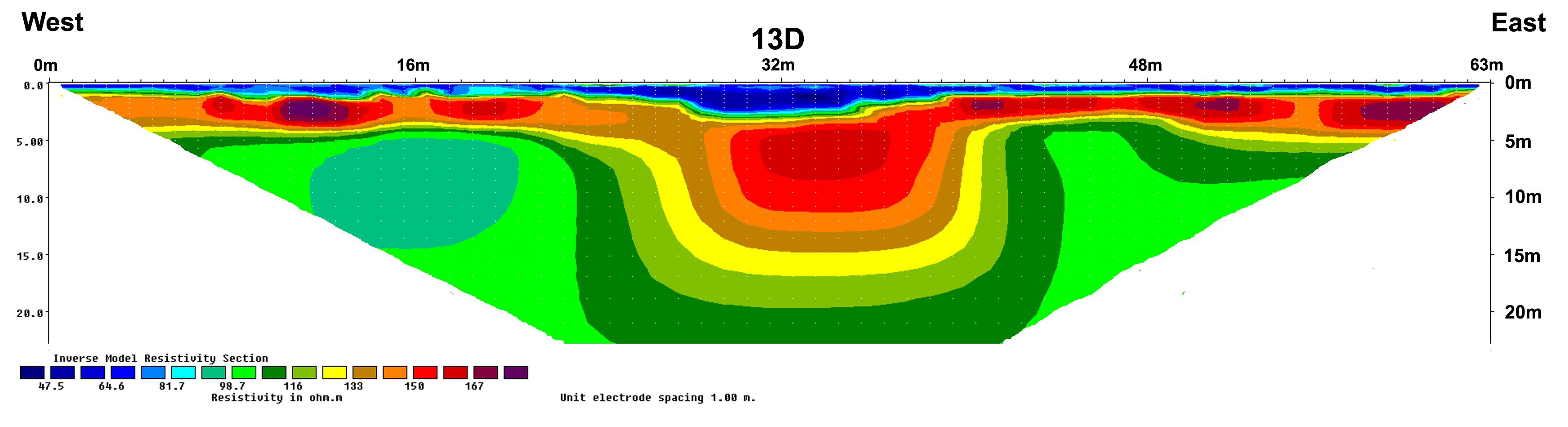
At 13D, a single ERT line (spacing 1m) was surveyed across the presumed pit (Fig. 11). In the near surface there is a thin, low resistivity layer imaged to depths of less than 1m along the length of the line. Over the presumed pit, a low resistivity feature increases in depth to approximately 4m. Despite the similarity in resistivity of these two regions, it is difficult to confirm (without excavation) if the lower infilling is topsoil derived. The low resistivity signatures do, however, contrast with the higher resistivity layer that also increases in depth over the pit location. The shape of the anomaly is rather amorphous, with a gentle dip to the sides.
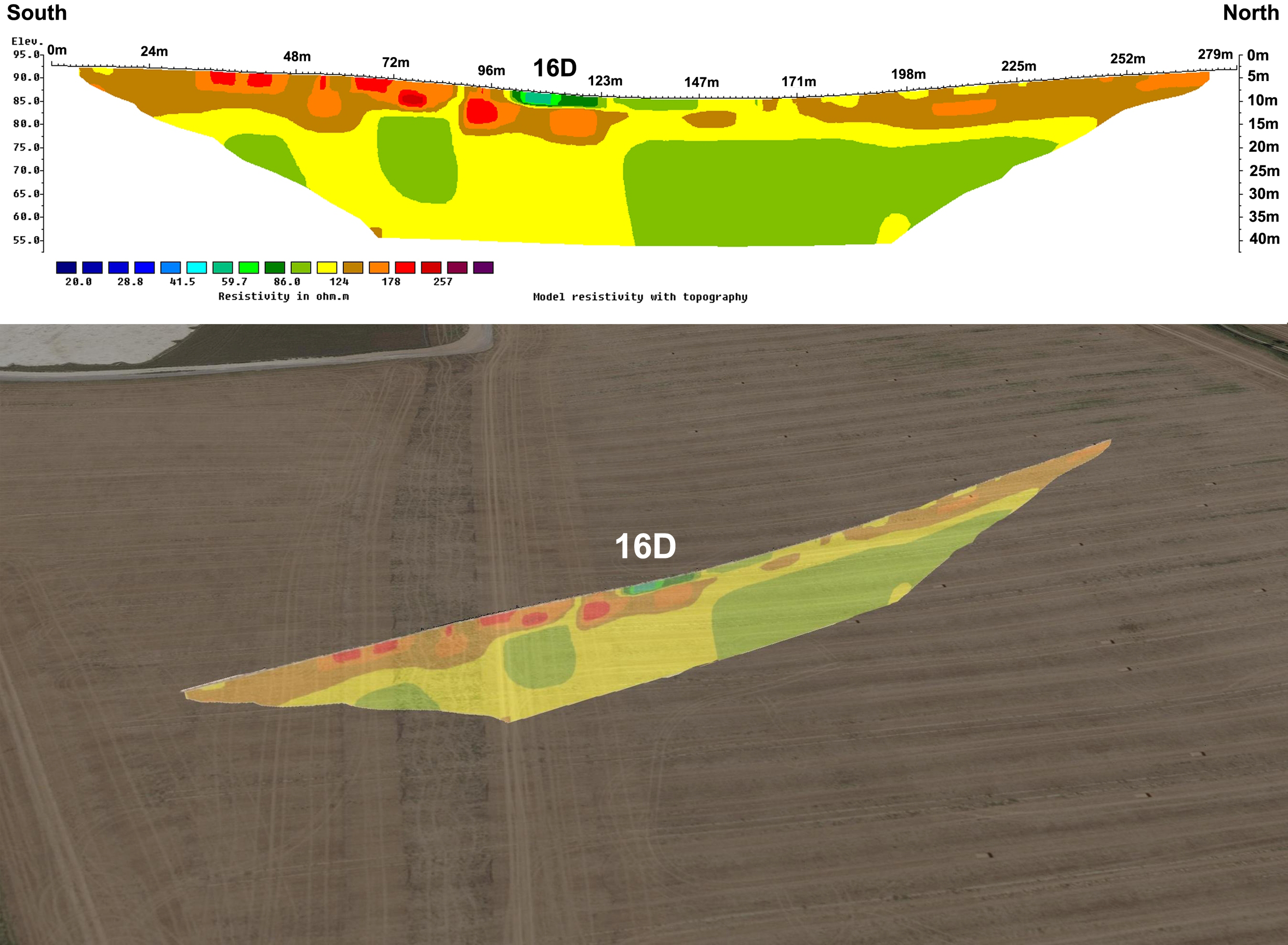
At 16D, a relatively long ERT survey line, with an electrode spacing of 3m, was laid north–south, across a shallow valley and through the centre of the feature. This coarser resolution resulted in a slightly poorer definition across the target feature. However, as the intention was to view the pit in context, the results successfully indicated that the pit response is anomalous throughout the section. Figure 12 (top) shows the pseudo-section with penetration to >30m beneath the ground surface. Electrical resistivity values were modelled with a range of resistivity values from 20-300ohmm. The near-surface resistivity values are consistent with the surface, electromagnetic derived ground conductivity, showing a general low conductivity (higher resistivity) area to the south with an increase in conductivity (lower resistivity) in the centre of the valley and immediately to the north of 16D (Fig. 12, below).
Given the 3m electrode spacing utilised, the thin surface present at 16D and described above, was not imaged here. However, the location of the anomaly is coincident with a zone of relatively lower resistivity that is consistent with both the size (c.20m in diameter) and depths (c.5m) of known pits in both the northern and southern arcs (Gaffney et al. 2020). Again, the profile of the low-resistivity zone, with a flat base and dipping sides, is also comparable with those other features interpreted as pits in Gaffney et al. 2020. Furthermore, there is no evidence for changes in resistivity, either below the known features or at any point along the section, that would suggest the presence of structures, such as sinkholes, that might disrupt the continuity of the geological strata at depth.
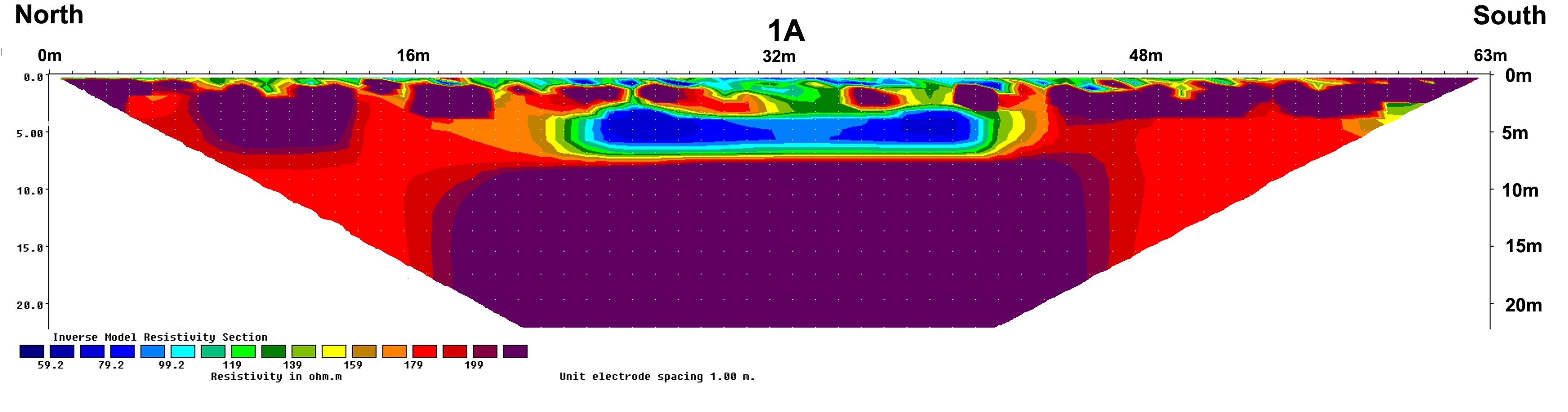
An ERT line with 1m electrode spacing was also placed across 1A. The centre of the feature was marked by a low resistivity zone of approximately 8m width with relatively steep sides (Fig. 13). The base is marked by an abrupt increase in resistivity at approximately 4.5m depth. At depths over 5m the model shows small contrasts in resistivity along approximately vertical boundaries. However, given the electrode spacing, the model results at these depths are based on relatively few data points and caution is advised when attempting interpretation.
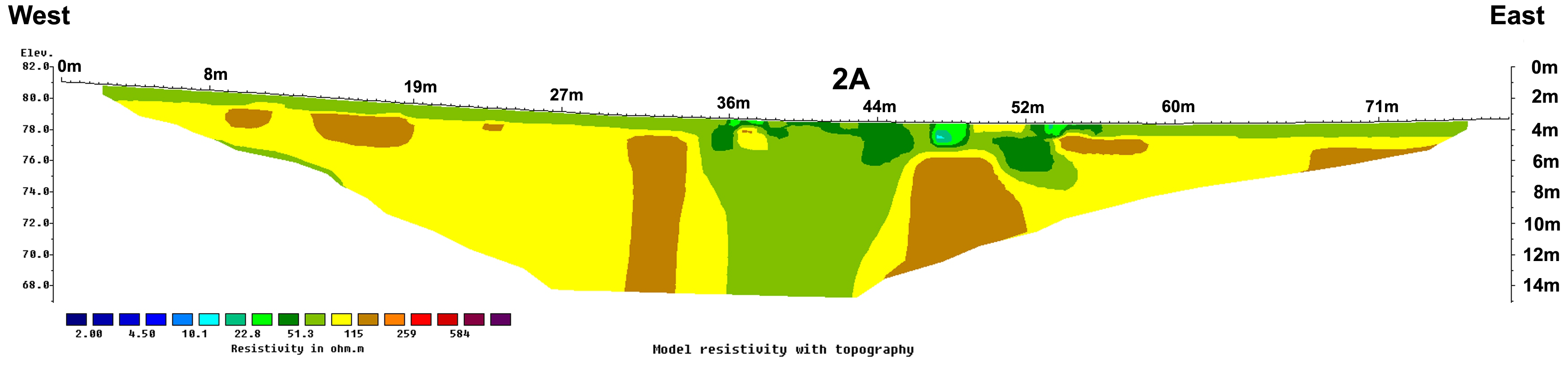
ERT results from 2A, acquired with an electrode spacing of 1m, contain a zone of disrupted resistivity that contrasts with the surrounding area (Fig. 14). Here the magnitude of contrast is less than across other anomalies surveyed. The disrupted area is approximately 20m wide and less than 5m deep.
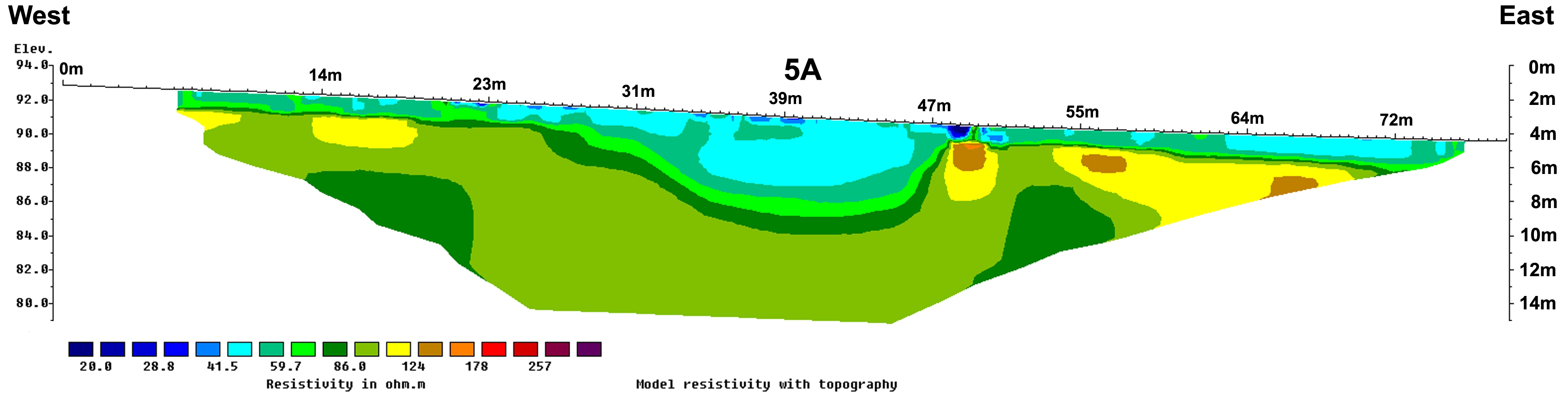
At 5A plots were generated using an electrode spacing of both 1m (Fig. 15) and 2m (supplementary data file 4, fig. 4.11). The feature is indicated by an area of lower resistivity in comparison to the surrounding bedrock, and the results again demonstrate a similar pattern to those features interpreted as pits. Both sections imaged a slight layer of lower resistivity along the surface that corresponds to the relatively thin surface soil horizon, as is seen in pit 1A. The sides of the anomaly are gently sloping and indicate a feature with a diameter of approximately 20m. The base is indicated by a rapid increase in resistivity that is approximately parallel to the ground surface at a depth of 5m. Below the anomaly there is no disruption in the data that might suggest any further disturbance in the geology at depth.
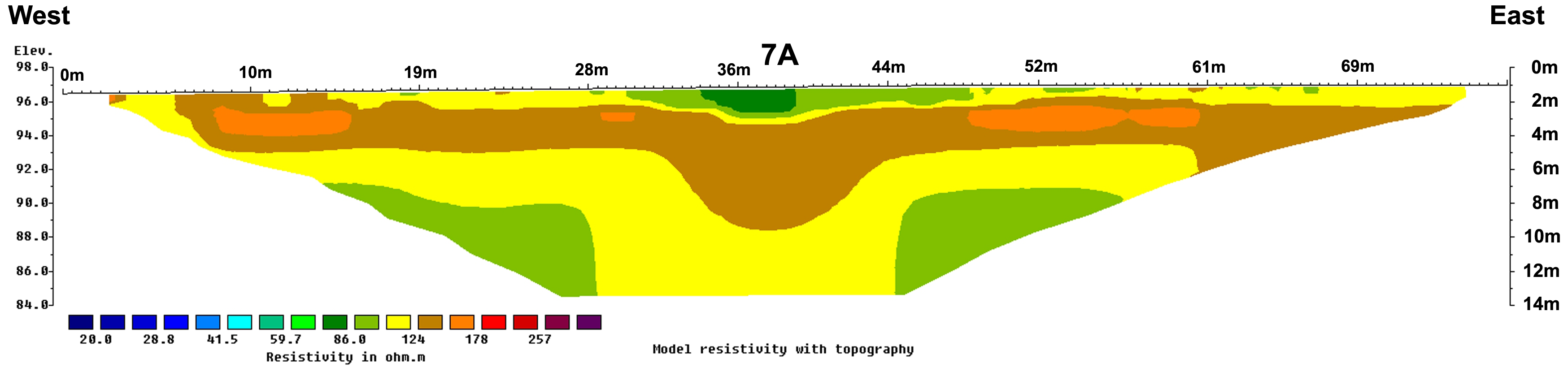
The results for ERT survey over 7A, using an electrode spacing of 0.5m, are shown in Figure 16. The survey line was orientated in an east–west direction across the centre of the pit. Resistivity measurements ranged between 20 and 300ohmm, with the area of the pit marked by a decrease in near-surface resistivity compared to the surrounding area. The feature is approximately 20m wide, with sides that appear to slope gently.
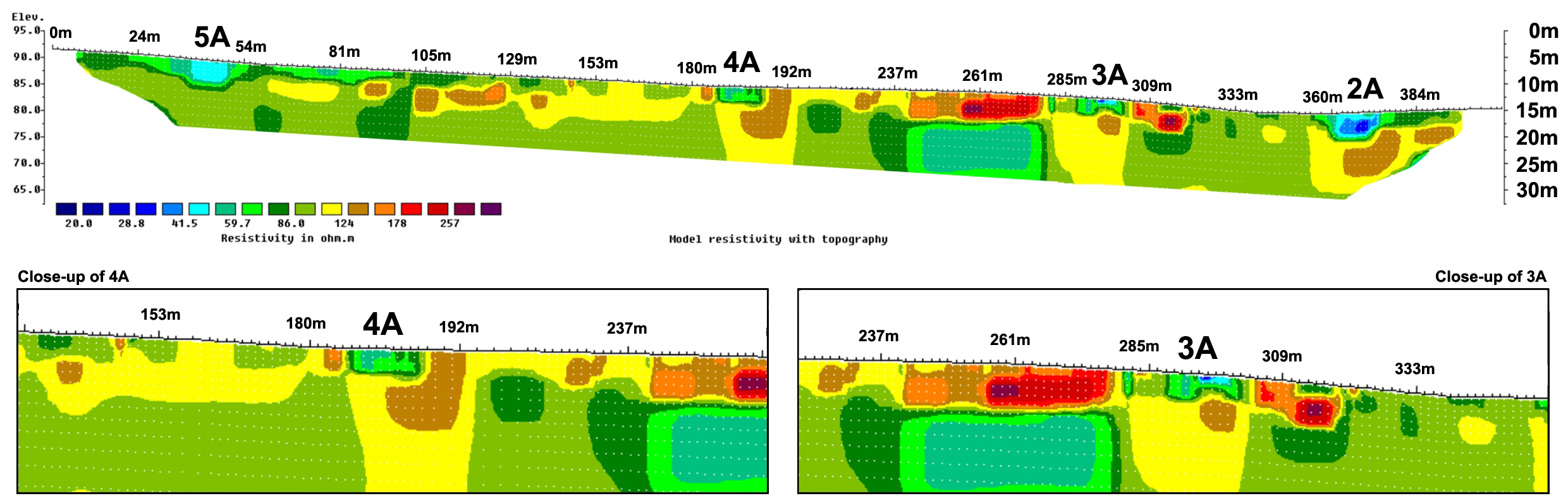
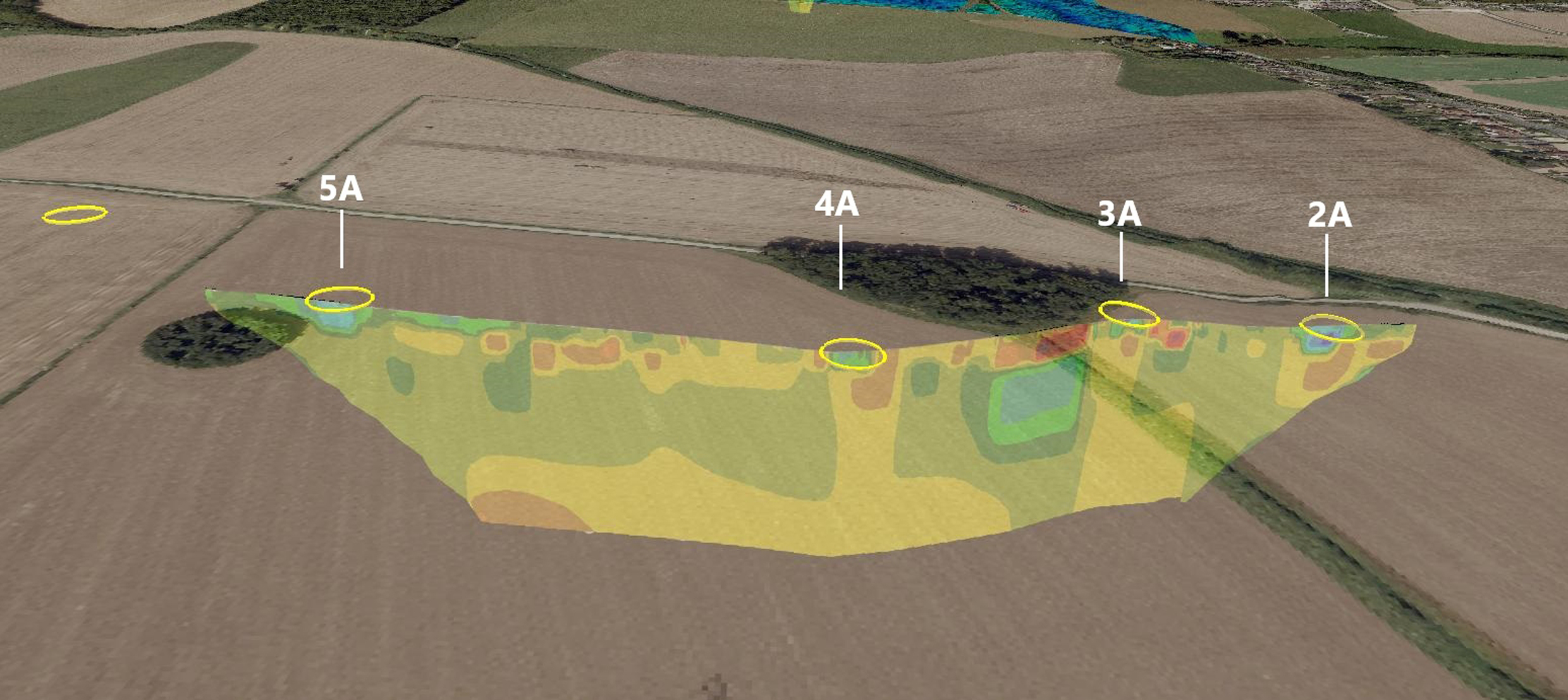
A continuous ERT line (Figs 17–18) was acquired through features 2A, 3A, 4A and 5A, and utilised an electrode spacing of 3m. This was selected to assist in understanding the contrast in properties between the features and different superficial deposits. The line extended from west of 5A to east of 2A and, according to BGS mapping of the superficial geology, crossed from an area mapped with topsoil, but no superficial sediments, to an area that featured Head deposits consisting of clay, silts, sand and gravel. The 3m electrode spacing supported penetration to at least 20m with resistivity variation of between 20 and 300ohmm (supplementary data file 4, figs 4.7–4.10). Each of the target locations shows a consistent pattern of lower resistivity compared to the surrounding geology. The thin surface layer seen in the ERT surveys with closer electrode spacing was not imaged here. However, the character of the section is different in the near surface between 2A/5A and 3A/4A. It is suggested that 2A/5A are located at the edge or outside the Head deposits, whereas 3A/4A were within the Head deposits (Fig. 25). 2A and 5A provided the largest anomalous zones (low resistance/high conductivity), with cross-sectional distances of over 20m for each anomaly, and a depth to base of approximately 5m. Features 2A/3A and 4A all show a small disruption in resistivity at depths greater than 5m that is wider than the anomaly zone itself. The contrast in resistivity here is smaller than the contrast within the anomaly zones and may be linked to the presence of Head deposits.
Features 1A, 2A, 3A, 13D and 16D were targeted for borehole investigation. Coring, as in 2019–20, was conducted mechanically with a Dando Terrier rig mounted on a small crawler unit. Core diameter size was a maximum 10cm or less. Opaque, black plastic liners were used to store the cores, and retention of a secondary core was considered for each surveyed feature, following an initial field assessment of the primary core. The opportunity was taken to recover a second core at 13D to increase the chances of finding dating evidence. Further methodological details of the borehole investigations are given in supplementary data file 6. Descriptions for cores taken from 5A and 8A in 2019 were published in Gaffney et al. (2020).
The boreholes (summarised in Table 8, with imagery in supplementary data file 6) were successful in reaching the base of four of the target features. It was difficult to ascertain if the base of feature 2A was reached. This feature was cut into Pleistocene Head deposits rather than Chalk and defining the base of an infilled feature that is cut into sediments very similar to the fill units is difficult. Results of complementary ERT survey suggest this feature is less than 5m deep, which would suggest that the Pleistocene Head deposits are encountered where shattered flint cobbles were recorded in the core and at a depth of around 4.80m.
Core WS 1A consisted of a series of stratified clay-silt dominated units with variable flint content. Bedrock was reached at 4.65m depth. A possible buried soil was encountered between 2.70 and 2.88m depth. Core WS 2A was not bottomed onto Chalk, although the ERT suggested the base may have been at a depth of c.4.8m. The sediments in this core were typically finer grained than those in WS 1A. Core WS 3A consisted of an uppermost clay silt unit (top to 2m) overlying a flint gravel. Possible weathered Chalk was encountered at 6.9m depth. Core WS 16D consisted of stratified clay silts overlying probable Chalk bedrock at 5.75m depth. Core WS 13D (1) consisted of an upper red-brown clay silt to a depth of 2.8m, overlying pale yellow-brown clay silt to 4m. A further dark red brown, clay silt with flints lay above probable Chalk bedrock at a depth of 4.6m.
In most cases, the lithology of the sequences in the boreholes are consistent with feature fills. However, the thick gravel in WS 3A is unusual and potentially indicative of either deliberate filling of the feature or the presence of Pleistocene sediments beneath the feature.
| Core (window sample) | X | Y | Z | length (m) | topsoil (m) | natural (m) | Comment | |
|---|---|---|---|---|---|---|---|---|
| WS 1A | 415454 | 142717 | 82 | 6 | 0–0.3 | 4.65 | bottomed | |
| WS 2A | 415003 | 142569 | 80 | 7 | 0–0.5 | ≥ 6.7m | - | |
| WS 3A | 414934 | 142565 | 83 | 7 | 0–0.5 | 6.90 | bottomed | |
| WS 13D (1) first core | 414816 | 144762 | 92 | 5 | 0–0.6 | 4.60 | bottomed | |
| WS 13D (2) second core | 414816 | 144761 | 92 | 5 | 0–0.3 | 4.65 | bottomed | |
| WS 16D | 414907 | 144795 | 90 | 6 | 0–0.5 | 5.75 | bottomed |
Ninety-four samples were selected from three cores for analysis by inductively coupled plasma mass spectroscopy (ICP-MS) and inductively coupled plasma optical emission spectrometry (ICP-OES) techniques (see Table 9). Prior to analysis, all samples were dried and passed through a 2mm sieve to guarantee that large clasts of material were removed, ensuring that the finer grained matrix was analysed. The sieved material was ground to a fine powder in agate mortars. Following grinding, the samples were prepared for ICP analyses by using the lithium metaborate (alkali) fusion procedure, as advocated by Jarvis and Jarvis (1992a; 1992b). The prepared samples were then analysed using ICP-OES and ICP-MS instruments, with quantitative data being acquired for 49 major and trace elements. The precision and accuracy of the geochemical data acquired by the ICP analyses is determined by replicate analyses of multiple preparations of certified rock standard reference materials (SRMs), along with duplicate preparations of three unknown samples and are satisfactory for this study.
| Core (window sample) | Samples analysed by ICP MS & ICP OES | Sample depth range (m) |
|---|---|---|
| WS 8A (2019-BH2) | 38 | 0.50–4.93 |
| WS 16D | 37 | 0.96–5.85 |
| WS 13D (1) | 19 | 1.89–4.86 |
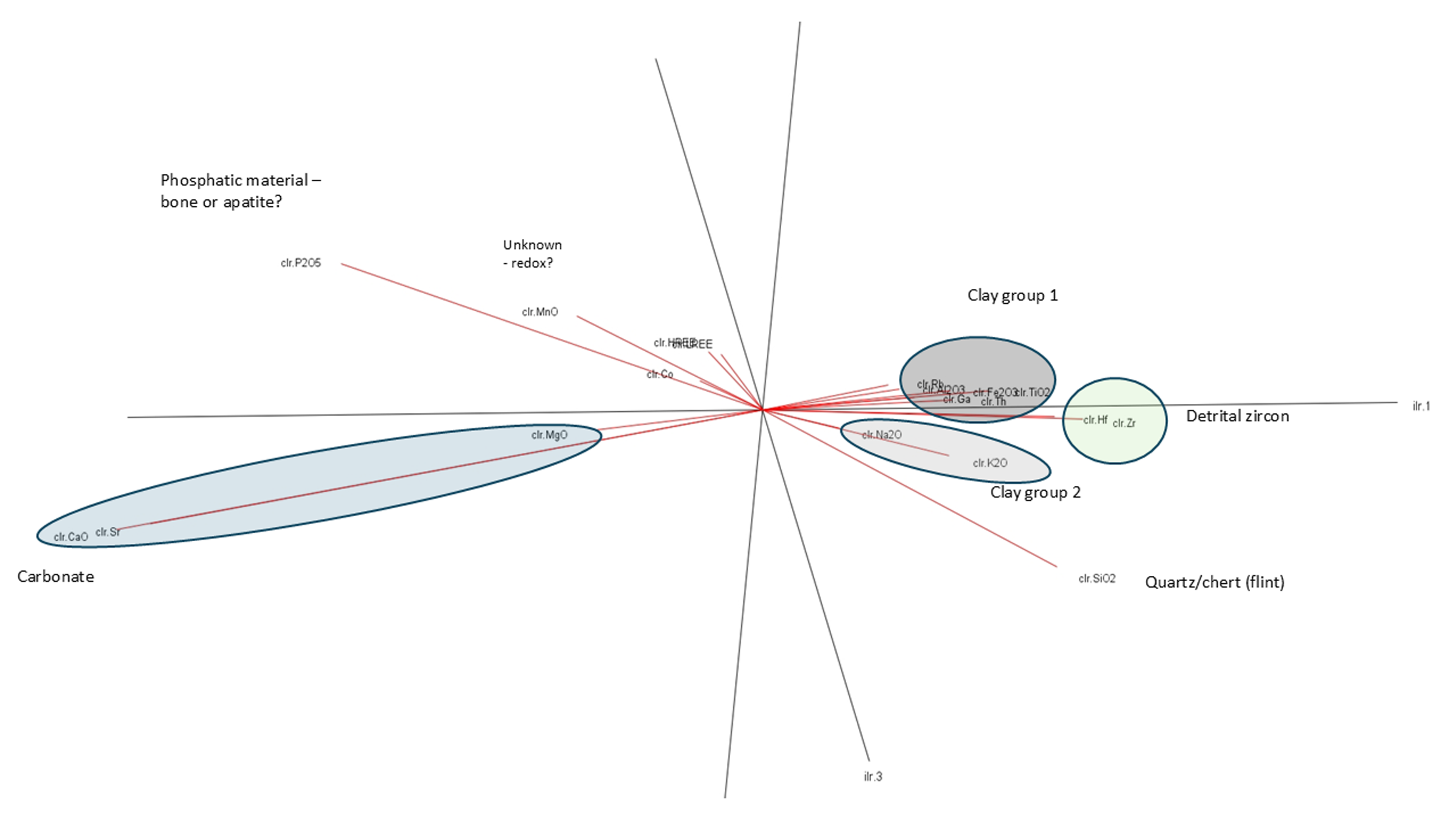
The results of the elemental analysis provided the foundation for constructing a chemical stratigraphy (chemostratigraphy) following the method described in Finlay et al. (2022). Initially, the data were evaluated statistically using Principal Component Analysis (PCA, Fig. 19). PCA is a statistical technique used to simplify multi-dimensional datasets while retaining the variation in the data. Therefore, as the ICP analysis produces data for 49 elements for every sample analysed in this study, the PCA establishes the main variations in the data. PCA analysis revealed three groups of elements, likely being driven by variations in the carbonate (chalk) and clay content, as well as elements probably associated with phosphatic material (possibly bone derived?), quartz or chert (possibly flint?) and detrital zircon variations (e.g. Finlay et al. 2022).
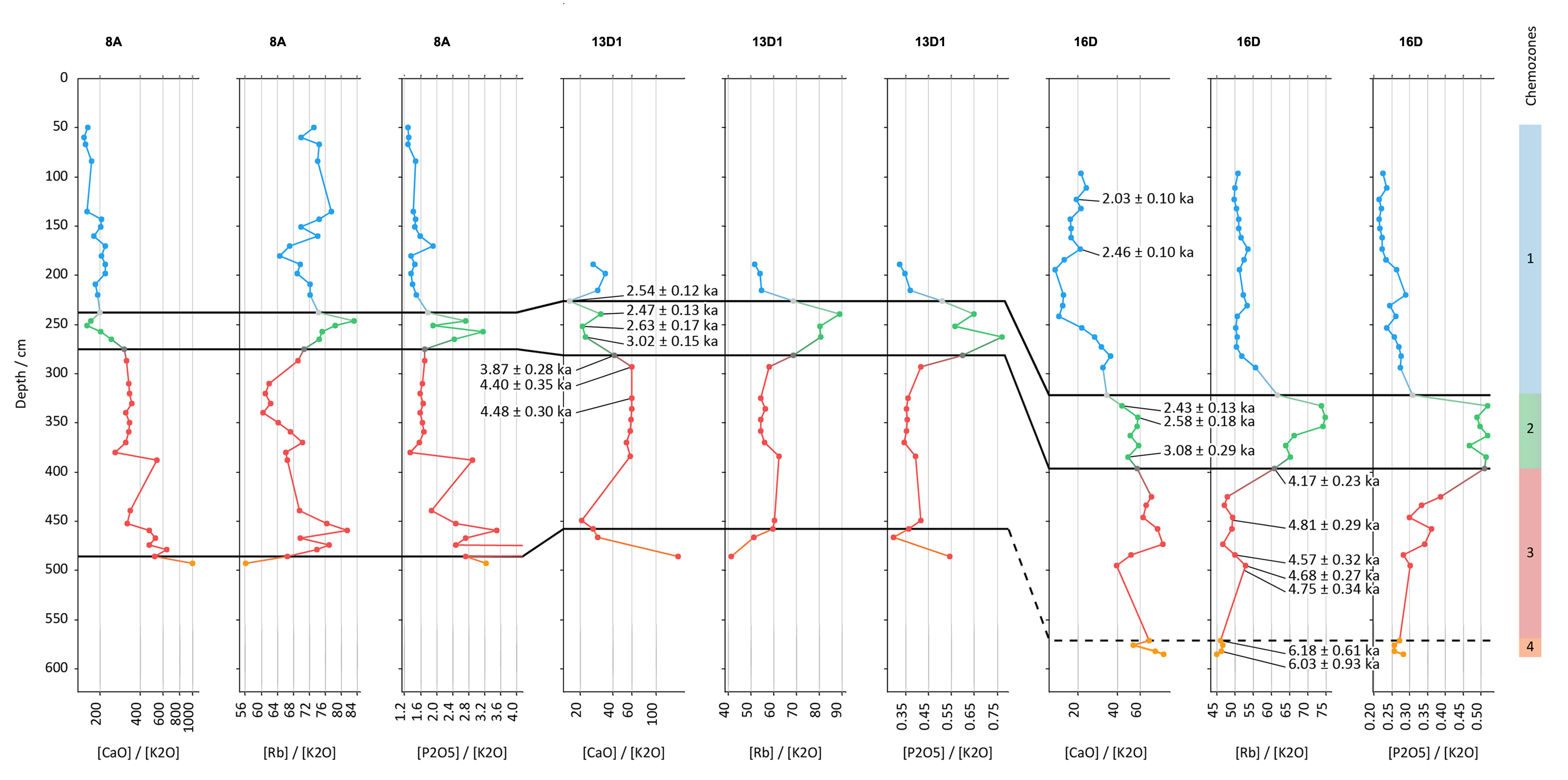
After visual inspection of down-core variation, three elemental ratios were selected to establish four chemo zones (CZ1 –CZ4; Table 11) reflecting similarities in soil texture and mineral content.
Chemostratigraphic correlation involves the characterisation, correlation or differentiation of sedimentary rock successions based on stratigraphic variations in the elemental geochemical data (see Finlay et al., 2022). As all three cores analysed in this study display the same elemental profiles, this enables these chemo zones to be chemostratigraphically correlated across several of the Durrington Walls pits (Fig. 20).
The boundary between chemo zones (CZ) 1 and 2 is well correlated across WS 8A, WS 13D (1) and WS 16D. It is defined by a downhole decrease in CaO/K2O and increase in Rb/K2O and P2O5/K2O. The boundary between CZ2 and CZ3 is well correlated across WS 8A, WS 13D (1) and WS 16D. It is defined by a downhole increase in CaO/K2O and downhole decrease in Rb/K2O and P2O5/K2O. The boundary between CZ3 and CZ4 is well correlated in cores WS 8A and WS 13D (1), but is poorly correlated into WS 16D, due to a sample gap. The CZ3 and CZ4 boundary is defined by a large downhole increase in CaO/K2O and P2O5/K2O values and a large decrease in Rb/K2O values (Fig. 20 and Table 11).
Optically stimulated luminescence profiling and dating (OSL-PD) was applied to the sediments recovered from cores WS 1A, WS 2A, WS 3A, WS 5A, WS 8A, WS 16D, WS 13D (1) and WS 13D (2) to determine dates for the construction of the pits and obtain chronologies for the sequence of infills (chemo zones 1 to 3). The methodological approach of OSL-PD as described in Kinnaird et al. (2025) was followed: in the first phase of the investigation, portable OSL equipment is used to appraise the luminescence properties of the sediment recovered from the core. Core WS 13D (2) was examined in the field immediately after recovery; however, cores WS 1A, WS 2A, WS 3A, WS 5A, WS 8A, WS 16D and WS 13D (1) were retrospectively examined in the laboratory. In the second stage, a representative sub-set of the samples are progressed to calibrated OSL screening and characterisation in the laboratory. Finally, after consideration of the stage 1 and 2 datasets, strategic samples from across the cores were progressed to quartz SAR OSL dating – stage 3. Further methodological detail for stages 1 to 3 is provided in supplementary data file 8.
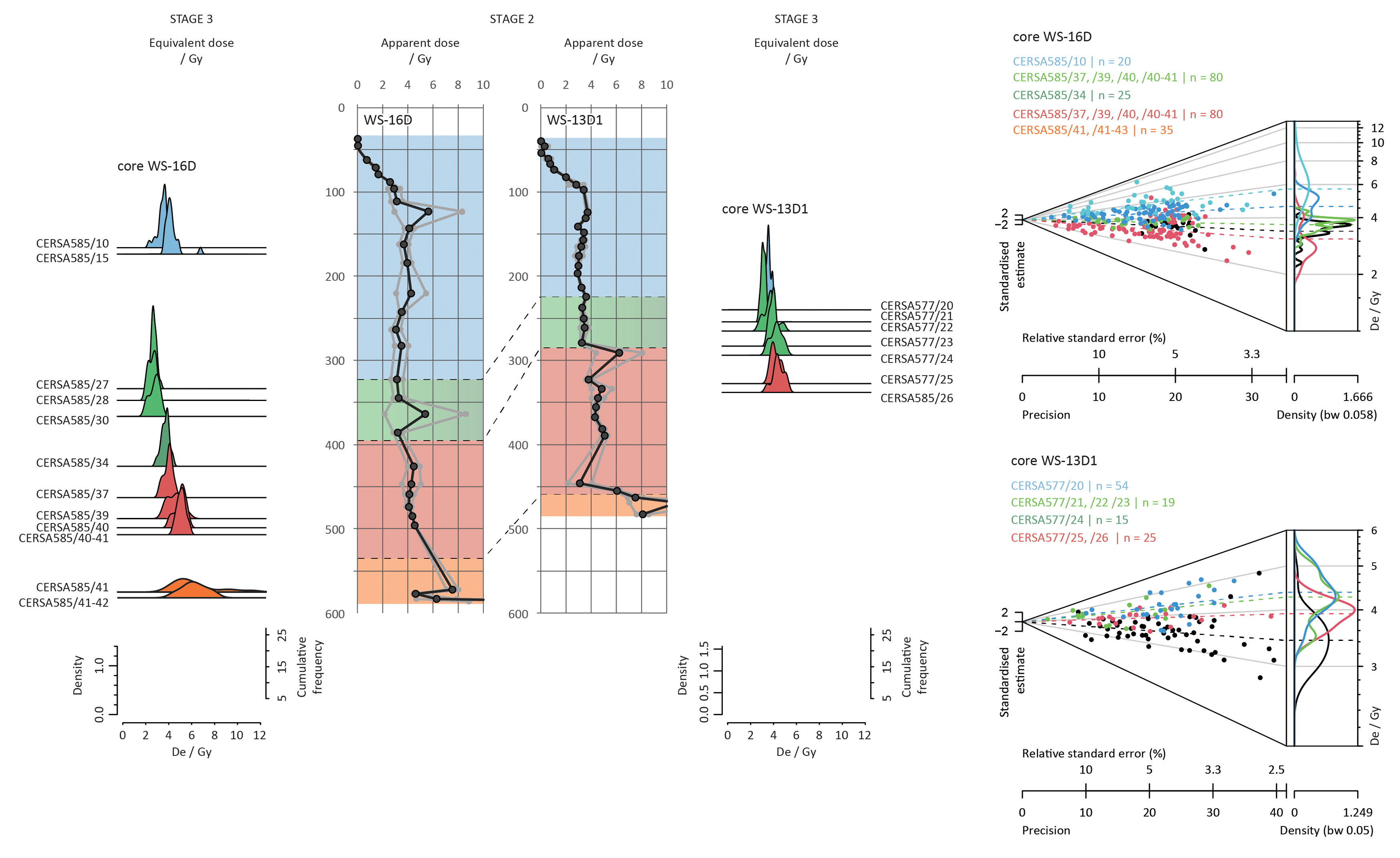
A luminescence age is the quotient of the burial dose (measured in Gy) over the environmental dose rate (mGy a-1). Table 10 lists the burial doses, total effective environmental dose rates and OSL depositional ages obtained from sediment recovered from cores WS 1A, WS 2A, WS 16D and WS 13D (1 and 2). The burial dose was determined through equivalent dose measurements on 24+ aliquots per sample using the single aliquot regenerative dose (SAR) OSL method (Murray and Wintle 2000). Figure 21 illustrates how the equivalent dose distributions vary with position in the core stratigraphy and in relation to the core chemostratigraphy. Environmental dose rates were calculated from the concentrations of K, U and Th determined by ICP-OES (K) and ICP-MS (U, Th) (as described above). The radionuclide concentrations were used to determine infinite matrix doses for α, γ and β radiation), using the conversion factors of Guérin et al. (2011), adjusted for attenuation by grain-size and chemical etching using the datasets of Guérin et al. (2012) and Mejdahl (1979), respectively.
| Field ID | Lab. code | Depth cm | Chemo zone | Palaeodose/Gy | Dose rate/mGy a-1 | Age/ka | Calendar years |
|---|---|---|---|---|---|---|---|
| WS1A-13 | 579-13 | 187 | ? | 1.46 ± 0.04 | 1.04 ± 0.05 | 1.41 ± 0.08 | AD 610 ± 80 |
| WS1A-14 | 579-14 | 195 | ? | 1.49 ± 0.05 | 1.00 ± 0.05 | 1.49 ± 0.08 | AD 530 ± 80 |
| WS1A-19 | 579-19 | 457 | 3 | 3.65 ± 0.15 | 0.71 ± 0.06 | 5.14 ± 0.48 | 3120 ± 480 BC |
| WS1A-20 | 579-20 | 464 | 3 | 2.68 ± 0.07 | 0.63 ± 0.06 | 4.24 ± 0.44 | 2220 ± 440 BC |
| WS1A-23 | 579-23 | 578 | 4 | 11.88 ± 1.73 | 0.69 ± 0.08 | 17.14 ± 3.14 | > |
| WS1A-24 | 579-24 | 585 | 4 | 7.87 ± 1.67 | 0.71 ± 0.08 | 11.14 ± 2.67 | > |
| WS1A-25 | 579-25 | 594 | 4 | 7.71 ± 2.40 | 0.72 ± 0.08 | 10.67 ± 3.53 | > |
| WS2A-43 | 581/43 | 669 | ? | 2.02 ± 0.05 | 5.19 ± 0.15 | 2.58 ± 0.1 | 550 ± 100 BC |
| WS2A-44 | 581/44 | 681 | ? | 1.95 ± 0.08 | 4.38 ± 0.26 | 2.25 ± 0.16 | 220 ± 160 BC |
| WS16D-10 | 585-10* | 123 | 1 | 3.27 ± 0.14 | 1.63 ± 0.05 | 1.94 ± 0.10 | AD 80 ± 100 |
| WS16D-15 | 585-15* | 175 | 1 | 4.11 ± 0.10 | 1.69 ± 0.05 | 2.36 ± 0.10 | 340 ± 100 BC |
| WS16D-27 | 585-27* | 333 | 2 | 2.67 ± 0.05 | 1.10 ± 0.05 | 2.36 ± 0.12 | 340 ± 120 BC |
| WS16D-28 | 585-28 | 344 | 2 | 2.53 ± 0.09 | 0.96 ± 0.05 | 2.64 ± 0.17 | 620 ± 170 BC |
| WS16D-30 | 585-30 | 385 | 2 | 2.52 ± 0.17 | 0.98 ± 0.06 | 2.55 ± 0.23 | 540 ± 230 BC |
| WS16D-34 | 585-34* | 400 | 3 | 3.63 ± 0.08 | 0.89 ± 0.04 | 3.96 ± 0.21 | 1940 ± 210 BC |
| WS16D-37 | 585-37* | 450 | 3 | 3.88 ± 0.09 | 0.82 ± 0.05 | 4.59 ± 0.28 | 2570 ± 280 BC |
| WS16D-39 | 585-39 | 484 | 3 | 4.49 ± 0.22 | 0.99 ± 0.05 | 4.53 ± 0.31 | 2510 ± 310 BC |
| WS16D-40 | 585-40 | 495 | 3 | 4.99 ± 0.20 | 1.08 ± 0.04 | 4.63 ± 0.26 | 2610 ± 260 BC |
| WS16D-40b | 585-40 to 41* | 500 | 3 | 5.07 ± 0.08 | 1.07 ± 0.07 | 4.62 ± 0.30 | 2600 ± 300 BC |
| WS16D-41 | 585-41 | 571 | 4 | 4.92 ± 0.41 | 0.81 ± 0.04 | 6.08 ± 0.60 | 4060 ± 600 BC |
| WS16D-41b | 585-41 to 42* | 582 | 4 | 4.59 ± 0.65 | 0.76 ± 0.04 | 5.87 ± 0.88 | 3850 ± 880 BC |
| WS13D1-19 | 577/19 | 215 | 1 | 3.27 ± 0.07 | 1.22 ± 0.07 | 2.69 ± 0.16 | 670 ± 160 BC |
| WS13D1-20 | 577/20 | 226 | 2 | 3.50 ± 0.07 | 1.38 ± 0.06 | 2.54 ± 0.12 | 520 ± 120 BC |
| WS13D1-21 | 577/21 | 239 | 2 | 3.05 ± 0.06 | 1.24 ± 0.06 | 2.47 ± 0.13 | 450 ± 130 BC |
| WS13D1-22 | 577/22 | 252 | 2 | 3.65 ± 0.16 | 1.39 ± 0.07 | 2.63 ± 0.17 | 610 ± 170 BC |
| WS13D1-23 | 577/23 | 263 | 2 | 3.90 ± 0.08 | 1.29 ± 0.06 | 3.02 ± 0.15 | 1010 ± 150 BC |
| WS13D1-24 | 577/24 | 281 | 3 | 4.18 ± 0.18 | 1.08 ± 0.06 | 3.87 ± 0.28 | 1850 ± 280 BC |
| WS13D1-25 | 577/25 | 293 | 3 | 4.04 ± 0.17 | 0.92 ± 0.06 | 4.40 ± 0.35 | 2390 ± 350 BC |
| WS13D1-26 | 577/26 | 325 | 3 | 4.38 ± 0.13 | 0.98 ± 0.06 | 4.48 ± 0.30 | 2460 ± 300 BC |
| WS13D2-9 | 587/9 | 443 | 2 | 4.49 ± 0.14 | 1.57 ± 0.06 | 2.87 ± 0.14 | 850 ± 140 BC |
| WS13D2-10 | 587/10 | 466 | 3 | 6.02 ± 0.20 | 1.32 ± 0.06 | 4.57 ± 0.25 | 2550 ± 250 BC |
| WS13D2-11 | 587/11 | 475 | 4 | 7.26 ± 0.67 | 1.22 ± 0.06 | 5.95 ± 0.62 | 3930 ± 620 BC |
| WS13D2-12 | 587/12 | 483 | 4 | > | 1.11 ± 0.07 | > | > |
Table 11 summarises the OSL and geochemistry of the cores (blue shading chemo zone 1, green chemo zone 2, red chemo zone 3 and orange chemo zone 4). It demonstrates coherent, comparable stratigraphies within each of the investigated cores. The base of CZ3 is dated to 2480 ± 130 BC, or 2350-2610 BC, based on the weighted combination of ages across WS 1A, WS 13D (1), WS 13D (2) and WS 16D. This marks the pit base, so provides a constraint terminus ante quem for construction, i.e. mid-3rd millennium BC. There is little age-progression through the main body of CZ3, implying a rapid sedimentation rate. The transition from CZ3 to CZ2 is dated to between 1850 ± 280 BC and 1940 ± 210 BC (cores WS 13D (1) and WS 16D, respectively) and 1010 ± 150 BC and 850 ± 140 BC (cores WS 13D (1) and WS 13D (2)). The main body of CZ2 is dated to, most probably, between 610 ± 170 BC and 540 ± 230 BC, and the top, to 450 ± 130 BC and 340 ± 120 BC, cores WS 13D (1) and WS 16D, respectively. This implies that for the investigated cores, CZ2 was deposited over c.300–200 years. A single constraint for CZ1 was obtained in WS 16D, the sediment at 123cm depth in core returned an age of AD 80 ± 100
| Chemo zone | OSL age | Depth (m) – core window sample | Interpretation | |||
|---|---|---|---|---|---|---|
| WS 8A | WS 13D (1) | WS 16D | ||||
| CZ1 | <340 BC | Organic-rich chalk-poor fill | ||||
| Boundary | ~540–340 BC | ~2.38 | ~2.26 | ~3.22 | ||
| CZ2 | Bone-rich unit with distinct clay mineralogy | |||||
| Boundary | ~1940–1850 BC | ~2.75 | ~2.81 | ~3.96 | ||
| CZ3 | Moderate chalk content increasing at base of zone, mirrored by clay content | |||||
| Boundary | ~2480 BC | ~4.79 | ~4.58 | ~<5.71 | ||
| CZ4 | ~>4000 BC | Boundary with natural chalk basement | ||||
SedaDNA analysis was applied to 83 samples spanning cores WS 1A, WS 2A, WS 3A, WS 5A, WS 7A, WS 8A, WS 13D and WS 16D to determine the ecological composition of the cores, authenticate the presence of ancient DNA, and assess for evidence of taphonomic processes at work. Cores were sampled at the University of Warwick's ancient DNA facility under red light and subjected to CTAB-based DNA extraction (see supplementary data file 9 for methodology). Shotgun libraries (untargeted libraries of all DNA present) were prepared and sequenced on the Illumina NextSeq platform. After initial bioinformatic processing, taxonomic assignations were achieved using Phylogenetic Intersection Analysis (PIA) (Cribdon et al. 2020). SedaDNA reads were authenticated for damage using MetaDamage, which utilises the characteristic pattern of C-T and complementary G-A mismatches at the 5' ends of DNA molecules caused by cytosine deamination over time, typical of ancient DNA. Samples were assessed for evidence of post-depositional DNA movement through stratification and diffusion analyses, first described in Allaby et al. (2023). Stratification analysis tests whether DNA has moved after deposition by assessing whether read counts of taxa present in adjacent samples could have been drawn from the same underlying beta distributions. Diffusion analysis assesses the likelihood that DNA patterns are a result of diffusion between adjacent samples and estimates the proportion of the read counts observed that could be explained by diffusion from an adjacent sample. The analysis also employed a depositional model (Allaby et al. 2023) to estimate whether the DNA present originated from local sources (direct deposition) or originated from a distal source (associated with sediment source location) and brought in with influxing sediments.
Stratigraphic independence tests show that 82% of the taxa found within the pits sampled came from distinct underlying statistical distributions, indicating a generally stratified signal (see Table 9.1 in supplementary data file 9). This suggests that DNA is not undergoing reworking/movement after it has been deposited. We also found little evidence of post-depositional DNA diffusion, supporting this conclusion (see Table 9.1 in supplementary data file 9). The depositional model showed that read counts were best explained by a mix of depositional scenarios. All sediments in this study were silts of varying colour; yellow, brown or red. When analysed as a combined group, regardless of colour, all sediments show that 57% of the DNA present is associated with sediments from influxing sources, while the remainder is attributable to an immediately local origin. When sediment types are considered separately, yellow silts show a dominant local signal, but the influence of distal sources is correlated with progressively darker sediments, with brown silts showing 93% of DNA is associated with distal sources and influxing sediments (see Table 9.2 in supplementary data file 9). These findings support the interpretation from the chemostratigraphy and OSL that the infilling of these pits may not have been due to natural processes since the sedaDNA taphonomy changes with the infilling process, suggesting a change from the original system and possible rapid periods of infilling in which the local signal becomes negligible. MetaDamage analysis shows a trend of increasing damage signature with increasing depth in the cores, supported by the OSL dates (Figs 9.1–9.8 in supplementary data file 9).
Our taxonomic assignations show that Durrington Walls likely resided in a meadow-like landscape, with a high proportion of large mammal signals (Ovis and Bos) present within the lower strata of the pits sampled. The deposition of these large mammal signals appears not to be random, with Ovis localised to the south and Bos present to the north and south (Fig. 22). The animal signals associated with ancient DNA correspond to chemostratigraphic zones CZ2 and CZ3 in cores WS 16D, WS 13D and WS 8A, which are bone/phosphoric rich zones, with bone fragments found at 4.79m in CZ3 of WS 8A.
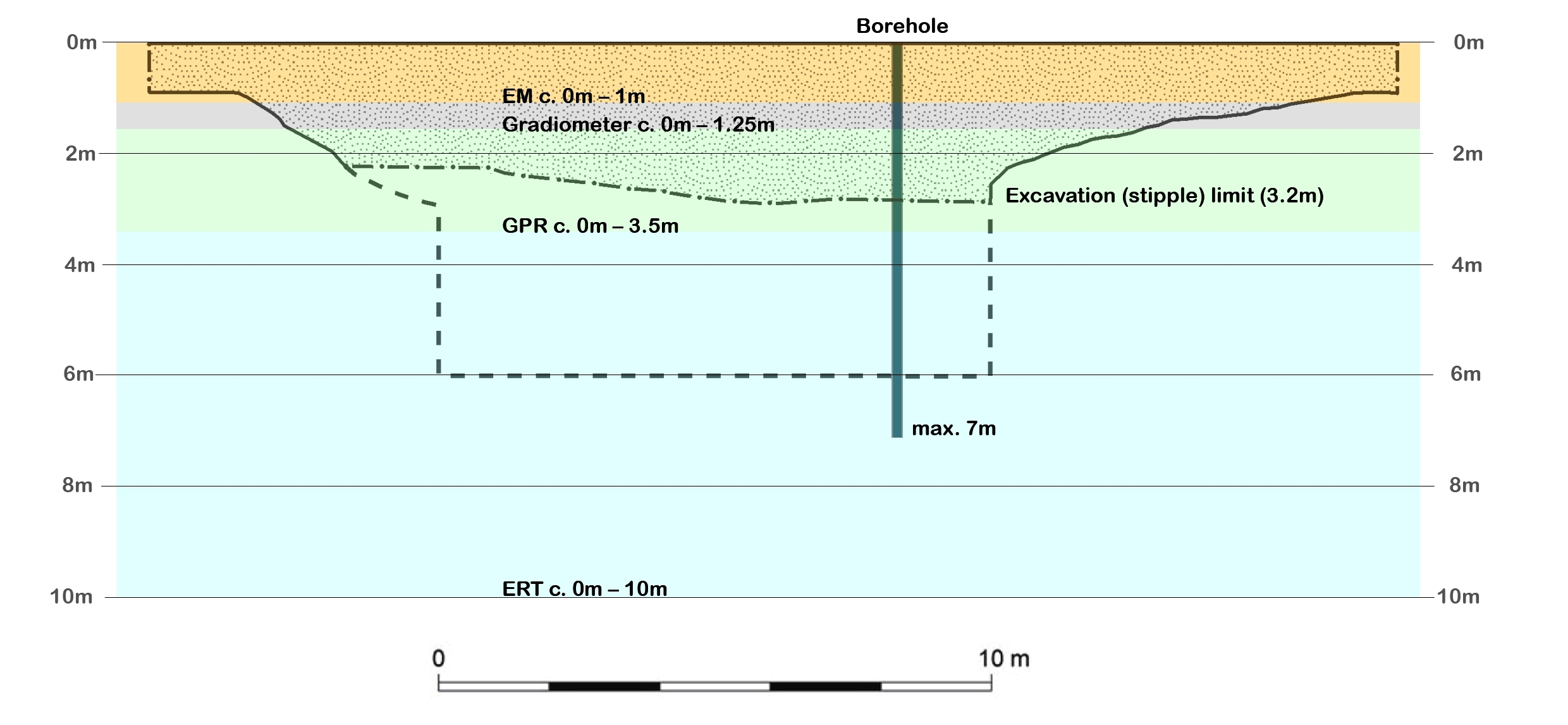
For illustrative purposes, Figure 23 provides a schematic overview of the relative depths of penetration of the various invasive and non-invasive techniques applied to the pit features near Durrington Walls Henge. To date, none of the recorded pits has been subject to total excavation. It is likely that the partial excavations that have been carried out were not able to clarify the nature of such large features. Mitigation excavations were of necessity limited and, in all likelihood, did not generally extend below the erosion cone of the features revealed by remote sensing. Coring, however, provided invaluable information on the sediments contained within each pit and underpinned the detailed analysis provided through geochemistry and sedaDNA as well as providing crucial dating evidence. Core data frequently confirmed the depth of individual features, although this was not the case in pits 2A, 5A or 15D (Table 1; Thompson and Powell 2018, 40–41). Moreover, individual cores could not provide information on the full geometry of these features. Consequently, information on the diameter and shape of specific pits was generally provided through remote sensing.
Unsurprisingly, individual remote sensing methods were unable to completely define the nature of these features. EM and gradiometry, as applied here, provided information on the shape of the upper levels of these features to a maximum of 1 to 1.25m, but did not generally penetrate beyond the weathering cone. In contrast, GPR could, under the best of conditions, penetrate beyond the erosion cone and up to 4m in depth. Time-slicing of the GPR data also provided information on the changing shape of the features beyond the erosion cone. This was key to confirming the uniformity of the surveyed pits both in size and shape, thereby linking them as part of a larger structure. Among the remote sensing techniques applied, only ERT located the base of pits consistently. However, the application of ERT at Durrington provided sections rather than plans and the spacing of the electrodes (0.5m, 1m, 2m, and 3m) necessarily reduced the resolution of the data in comparison to, for example, gradiometry.
Clearly, no individual technique provided the range of data required to characterise the Durrington Walls pit alignment. However, in the absence of a large and expensive excavation, the application of a range of techniques at Durrington has provided the information required to characterise the pit structure and certainly provides a model for the rapid exploration of similar massive features elsewhere.
As stated in the introduction, the original intent of this article was to provide supplementary information to that contained within our earlier publication on the pit group surrounding Durrington Walls (Gaffney et al. 2020). However, the emphasis here was necessarily modified to consider published discussion of the earlier work, and notably that contained in articles by Ruggles and Chadburn (2024) and Leivers (2021). While the authors are aware that the history of research in the Stonehenge landscape is littered with contentious claim and counter claim, not all of which are of equal value, the team felt that, on this occasion, a response was required.
The arguments provided by Ruggles and Chadburn (2024) essentially highlight several key issues. It is asserted that the original publication demonstrates the dangers of data selection, as well as of biased interpretation, 'not least because many of the areas in and around the “circle” have not been investigated. Many comparable features being omitted' (Ruggles and Chadburn 2024, 104). The dating of the investigated features was also considered suspect, with individual pits varying in date by around 4000 years. Following these observations, it is claimed that the pit circle identified in our earlier paper is a portmanteau, comprising a series of unrelated and unverified features, some of which had been identified as sinkholes
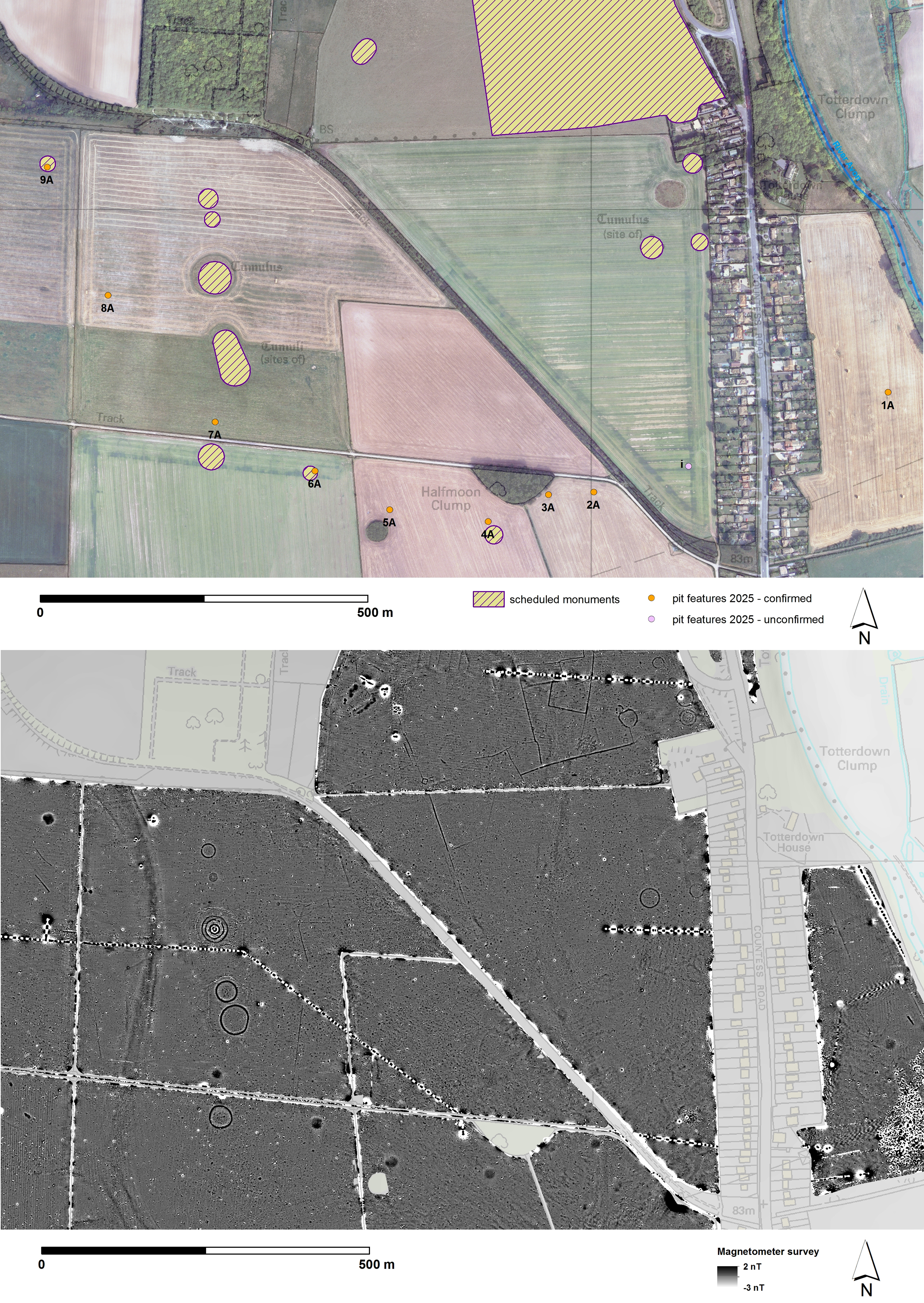
Although survey has demonstrated that those features interpreted as pits are similar in character, size and depth, and that these observations are replicated north and south of Durrington Walls (Fig. 1), Ruggles and Chadburn suggest that the separation of these features as a distinct and coherent group is a result of biased decision-making. To demonstrate this, their article includes a map of known archaeological features in the vicinity of the southern arc of features (Ruggles and Chadburn 2024, fig. 3). The absence of any consideration of these sites within the original paper is held to be evidence for selective interpretation. In fact, the entire area of Durrington Walls and the adjacent land has been surveyed by the Stonehenge Hidden Landscapes project. Although subject to a separate publication process, some of the information for these features has already been released and utilised by other academics (Gaffney et al. 2018, figs 1 and 2; Bowden et al. 2015, table 3.1). However, for the purposes of this article, the relevant data are reproduced in Figure 24. Setting aside the three pit features (4A, 6A and 9A). which are clearly not transcribed by Ruggles and Chadburn in their correct position, consideration of the geophysical anomalies associated with the remaining 'comparable' features confirms that these cannot be analogous with those selected for study as part of this sub-project. Most archaeologists would readily interpret these as Neolithic mortuary structures, simple and complex ring features and later enclosures, and morphologically distinct from those studied as part of this and the 2020 paper (see supplementary data file 10 for detail on individual sites).
Consequently, far from being impacted by 'Missing Data', as Ruggles and Chadburn's original paper suggested, the results presented here are part of a larger dataset that clearly distinguishes these features from any others adjacent to Durrington Walls. The exclusion of any monument in our previous publication was primarily the result of an interpretation based on their geophysical response. That, along with information recorded in publicly available archives, demonstrated that excluded features were not comparable with those anomalies selected for detailed study and which appeared to form part of a coherent cluster (https://historicengland.org.uk/listing/the-list/).
Having asserted the consistency of the features in morphological terms, a comment on the potential origin of the features forming the Durrington pit alignment is required. Ruggles and Chadburn (2024) and Leivers (2021) suggest that a significant number of pit-like features, notably in the north, are of natural origin and probably sinkholes, and that the putative pit structure should be discounted on that basis. While they do not actually provide any justification for this statement, it should be noted that our original paper (Gaffney et al. 2020) did not discount the origins of some of these features as natural. Indeed, it was stressed that 'if any of the features near Durrington originate as natural features, it seems reasonable to suggest that a larger monumental circle may have emerged, centred on the area of the Durrington Henge, and involving tens of similar, massive pits' (Gaffney et al. 2020). Given the lack of a comprehensive excavation of any of these features it is better that we turn to the wider geological context for explanation.
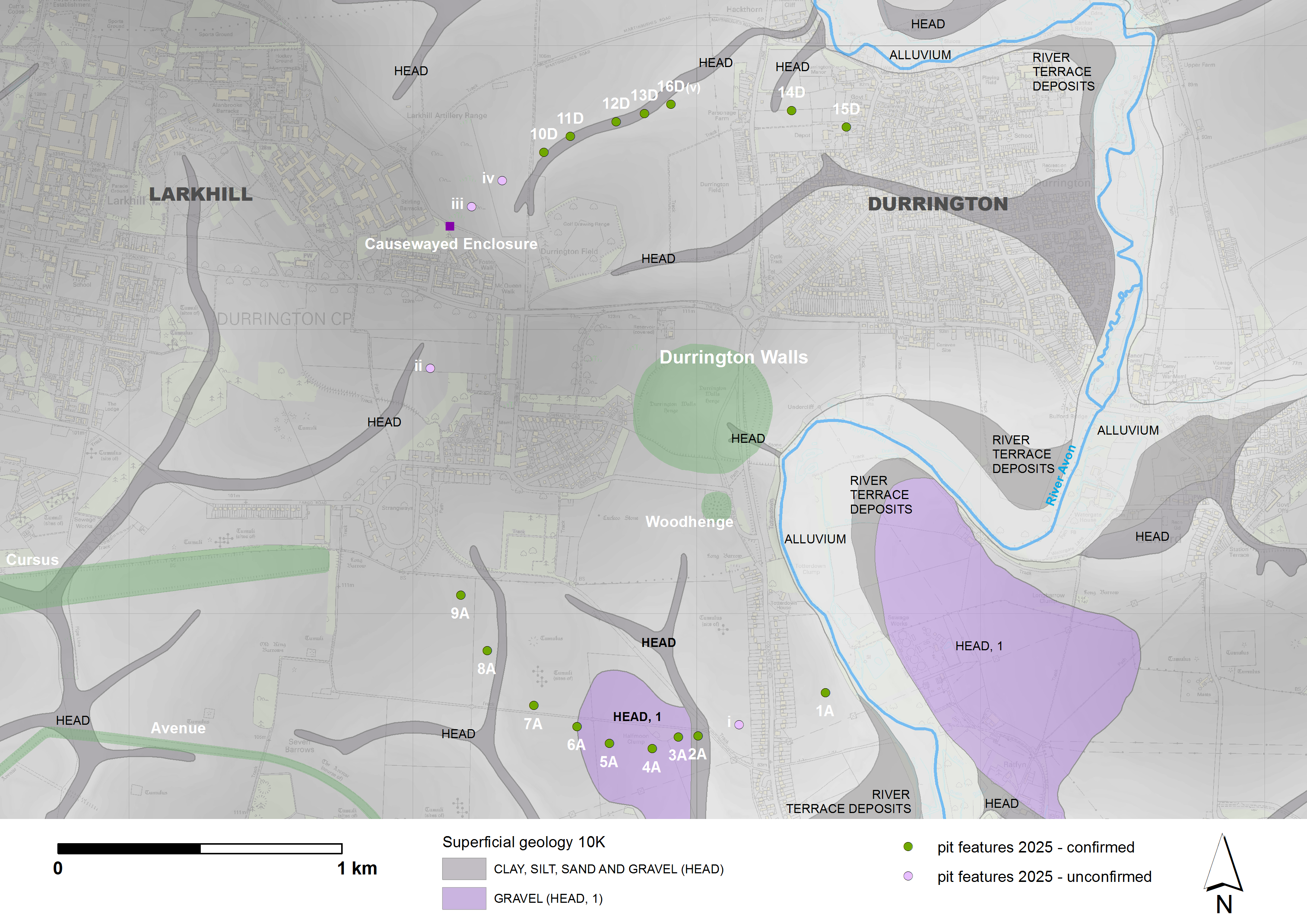
Geologically, all the features under investigation here are located on a layer of Late Cretaceous Chalk which is approximately 85 million years old. These rocks are locally called the Seaford Chalk Formation. Features 2A, 12D and 13D lie within dry valleys with superficial head (clay, silt, sand and gravel) deposits, while features 3A, 4A and 5A are associated with superficial head (gravel) deposits (Figure 25).
Several characteristics associated with active sinkholes can be considered when examining the likely origin of our features. According to Waltham et al. (2005), active sinkholes in the United Kingdom are often small and of limited distribution. However, buried sinkholes are common near the chalk and Tertiary bedrock contact (Waltham et al. 2005) and their formation process often necessitates the presence of overlying Tertiary sediments. Today there is no Tertiary sediment cover in the vicinity of the study area. Sperling et al. (1977), who examined the density of solution hollows on the chalk in Dorset, note their high density, reaching 99/km2 at Southover Heath and 157/km2 on Puddletown Heath but without any discernible patterns of distribution. The size of the features in the Dorset study has the modal distribution between 10–20m while their average depth (rampart to centre) is typically 2–4m. Mapping of the distribution of sinkholes within the Salisbury Plain area (Hopson et al. 2006) clearly shows that sinkholes throughout the district are associated with the river drainage networks across the region rather than being distributed across the flatter interfluves between the rivers, as is the case for a significant number of the features forming the Durrington pit circle.
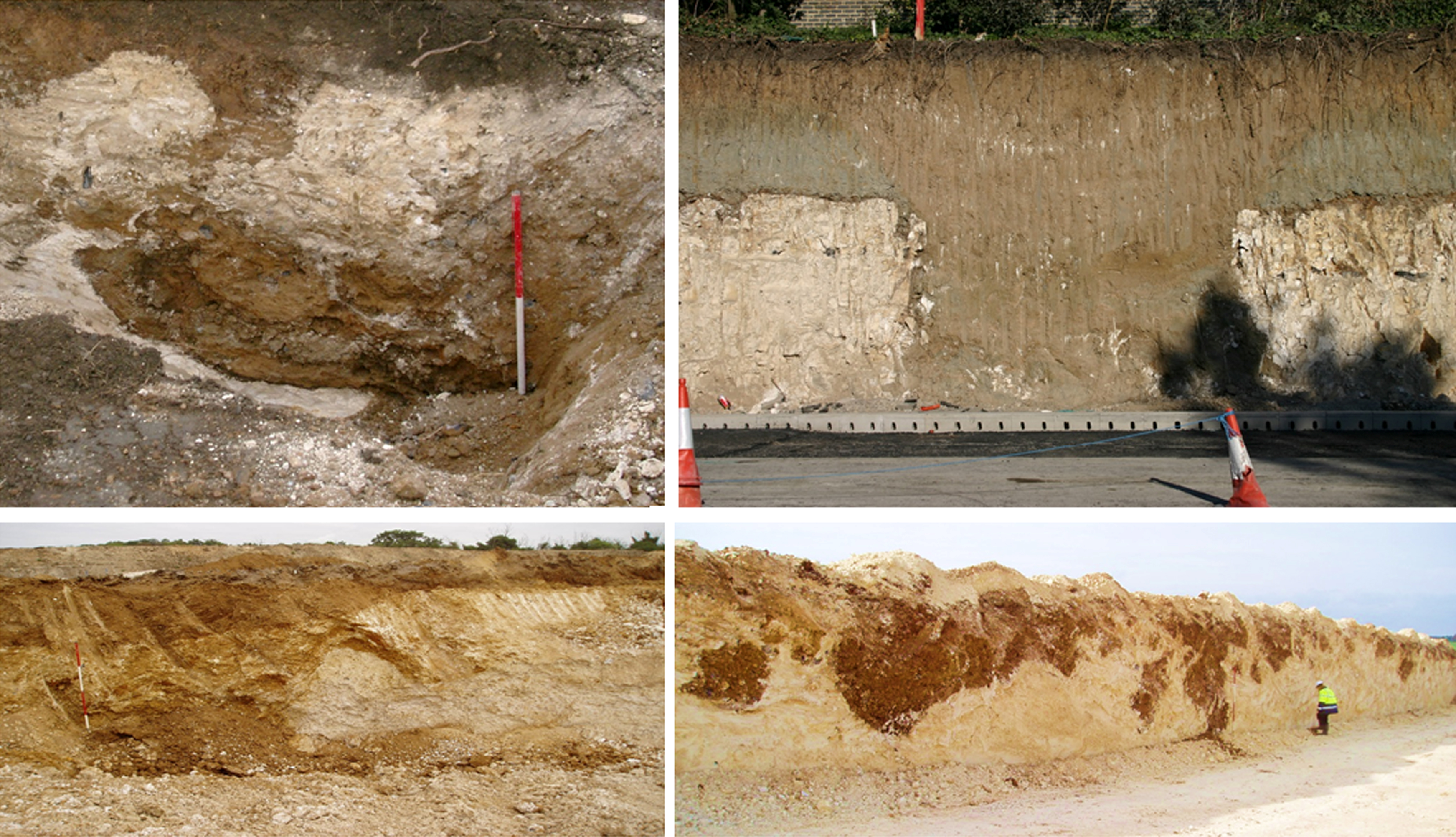
Structurally, natural solution features in chalk exhibit a thin, blackish clayey band, usually up to 1cm in thickness between the chalk bedrock and the sediments infilling a solution feature (Chartres and Whalley 1975). The contact with the underlying chalk rubble is always sharp but the contact into the overlying loamy gravels is often graded over 10–50mm. This black band of clay is often continuous around the whole margin of the solution feature but is notably absent in those features cored to bedrock as part of this study (Fig. 26).
The origin of sinkholes remains somewhat opaque. Sperling et al. (1977) suggest that, in Dorset, these features result from intense and localised solutional activity promoted by highly acidic conditions under heathland conditions. The association of the distribution of Tertiary sediments with solution in the underlying chalk is indicative of the activity of underground processes at work in the creation of the sinkholes rather than necessarily formation occurring under subaerial conditions (Jeffrey et al. 2020). Thorez et al. (1971) have demonstrated that around South Mimms the fills of solution features are predominantly derived from the Tertiary sediments, indicating formation beneath the Tertiary cover rather than subaerially.
Consequently, we argue that these features are not sinkholes as they do not conform to the internal structure, or distribution, commonly associated with such features. Furthermore, such features are typically of some antiquity (e.g. in Kent, Middle and Lower Palaeolithic material can be found in such features) and consequently the young age of the fills dated as part of this project mitigates against a natural origin. Most significantly, perhaps, is the observation that the formation processes necessary to create such natural features cannot have existed within the time frames indicated by the dating of the sediments infilling the features reported here. If creation of natural sinkholes requires a cover of Tertiary sediments over the chalk, then such a cover would have to have existed prior to and during the Neolithic period, as indicated by the dating evidence from the features. Subsequently this cover would have to be removed across the whole of the study area. There is no indication of such large-scale stripping of Tertiary sediments in this landscape currently. A final point relates to the geometry of the structure. The initial publication recorded the location of large pit-like anomalies, derived from remote sensing and other available data, across the Stonehenge landscape (Gaffney et al. 2020, fig. 9, see also supplementary data file 10, section 10.3, figure 10.6). The proposed structure is clearly distinct from other recorded features, primarily in the manner in which the pits appear to conform to a band c.864m from the boundary of the henge (Gaffney et al. 2020, figs 22 and 23). This distinctive pattern emerges irrespective of topography and presents an arrangement that most would regard as unusual if these were solely composed of natural features.
If the features, overall, are unlikely to be of geological origin, what then can we determine from the evidence provided through the chemostratigraphic and dating programmes applied to the cores retrieved from individual pits? It is certainly not possible to confidently distinguish whether fills are formed by natural infilling or by anthropogenic processes from chemistry alone. The chemostratigraphy, combined with OSL dating, demonstrate that the fills within the studied pits comprise three chemically and chronologically distinct units that correlate across the site (Fig. 20). This regularity of pit fills around Durrington Walls could be explained by a 'layer cake' stratigraphy across the entirety of the superficial geomorphology of the general Durrington area. However, the geophysics show that these features are distinct within the landscape. Furthermore, Core 13D (1) is sited inside a different superficial geological unit to core 16D (Fig. 25) and therefore it is highly unlikely if both features were natural that they would have the same fill composition. The chemostratigraphy (along with the lithology) also suggests that the boundaries between these units are sharp. Such patterns conform to those seen in cut features and in contrast with rather more gradational contacts seen in natural solution hollows (see Fig. 26).
Ruggles and Chadburn (2024) assert that the dating of the investigated pits is suspect, with features varying in date by around 4000 years. In fact, detailed OSL dating undertaken during this study shows that the chemostratigraphic boundaries in cores WS 1A, WS 13D (1), WS 13D (2) and WS 16D are of equivalent age, within error, providing a constraint for the base of CZ3 at 2480 ± 130 BC, or 2350-2610 BC, which also provides a terminus ante quem for construction of these pits (Table 10 and Table 11). The top of CZ3 is dated to c.1900 ± 170 BC, and there is likely a hiatus between deposition of CZ3 and CZ2, with CZ2 dated to between 610 ± 170 BC and 340 ± 120 BC in cores WS 13D (1) and WS 16D. Ruggles and Chadburn (2024) highlighted the inversion observed in the radiocarbon ages reported in Gaffney et al. (2020) for core WS 8A. Gaffney et al. (2020) argue for construction of pit 8A in the mid 3rd millennium BC, based on the basal radiocarbon date of 2460-2270 cal BC (78%) or 2260-2200 cal BC (17%). This is in good agreement with the dates for construction of pits 1A, 16D and 13D. The additional dates in core WS 8A – 3930-3870 cal BC (11%) and 3810-3690 cal BC (84%) at 435-440cm depth and 4750-4550 cal BC at 150-155cm depth are from parts of the cores that were shown to be re-deposited. In these parts of the sequences, the sediment is characterised by intensities in excess of the down-profile signal-depth progression, i.e. the luminescence is dominated by residual signals. These instead provide an insight on the adjacent landscape and palaeo-environment, and a terminus post quem for sediment in the immediate vicinity to the pits (a conclusion corroborated with the OSL ages obtained for CZ4, >c.3850 BC). Gaffney et al. (2020) also argued for recuts within the pits, based on a radiocarbon date of 1390–1340 cal BC (13%) or 1310–1160 cal BC (79%) or 1150–1130 cal BC (3%) from 5.18m depth in WS 5A. This agrees with the OSL ages obtained at the transition between CZ3 and CZ2 in WS 13D (1) and WS 13D (2). Consequently, rather than being a recut, this probably indicates the same chemostratigraphy in WS 8A as WS 1A, WS 13D (1), WS 13D (2) and WS 16D. Thus, the independent chronologies are in agreement and, together with the geochemistry and sedaDNA damage proxies, suggest that it is highly unlikely that the consistent fills across the larger area of the site are natural. Instead, it is more likely that some of these pits may have been deliberately filled in a similar manner, or process, during parts of their histories.
The results of fieldwork presented here supports previous assertions that Durrington Walls henge is surrounded by a ring of massive pits that form a cohesive structure incorporating the earlier Larkhill Causewayed Enclosure (Gaffney et al. 2020). Contra Ruggles and Chadburn (2024), those features that they highlight as missing from our interpretation differ significantly to those identified as pits (see supplementary data file 10). As was stressed in our earlier publication, some pits may well have originated as natural features. However, since none of the features identified through fieldwork have been fully excavated, there is currently no evidence to support such an assertion, in the manner attempted by either Ruggles and Chadburn (2024) or Leivers (2021). Despite this, it remains true that, while the consistent size, shape and depths of those features interpreted as pits suggest linkage, it is not possible to definitively exclude the existence of other, perhaps earlier, structures within such large features.
Setting aside the significance of internal features that are currently hypothetical, it remains true that not all the cored features provided a detailed chronology. However, fieldwork has produced temporal evidence for complete stratigraphic profiles of individual pits, and the results of OSL dating, combined with the geo-stratigraphic and DNA analysis presented here, suggest that pits across the cluster are characterised by consistent morphological profiles. They also support a later Neolithic date for the emergence of the pit alignment. There is, furthermore, the possibility that some of these features, at least, may have been deliberately infilled, and that the DNA data provides intriguing evidence for structured deposition or, at least, the preferential presence of animals between the northern and southern arcs of pits, and perhaps a distinction between upper and lower pit deposits. Such a statement is necessarily provisional, although the evidence for structured deposition of animal parts at Woodhenge provides a context for such observations (Pollard 1995). Published data from pits in the Stonehenge region also hints at changes in meat preferences across the Neolithic (Worley et al. 2019). Consequently, given the stratigraphic position of the sedaDNA samples, there is a possibility that such patterns may have a temporal aspect. The value of further work to establish the role of sedaDNA analysis within terrestrial, archaeological field work is evident from the study presented here, but the cumulative evidence for the cultural context of such detail is gradually emerging.
Having demonstrated the likely cultural component of the pits, is it possible to add to the interpretation presented as part of the original paper? That publication contained a summary of the evidence for the digging of substantial pits elsewhere during the Neolithic. While it is not the intention to repeat such information, our knowledge of such activities has progressed since the work at Durrington Walls was initiated. It is noteworthy that the practice of digging very large pits during the Mesolithic period is attracting increasing archaeological interest across Britain (Gaffney et al. 2013; Luke and Kozimiński 2023; Wolframm-Murray 2024). Examples of recent finds include the cluster of large pits at Milltimber, Aberdeenshire (Dingwall 2018), while the recent discovery of at least 25 large pits at Linmere, in Bedfordshire, adds significantly to the corpus of such finds. Excavated by Museum of London Archaeology (MOLA) and Albion Archaeology, these features are asserted to be of a monumental scale, and up to 5m wide and 1.85m deep (Gaffney et al. 2023). Dated between 8500 and 7700 years ago, the excavators state that the current pit count is unlikely to represent the total number of such features. The pits do not appear to have a hunting or storage function, while their location next to water and, potentially, their arrangement suggest a 'special significance' (Alberge 2023). The presence of individual large, Mesolithic pits, including examples at Stonehenge, also indicate the archaeological value of such apparently prosaic features (De Smedt et al. 2022). There is therefore an increasing context for the special nature of large pits, individually or in clusters, dating from the Mesolithic at least, while the evidence from later periods incorporates formal monuments that may include, or be composed of, pit-like features (Gaffney et al. 2020).
While the size and scale of the pit circle at Durrington might, initially, be considered surprising, the alignment is set within a landscape that is testament to the capacity of prehistoric communities to invest in the construction of large, and frequently unique, monuments. The construction of a pit circle, even at the scale demonstrated at Durrington, was clearly not an exceptional act for communities that could erect Stonehenge. Consequently, as data accumulates on the extended history and significance of pit-digging in prehistory, the lesson may be that the existence of large pit clusters or structures should probably be anticipated during fieldwork, rather than simply encountered. We should certainly not dismiss such features as natural, coincidental or insignificant to past communities.
There are, nevertheless, characteristics of the Durrington pit group, and its development, that do deserve further comment, even when set within a landscape as complex as that surrounding Stonehenge. The significance of emergent complexity within archaeological landscapes is well established (Tilley 1994), and the potential for monument groups to be ordered at a very large scale has been demonstrated elsewhere. Examples include New Grange (Condit and Keegan 2018 2020; Davis and Rassmann 2021), and such patterning has been claimed, recently, in the distribution of stone circles on Dartmoor (Morris 2024). Stonehenge, unsurprisingly, has seen repeated attempts to interpret the cosmology behind the spatial structures of the monument and its surrounding landscape (Darvill 1997; Parker Pearson and Ramisillona 1998). How we perceive order within complex monumental landscapes is therefore of considerable significance when assessing phenomena like the Durrington pits. When considering such issues, Bradley's (1998) discussion of the role of time in the creation of monuments and their landscapes is particularly instructive. He notes that the contemporary concept of time frequently inhibits interpretation of complex, ritual structures (1998, 87). Bradley emphasised the role of social time, and the long repetition of liturgical actions, in ordering both the landscape and society, and noted that such order is frequently situated in reference to the past. When published, Bradley cited Woodward and Woodward's (1996) paper on the configuration of burial mounds around Stonehenge as an example of such a process. It had been suggested that these mounds formed two concentric circuits and reflected, in some manner, the monument itself. The significance of circular arrangements and structures in prehistory is, of course, well documented and has attracted substantive commentary (Bradley 2012, see also supplementary data file 10). In retrospect, however, such interpretations are only partially correct for the Stonehenge landscape. Later study of the burial mounds surrounding the Stonehenge indicated that the apparent placement of mounds may have been the result of many different, largely visual, links to a number of earlier monuments (Exon et al. 2001). What remains true, as Bradley has noted, is that in the Stonehenge landscape, 'like the Renaissance Theatre of Memory…, every element referred to something in the past' (1998, 100). The implication of such an observation is that the spatial order that archaeologists observe within a monument group may not be inherent, but achieved without direct intentionality over significant time scales. In the case of Stonehenge, it could never have been the intention of those who initially established the monument that it would be surrounded by tumuli. Yet, the presence of Stonehenge, and its topographic setting, was clearly essential to the siting of later burial mounds. The resultant, perceived order, usually interpreted by archaeologists as a monument complex, was not in itself a mere reflection of the belief structures of individual communities separated by millennia, but is better understood as a development contingent upon earlier, and frequently unrelated, decisions.
Evidence for emergent patterning is recorded elsewhere in the natural world and is often interpreted as evidence for stigmergy: a term coined by zoologist Pierre-Paul Grassé (1959). This originally referred to the effect of pre-existing environmental states on the actions of termites when constructing mounds. These have apparent form and function but arise without any requirement for planning or direct communication. It seems likely that stigmergy also occurs in other social species, including humans (Ch'ng et al. 2014; Helbing et al. 1997a; 1997b). The manner in which large monumental structures emerge over time, and display apparent order, may therefore be examples of such a process, and the pits at Durrington could be interpreted in a similar manner. This does not, of course, suggest that the resultant order was not culturally significant or uninterpretable. The Durrington pit cluster, for example, appears to relate directly to the existence of the henge monument at its centre, yet also incorporates the earlier causewayed enclosure at Larkhill within the circuit. The cosmological significance of appropriating past monuments in this manner would certainly have been meaningful to contemporary societies and the social structures that underpinned such built landscapes.
However, while the ordering of, for instance, the tumuli around the Stonehenge visual envelope arises from the specific situation of Stonehenge and the natural variation of the surrounding topography, this is not necessarily the case for the Durrington pits. As stated in the original paper, there is no consistent visual relationship between the pit group and the henge monument that it surrounds. If there is a definable relationship between these features, it seems to lie in the deliberate positioning of the pits to reflect the distance between the henge and the earlier Larkhill causewayed enclosure. Our earlier publication suggested that the configuration of pits and monuments indicated the use of a numeric system, and that the imperfect nature of the circuit probably derived from the use of pacing to set out the ring. In contrast to many situations in prehistory in which intervisibility and topography act as primary drivers, the Durrington pits demonstrate a different level of intentionality. This is indicated by the evidence for mensuration and, through that act, a very different mode of control over the landscape. Ultimately, this, and the landscape scale at which the circuit of pits has been created, remains unusual and currently unique for this period, within Britain at least.
Such a statement remains, of course, an interim position without further detailed study and probably, the total excavation of one or more of the features forming the larger pit circle. Despite that requirement, the results presented here, from a second season of fieldwork at Durrington Walls, demonstrate that the published critique presented by Ruggles and Chadburn (2024), is not upheld. The weight of evidence continues to indicate that 'a series of features, most likely large pits, surrounds the Durrington Walls henge enclosure', and that 'this group represents an elaboration of the monument complex at a massive, and unexpected, scale' (Gaffney et al. 2020). Moreover, the improved dating evidence suggests that, irrespective of the histories of individual pits, the larger group likely emerges as a cohesive structure during the Late Neolithic.
A full list of individuals and contractors involved in fieldwork supporting this article is contained in supplementary data file 11. Here we would like to acknowledge and thank the National Trust, and Dr Nicola Snashall, for facilitating the fieldwork reported here, as well as tenant farmers Bill King and Hugh Morrison for providing access to undertake the fieldwork on National Trust land. The Ministry of Defence and Dr Richard Osgood also supported the fieldwork reported here, along with tenant farmers Ian Baxter and Mathew Reed, who provided access for fieldwork on MoD land. Further thanks to landowners Bill King and Hugh Morrison for permitting access to privately owned farmland. We were very pleased to work with Wild Blue Media, and particularly Cameron Balbirnie, Kate Dooley and Rachel Vaknin, both during fieldwork, on the accompanying documentary and while preparing this article for publication. We must express our thanks to Professor Richard Bradley who provided advice during the preparation of this report.
The original magnetic survey of the southern pit group was undertaken as part of the 'Stonehenge Hidden Landscapes Project': an international, collaborative research programme supported through the Ludwig Boltzmann Institute for Archaeological Prospection and Virtual Archaeology (https://archpro.lbg.ac.at) incorporating the Ludwig Boltzmann Gesellschaft (Austria), Amt der Niederösterreichischen Landesregierung (Austria), the University of Vienna (Austria), the Vienna University of Technology (Austria), ZAMG Central Institute for Meteorology and Geodynamics (Austria), Airborne Technologies (Austria), 7reasons (Austria), ÖAW– Austrian Academy of Sciences (Austria), ÖAI – Austrian Archaeological Institute (Austria), RGZM Mainz – Römisch-Germanisches Zentralmuseum Mainz (Germany), the University of Birmingham in collaboration with the University of Bradford (GB), Arkeologerna of Statens Historiska Museer (Sweden), NIKU – Norwegian Institute for Cultural Heritage (Norway), and Vestfold fylkeskommune – Kulturarv (Norway).
The authors would like to thank the anonymous reviewers of the article for their consideration and thoughtful comments on the original text.
Internet Archaeology is an open access journal based in the Department of Archaeology, University of York. Except where otherwise noted, content from this work may be used under the terms of the Creative Commons Attribution 3.0 (CC BY) Unported licence, which permits unrestricted use, distribution, and reproduction in any medium, provided that attribution to the author(s), the title of the work, the Internet Archaeology journal and the relevant URL/DOI are given.
Terms and Conditions | Legal Statements | Privacy Policy | Cookies Policy | Citing Internet Archaeology
Internet Archaeology content is preserved for the long term with the Archaeology Data Service (ROR). Help sustain and support open access publication by donating to our Open Access Archaeology Fund.