Cite this as: Savine, B. et al. 2026 Archaeological Excavations at the North Annexe, York Guildhall, Internet Archaeology 71. https://doi.org/10.11141/ia.71.10
Roman Pottery | Post-Roman Pottery | Ceramic Building Material | Stone Building Materials | Mortar, Plaster and Painted Plaster | Daub and Opus Signinum | Small Finds | Roman Frit Objects | Roman Vessel Glass | Roman Window Glass | Coins | Worked Stone
A total of 2325 sherds of Romano-British period pottery (weighing c. 51.7 kg) were recovered during multiple phases of excavations (Table 2). The complete pottery assemblage includes material dating from the Romano-British, later medieval, post-medieval and modern periods.
| Ware | Count | % | Weight (g) | % | EVEs | % |
|---|---|---|---|---|---|---|
| Amphorae | 121 | 5.2% | 13227.1 | 25.6% | 50 | 1.2% |
| Fine ware - Samian | 341 | 14.7% | 3422.6 | 6.6% | 639.5 | 15.2% |
| Fine ware - other | 71 | 3.1% | 413.9 | 0.8% | 141 | 3.4% |
| Mortaria | 34 | 1.5% | 4817.7 | 9.3% | 214.5 | 5.1% |
| Coarse ware | 1758 | 75.6% | 29852 | 57.7% | 3154 | 75.1% |
| Grand Total | 2325 | 100.0% | 51733.3 | 100.0% | 4199 | 100.0% |
The Romano-British pottery was examined visually and sorted into broad ware groups including amphorae, fine (Samian and other fine wares) and coarse wares, and mortaria, based on colour, hardness, fracture, and inclusion composition, as outlined in Tomber and Dore (1998, 6–8). The assemblage was catalogued and analysed in accordance with national guidelines (CIfA 2014 ; Barclay et al. 2016). These ware groups were further refined by ware class and individual fabric. Individual fabrics were physically checked against the type series developed by Monaghan (1997) and held at York Archaeology, York, and his codes are referred to where appropriate. This analysis was undertaken with reference to the Yorkshire Archaeological Research Framework's resource assessment (Roskams and Whyman 2005) and research agenda (Roskams and Whyman 2007).
All pottery was quantified by count, weight, Estimated Vessel Equivalents (EVEs, based on percentage of rim preserved); Samian pottery was also quantified by maximum number of vessels to compare with other Samian ware assemblages. Local/regional wares, nationally traded products, and international imports were identified. Pottery sherds with diagnostic features, which aid identification to vessel form, were noted; featured vessels are identified and referred to in this text with their 'ID' code.
Analysis of pottery fabrics was undertaken using a low power microscope at x30 magnification with basic classification (e.g. amphorae, mortaria, fine wares and coarse wares); imported Romano-British fabric codes are based on The National Roman Fabric Reference Collection (Tomber and Dore 1998), and reference is made to regional type series (e.g. Monaghan 1997; Leary 2020; 2021) for local/regional products. Reference is also made to Swan (2002).
The pottery assemblage was analysed by stratigraphic phase (Romano-British periods, 3–17). Reference is made to ceramic periods assigned by Monaghan (1997, 835), and his extensive study of pottery from York should be used alongside this publication.
Each ware class (amphorae, fine wares (including Samian), mortaria, and coarse wares) is considered individually, with key types within each group, and their sources, discussed. Functional analysis follows, with any changes over time for the supply and use of vessel forms identified; comparisons are made with other sites in, or close to, the city of York. An analysis of wares and their relative proportions over time was undertaken, with comparisons between sites of similar date in the city. Finally, the assemblage is discussed with regards to its local context. Material considered residual and out-of-phase (i.e. where items are found mixed with much later dating material) was removed from data sets in order to avoid anomalous spot dating of contexts due to the secondary deposition of these sherds. However, these changes from one phase/period to the next are not always clear on urban archaeological sites and, where appropriate, comment is made on pottery groups which may be transitional, or that did not necessarily fit neatly into a single phase/period (i.e. Period 3 to 4).
Even though residual material was removed for the data sets, an overview of residual Romano-British pottery present in later dated deposits is provided, as later Roman pottery of note was present in medieval deposits and phases. Reference is made to Monaghan's (1997) ceramic groups and ceramic periods, as necessary. Due to the relatively small area of the site, no spatial analysis was undertaken.
A total of 2325 sherds of Roman period pottery were recovered from multiple features and phases across the site (Tables 2 and 3). Table 4 presents all pottery by major ware group and ware class. The site has been subjected to extensive development and redevelopment, with evidence for almost 2000 years of occupation. Therefore, many of the artefactual remains across the site have been disturbed and redeposited, perhaps on multiple occasions; with regards to the pottery assemblage there was much mixing of Romano-British and medieval (and later) deposits. However, a total of 1157 sherds of Roman period pottery (weighing c. 24.8 kgs, 2221.5 EVEs) were recovered from stratigraphically secure deposits dating throughout the Romano-British period. The remaining sherds (1168 sherds weighing c. 26.8 kgs) were residual and occurred in later dating features, and in unstratified deposits (noted as context 0) (Table 2). It should be note that, while there were small quantities of medieval pottery in deposits of Romano-British phases, these were considered intrusive and the result of extensive post-depositional disturbance at the site. Medieval and later dating pottery is considered in full by Jenner (see section 6.2).
| Period and phases | Ware | Count | % | Weight (g) | % | EVEs | % |
|---|---|---|---|---|---|---|---|
| Fine ware - other | 22 | 1.9% | 76.8 | 0.3% | 7 | 0.3% | |
| Mortaria | 14 | 1.2% | 2864.6 | 11.5% | 121 | 5.4% | |
| Coarse ware | 842 | 72.8% | 15615.7 | 62.7% | 1656.5 | 74.6% | |
| Sub-total | 1157 | 100.00% | 24886.9 | 100.00% | 2221.5 | 100.00% | |
| Medieval and later periods (phases 18 and later) | Amphorae | 59 | 5.3% | 7380.3 | 29.7% | 50 | 2.6% |
| Fine ware - Samian | 91 | 8.2% | 1271.7 | 5.1% | 183 | 9.5% | |
| Fine ware - other | 48 | 4.3% | 334.3 | 1.3% | 134 | 6.9% | |
| Mortaria | 18 | 1.6% | 1893.1 | 7.6% | 93.5 | 4.8% | |
| Coarse ware | 888 | 80.4% | 13950.3 | 56.2% | 1469.5 | 76.1% | |
| Sub-total | 1104 | 100.00% | 24829.7 | 100.00% | 1930 | 100.00% | |
| Unstratified | Amphorae | 13 | 20.3% | 1516.7 | 75.2% | 0.0% | |
| Fine ware - Samian | 20 | 31.3% | 151.2 | 7.5% | 19.5 | 41.1% | |
| Fine ware - other | 1 | 1.6% | 2.8 | 0.1% | 0.0% | ||
| Mortaria | 2 | 3.1% | 60 | 3.0% | 0.0% | ||
| Coarse ware | 28 | 43.8% | 286 | 14.2% | 28 | 58.9% | |
| Sub-total | 64 | 100.00% | 2016.7 | 100.00% | 47.5 | 100.00% | |
| Grand Total | 2325 | 51733.3 | 4199 |
| Wares | Count | % | Weight (g) | % | EVEs | % |
|---|---|---|---|---|---|---|
| Amphorae | 121 | 100.0% | 13227.1 | 100.0% | 50 | 100.0% |
| Aegean amphorae | 2 | 1.7% | 360.8 | 2.7% | 0.0% | |
| Amphorae unidentified | 1 | 0.8% | 25.3 | 0.2% | 0.0% | |
| Baetican amphorae | 58 | 47.9% | 10196.1 | 77.1% | 50 | 100.0% |
| Cadiz amphorae | 2 | 1.7% | 12.9 | 0.1% | 0.0% | |
| Campanian amphorae | 4 | 3.3% | 69.9 | 0.5% | 0.0% | |
| Gaulish amphorae | 47 | 38.8% | 2202.7 | 16.7% | 0.0% | |
| North African amphorae | 6 | 5.0% | 346.7 | 2.6% | 0.0% | |
| Southern Spanish amphorae | 1 | 0.8% | 12.7 | 0.1% | 0.0% | |
| Fine ware - Samian | 341 | 100.0% | 3422.6 | 100.0% | 639.5 | 100.0% |
| Central Gaulish Samian ware | 144 | 42.2% | 1696.2 | 49.6% | 200 | 31.3% |
| East Gaulish Samian ware | 46 | 13.5% | 568.2 | 16.6% | 75.5 | 11.8% |
| South Gaulish Samian ware | 151 | 44.3% | 1158.2 | 33.8% | 364 | 56.9% |
| Fine ware - other | 71 | 100.0% | 413.9 | 100.0% | 141 | 100.0% |
| Central Gaulish Black-slipped ware | 2 | 2.8% | 3.9 | 0.9% | 0.0% | |
| Ebor White-slipped ware | 1 | 1.4% | 17.5 | 4.2% | 0.0% | |
| Lower Nene Valley Colour-coated ware | 50 | 70.4% | 316 | 76.3% | 119.5 | 84.8% |
| Mica-dusted ware | 1 | 1.4% | 6.7 | 1.6% | 0.0% | |
| Moselkeramik Black-slipped ware | 7 | 9.9% | 29 | 7.0% | 0.0% | |
| Oxidised ware | 1 | 1.4% | 1.3 | 0.3% | 3.5 | 2.5% |
| Reduced ware | 1 | 1.4% | 3.5 | 0.8% | 0.0% | |
| White ware | 3 | 4.2% | 16.6 | 4.0% | 18 | 12.8% |
| White-slipped ware | 1 | 1.4% | 2.5 | 0.6% | 0.0% | |
| Ebor Roughcast ware | 4 | 5.6% | 16.9 | 4.1% | 0.0% | |
| Mortaria | 34 | 100.0% | 4817.7 | 100.0% | 214.5 | 100.0% |
| Cantley White-slipped ware | 1 | 2.9% | 173.7 | 3.6% | 17.5 | 8.2% |
| Catterick Vicinity White-slipped ware | 7 | 20.6% | 649 | 13.5% | 41 | 19.1% |
| Catterick/Cantley/Swanpool | 2 | 5.9% | 327.9 | 6.8% | 0.0% | |
| Catterick/Cantley/Swanpool? | 1 | 2.9% | 392 | 8.1% | 22 | 10.3% |
| Ebor Oxidised ware | 4 | 11.8% | 590.8 | 12.3% | 17.5 | 8.2% |
| Ebor reduced ware | 4 | 11.8% | 1167.5 | 24.2% | 47.5 | 22.1% |
| Ebor White-slipped | 4 | 11.8% | 740.6 | 15.4% | 23 | 10.7% |
| Ebor white-slipped ware | 1 | 2.9% | 46.7 | 1.0% | 4 | 1.9% |
| Mancetter-Hartshill White ware | 5 | 14.7% | 265.5 | 5.5% | 23 | 10.7% |
| North Gaulish White ware | 3 | 8.8% | 415.4 | 8.6% | 19 | 8.9% |
| Verulamium Region White ware | 2 | 5.9% | 48.6 | 1.0% | 0.0% | |
| Coarse ware | 1758 | 100.0% | 29852 | 100.0% | 3154 | 100.0% |
| Black-burnished ware | 109 | 6.2% | 1316.3 | 4.4% | 177.5 | 5.6% |
| Calcite-gritted ware | 38 | 2.2% | 945 | 3.2% | 123.5 | 3.9% |
| North Gaulish White ware | 1 | 0.1% | 5.1 | 0.0% | 0.0% | |
| Oxidised ware | 699 | 39.8% | 12367.5 | 41.4% | 1151 | 36.5% |
| Reduced ware | 642 | 36.5% | 10479.2 | 35.1% | 1199 | 38.0% |
| Verulamium Region White ware | 9 | 0.5% | 143.6 | 0.5% | 0.0% | |
| White ware | 62 | 3.5% | 1336.8 | 4.5% | 266.5 | 8.4% |
| Dales-type ware | 6 | 0.3% | 52.8 | 0.2% | 7 | 0.2% |
| White-slipped ware | 188 | 10.7% | 3156.2 | 10.6% | 213.5 | 6.8% |
| Derbyshire Coarse ware | 2 | 0.1% | 22.5 | 0.1% | 1 | 0.0% |
| Shell-tempered ware | 1 | 0.1% | 10 | 0.0% | 0.0% | |
| Ebor Roughcast ware | 1 | 0.1% | 17 | 0.1% | 15 | 0.5% |
| Grand Total | 2325 | 100.0% | 51733.3 | 100.0% | 4199 | 100.0% |
Amphorae
A total of 121 sherds of amphorae were recovered, forming 5.2% of the overall assemblage by sherd count, 25.6% by weight, and 1.2% by EVEs (Tables 1 and 3). Forty-nine sherds were recovered from securely stratified Roman period deposits, and fifty-nine sherds were residual in medieval and later dating deposits; thirteen sherds were found in unstratified deposits (Table 4). As was common at Romano-British military and urban sites in Britain, amphorae from the southern Spanish province of Baetica, close to the Guadalquivir River and its tributaries between Seville and Córdoba (University of Southampton 2014), form the bulk of the amphorae assemblage, with 58 sherds (47.9% by count, 77.1% by weight, and 100% by EVEs; Table 5). The remains of Baetican amphorae were predominantly body sherds, most likely Dressel 20 types. Three rims were recovered, two Dr.20 (ID1943, 110 to 150 CE, and ID1988, 50 to 70 CE), and one Dr.2-4 (a relatively rare type from the province); the remains of two handle fragments were also recovered. All but one of the diagnostic sherds are of Dressel 20 types (or possibly Dressel 23); these types were used to transport olive oil to Britain from the 1st to 3rd centuries CE (Williams 1997, 968–9) and are common on York sites and military and urban sites across the country. The rim sherd (ID1966) of a Dressel 2-4 is of 1st to 2nd century CE date, a type predominantly used to transport wine (University of Southampton 2014). Additional Spanish amphorae were recovered in small quantities, namely two body sherds of possible Cadiz origin (CAD AM, Tomber and Dore 1998, 87), perhaps used to transport fish-based products (possibly Class 17/18, Peacock and Williams 1986, 120–3). One sherd of unidentified origin was also found.
| Period and phases | Origin | Count | Weight | EVEs |
|---|---|---|---|---|
| Romano-British (phases 3 to 17) | Baetican amphorae | 22 | 3263.5 | |
| Cadiz amphorae | 2 | 12.9 | ||
| Campanian amphorae | 2 | 40.9 | ||
| Gaulish amphorae | 20 | 839.1 | ||
| North African amphorae | 3 | 173.7 | ||
| Sub-total | 49 | 4330.1 | ||
| Medieval and later phases | Aegean amphorae | 2 | 360.8 | |
| Amphorae unidentified | 1 | 25.3 | ||
| Baetican amphorae | 28 | 5454.9 | 50 | |
| Campanian amphorae | 2 | 29 | ||
| Gaulish amphorae | 22 | 1324.6 | ||
| North African amphorae | 3 | 173 | ||
| Southern Spanish amphorae | 1 | 12.7 | ||
| Sub-total | 59 | 7380.3 | 50 | |
| Unstratified | Baetican amphorae | 8 | 1477.7 | |
| Gaulish amphorae | 5 | 39 | ||
| Sub-total | 13 | 1516.7 | ||
| Grand Total | 121 | 13227.1 | 50 |
The second greatest component of the assemblage are Gaulish vessels, with forty-seven sherds (38.8% by count, 16.7% by weight). Most of the remains were body sherds, with three bases of flat-based types; no rims were recovered. Gaulish amphorae were predominantly used to transport wine across the empire (e.g. 2014) and were common in Britain from the 1st to 3rd centuries CE. Four body sherds of Campanian Black sand amphorae (CAM AM, Tomber and Dore 1998, 88) were recovered, forming 3.3% of the assemblage by count, and 0.5% by weight. These sherds probably derived from one or more vessels of Dressel 2–4 type, which were used to transport wine from Italy to Britain in the 1st century CE. In addition, six body sherds of North African amphorae (NAF AM, Tomber and Dore 1998, 101–2) were recovered, forming 5.0% of the assemblage by count, and 2.6% by weight. Vessels in these fabrics were used to transport a variety of commodities, including olive oil (Bonifay 2014), and perhaps wine and fish-based products (Bonifay and Keay 2014). A single body sherd weighing 25.3 grams of unidentified amphorae was also recovered.
Of note were the remains of one, possibly two, Kapitän 2/Peacock and Williams 47 amphorae (P&W AM 47, Tomber and Dore 1998, 109). The type dates broadly to the 3rd and 4th century CE, and while rare in Britain, examples have been found in York (Williams 1997, 972). The origin of these types is unknown, but based on their distribution, somewhere in the Aegean has been suggested; the original contents are unknown, but wine has been suggested (Williams et al. 2014).
The quantities and range of amphorae recovered from the Guildhall is not unusual for York and is broadly characteristic of military and urban settlements. The results indicate continued supply of continental commodities including olive oil, wine, and potentially fish-based products. Fish bones recovered from the site indicate that salsamenta, preserved whole or large sections of fish, in this case Atlantic chub/Spanish mackerel, were being imported from the continent, probably from the southern coasts of modern-day Portugal, Spain or France (see section 7.2).
Samian ware
A total of 341 sherds of Samian ware weighing 3422.6 grams were recovered, forming 14.7% of the overall pottery assemblage by sherd count, 6.6% by weight,15.2% by EVEs and 279 MNV (maximum number of vessels) (Tables 1, 3, and 5). Two-hundred and thirty sherds were recovered from securely stratified Roman period deposits dating from the 1st to 3rd centuries CE (Table 6); 91 sherds were residual in medieval and later deposits; 20 sherds were found in unstratified deposits. A total of 11 vessels are stamped with a maker's mark, and 71 sherds are decorated. There were vessels sourced from production in all three major regions of Gaul (Table 6). The sherds are generally in good condition, indicating limited post-deposition disturbance.
| Phase and period | Origin | Count | Weight | EVEs | MNV |
|---|---|---|---|---|---|
| Romano-British (phases 3 to 17) | South Gaulish Samian ware | 110 | 741.5 | 277.5 | 76 |
| Central Gaulish Samian ware | 91 | 976.5 | 123.5 | 78 | |
| East Gaulish Samian ware | 29 | 281.7 | 36 | 26 | |
| Sub-total | 230 | 1999.7 | 437 | 180 | |
| Medieval and later phases | South Gaulish Samian ware | 25 | 302.6 | 67 | 23 |
| Central Gaulish Samian ware | 50 | 690 | 76.5 | 45 | |
| East Gaulish Samian ware | 16 | 279.1 | 39.5 | 13 | |
| Sub-total | 91 | 1271.7 | 183 | 81 | |
| Unstratified | South Gaulish Samian ware | 16 | 114.1 | 19.5 | 14 |
| Central Gaulish Samian ware | 3 | 29.7 | 3 | ||
| East Gaulish Samian ware | 1 | 7.4 | 1 | ||
| Sub-total | 20 | 151.2 | 19.5 | 18 | |
| Grand Total | 341 | 3422.6 | 639.5 | 279 |
A total of 151 sherds weighing 1158.2 grams of South Gaulish origin were recovered, forming 44.3% of the Samian ware assemblage by count, 33.8% by weight, and 56.9% by EVEs (Table 4). The relative proportion of South Gaulish material in the assemblage indicates the established supply, consumption, and disposal of fine table wares during the 1st and early 2nd centuries CE (Table 6). The source of this pottery was the kiln sites around La Graufesenque (LGF SA, Tomber and Dore 1998, 28); vessel forms included bowls (Dr29, Dr30, Dr35, Dr37, Cu11, and Ritt8), dishes (Dr15/17, Dr18 and Dr18R, Dr18/31 and Dr18/31R, Dr22(?), Dr36, and Dr42, a platter or dish Dr15/17R or 18R, and cups Dr27, Dr33, and Dr35.
A total of 144 sherds weighing 1696.2 grams of Central Gaulish origin were recovered, forming 42.2% of the Samian ware assemblage by count, 49.6% by weight, and 31.3% EVEs (Table 4). Samian ware of Central Gaulish origin formed a similar relative proportion to South Gaulish material, indicating continued supply of fine table wares during the 2nd century CE and perhaps into the early 3rd century CE (Table 6). The sources of this material were the kiln sites of Lezoux (LEZ SA, Tomber and Dore 1998, 31-2) and Les Martres-de-Veyre (LMV SA, Tomber and Dore 1998, 30); vessel forms included bowls (Dr31R, Dr37, Dr38/44, and Cu11, dishes (Dr15/17, Dr18, Dr18/31, Dr36, and Wa79), and cups (Dr27, Dr33, Dr35, Dr46, and OP46).
A total of 46 sherds weighing 568.2 grams of East Gaulish origin were recovered, forming 13.5% of the Samian ware assemblage by count, 16.6% by weight, and 11.8% by EVEs (Table 4). The quantities of Samian ware of East Gaulish origin were significantly lower than South and Central Gaulish material, indicating a lower level of supply of these types of continental fine table wares (Table 6). The sources of this material were the kiln sites of Heiligenberg (HGB SA, Tomber and Dore 1998, 37), La Madeleine (MAD SA, Tomber and Dore 1998, 38), Rheinzabern (RHZ SA, Tomber and Dore 1998, 39), Sinzig (SIN SA, Tomber and Dore 1998, 40), and Trier (TRI SA, Tomber and Dore 1998, 41); vessel forms included bowls (Dr31R, Dr37, Dr38, and Dr44), dishes (Dr18/31, Dr31, and LudTg), cups (Dr33), and a beaker.
Form and function
The Samian vessel forms are predominantly cups (39.8% by EVEs and 16.1% by MNV), with bowls forming 25.9% by EVEs (37.6% by MNV) and dishes 34.2% by EVEs (19.4% by MNV); undiagnostic body sherds formed 25.5% by MNV (Table 7). No Samian mortaria were found, which may be chronologically significant, as these specialist vessels began arriving in Britain later in the 2nd century CE (c 170 until c. 230 CE). In addition, none of the 341 sherds recovered have evidence of repair which, again, may be chronologically significant or, perhaps, indicate that there was a constant supply of Samian and whoever was using these vessels was able to buy new items as pots broke and were discarded.
| Form | EVEs | % | MNV | % |
|---|---|---|---|---|
| Beaker | 0.0% | 1 | 0.4% | |
| Bowl | 165.5 | 25.9% | 105 | 37.6% |
| Cup | 254.5 | 39.8% | 45 | 16.1% |
| Dish | 218.5 | 34.2% | 54 | 19.4% |
| Dish/bowl | 1 | 0.2% | 3 | 1.1% |
| Uncertain | 0.0% | 71 | 25.4% | |
| Grand Total | 639.5 | 100.0% | 279 | 100.0% |
Other fine wares
A total of 71 sherds of other fine table wares weighing 413.9 grams were recovered, forming 3.1% of the overall pottery assemblage by sherd count, 0.8% by weight, and 3.4% by EVEs (Tables 1 and 2). Twenty-two sherds were recovered from securely stratified Roman Period 1 deposits (Phases 3 to 17, 1st to 3rd centuries CE (Table 8), and 48 sherds were residual in later Roman, medieval and later dating deposits; one sherd was found in an unstratified deposit (Tables 2, 3, and 7).
The bulk of the non-Samian fine wares consist of 50 sherds of Lower Nene Valley Colour-coated wares, dating from approximately the middle of the 2nd century CE until the 4th century CE. Most vessels were beakers; however, only three rims (IDs 1445 (c 150 to 225 CE), 1458 (c 150 to 280 CE), and 1473 (c 150 to 500 CE) were found allowing for identification to type. In addition, the remains of two dishes (IDs 1437 and 1454) were found, both dating from the middle of the 3rd to the 4th century CE. All other fine wares are only present in small quantities (Table 8) and the remains of beakers in wares include local Ebor wares, mica-dusted ware of unknown source, plain oxidized and reduced wares. Fine wares imported from the continent include two small sherds (2.1 and 1.8 grams each) from beakers produced in Central Gaulish Black-slipped ware (IDs 1452 and 1466, second-half of the 2nd century CE), two black-slipped beakers (IDs 1432 and 1438) and two black-slipped roughcast beakers (IDs 1453 and 1472) in Moselkeramik Black-slipped ware dating from the late 2nd to mid- 3rd century CE.
| Period and phases | Ware | Count | Weight (g) | EVEs |
|---|---|---|---|---|
| Romano-British (Phases 3 to 17) | Central Gaulish Black-slipped ware | 1 | 2.1 | |
| Ebor Roughcast ware | 2 | 7.6 | ||
| Lower Nene Valley Colour-coated ware | 13 | 47.7 | 7 | |
| Moselkeramik Black-slipped ware | 6 | 19.4 | ||
| Sub-total | 22 | 76.8 | 7 | |
| Medieval and later Phases | Central Gaulish Black-slipped ware | 1 | 1.8 | |
| Ebor Roughcast ware | 2 | 9.3 | ||
| Ebor white-slipped ware | 2 | 20 | ||
| Lower Nene Valley Colour-coated ware | 36 | 265.5 | 112.5 | |
| Mica-dusted ware | 1 | 6.7 | ||
| Moselkeramik Black-slipped ware | 1 | 9.6 | ||
| Oxidised ware | 1 | 1.3 | 3.5 | |
| Reduced ware | 1 | 3.5 | ||
| White ware | 3 | 16.6 | 18 | |
| Sub-total | 48 | 334.3 | 134 | |
| Unstratified | Lower Nene Valley Colour-coated ware | 1 | 2.8 | |
| Sub-total | 1 | 2.8 | ||
| Grand Total | 71 | 413.9 | 141 |
Mortaria
A total of 34 sherds of mortaria weighing 4817.7 grams were recovered, forming 1.5% of the overall pottery assemblage by sherd count, 9.3% by weight, and 5.1% by EVEs (Tables 1, 3, and 8). Fourteen sherds were found in securely stratified Romano-British deposits, with eighteen sherds residual in medieval and later dating periods, and two were unstratified (Table 9). Due to the relatively small size of the mortaria assemblage, it was not possible to undertake robust statistical analysis. Table 9 presents mortaria by broad period.
The mortaria comprise local and regional products, for example York Ebor ware, Cantley and Catterick vicinity wares. Vessels from further afield include common nationally traded products from the kilns at Mancetter-Hartshill and the Verulamium region. Three sherds of mortaria from northern Gaul are also present. The quantities of products from all sources are relatively small, and there was no clear pattern in the supply over time. Vessel forms include bead and flange types, Class A and B, and a group of early Roman Gillam Types 237 (1968) (c 60 to 90 CE, see examples from pre-70 CE deposits at Scotch Corner (Griffiths and Hartley 2020, 362, figs. 5, 33, no. 325), and similar at Blake Street, York (Hartley 1993, 776-7, fig. 288, no. 2821)). Most vessels were produced in Ebor wares, including white slipped, and early Roman oxidized and reduced ware. Later dating forms include a variant of Gillam Type 240 (1968) (80 to 150 CE?) produced in northern Gaul (ID1923), fragments of bead-and-flange Mancetter-Hartshill vessels dating from c. 150/170 to 230 CE, and a single sherd of mid-3rd to mid- 4th century CE hammerhead type also produced at Mancetter-Hartshill (ID1927). Products of 3rd to 4th century CE are few, with one vessel (ID1919) produced at Cantley, South Yorkshire, and three vessels (IDs 1920, 1932 and 1976) in fabrics referred to as Cantley/Swanpool/Catterick, where it was not possible to assign to a specific source (Table 10). The early Roman period Gillam Types 237s are of interest, and are considered below, as part of the analysis of the pottery assemblage as a whole. There were no Crambeck products present in the assemblage, perhaps indicating that occupation and/or rubbish disposal was not undertaken at the site in the 4th century CE.
| Period and phases | Ware | Count | Weight (g) | EVEs | |
|---|---|---|---|---|---|
| Romano-British (phases 3 to 17) | Central Gaulish Black-slipped ware | 1 | 2.1 | ||
| Ebor Roughcast ware | 2 | 7.6 | |||
| Lower Nene Valley Colour-coated ware | 13 | 47.7 | 7 | ||
| Moselkeramik Black-slipped ware | 6 | 19.4 | |||
| Sub-total | 22 | 76.8 | 7 | ||
| Medieval and later phases | Central Gaulish Black-slipped ware | 1 | 1.8 | ||
| Ebor Roughcast ware | 2 | 9.3 | |||
| Ebor white-slipped ware | 2 | 20 | |||
| Lower Nene Valley Colour-coated ware | 36 | 265.5 | 112.5 | ||
| Mica-dusted ware | 1 | 6.7 | |||
| Moselkeramik Black-slipped ware | 1 | 9.6 | |||
| Oxidised ware | 1 | 1.3 | 3.5 | ||
| Reduced ware | 1 | 3.5 | |||
| White ware | 3 | 16.6 | 18 | ||
| Sub-total | 48 | 334.3 | 134 | ||
| Unstratified | Lower Nene Valley | Colour-coated ware | 1 | 2.8 | |
| Sub-total | 1 | 2.8 | |||
| Grand Total | 71 | 413.9 | 141 |
| Form code | LGF SA | LEZ SA | LMV SA | EG SA | HGB SA | MAD SA | RHZ SA | SIN SA | TRI SA | Grand Total | |
|---|---|---|---|---|---|---|---|---|---|---|---|
| Function | Beaker sub-total | 1 | 1 | ||||||||
| Beaker | Beaker | 1 | 1 | ||||||||
| Bowl | Bowl sub-total | 39 | 31 | 15 | 8 | 3 | 1 | 3 | 1 | 4 | 105 |
| Plain bowl | Bowl | 4 | 5 | 2 | 1 | 12 | |||||
| Plain bowl | Dr18/31 or 18/31R | 1 | 1 | ||||||||
| Plain bowl | Dr31R | 8 | 2 | 1 | 3 | 14 | |||||
| Plain bowl | Dr38 | 1 | 1 | ||||||||
| Plain bowl | Dr38/44 | 1 | 1 | 2 | |||||||
| Plain bowl | Dr44 | 1 | 1 | ||||||||
| Plain bowl | Ritt8 | 2 | 2 | ||||||||
| Decorated bowl | Dec bowl | 9 | 7 | 8 | 2 | 1 | 2 | 29 | |||
| Decorated bowl | Dr29 | 13 | 13 | ||||||||
| Decorated bowl | Dr30 | 2 | 2 | ||||||||
| Decorated bowl | Dr37 | 6 | 10 | 2 | 3 | 2 | 23 | ||||
| Decorated bowl | Cu11 | 3 | 2 | 5 | |||||||
| Cup | Cup sub-total | 17 | 17 | 9 | 1 | 1 | 45 | ||||
| Dr27 | 15 | 7 | 3 | 25 | |||||||
| Dr33 | 1 | 8 | 4 | 1 | 1 | 15 | |||||
| Dr35 | 1 | 1 | |||||||||
| Dr35/36 | 1 | 1 | |||||||||
| Dr46 | 1 | 1 | |||||||||
| O&P46 | 1 | 1 | |||||||||
| Cup | 1 | 1 | |||||||||
| Dish | Dish sub-total | 30 | 5 | 10 | 6 | 2 | 1 | 54 | |||
| Dish | 5 | 1 | 1 | 1 | 8 | ||||||
| Dr15/17 | 1 | 1 | 2 | ||||||||
| Dr18 | 16 | 3 | 19 | ||||||||
| Dr18/31 | 3 | 1 | 1 | 5 | |||||||
| Dr18/31 or 18/31R | 1 | 1 | |||||||||
| Dr18/31R | 1 | 1 | |||||||||
| Dr18R | 1 | 1 | |||||||||
| Dr22? | 1 | 1 | |||||||||
| Dr31 | 3 | 3 | 4 | 1 | 11 | ||||||
| Dr36 | 1 | 1 | 2 | ||||||||
| Dr42 | 1 | 1 | |||||||||
| LudTg | 1 | 1 | |||||||||
| Wa79 | 1 | 1 | |||||||||
| Dish/bowl | Dish/bowl sub-total | 1 | 1 | 3 | |||||||
| Dish/bowl | 1 | 2 | |||||||||
| Dr18R/31R | 27 | 22 | 14 | 5 | 1 | 1 | 1 | 1 | |||
| Uncertain | Uncertain sub-total | 27 | 22 | 14 | 5 | 1 | 1 | 1 | 71 | ||
| Uncertain | 113 | 77 | 49 | 20 | 7 | 3 | 4 | 1 | 5 | 71 | |
| Grand Total | 1 | 1 | 279 |
A total of 1758 sherds of coarse wares weighing c. 29.5 kgs grams were recovered, forming 75.6% of the overall pottery assemblage by sherd count, 57.7% by weight, and 75.1% by EVEs (Tables 1, 3 and 10). This assemblage is significantly larger than all other ware groups. A total of 842 sherds weighing c. 15.6 kgs were recovered from securely stratified deposits dating to the Romano-British period (Phases 3 to 17), with 888 sherds weighing c. 13.9 kgs residual in deposits dating from the medieval and later periods; 28 sherds weighing 0.286 kgs were unstratified (Table 11).
Oxidised and reduced wares form the largest component of the coarse ware assemblage, with 699 and 642 sherds respectively (Table 9), and a wide range of forms are present (Table 10). Most of the oxidized pottery was produced locally in Ebor wares, and possibly at other kiln sites locally and/or in the wider region. Reduced (grey) wares include local and regional products, including Ebor wares and north and east Yorkshire wares such as Norton and Holme-on-Spalding-Moor. White ware products were difficult to source: Monaghan states his P1 fabric code was possibly made in the Mancetter-Hartshill region, however, Leary's (2018) suggestion of a more local/regional source is more likely given the date range of the forms present (mostly flagons and jars, but also beakers, a cup, and a lid). White-slipped wares are common, and almost all were the remains of flagons, mostly produced locally in the 2nd century CE (e.g. Ebor wares); other vessels included a dish/platter (ID219), dating to first half of the 2nd century CE, and a tazze/incense burner (ID699), late 1st to 2nd century CE. While many of the reduced ware types are burnished with dark grey and black surfaces, the black burnished wares referred to in Tables 8 and 10 were assigned based on common fabrics of the main sources, e.g. DOR BB1 (South-East Dorset Black-burnished ware, Tomber and Dore 1998, 127) and forms, e.g. BB1 and BB2 types; burnished reduced wares are included in the Reduced ware category. The black-burnished ware forms include jars, bowls, and dishes. Other coarse wares include 38 sherds of calcite-gritted wares, mostly in east Yorkshire Huntcliff-types and Knapton fabrics; only two sherds were recovered from the Romano-British phases, with the remainder residual in medieval and later dating deposits (Table 11). As with the Samian and mortaria assemblages, the absence of later Roman period material is notable. Other coarse wares include Dales-type wares from the Midlands, and a single sherd of shell-tempered ware. Coarse wares from further afield included Verulamium Region White ware (nine sherds) and a single sherd of North Gaulish White ware, possibly a flagon. A single sherd of an Ebor ware roughcast small jar/beaker is also present. Two vessels of African-style forms were recovered, a bowl Hayes Form 183.4 (1972, 202) (ID915, Monaghan 1997, 1000, no 3934, fig.395, 1001; Leary 2021, 121. no. 222, fig.9.64, 145), and a shallow dish Hayes Form 181 (1972, 200–1). Specialist Romano-British coarse ware types including a candlestick, six tazze/incense burners, an unguentarium, and a large bowl or dolium were also recovered, many were residual in post-Roman deposits; most of these vessels were produced locally in Ebor wares.
| Period and phases | Wares | Count | Weight | EVEs |
|---|---|---|---|---|
| Romano-British (phases 3 to 17) | Oxidised ware | 375 | 6851 | 612 |
| Reduced ware | 290 | 5479.8 | 653 | |
| White-slipped ware | 105 | 1765.2 | 89.5 | |
| Black-burnished ware | 35 | 560.2 | 79.5 | |
| White ware | 28 | 815.5 | 207.5 | |
| Ebor Roughcast ware | 1 | 17 | 15 | |
| Calcite-gritted ware | 2 | 40.4 | ||
| Dales-type ware | 1 | 5.6 | ||
| Verulamium Region White ware | 4 | 75.9 | ||
| North Gaulish White ware | 1 | 5.1 | ||
| Sub-total | 842 | 15615.7 | 1656.5 | |
| Medieval and later phases | Oxidised ware | 316 | 5446.6 | 539 |
| Reduced ware | 337 | 4818 | 518 | |
| White-slipped ware | 83 | 1391 | 124 | |
| Black-burnished ware | 70 | 724.3 | 98 | |
| Derbyshire Coarse ware | 2 | 22.5 | 1 | |
| White ware | 34 | 521.3 | 59 | |
| Calcite-gritted ware | 35 | 901.7 | 123.5 | |
| Dales-type ware | 5 | 47.2 | 7 | |
| Shell-tempered ware | 1 | 10 | ||
| Verulamium Region White ware | 5 | 67.7 | ||
| Sub-total | 888 | 13950.3 | 1469.5 | |
| Unstratified | Oxidised ware | 8 | 69.9 | |
| Reduced ware | 15 | 181.4 | 28 | |
| Black-burnished ware | 4 | 31.8 | ||
| Calcite-gritted ware | 1 | 2.9 | ||
| Sub-total | 28 | 286 | 28 | |
| Grand Total | 1758 | 29852 | 3154 |
Phase 3 (P3): Gravel bank (G102)
This was a small group with a total of three sherds weighing 16.3 grams, recovered from the earliest deposit (G102) containing Romano-British pottery. The group comprised the remains of a South Gaulish Samian dish (Dr18, 45–90 CE) and two coarse ware sherds, one each of Ebor oxidized ware and Ebor reduced ware (a jar).
Phase 5 (P5): Flat build-up south-west of slope (G104–5)
A total of 96 sherds weighing 3031.6 grams (371 EVEs), were recovered from Phase 5 deposits. While physically 5m apart, the deposits within groups G104 and G105 were similar in composition this was also the case for the pottery recovered. Gaulish wine amphorae are present in both groups, as is Samian ware, predominantly of South Gaulish origin (La Graufesenque) (forms included Dr18 dishes and bowls Dr29 (45 to 90 CE), Dr37 (60 to 110 CE), and a particularly early Ritt18 form dating from 40 to 70 CE). An early Central Gaulish (Les Martres-de-Veyre) dish of form Dr15/17 was also recovered. The remains of two early mortaria were recovered, both with unusual fabrics. ID1917 is fully reduced, which is rare for mortaria, and soft. The heavily abraded surface of this vessel also shows evidence for extensive wear through use.
The second, ID1916, is in excellent condition with evidence for only limited use; it has a thick, reduced core and red-brown surfaces. Both vessels were Gillam Types 237 and date from approximately 60 to 90 CE. Coarse wares and oxidized wares include carinated bowls, ring-necked flagons, jars, a lid, a tazze, and an unguentarium. Reduced wares included mostly jars (including Rusticated ware vessels) and fewer bowls. A single oxidised white-slipped flagon was found which Monaghan (1997) dates broadly to the 2nd century CE.
Phase 6 (P6): Surface and occupation (G106)
A total of 84 sherds weighing 2445.5 grams (154 EVEs) were recovered. Amphorae from three sources were recovered, including wine amphorae from Gaul, olive oil amphorae from southern Spain (Baetica), and North Africa, the original contents of which may have been olive oil, or perhaps wine or fish-based products. While Gaulish and Baetican amphorae were imported into Britain from the 1st century CE, vessels from North Africa only arrive from approximately 140 CE. The quantity of Samian ware is small (five sherds) and all are of South Gaulish origin; vessel forms present include cups (Dr27), dishes (Dr18 and possibly a Dr22), and a Dr29 decorated bowl. No other fine wares are present. Two sherds of mortaria were recovered, one in Ebor ware and one in a Catterick vicinity fabric dating to the 2nd century CE. Coarse wares are predominantly oxidized and reduced wares, most likely local and/or regional; vessel forms included jars, lids, bowls, and a beaker. Four sherds of white-slipped wares were recovered, likely to be from flagons. A sherd of a white ware lid was also recovered, and a single sherd of a North Gaulish flagon was also found. While all the well-dated Samian ware dates to the late 1st and early 2nd centuries CE, the presence of North African amphorae indicates a mid- to late 2nd century CE date for this phase.
Phase 7 (P7): Dumping (G107)
This is a small group of seven sherds weighing 61.8 grams. These consist of two South Gaulish Samian cups (forms Dr27 and Dr33), both of late 1st to early 2nd century CE date, a reduced ware beaker and oxidized body sherds.
Phase 8 (P8): Demolition material (G108–9)
A total of 60 sherds weighing 1574.4 grams (200 EVEs) was recovered from Phase 8 deposits (G108, 24 sherds, and G109, 36 sherds). This includes a single sherd of a Gaulish amphora. Samian ware is mostly of South Gaulish origin, with vessels including two Dr18 dishes, a Dr29 decorated bowl, and two decorated Dr37 bowls. A single sherd of an East Gaulish Dr31R bowl was recovered (G109), dating from 160 to 250 CE. Coarse wares include oxidized and reduced ware jars (included Rusticated ware), a reduced ware bowl, a reduced ware beaker/small jar, and flagons in oxidized ware, white-slipped ware, and white ware fabrics. Most fabrics are Ebor and other regional products. However, this is the first appearance of black-burnished ware (from South-East Dorset (DOR BB1, Tomber and Dore 1998, 127).
The presence of the East Gaulish Dr31R indicates a date after 160 CE.
Phase 9 (P9): Dumped deposits above demolition material (G110–11, G185)
A total of 79 sherds weighing 2209.3 grams (EVEs) were recovered. Amphorae was only recovered in G110 deposits and includes Baetican and Gaulish body sherds. Samian ware was all of South Gaulish origin (late 1st to early 2nd century CE) and included Dr18 and Dr42 (45 to 120 CE) dishes, three Dr27 cups, Dr29, Dr30, and Dr37 decorated bowls. A large fragment (536.9 grams) of a 1st century CE Gillam Type 237 mortarium was recovered, produced in an unsourced possibly local/regional fabric (60 to 90 CE). Coarse wares are predominantly oxidized and reduced (including Rusticated wares) wares, with fewer white wares. The fabrics are mostly Ebor wares and other local/regional products; also present are two sherds of Verulamium Region white ware. Vessel forms include jars and bowls. Of note is the African-style bowl (ID915) found in Group 110; these types date from the late 2nd to 3rd centuries CE (Monaghan 1997, 1000, no 3934, fig. 395, 1001; Leary 2021, 121. no 222; fig. 9.64, 145).
Phase 10 (P10): Surface and associated activity in Trench 2 (G112)
A total of 100 sherds weighing 2894.1 grams (253 EVEs) were recovered a quantity of material in these deposits is residual from earlier phases. Two body sherds of Spanish amphorae (CAD AM, Tomber and Dore 1998, 87), were possibly used to transport fish-based products to Britain during the 1st and 2nd centuries CE (possibly Class 17/18, Peacock and Williams 1986, 120–3). Relatively large quantities of Samian ware were recovered, including 16 residual sherds of South Gaulish material, and the first occurrence of Central Gaulish products from Les Martres-de-Veyre, two sherds including one of a Cu11 bowl (100 to 130 CE). In addition, the earliest occurrence of Lower Nene Valley Colour-coated ware (ID1443, beaker, dating from c. 140 CE) is during this phase. Three fragments weighing 683 grams of a 1st century CE Gillam Type 237 (ID1933, 60 to 90 CE) mortarium was recovered, produced in fully reduced fabric which is unusual; this vessel had been used extensively and probably over a long period, as there is heavy wear on the internal surface and few trituration grits remain. Coarse wares include jars in oxidized, reduced wares (including Rusticated wares) and white wares, with most vessels produced in York and the wider region; a single, black-burnished ware (DOR BB1) jar was also recovered. Bowls include three sherds in a white ware (fabric P1) and a single sherd in a reduced fabric. The remains of two flagons are present, one each in white-slipped (c 2nd century CE) and a white ware. In addition, a lid in Ebor ware was found. Of note are a candlestick (ID616, 3rd to 4th century CE (Monaghan 1997, 1023, no 4123; fig. 411, 1023)), and a tazze/incense burner (ID615, late 1st to 2nd century CE (Monaghan 1997, 1020-1)). During this period there was the first appearance of Central Gaulish Samian and Lower Nene Valley Colour-coated wares.
Phase 11 (P11): Structure and associated activity at the south-western end of Excavation Area 2 (G113–14)
A total of 72 sherds weighing 973 grams (42.5 EVEs) were recovered; a quantity of material in these deposits was residual from earlier phases. A single sherd of Campanian Black-sand amphorae was recovered (G114); these types were used to transport wine to Britain during the 1st century CE (the sherd was residual in this phase). Six small sherds (2.3 grams average sherd weight) of Central Gaulish (five body sherds, including one from a bowl) and one sherd of an East Gaulish beaker (ID1611, 150 to 250 CE) are present. Other fine wares include a single body sherd of a Lower Nene Valley Colour-coated ware roughcast beaker (ID1436, 150+ CE). A single sherd of an Ebor mortarium (ID1486) was recovered, possibly of 1st century CE date and residual. Coarse wares include jars in oxidized and reduced wares, oxidized ware bowls, including a 3rd century CE type (ID565, Monaghan 1997, 1007, no 3980; fig. 399, 1006). At least four flagons were recovered, all in Ebor White-slipped ware dating to the 2nd century CE. A single Ebor oxidized ware lid was also found.
Phase 12 (P12): Demolition material (G115, G186)
This is a large group, with a total of 283 sherds weighing 5176.7 grams (514.5 EVEs) recovered; a quantity of material in these deposits was residual from earlier phases. Amphorae included body sherds of Baetican (six sherds) and Gaulish (one sherd) vessels. Seventy-seven sherds of Samian ware were recovered, including 25 sherds of residual South Gaulish material, 44 sherds of Central Gaulish wares including Dr18/31 and Dr31 dishes (note: some of the early 2nd century Les Martres-de-Veyre types, e.g. Dr18 dishes, were residual in this phase), plain (Dr31R and Dr38/44) and decorated bowls (Dr37), Dr27, Dr33, and Dr46 (early 2nd century CE) cups. East Gaulish products include Dr31 and LudTg dishes (mid- 2nd to mid- 3rd century CE), Dr37 decorated bowls, and a Dr33 cup (mid- 2nd to mid- 3rd century CE). Small quantities of other fine wares are present, including four sherds of Moselkeramik Black-slipped ware beakers (180 to 250 CE), one sherd of a Central Gaulish Black-slipped ware beaker (150 to 200 CE), and one possibly locally produced roughcast beaker. Two sherds of 2nd century CE Catterick vicinity mortaria were also recovered. Coarse wares include large quantities of reduced and oxidized wares, in a wide range of forms, white-slipped ware flagons (2nd century CE), and small quantities of white ware flagons, a beaker, and a cup. The white ware cup (ID1842) is of note and rare; the form is an imitation of a Samian ware Dr33 cup, and similar examples in reduced (grey) wares have been found at sites in North Yorkshire including Aldborough (Snape 2002, 104, fig. 31, no. 49 and fig. 32, no's 61–2) and Catterick (Leary 2021, 124, no's 318-321, fig. 9.67), and dated to the 3rd century CE. Eighteen black-burnished ware sherds were recovered, mostly in Dorset BB1s, and include 2nd century CE jars (JP3); black-burnished ware 2-types (fabric B6) are present, including a bowl/dish (ID1384) from the first half of the 2nd century CE (Gillam 1976, forms 70–3). A single sherd of Dales-type ware (3rd to 4th century CE) was also recovered.
Four sherds of Crambeck Reduced ware (270 to 400+ CE) and six sherds of medieval pottery were recovered from deposits in this phase but were intrusive due to the heavy levels of post-Roman disturbance at the site.
Phase 13 (P13): Post-demolition ground raising activities (G116–17, G120–23, G187–88)
This is a large group, with a total of 227 sherds weighing 3825.4 grams (315 EVEs) recovered; a quantity of material in these deposits was residual from earlier phases. Amphorae include body sherds of Baetican (seven sherds), Gaulish (three sherds), and Campanian Black-sand vessels (one sherd and residual in this phase). Thirty-four sherds of Samian ware were recovered, including fourteen of residual South Gaulish material, and twelve sherds of Central Gaulish vessels including plain (Dr31R) and decorated bowls (Dr37), dish/bowls (Dr18/31 or 18/31R), and a Dr27. East Gaulish Samian ware include a dish (uncertain form, c. 130 to 250 CE), and decorated bowls (Dr37, 150 to 260 CE). Other fine wares include two Lower Nene Valley Colour-coated ware beakers (150 to 400 CE), and an early to mid-2nd century CE Ebor Roughcast beaker (ID1913). A single sherd of a late 1st to 2nd century CE white slipped mortarium was recovered. Coarse wares include large quantities of reduced and oxidized wares, in a wide range of forms and fabrics: mostly Ebor wares and other regional products, including the first examples of eastern Yorkshire products including 3rd century CE Holme-on-Spalding-Moor wares (HSM RE, Tomber and Dore 1998). Five sherds of black-burnished ware were recovered, both Dorset BB1's and BB2-types. Twenty-nine sherds of white-slipped ware (Ebor ware, 2nd century CE) flagons, a small quantity (six sherds) of white wares (including three flagon), and a single sherd of a Verulamium Region White ware flagon (dating from the 1st to 2nd century CE) were recovered. A single body sherd of calcite-gritted ware was also present, likely to be of East Yorkshire origin and possibly dating from the 3rd century CE onwards.
Phase 14 (P14): Wall foundation (G124)
This is a small group, with a total of 27 sherds weighing 850.3 grams (35.5 EVEs); a quantity of material in these deposits was residual from earlier phases. Three sherds of amphorae were recovered, including vessels of Baetican, Gaulish, and North African origin. Six sherds of a Central Gaulish Samian cup (Dr33, 120 to 200 CE) were recovered. A single sherd of a Lower Nene Valley Colour-coated ware beaker (c 150 to 400 CE) was also found. Coarse wares included black-burnished wares, but mostly oxidized and reduced wares. Vessel forms, where identifiable, were jars, including rusticated types.
Phase 15 (P15): Surface (G118)
This was a small group, with a total of 12 sherds weighing 118.6 grams (9 EVEs). Much of the material is residual in this phase, including mostly Samian wares and an Ebor flagon. Items of contemporary date with the phase of activity include single fragments of a Gaulish amphorae (of 1st to 3rd century CE), and an East Gaulish Samian ware decorated bowl (c 150 to 250 CE).
Phase 16 (P16): Stony levelling deposits (G119, G125)
A total of 107 sherds weighing 1710.1 grams (27 EVEs) was recovered. As with G118, much of the pottery is residual from earlier phases (around half). No amphorae of contemporary date are present. Fine wares include East Gaulish Samian bowls and dishes, and Lower Nene Valley Colour-coated ware beakers. Coarse wares include mostly reduced wares (including small quantities of East Yorkshire wares, including Holme-on-Spalding-Moor), a few oxidized products, and a single East Yorkshire calcite-gritted ware sherd (of c. 200 to 400+ CE date).
More than half (1168 sherds weighing c. 26.8 kg) of the Roman pottery was recovered from post-Roman, medieval, and later period deposits (Table 3). The bulk of the Roman pottery found in these deposits dated from the 1st to 2nd/early 3rd centuries CE. There was limited material dating to the later Roman period, i.e. from later 3rd and 4th centuries CE; material from this period included wares and types common in the region, i.e. Crambeck wares, East Yorkshire Calcite-gritted wares (e.g. Huntcliff-types), and coarse ware flanged bowls, also nationally traded wares for example late Lower Nene Valley fine wares and a single fragment of late Mancetter-Hartshill mortaria. The remains of an amphora of possible Aegean origin (P&W AM 47, c. 250 to 350 CE) was also recovered. These later Roman vessels were relatively few (approximately 90 sherds), with the majority (c. 80 sherds) residual in post-Roman period deposits. In conclusion, there was certainly later 3rd and 4th century CE activity at or very close to the site; however, it was not possible to assign features or structures, or a secure stratigraphic phase.
Functional analysis was undertaken (Table 12) with phase/chronological results compared with sites considered by Monaghan (1997, 855–9). Phase data presented in Table 12 has been condensed into chronological phases to compare with other sites. Residual (i.e. those vessels which were clearly out of production and use during the chronological period (i.e. out of phase) were removed prior to analysis; those sherds considered intrusive in phase were also removed. However, there was a ceramic group which may be considered transitional, between Periods 3 and 4. The assemblage quantification is based on EVEs and the relative proportions of each form (e.g. bowls, flagons etc) during each period. The amphorae data has been removed due to often limited quantities of rims compared to body sherds of the vessel type, and the vessel's function primarily as transportation for commodities. Where vessels of note were present, but no part of a rim was preserved, they are marked as '0.0%' in Table 12.
| Form | Period | Grand Total | ||||
|---|---|---|---|---|---|---|
| 2 | 3 | 4 | 5 | Post-Roman | ||
| Cup | 11.0% | 4.1% | 7.6% | 6.5% | ||
| Beaker | 5.6% | 0.0% | 10.4% | 3.3% | 2.8% | |
| Beaker/Small Jar | 3.2% | 2.6% | 1.0% | |||
| Bowl | 20.4% | 28.6% | 19.4% | 26.7% | 19.2% | 21.0% |
| Bowl/dish | 0.3% | 0.1% | ||||
| Dish | 3.0% | 4.9% | 9.2% | 10.4% | 5.1% | 5.7% |
| Dish/bowl | 0.2% | 0.0% | 0.0% | |||
| Dish/platter | 0.3% | 0.2% | ||||
| Flagon | 27.5% | 14.1% | 31.1% | 20.1% | 21.6% | |
| Flagon/Amphora | 0.0% | 0.0% | 0.0% | |||
| Flagon/Jar | 0.0% | 0.0% | ||||
| Jar | 31.7% | 20.3% | 23.0% | 26.7% | 33.6% | 29.1% |
| Jar narrow-necked | 2.3% | 2.9% | 0.6% | 1.2% | ||
| Jar/bowl | 0.7% | 0.4% | ||||
| Deep bowl/Jar | 0.7% | 0.4% | ||||
| Dolium/large bowl | 0.7% | 0.4% | ||||
| Mortaria | 11.0% | 3.5% | 3.5% | 25.9% | 5.5% | 5.8% |
| Lid | 1.2% | 6.4% | 3.7% | 1.5% | 2.6% | |
| Bowl/lid | 2.1% | 0.2% | 0.3% | |||
| Tazze | 3.0% | 0.0% | 0.9% | 0.8% | ||
| Candlestick | 0.0% | 0.0% | ||||
| Unguentaria | 0.0% | 0.0% | ||||
| Grand Total | 100.0% | 100.0% | 100.0% | 100.0% | 100.0% | 100.0% |
| n= | 363 | 536.5 | 623 | 67.5 | 1713 | 3303 |
Period 2 (Phases 3–5). Late 1st to 2nd century CE
York sites considered by Monaghan (1997, 855–9) of a comparable phase/period to Guildhall Period 2 (Phases 3 to 5) include: Swinegate, Period 2 (Monaghan 1997, 856, table 135); 16–22 Coppergate Period/Phase 1/2 (Monaghan 1997, 858, table 139); and 9 Blake Street Periods 1 and 2 (Monaghan 1993, 696, table 106).
The earliest Romano-British period activity undoubtedly had a strong association with the Roman military and the establishment of a major stronghold and subsequent large civilian urban centre. At the Guildhall (based on 363 EVEs, Table 12) jars form the largest component of the pottery with 31.7%, with flagons and bowls forming 27.5% and 20.4% respectively; other forms include dishes at 3.0%, bowl/lids at 2.1%, and lids forming 1.2%, and tazze forming 3.0%, with a single unguentaria recovered; unfortunately, no part of the rim was preserved. Mortaria form 11.0%, which was a high proportion during this period. Broadly similar relative proportions of certain vessels were present during Period 3 at Swinegate/Back Swinegate (Monaghan 1997, 856, table 135), with jars forming 42%, flagons 36%, and bowls at 28%. This contrasts with the assemblage recovered from 16-22 Coppergate, Period 1/2 (Monaghan 1997, 858, table 139), where jars formed 62% of the assemblage, with flagons forming 3%, much lower than Guildhall and Swinegate; bowls formed 12%, again, lower than the two other sites. Drinking vessels, i.e., cups and beakers are completely absent at Guildhall, which was unusual; beakers and cups formed 7.5% and 1.8% respectively at Swinegate; however, no cups or beakers were present at Coppergate. Tazze were present at Swinegate, possibly only one (as at Guildhall) but none were found at Coppergate (Period 1/2). The mortaria recovered from Period 2 Guildhall formed 11.0% (two vessels), a relatively high proportion in any period at most sites; at Swinegate they only formed 1% and none were present at Coppergate. The two mortaria vessels (ID's 1916 and 1917) were both Gillam Type 237's, early in date, c. 60 to 90 CE, and were likely to have been produced at, or close to, York. At Blake Street there were similar levels of flagons in Periods 1 and 2 (both late 1st century CE, Period 1 earlier than 2), with 28% and 26% respectively. Jars formed 25% in Period 1 and 46% in Period 2, compared with 31.7% at the Guildhall. Table wares at Blake Street had high levels of platters/dishes with 16% in Period 1 with only 2% in Period 2, with table wares combined forming 27% in Period 1 and 19% in Period 2, compared with 23.4% at Guildhall. Mortaria formed 5% in Period 1 and 2% in Period 2, compared with 11% at Guildhall.
Period 3 (Phases 6–9). 2nd to early 3rd century CE
York sites considered by Monaghan (1997, 855–9) of a comparable phase/periods to Guildhall Period 2 (Phases 6 to 9) include: 1-9 Micklegate, Period 1 (Monaghan 1997, 856, table 134); Swinegate, Period 4 (Monaghan 1997, 856, table 135), 35-41 Blossom Street, Period 3 (Monaghan 1997, 857, table 136), Peasholme Green (Adams Hydraulics), Period 1 (Monaghan 1997, 857, table 137), 21–33 Aldwark, Period 1 (Monaghan 1997, 857, table 138), and 16–22 Coppergate Period/Phase 1/3 (Monaghan 1997, 858, table 139).
It is clear in the Period 3 assemblages that there was an increase in table wares (cups and beakers, bowls and dishes) and the range of forms present, compared with Period 2 (based on 536.5 EVEs, Table 12). The relative proportion of jars reduced to 22.6% including narrow-necked types (2.3% of the assemblage), with lower levels of flagons at 14.1% (compared with 27% in Period 2). The Period 3 assemblage contains the earliest examples of cups and beakers, and narrow-necked jars. The proportions of bowls and dishes increased to 28.6% and 4.9% respectively, which corresponds with the overall increase in the relative proportions of fine table wares to 53.5% of the whole assemblage, compared with 23.4% in Period 2. Mortaria formed 3.5%, and lids 6.4%. The levels of jars and flagons at Micklegate were greater than at Guildhall, at 35% and 29% respectively, similar to Guildhall Period 2 (Table 12); however, the levels of fine table wares were lower at 36% (although there are no cups or beakers at Guildhall Period 2). No mortaria were present at Micklegate during this period. At Swinegate Period 4, jars formed 21% and flagons 26% (similar to Guildhall); however, the proportions of table wares were lower, at 34.8%. The proportion of mortaria was less than 1%, compared with 3.5% at the Guildhall. At Blossom Street, jars and flagons formed 33% and 16% respectively, with table wares forming 37.4%. Lids formed 7.8% and mortaria 2.4%. The flagon, lid and mortaria assemblages from Blossom Street were broadly comparable with the Guildhall; however, the proportions of jars was slightly higher at 33% compared with 22.6%, with table wares lower at 37.4%. At Peasholme Green (Adams Hydraulics), the relative proportions of jars were similar, at 20%, but with more than double the proportions of flagons at 33%. The proportions of fine table wares were lower, at 36.4%. Lids formed 4.3% and mortaria less than 1%. At 21–23 Aldwark Period 1 the range of vessel forms was fewer, likely as a result of the small assemblage size; table wares formed 78.5% (mostly bowls at 72%), with jars at 11%. At 16–22 Coppergate Period 1/3, some of the proportions of vessel forms were not too dissimilar to the Guildhall; however, Period 1/3 at the site contains mid- to late 3rd century CE material. Jars formed 34% (compared with 22.6%), and flagons 15% (14.1% at the Guildhall); the proportion of table wares was lower at Coppergate, with 38.9% compared with 53.5%. The proportions of lids and mortaria were comparable, with 9.2% and 3.3% respectively, compared with 6.4% and 3.5% at the Guildhall. The relative proportions compare better with Micklegate Period 2, rather the Period 2.
Period 4 (Phases 10–13). Mid- to late 2nd to early 3rd century CE
York sites considered by Monaghan (1997, 855–9) of a comparable phase/period to Guildhall Period 4 (Phases 10 to 13) include: 1–9 Micklegate, Period 2 (Monaghan 1997, 856, table 134); and Peasholme Green (Adams Hydraulics), Period 2 (Monaghan 1997, 857, table 137), and 9 Blake Street Period 4a (Monaghan 1993, 696, table 106).
In Period 4 assemblage there was an increase (compared to Period 3) in the levels of jars to 25.9%, and flagons, with 31.1% compared with 14.1% (based on 623 EVEs, Table 13). The relative proportions of table wares reduced to 35.8% from 53.3%, with lids reduced to 3.7% from 6.4%; the proportions of mortaria stayed the same at 3.5%. The proportions of vessel types at Micklegate Period 2 contrasts with Period 4 at the Guildhall; proportions of jars and flagons were lower at Micklegate, at 19% and 15% respectively, with table wares forming 55.9%, compared with 35.8%. There were lower proportions of lids, 1.6% compared with 3.7% at the Guildhall, but higher proportions of mortaria, with 5.7% compared with 3.5%. What is notable is the very similar relative proportions of jars (19%), flagons (15%), and table wares (55.9%) in the Micklegate Period 2 assemblage compared with Guildhall Period 2 (above), where jars formed 22.6%, flagons formed 14.1%, and table wares formed 53.3% of the assemblage (Table 12). In addition, both Guildhall Periods 3 and 4 and Micklegate Periods 1 and 2 contain material of a similar date range of the 2nd to early 3rd century CE. The assemblage from Peasholme Green Period 2 is considered here with this period at Guildhall (as it was for Period 3, above), as it has a comparable date range. The Peasholme Green assemblage compares closely with this period at Guildhall, with jars forming 20% compared with 25.9% at Guildhall, and flagons forming 33%, compared with 31.1%. The relative proportion of table wares was also similar, with 36.4% at Peasholme Green compared with 35.8% at the Guildhall. There were a similar proportion of lids (4.3% compared with 3.7%), but less than 1% mortaria, compared with 3.5% at Guildhall. At Blake Street, jars formed 35% and flagons 15%, compared with 25.9% for jars and 31.1% for flagons at the Guildhall. Fine table wares formed 40% at Blake Street, comparable with 35.8% at the Guildhall; the proportions of lids (5%) and mortaria (2%) at Blake Street were also comparable with the Guildhall (3.7% for lids and 3.5% for mortaria).
Period 5 (Phases 15–17). 3rd century CE and later
York sites considered by Monaghan (1997, 855–9) to be of a comparable phase/period to Guildhall Period 5 (Phases 15–17) include: 1–9 Micklegate, Period 3 (Monaghan 1997, 856, table 134); 35–41 Blossom Street, Period 3a (Monaghan 1997, 857, table 136), Peasholme Green (Adams Hydraulics), Periods 2 and 3 (Monaghan 1997, 857, table 137), 21-33 Aldwark, Periods 2 (Monaghan 1997, 857, table 138).
This is the smallest assemblage from any period (Table 12), with 67.5 EVEs, therefore, any conclusions must be considered with regards to a limited sample size. The relative proportion of jars was 26.7%, and there were no flagons. The absence of flagons is likely to be due to the reduction in the production of these vessel types in Ebor wares at the end of the 2nd century CE, and the assemblage not containing wares common from the later 3rd and 4th centuries CE. Table wares form 47.5% of the assemblage; again, this relatively large figure is due to the absence of flagons and a limited range of vessel forms contemporary with these later dating phases (however, these types are present/residual in post-Roman deposits, albeit in limit quantities (Table 12). Mortaria forms 25.9% of the assemblage, however, this is again likely to be based on the small sample size (only one fragment of mortaria was contemporary with this phase). At Micklegate, Period 3, jars formed 26% and flagons 3.3%, both figures comparable with the Guildhall. Table wares formed 58%, comparable with the Guildhall (47.5%). Lids formed 9.9% at Micklegate, but there were none at the Guildhall. There was less than 1% mortaria. At Blossom Street Period 3a, jars formed the greatest proportion at 51%, with flagons forming 5.2%; table wares formed 34.1%, with lids at 7.1% and mortaria at 2.7%. The Blossom Street Period 3a assemblage, while of a similar date to the Guildhall, was not comparable. At Peasholme Green Periods 2 and 3, jars formed 23% and 29% respectively, broadly comparable with the Guildhall; flagons formed 4.8% and 4.6%, however, none were present at the Guildhall. Table wares formed 41.2% and 41.4% respectively, similar to the 47.5% at the Guildhall. However, there was a high proportion of lids at 15%, and less than 1% for mortaria, which contrasted with the Guildhall. At Aldwark, similar proportions of jars were recovered in Period 2 (28%), with fine table wares slightly more than at the Guildhall, 60.1% compared with 47.5%. Lids and mortaria were 5.2% and 2.1% respectively, compared with no lids and 25.9% mortaria.
Assemblages from sites in the York fortress area considered in this section include 9 Blake Street (Monaghan 1993), Bedern SW (Monaghan 1997, table 186), 1–5 Aldwark (Monaghan 1997, table 188), and 12–18 Swinegate (Monaghan 1997 table 129). York defences and colonia include 35–41 Blossom Street (Monaghan 1997, table 214). In the colonia bridgehead and waterfront included 1–9 Micklegate (Monaghan 1997, table 204) and Wellington Row (Monaghan 1997, table 211). York extramurual included 21–33 Aldwark (Monaghan 1997, table 193), Peasholme Green (Monaghan 1997, table 194), 16–22 Coppergate (Monaghan 1997, table 196), and 39–41 Coney Street (Monaghan 1997, table 197).
Period 2 (Phases 3 to 4). Late 1st to 2nd century CE
It is clear that Ebor coarse wares form the largest fabric group in the Guildhall assemblage, at 63.8% (Table 13), a proportion similar to that found at another waterfront site, 39–41 Coney Street (74.2%), but greater than in the fortress at 9 Blake Street's Periods 1 (42.9%) and 2 (42.9%), and much greater than at Bedern SW Phase 1 (defences) and 16–22 Coppergate Phase 1/2 (extramural): 36.6% and 17.0% respectively. However, when proportions of selected coarse ware fabrics are combined (Ebor (oxidized ware), miscellaneous oxidized, Ebor white slipped ware, grey and grey burnished (both reduced wares), rusticated ware (another reduced/grey ware), and white wares), the results compare closely with figures between c. 70 and 90%, with Phase 2 Blake Street lower at 62% (probably due to the high levels of Samian wares). Fine table wares formed 8.4% of the assemblage at the Guildhall, all of which were South Gaulish Samian vessels; most of these were Dr18 dishes, plain Ritt8-type and decorated Dr29 and Dr37 bowls. The proportions of fine wares at Guildhall are lower than Coney Street Period 1 with 25.8%, and Blake Street's Period 1 (15.8%) and 2 (35.1%, which had lower proportions of Samian ware but more Gallo-Belgic and fine grey ware products). The proportions of fine wares at Bedern were similar, with 7.2%, including 4.8% Samian and 2.4% colour-coated wares. The levels at Coppergate Period 1/2 were greater than at Guildhall, with 12.4% SGS and 5.2% of Central Gaulish Les Martres-de-Veyre Samian. The high proportion of mortaria is notable at Guildhall Period 2, at 10.4%, compared with much lower levels at other sites considered here: 2.5% at Blake Street Period 1 and 1.6% in Period 2; no mortaria (by EVEs) were present at Coney Street, Bedern SW, or Coppergate. However, the high relative proportion of mortaria at the Guildhall is based on two vessels comprised of large rim fragments; both vessels were early in date (c. 60 to 90 CE) and comparable with those found in Periods 1 and 2 (Hartley 1993, 729–31).
Period 3 (Phases 6 to 9). 2nd to early 3rd century CE
York sites comparable with Guildhall Phase 3: 39–41 Coney Street Period 3, 9 Blake Street Period 2 (also compared with Period 1), 12–18 Swinegate Period 4, Bedern SW Period 2, 1–5 Aldwark Period 3, Wellington Row Period 1, 16–22 Coppergate Period 1/3, and 35-41 Blossom Street Period 1.
There is a change in the relative proportions of fabrics and ware groups (i.e. fine wares, coarse ware etc) from Period 2 to Period 3 at the Guildhall. Coarse wares reduce from 81.2% to 67.9% (Table 13); while this was the case, Ebor wares (oxidized and Ebor white) reduced to a much greater extent, from 63.8% to 38.3%. This reduction does not indicate that there were fewer Ebor wares in circulation but shows increased presence of other coarse wares such as grey burnished (9.5%) and rusticated ware (3.3%). A significant increase in fine table wares can be noted, from 8.4% in Period 2 to 28.6% in this period, 27.7% South Gaulish and 0.9% of East Gaulish Samian. The relative proportion of mortaria reduces from 10.4% to 3.5%, however, this is likely to be due to the larger sample size of Period 3 material and more statistically robust relative proportions than in Period 2 (as was noted with regards to remains of two mortaria forming 10.4% of the assemblage in the period). The coarse wares at Coney Street were of a similar proportion, with 83.3% (71.4% Ebor ware and 11.9% Grey ware). Fine wares were relatively high at Coney Street at 16.7%, all of which were North Gaulish Grey ware (Monaghan 1997, 889) bowls. There were no mortaria at Coney Street during this period. The proportions of coarse wares at Swinegate were high, forming 90.4% (Ebor oxidized wares at 44.1%), much greater than at the Guildhall. Within the coarse wares, white wares formed 6.7% of the overall assemblage, comparable with the 5.5% at the Guildhall. Fine wares were few at 3.1%, with SGS at 2.4% and CGS (LMV) at 0.7%; significantly lower than at the Guildhall. The Guildhall Period 3 assemblage compares closely with Blake Street Period 2: coarse wares formed 62.2% (38.9% Ebor oxidized ware). Fine wares (almost all South Gaulish Samian) formed 35.1%, a high figure for Roman period sites, similar to the 28.6% at the Guildhall. Mortaria formed 1.6% compared with 3.5% at the Guildhall. Sites elsewhere in York generally had lower levels of fine wares, for example 1-5 Aldwark (0%), Bedern SW (7.2%) Coppergate (11.2%), and Blossom Street (16.3%). The assemblage from Wellington Row had 22.6% fine wares, however, this figure includes 15.4% of Central Gaulish Les Martres-de-Veyre (mostly early 2nd century CE) and 5.0% other colour-coated wares. The fine wares at Wellington Row and Blossom Street also include Central Gaulish Les Martres-de-Veyre and are at higher levels than South Gaulish products. The relative proportions of coarse wares from these sites ranged from c. 72% to 100% of their assemblages, with Wellington Row and Coppergate comparable with 72.2% and 77.7% respectively, while Blossom Street, Bedern and Aldwark having 83.1%, 90.2%, and 100.0% respectively. Mortaria at Coppergate was comparable at 3.3%, with slightly more at Wellington Row with 5.0%, and there was 1.4% at Bedern; mortaria were present in small quantities at Aldwark and Blossom Street, but none with rims preserved.
Period 4 (Phases 10 to 13). Mid- to late 2nd to early 3rd century CE
York sites comparable with Guildhall Phase 4: 39–41 Coney Street Period 5, 9 Blake Street Period 4a, 12–18 Swinegate Period 4, Bedern SW Period 3, 21–33 Aldwark Period 1, Micklegate Period 2, Wellington Row Period 2, 16–22 Coppergate Period 4, Peasholme Green (Adams Hydraulics), and 35–41 Blossom Street Period 2.
There is a change in the relative proportions of fabrics and ware groups (i.e. fine wares, coarse ware etc) from Period 3 to Period 4 at the Guildhall. Coarse wares increase to 83% from 67.9% (Table 13). The levels of the ware groups broadly stay the same (e.g. Ebor oxidized wares slightly down to 25.1% from 25.9%). However, the level of Ebor white slipped wares, mostly flagons, is reduced from 12.4% to 3.5%, potentially indicating lower levels of these types produced and in circulation towards the end of the 2nd century CE. In contrast to the Ebor white slipped wares, white ware products (Monaghan's P fabric codes (1997, 1029), increase from 5.5% to 23.6%; vessel forms in white wares included a beaker, cup, and bowl, jars and flagons. Grey and grey burnished proportions are similar, however, there was an increase in black burnished wares from 2.3% (BB1) to 6.7% (5.3% for BB1s and 1.4% for BB2s).
A fall in the relative proportions of fine wares is evident, from 28.6% in Period 3 to 13.7% in Period 4; almost all of the fine wares were Samian wares, mostly Central Gaulish but a small quantity of East Gaulish vessels were also present. A small quantity of Lower Nene Valley Colour-coated wares was present (five sherds weighing 17.9 grams); however, no rims were preserved.
The Period 4 assemblage provides evidence for changes in the supply of fine wares to York with reduction in Samian wares and the beginning of the supply of Lower Nene Valley products in the later 2nd to early 3rd century CE at York. The levels of mortaria in Period 4 were the same as Period 3, at 3.5%. While there are similarities with the other waterfront assemblage considered here, Coney Street, with coarse wares at 83.9% (compared with 83.0% at the Guildhall), 49% of these were BB1 (27.3%) and BB2 (21.7%) and grey wares made up 34.9%. At the Guildhall the proportions of black burnished types are much lower (BB1 5.3% and BB2 1.4%), grey wares are also lower (including grey burnished) at 22.1%. However, Ebor oxidised forms 25.1% where none were present at Coney Street. There were no mortaria at Coney Street. The figures at Blake Street Period 4a include residual material, which makes it difficult to compare fine wares with the Guildhall where clearly residual sherds have been removed from the data set for this period. However, broad patterns were comparable with Blake Street, where coarse wares formed 78.4% compared with 83.0%; there were more Ebor oxidized wares (37.0% compared with 25.1% at the Guildhall), but fewer white wares, 3.0% compared with 23.6%. Fine ware proportions were higher, 17.4% compared with 13.5%, however, residual material was included in the Blake Street data set. While all fine wares at the Guildhall were Samian ware products, Blake Street included products from Germany (Moselkeramik/Trier Black-slipped ware), Northern Gaulish material, and Lower Nene Valley Colour-coated wares. The relative proportion of mortaria was 2%. The proportion of coarse wares was broadly similar at other York sites considered here, 84.6% at Bedern, 85.3% at Peasholme Green, 73.1% at Micklegate, 64.6% at Wellington Row, and 81.6% at Blossom Street.
Within the coarse wares, the proportions of each ware at Guildhall is most comparable with Micklegate, with Ebor oxidized wares at 28.4% compared to 25.1%, and white wares at 13.2% compared to 23.6%; while there is a difference of c. 10% for white wares, they were present at only three other sites considered here, with proportions lower than 3%. The proportion of fine wares at Peasholme Green and Blossom Street were similar to the Guildhall, at 13.6% and 15.6% respectively, and included mostly Central Gaulish Samian ware. Micklegate and Wellington Row had greater proportions of fine wares, with 20.9% and 31.0% respectively; both these assemblages included colour coated wares from the continent and Lower Nene Valley products. Mortaria at Guildhall formed 3.5%, compared with 2.0% at Blake Street, 6.6% at Bedern, none at Aldwark, 0.2% at Peasholme Green, 5.8% Micklegate, 3.8% at Wellington Row, and 2.3% at Blossom Street. While there were calcite gritted wares (broadly 3rd century CE onwards and including East Yorkshire and/or Knapton products), there were very small quantities at Blake Street (1.2%), Bedern (0.1%), Peasholme Green (0.8%), Wellington Row (0.6%), and Blossom Street (0.1%).
Period 5 (Phases 14 to 16). 3rd century CE and later
This was a very small group at Guildhall, with only 72 sherds (weighing 1643.1, 73 EVEs) contemporary with the dating of Period 5 (3rd century CE and later), which is too small for robust statistical analysis. The relative proportions are included in Table 12 for completeness.
| Ware group | Ware | Period | Grand Total | |||
|---|---|---|---|---|---|---|
| 2 | 3 | 4 | 5 | |||
| Fine ware - Samian | SGS South Gaulish | 8.40% | 27.70% | 0.00% | 11.30% | |
| CGS Central Gaulsih | 0.00% | 10.80% | 0.00% | 4.10% | ||
| EGS East Gaulish | 0.90% | 2.70% | 19.90% | 2.20% | ||
| Fine ware - other | CNG BS | 0.00% | 0.00% | |||
| NGWW | 0.00% | 0.00% | ||||
| NVCC | 0.00% | 9.60% | 0.40% | |||
| C24 Moselkeramik/Trier | 0.00% | 0.00% | 0.00% | |||
| Mortaria | Mortaria | 10.40% | 3.50% | 3.50% | 24.00% | 6.10% |
| Coarse ware | Ebor oxidised | 63.80% | 25.90% | 25.10% | 15.10% | 34.10% |
| Ebor white-slipped | 12.40% | 3.50% | 5.50% | |||
| Grey | 14.80% | 9.00% | 12.60% | 31.50% | 12.70% | |
| Grey B. | 0.00% | 9.50% | 9.50% | 0.00% | 6.80% | |
| Rustic | 0.00% | 3.30% | 2.00% | 0.00% | 1.90% | |
| Misc. oxid. | 0.00% | 0.00% | 0.00% | |||
| White | 5.50% | 23.40% | 10.80% | |||
| White (not Ebor) | 0.00% | 0.00% | 0.00% | |||
| BB1 | 2.30% | 5.30% | 0.00% | 2.80% | ||
| BB2 | 2.60% | 1.40% | 0.00% | 1.10% | ||
| C. gritted | 0.00% | 0.00% | 0.00% | |||
| H (shelly) | 0.00% | 0.00% | ||||
| Ver Wh. | 0.00% | 0.00% | 0.00% | |||
| Grand Total | 100.00% | 100.00% | 100.00% | 100.00% | 100.00% | |
| n= | 383 | 543.5 | 621 | 73 | 1620.5 | |
As noted above and in Table 3, approximately half of the Romano-British assemblage was recovered from deposits of medieval and later date. As one can see, there was little later 3rd to 4th century CE and later material in Period 5 deposits, and there were only small quantities of later Roman material present in post-Roman deposits. Pottery types whose production definitively dates from the middle or later 3rd and 4th century CE was limited. While one may assume that there was later 3rd and 4th century CE activity at the site, and that pottery vessels contemporary with this period are mixed with the extensive medieval and later period remains, wares of this date were few. Of note is the possible Aegean amphorae (ID1537 and 2013), which were traded from the mid-3rd to mid-4th centuries CE. Lower Nene Valley products are few, with only two dish fragments (c. 250+ CE) recovered, both from post-Roman deposits. There are relatively small quantities of calcite gritted Huntcliff-type and Knapton vessels. The quantities of Crambeck wares are small, with no mortaria present (common in the 4th century CE), and while there were Crambeck Reduced ware flanged bowls (late 3rd to 4th century CE), all were in post-Roman deposits. There is only one example of a Mancetter-Hartshill mortarium (c. mid-3rd to mid-4th century CE).
The assemblage was analysed by phase, with multiple phases grouped into broad chronological periods where appropriate. Only deposits and assemblages from those phases/periods which were stratigraphically secure and dated to the Romano-British period were analysed here. Roman pottery from post-Roman phases and unstratified deposits was excluded but are considered as part of the whole assemblage in various sections.
Period 2 (Phases 3 to 4). Late 1st to 2nd century CE
The assemblage from Period 2 was the smallest recovered from stratified deposits, with 99 sherds, offering only limited potential for statistical analysis. However, the range of wares and types present is informative with regards to supply and consumption, the range of forms, and site status. The pottery dates broadly from the late 1st to 2nd century CE, with much of the material dating to the early part of the 2nd century CE. Only two small sherds of amphorae were recovered from Period 2 deposits (11.4 grams and 50.3 grams respectively), both of which are from Gaul. All of the fine wares were imported Samian wares from the south of Gaul (La Graufesenque), forming 8.4% (by EVEs) of the stratified assemblage (not including amphorae, Table 8). Vessel forms (including those from Romano-British period and post-Roman deposits) include plain (Ritt8) and decorated bowls (Dr29, Dr30, Dr37, and Cu11), dishes (Dr15/17, Dr18 and Dr18R, Dr18/31 and Dr18/31R, Dr36, and Dr42), and cups (Dr27, Dr33, and Dr35/6). This wide range of types were common at early Roman military and urban centres. No other fine wares were recovered from Period 2 deposits.
The mortaria in this period form 10.4% of the stratified assemblage and represent two vessels. Both mortaria were Ebor products in early Roman forms, Gillam Type 237 (c. 60 to 90 CE), one is in excellent condition and probably not subjected to much use, the other is well worn and had been heavily used over its lifespan. The coarse wares are predominantly Ebor products, both oxidized and reduced wares, with other coarse wares likely to have been produced in the region. Most coarse ware forms are Legionary-type and other jars, flagons, and carinated bowls. Specialist types present in this phase include a tazze/incense burner (ID692, Monaghan 1997, 1020–1) and the lower-half of an unguentarium (ID2024, Monaghan 1997, 1023), both Ebor wares. Vessel forms are mostly table wares, particularly bowls and dishes mostly of Samian wares, with a small quantity of Ebor carinated bowls (Table 8). There is also a high level of flagons, vessels for storing but also serving drinks. The Period 2 pottery assemblage corresponds closely with Monaghan's Ceramic Periods 1a and 1b (1997, 861–3), and the range of types and forms present is mostly consistent with early Roman military and urban centres; however, the small quantities of imported amphorae was notable.
Period 3 (Phases 6 to 9). 2nd to early 3rd century CE
The assemblage from Period 3 consists of 230 sherds that were predominantly 2nd century CE in date, with limited quantities dated to the early 3rd century CE. The range of material and their sources increase during this period for most ware types. While amphorae are present in small quantities (18 sherds), there is evidence for commodities from Gaul (wine), Baetica (wine), and North Africa (wine, oil, or fish-based products). Almost all of the fine wares are South Gaulish: Samian ware (27.5%) and a single sherd (18 grams) of an East Gaulish bowl (Dr31R, 160 to 250 CE). Vessel forms include plain and decorated bowls (Dr29, Dr30, and Dr37), dishes (Dr18 and Dr42), and cups (Dr27 and Dr33). The relative proportion of fine wares increases from 8.4% in Period 2 to 28.6% in Period 3. While the proportion of mortaria reduces from Period 2 to 3, the Period 3 mortaria assemblage represents three vessels while the Period 2 assemblage comprises only two. Sources for Period 3 mortaria were local (two vessels in Ebor fabrics) from the Catterick vicinity, North Yorkshire (one vessel). There is a reduction in the relative proportion of coarse wares due to a corresponding increase in fine wares. However, the range of sources and forms for coarse wares represent increase from the previous period. The fabrics are still dominated by Ebor oxidized wares, and Ebor and other sources of reduced wares; Ebor White-slipped wares (mostly flagons, 2nd century CE), other reduced and grey burnished types, and black burnished ware (BB1) were also present. The first appearance of rusticated wares occurs during this period (late 1st to 2nd century CE), along with white wares. During this period nationally traded products appear in small quantities: black burnished wares from Dorset, Verulamium (St. Albans, Hertfordshire) region white ware, and wares from Holme-on-Spalding-Moor in the East Riding of Yorkshire. There is a significant increase in the relative proportions of table wares during this period, forming over half of the assemblage. Most of these types are Samian wares, including cups, bowls and dishes, with smaller quantities of other, mostly local, coarse ware bowls and beakers. This is a high proportion of table wares, especially fine Samian wares (see Webster 2005 for discussion of Samian ware and site status), probably due to the proximity of the Guildhall site to the fortress; however, the proportions of table wares at Guildhall are greater than at 9 Blake Street (Monaghan 1993, 696, table 106). This may be indicative of high-status activity at the site, but it may also be that rubbish from the fortress was dumped in the area, and/or used as hard core for levelling deposits.
Period 4 (Phases 10 to 13). Mid- to late 2nd to early 3rd century CE
The assemblage from Period 4 consists of 682 sherds predominantly mid- to late 2nd to early 3rd century CE. While some sherds are residual from Periods 2 and 3, this was still the largest assemblage of all stratified deposits. The range of pottery forms and their sources increases again from the previous period. Amphorae included Gaulish and Baetican types; however, other commodities supplied include wine from Campania, southern Italy, and Cadiz, Spain, perhaps used to transport fish-based products (see section 7.2). While the proportion of fine wares reduces overall, there is an increase in the range of sources and products; Central Gaulish Samian forms the greatest component, but also small quantities of East Gaulish material. Other sourced fine ware fabrics include continental imports: Central Gaulish Black-slipped, Trier/Moselkeramik, as well as a small quantity from the Lower Nene Valley in Cambridgeshire, and two sherds of an Ebor roughcast beaker. Mortaria were still mostly supplied by local potters (Ebor wares), with a small quantity of Catterick vicinity material. As with fine wares, the sources of coarse ware products increase, with the presence of pots from the wider region and nationally traded wares such as black-burnished wares (BB1s) and Verulamium region white wares. Ebor products continued to dominate supply but are complimented by reduced wares from elsewhere in Yorkshire (South and East), including Holme-on-Spalding-Moor products and coarser calcite- and shell-tempered wares, such as East Yorkshire Calcite-gritted and Dales-type wares (Yorkshire, Humberside, and Lincolnshire). Some of these 'new' wares are chronologically significant, with the beginnings of some calcite gritted, Dales-types, and Holme-on-Spalding-Moor products dating to the 3rd and 4th centuries CE. The proportions of table wares remain high during this period, forming over one third of the assemblage, with flagons increasing also to around one third. During this period Samian and the finer table wares (e.g. slipped products) still dominate, however, we begin to see the appearance of nationally-traded fine wares (Lower Nene Valley products) and other continental imports (Trier/Moselkeramik and Central Gaulish Black-slipped ware) as noted above. Also, relatively large quantities of coarse table wares, predominantly bowls, but also small quantities of beakers and a cup. Other specialist types include a candlestick (Monaghan 1997, 1023, no 4123 and fig. 411) and the remains of two tazze/incense burners (Monaghan 1997, 1020–1).
Period 5 (Phases 14 to 16). 3rd century CE and later
The assemblage from Period 5 consists of 146 sherds predominantly from the later 2nd to 3rd century CE, however, many sherds were residual from previous periods; this was a relatively small assemblage, which must be borne in mind with any statistical analysis. Eight sherds of amphorae were recovered from this period, including Gaulish, Baetican, and North African sherds. Fine wares are mostly East Gaulish Samian wares, but in small quantities; however, there are 27 sherds of Central Gaulish wares considered residual from earlier periods. Other fine wares include two sherds of Trier/Moselkeramik material and eight sherds of Lower Nene Valley Colour-coated ware. Mortaria included a single fragment of Cantley (South Yorkshire) White-slipped ware of uncertain date. The composition of the coarse ware assemblage is similar to the previous phase, with Ebor products and small quantities of calcite-gritted (one sherd) and Holme-on-Spalding Moor ware (two sherds). There are large quantities of 3rd century CE material as residual sherds in post-Roman deposits. While the contemporary Period 5 assemblage is relatively small, it is difficult to assess how much activity was taking place at the site, during the 3rd century CE.
Medieval and later periods
As stated previously, around half of the Romano-British pottery assemblage (and almost all later 3rd and 4th century CE material) was recovered from medieval and later period deposits (Table 3). The presence of this material indicates that there was some activity at the site in the later 3rd and 4th centuries CE, but certainly a limited amount when compared to the later 1st and 2nd centuries CE.
The study of the Romano-British pottery from the Guildhall provides insights into many aspects of daily life during the period in the centre of York. The status of the site may be inferred from the pottery, with a strong military and urban civilian character in the early periods, with high levels of fine table wares, perhaps used within or very close to the fortress. Nonetheless, the relatively low proportions of amphorae are notable. In later periods there is more pottery, especially coarse wares, with material from a wide range of sources. The location of the site between the fortress and the waterfront is significant, and the assemblage at different periods compares with those from the fortress, such as 9 Blake Street, and other waterfront sites (e.g. Coney Street), extramural (e.g. Coppergate), and colonia (e.g. Micklegate) sites. We can understand the nature of pot production and supply locally, nationally and from the Continent, and how this changed during the c. 300 years of Roman period activity at the site. We can also start to piece together the city markets – not just the pots that could be bought to prepare, cook, and serve food and drink, but the imported food available, brought from the Continent in amphorae to those who missed the tastes of home or those who had adapted to the changes in diet that the Romans brought to Britain. This demonstrates that there were established trade connections with southern Britain and the Continent, by the presence of nationally traded pottery from the Nene Valley and black-burnished wares from southern England, as well as those from Gaul and Germania (e.g. Trier), and food and drink supplied in amphora from Gaul, Spain, Italy, the Aegean, and North Africa, consistent with findings from previous excavations in Roman York (Monaghan 1997).
Roman Pottery | Post-Roman Pottery | Ceramic Building Material | Stone Building Materials | Mortar, Plaster and Painted Plaster | Daub and Opus Signinum | Small Finds | Roman Frit Objects | Roman Vessel Glass | Roman Window Glass | Coins | Worked Stone
A total of 4255 sherds weighing a total of 86.911kg were retrieved from the site (see Table 14), of which 36.7% is post-Roman in date (34% medieval, 0.7% Anglo-Scandinavian and 2% post-medieval). Anglian pottery is not present. This reflects the concentrations of activity during these times at the site of the Guildhall and leads to the hypothesis that there was a lack of occupation in the area during the Anglian, Anglo-Scandinavian and early post-medieval periods. There is little abrasion or wear on any of the sherds which implies that they have not moved far from where they were deposited.
Medieval pottery was the second most prolific assemblage retrieved during excavations at the Guildhall. The largest quantity of any medieval ware type was the Splash Glazed spouted pitchers, resembling Beverley 1 types.
Visual analysis involved separating fabric and form groups by date and type. The numbers of sherds of each type of pottery are recorded in tabular form (Table 14). Decorative schemas, stamps and other significant features are also noted.
The spot date method used in here is the latest date from the latest pottery type, although other archaeological organisations use different methods for calculating this.
Calculation of the date range for the purposes of this publication is the earliest date for the currency of the earliest pottery and the latest date from the latest pottery within each context. This is determined from previous published research into the various ware types found in York. When there are two different date ranges, these will be included in the text and tables, e.g. Roman and medieval. Sherds that can be identified as intrusive or residual will be noted (Barclay et al. 2016, Appendix 1). Abrasion is also noted as this, along with the sherd size, helps to determine residuality.
Sherd sizes are based on the following range of sizes and are measured across the widest dimension of the sherd. Small is anything less than 50mm, medium is anything above 50mm and below 100mm. Large is above 100mm. Sometimes very small (<10mm) and very large (>200mm) are used. These measurements are taken when there is no time to use weight as a corroborative measure.
Estimated vessel equivalents (EVES) are only given for the Splashed wares (see Tables 14 and 15). This is a method of calculating the amount of the rims and bases that are present within the assemblage. A radius chart is used to estimate the radius of the sherd and percentage of the whole vessel from which it came. The percentages of the rims and bases of each pottery type can then be estimated – 100% representing a complete rim or base, even when the rest of the vessel is missing from the archaeological record. Where a percentage in excess of 100% is given, this presents an estimation of more than one vessel, this method of calculation is also applied to the minimum number of vessels (see below). As with many measurements used by the pottery specialist, this is, and can only ever be, a best guess as to what might have been present when the vessels were disposed.
The minimum number of vessels (MNV) is an estimate of how many vessels might have been present when discarded. This is calculated simply by putting together sherds that appear to be from the same vessel due to their characteristics such as colouration, joins, type of glaze, decoration and form. Each group counts as one vessel. This measurement has only been taken for the Splashed wares from pit C3052 (P29).
The various pottery wares are described in Table 14.
| Fabric | Sherd Count | % | Dating |
|---|---|---|---|
| Beverley | 43 | 1 | Late 11th to early 14th C |
| Brandsby | 44 | 1 | Late 13th to early 14th C |
| Cistercian | 20 | 0.5 | Late 15th to late 16th C |
| 'd' ware | 5 | 0.1 | 9th to 11th C |
| English Stoneware | 3 | 0.1 | Late 17th to 19th C |
| Post-medieval Earthenware | 13 | 0.3 | Late 16th to 19th C |
| Frechen | 4 | 0.1 | Mid 16th to late 17th C |
| Gritty | 119 | 2.8 | Late 11th to early 13th C |
| Hambleton | 6 | 0.1 | Late 14th to early 15th C |
| Humber | 11 | 0.3 | Late 13th to late 15th C |
| Lincolnshire | 1 | < 0.1 | 13th to 14th C |
| Oxidised | 113 | 2.7 | Generic |
| Pearl | 3 | 0.1 | Late 18th / 19th to 20th C |
| Purple Glazed | 4 | 0.1 | Late 14th to 16th C |
| Raeren | 1 | < 0.1 | Late 15th to mid 16th C |
| Red Ware | 8 | 0.2 | Generic |
| Reduced Green Glazed | 28 | 0.7 | Late 12th to 16th C |
| Ryedale | 15 | 0.4 | Late 16th to early 18th C |
| Sandy Red | 2 | < 0.1 | Late 13th to early 14th C |
| Shelly | 9 | 0.2 | Late 1st to late 14th C |
| Slipware | 2 | < 0.1 | Late 17th to early 18th C |
| Splashed | 1061 | 24.9 | Late 11th to early 13th C |
| Stamford | 22 | 0.5 | 9th to 12th C |
| Terracotta | 1 | < 0.1 | Late 18th to 20th C |
| Tin Glazed | 1 | < 0.1 | Late 17th to early 18th C |
| Torksey | 2 | < 0.1 | Late 9th to 11th C |
| Torksey Type Greyware | 1 | < 0.1 | Late 9th to 11th C |
| Walmgate | 2 | < 0.1 | 14th to 15th C |
| Yellow Glazed | 7 | 0.2 | Late 16th to late 17th C |
| York Ware | 34 | 0.8 | 9th to 11th C |
| York Glazed | 54 | 1.3 | Late 12th to early 13th C |
| Yorkshire Red Ware | 2 | < 0.1 | Late 13th to early 14th C |
| Sub-total | 1641 | 38.6 | |
| Roman (all) | 2490 | 58.5 | |
| Unidentified | 124 | 2.9 | |
| Total | 4255 | 100 |
Post-Roman and Anglo-Scandinavian
A very small proportion of the wares are from this period, suggesting that there was very little activity in the vicinity of the Guildhall immediately after the Roman abandonment of the fortress.
Anglo-Scandinavian
A small amount of Anglo-Scandinavian pottery was present: a total of 35 sherds weighing 375g (see Table 14), less than 2% of the total number of sherds. They included small, abraded sherds of York ware, Shelly, 'd' ware and Stamford ware.
York ware: 9th to 11th century
Fabrics vary in hardness, colour and size of the inclusions used to temper the clay body. Surfaces are often rough to the touch, as many of the grits are angular. Large fragments of sandstone can be seen by eye but smaller grains of quartz sand, feldspars and muscovite, occasional oxides, siltstones and calcite can be seen using x20 magnification (Mainman 1990, 406). Forms are nearly always flat-bottomed unglazed 'cooking pots' (Mainman 1990, 402), often covered with dark soot.
The colour of these vessels varies from patchy reddish brown to buff or grey and the core varies from buff to red. These differences may be because they were made by different potters and workshops or may be due to the relatively uncontrollable conditions within the bonfire kilns in which they were fired. They are thought to have been in circulation from the 9th to 11th centuries.
Thirty-four sherds of this ware contributed to 0.8% of the total pottery sherd count from the Guildhall assemblage. They are all small sherds, probably from jars.
'd' ware: 9th to 11th century
This grey ware occurs in small quantities in York, Beverley and Lincolnshire. Although no kiln has been found, its distribution suggests that it was made in the vicinity of York and was in circulation at the same time as York ware. This ware has angular and sub-angular quartz inclusions but is not as sandy as Torksey ware (Mainman 1990, 411).
Only five sherds are present within the assemblage from the Guildhall, providing only 0.1% of the total number of wares. Sherds are small and could not be attributed to form.
Shelly ware: Roman to medieval
Shelly wares vary enormously as a group and were made from the Roman to the late medieval period.
Many of the shelly wares found on excavations in York were made in Lincolnshire, though some may have come from Yorkshire, London, and more rarely Oxfordshire. Only nine sherds of Shelly ware are present in the Guildhall assemblage (0.2% of the total), a quantity insufficient for further analysis. The few small sherds of this ware are, however, probably medieval types from Lincolnshire.
Stamford ware: late 9th to 11th century
This type is a very fine, wheel thrown whitish grey ware which has few visible inclusions. It was in circulation from the 9th to the late 11th centuries in York. The kiln site where it gets its name from is in Stamford (Kilmurry 1980), but products from Stamford are very similar to those made at a kiln site in West Yorkshire (Roberts and Cumberpatch 2009).
Twenty-two sherds amounted to 0.5% of the total number of sherds within the Guildhall assemblage. These were mainly unglazed jars.
Torksey ware and Torksey -type Grey ware: late 9th to 11th century
This ware type is a predominantly grey coloured, sandy ware. It has a pimply surface texture and frequently has a reddish-brown core.
Only two small sherds of Torksey ware and one Torksey-type ware were present amongst the Guildhall assemblage, each ware making up less than 0.1% of the total. The Torksey-type ware is possibly a Grey ware pitcher with a short, square-shaped tubular spout and a dark grey fabric and burnished vertical lines on the external surface, or perhaps a medieval Grey ware, but with a foreign provenance.
Medieval wares are the second most common pottery types after Roman wares. They amount to 1448 sherds, weighing 28.054kg. The majority of these are Splashed wares amounting to 1061 sherds (see Table 14) of which the largest number of sherds are from pitchers. Splashed wares amount to 24.9% of all wares from the Guildhall assemblage (Table 14).Other pottery wares included Gritty wares (119 sherds), York Glazed wares, Brandsby wares (44 sherds), Sandy Red (2 sherds), Yorkshire Red (2 sherds), Beverley (43 sherds), Humber (11 sherds), Reduced Green Glazed (28 sherds), Walmgate (2 sherds) and Yorkshire Red wares.
The following text describes each ware type in turn, in order of the date in which they were thought to be made and in circulation. Sherds are attributed to ware types based on the classification set out in Mainman and Jenner (2013), which should be consulted for further detail.
Splashed Wares (also known as Splash Glazed wares): late 11th to mid-13th century
Splashed wares occur across England from the late 11th century and were in circulation until the mid-13th century. They were in circulation concurrently with York Glazed wares which took over as the predominant ware type in the late 12th and early 13th centuries.
Splashed wares totalled 1061 sherds, accounting for 24.9% of the Guildhall assemblage. 'Beverley' ware may also include some Splashed wares, but the majority of the 43 sherds of this type (1% of the total assemblage) are later fully glazed Beverley wares.
Fabric
The three main types of Splashed ware within assemblages from York are oxidised, reduced and white firing wares which date from the late 11th to mid-13th century (Mainman and Jenner 2013, 1185). These are subdivided into finely, moderately or coarsely gritted wares.
The largest proportion of pottery from the Guildhall site were fine oxidised Splashed wares with chalk inclusions, with the majority of those originating from a single context (C3052) (Figure 62). This type of pottery was almost certainly made in Beverley, unless chalk was used to temper a locally sourced red-firing, iron-rich clay. Although finely oxidised splashed wares have been noted in York, there have previously been no noted occurrences of Beverley splashed glazed wares with chalk inclusion in York. Two sherds of candlesticks were in a white fired, Splashed glazed fabric, a type thought to have been made in the Howardian Hills.
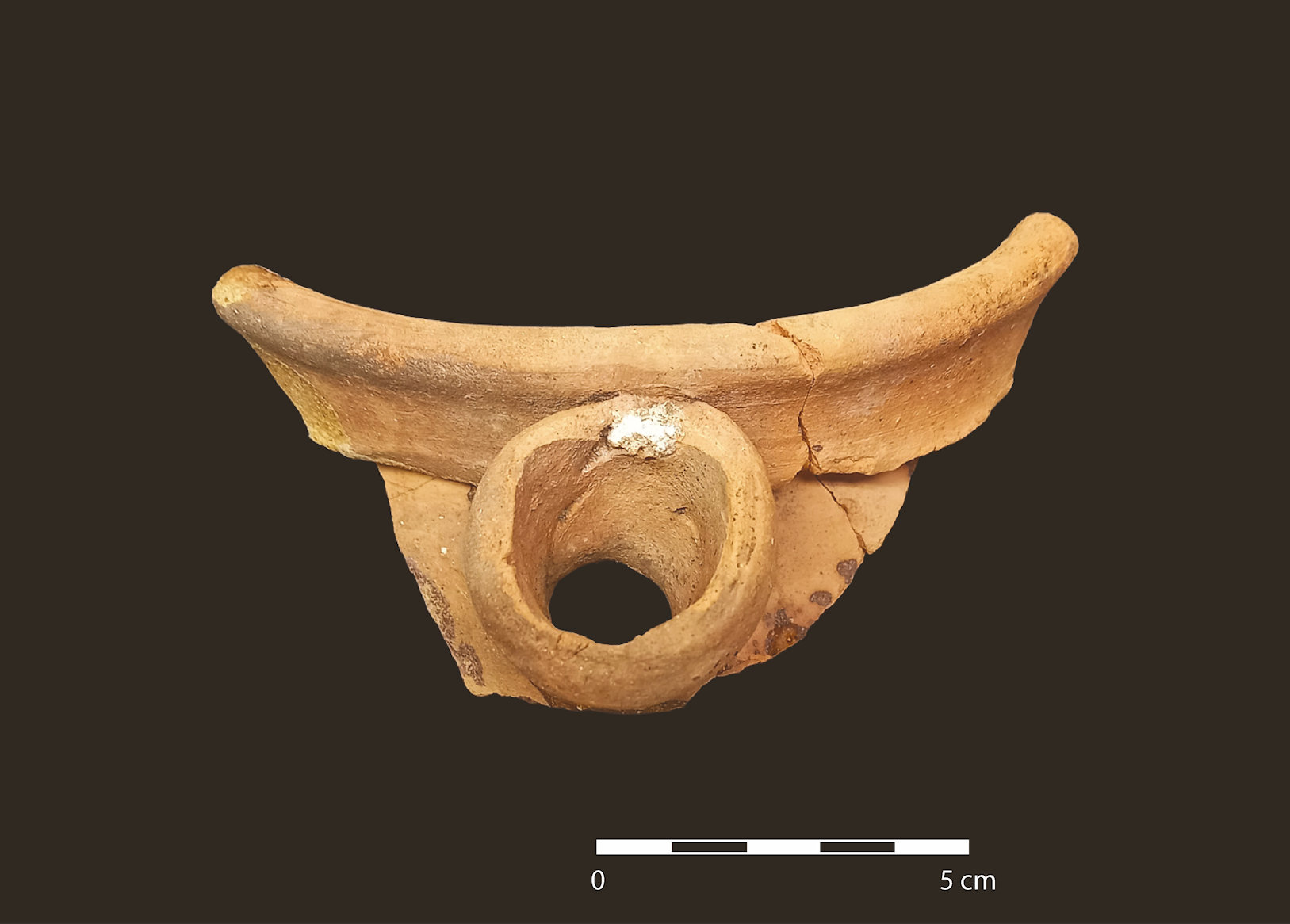
A smaller number of reduced sherds, which could have been over-fired, also exist within the Guildhall assemblage. In one case, an over-fired rim sherd joins an underfired one (Figure 63). This implies that the over-fired sherd suffered some considerable heat after it had broken away from the underfired sherd.
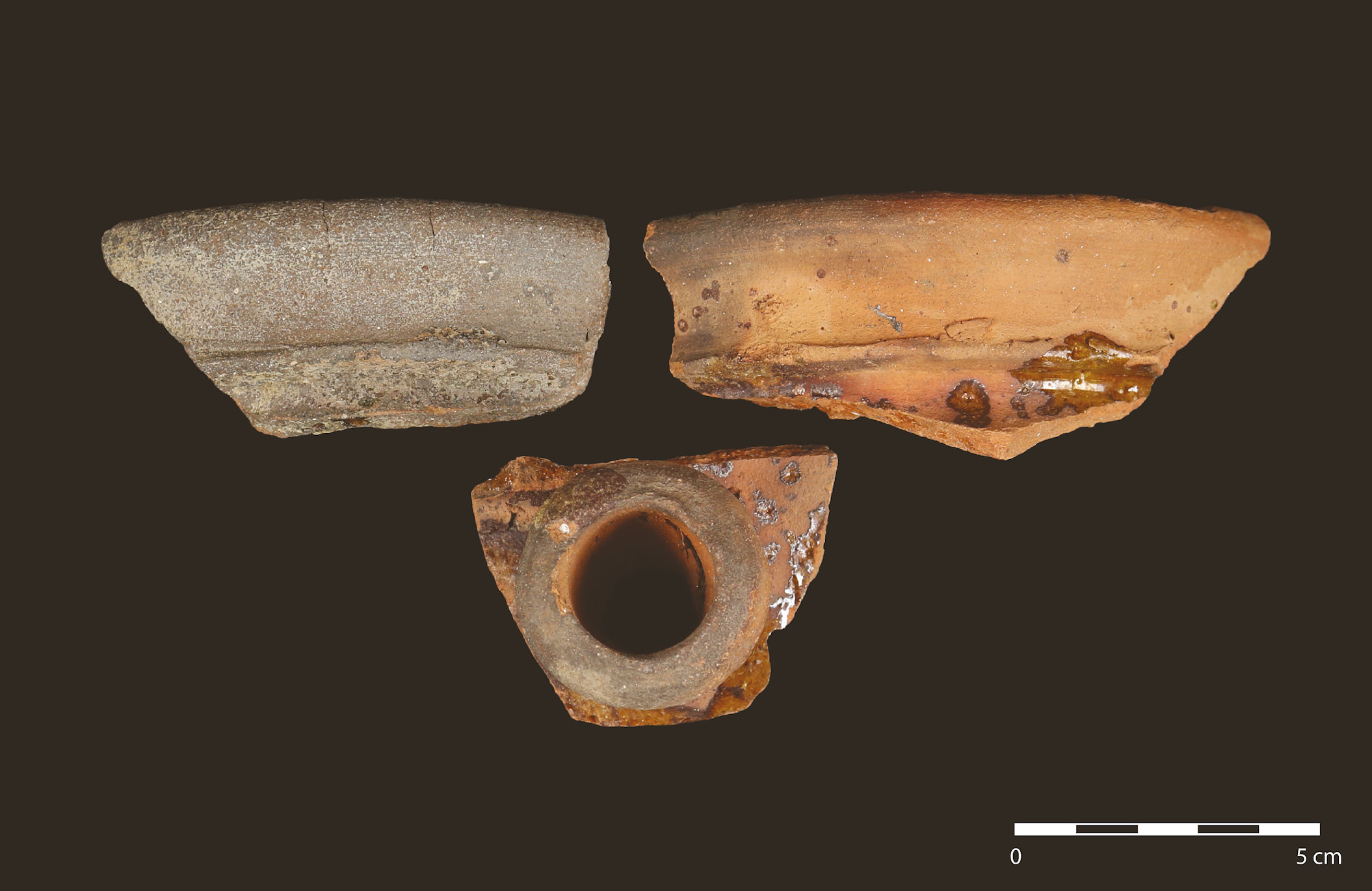
Forms
Forms include pitchers, jugs, jars and candlesticks. Most of the Splashed ware forms from the Guildhall site are pitchers, with only very few jugs and jars are represented. As noted above, there were two candlesticks (Figure 64 and Figure 65), from C3050 and C3052, of a white firing. There was limited glaze on these, but the glaze was of quite good quality, perhaps indicating the change between splashed glaze and the later suspension York Glazed ware which is now thought to have been made in that area.
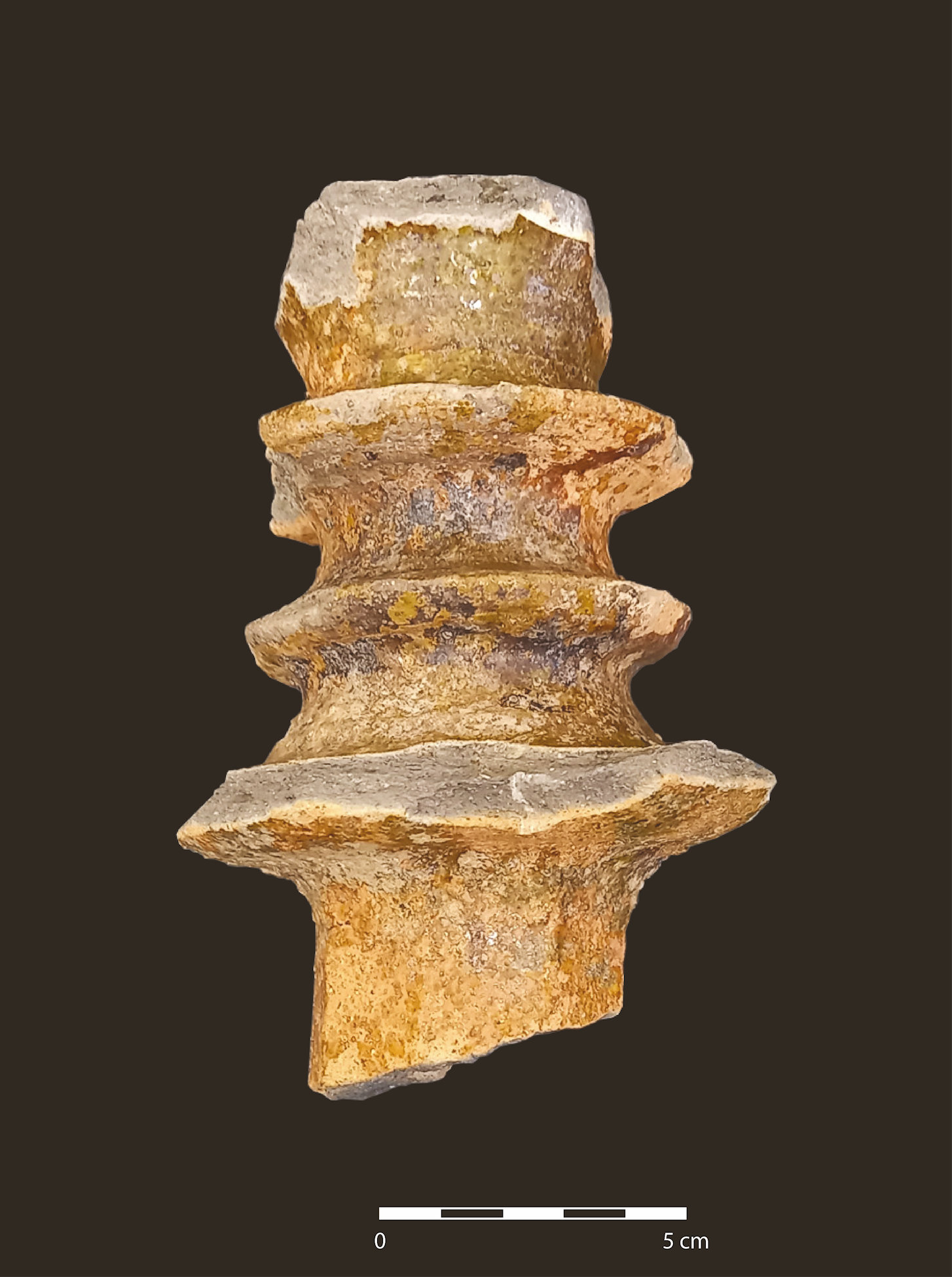
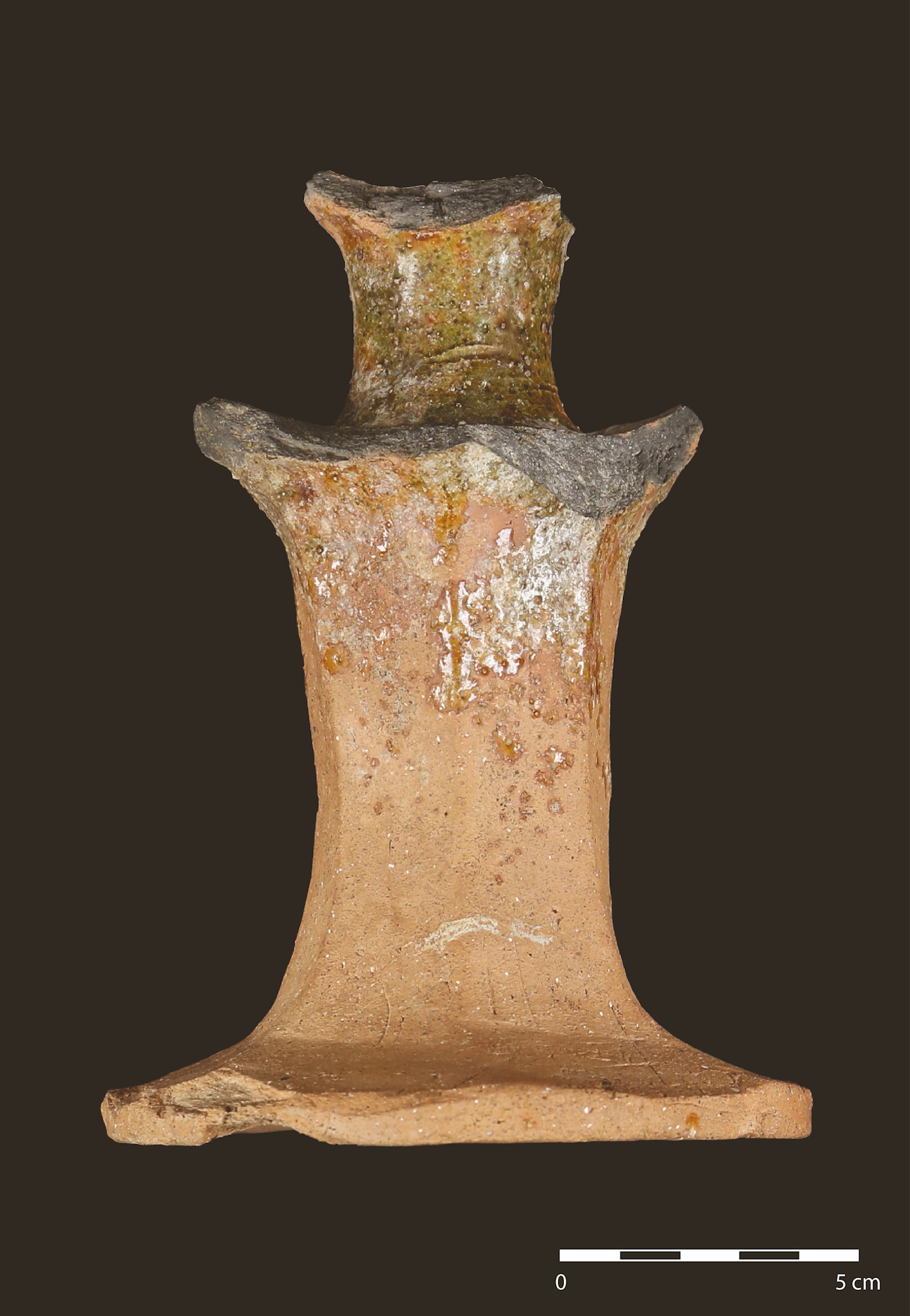
The majority of the pitcher rims were collared (cf. Mainman and Jenner 2013, 1187, fig. 446, 4178), and a small number of rims were rounded (Mainman and Jenner 2013, 4174) or square (Mainman and Jenner 2013, 4172). The jar rims were squared and occasionally had a thin, incised line along their outer edge (bifid rimmed), presumably this was to fit a string into to secure a lid.
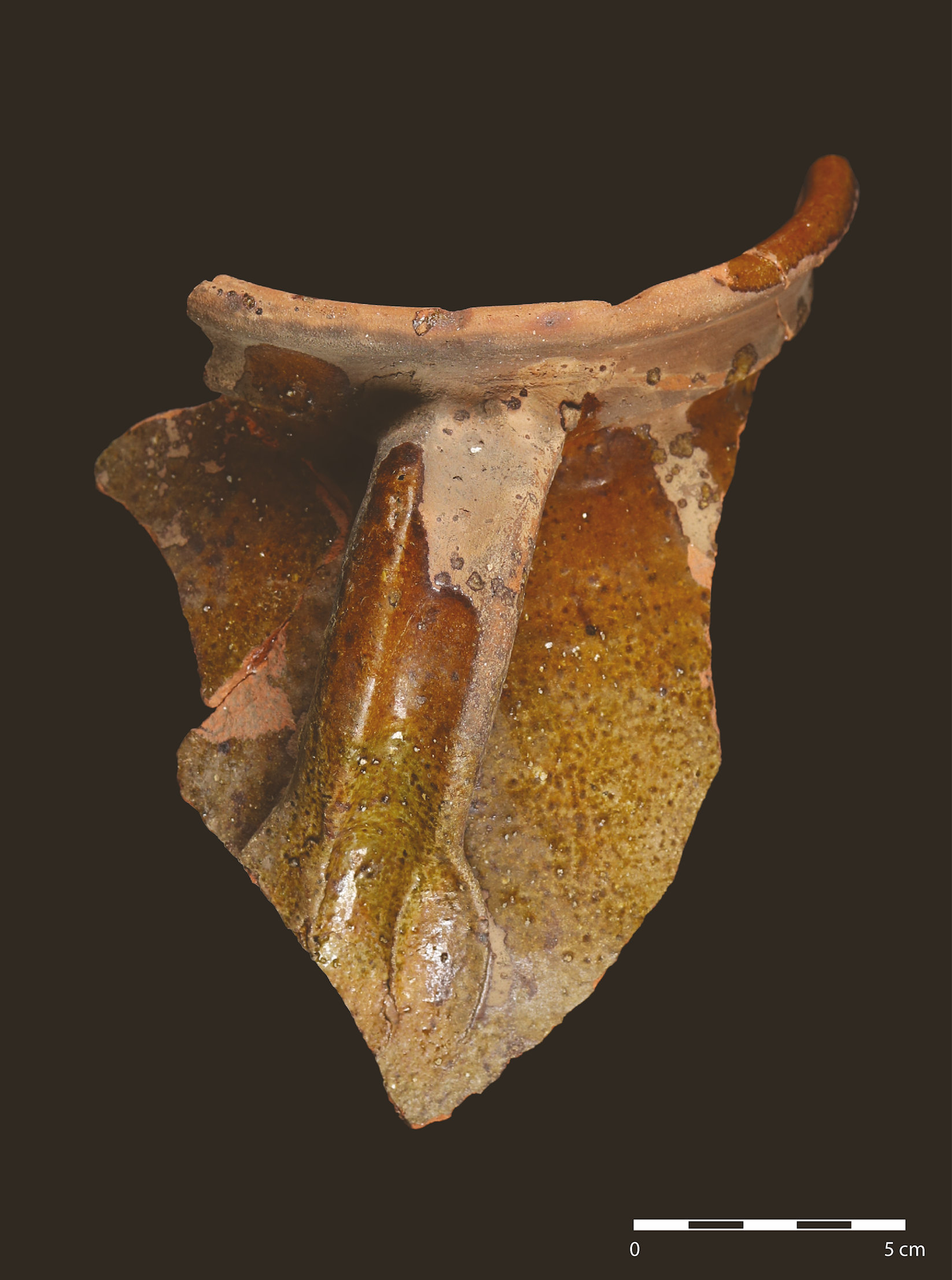
Pitchers generally have a wide mouth (approximately 90mm radius), a high shoulder and a sagging base. The shape of this form shares elements with the contemporaneous Buff Gritty ware jar, but with a strap handle added. Some have a handle that is twisted to the left at the lower end (Figure 66). This possibly suggests that the potter was left-handed. Handles are normally wide and fairly thin with a central depression. There is evidence for two and possibly three handles on at least one of the pitchers from the Guildhall (Figure 67). This is the first occurrence of this type to be noted in York.
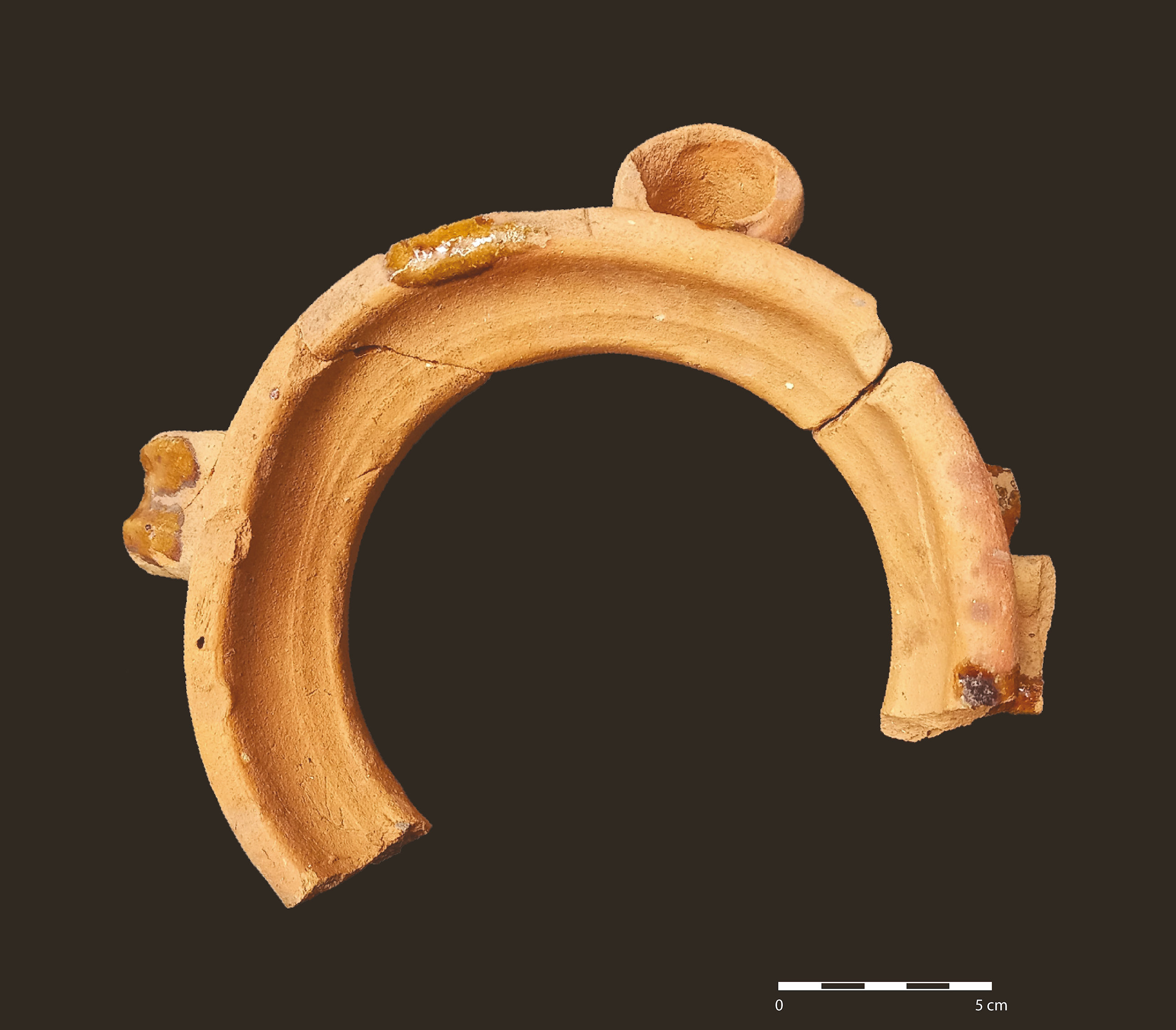
Many of the pitchers within the Guildhall assemblage probably had short, rounded and wide spouts for use in pouring liquids, though only parts of seven spouts have been recognised. This is close to the base EVEs of just over 780% and therefore represents just under eight vessels (see Table 15). Rim EVES are substantially more (see Table 16), but the reason for the disparity is unclear. This type of spout was often found on Anglo-Scandinavian wares, such as Torksey and Stamford types. It has also been noted on the fairly rare Buff Gritty ware bowls.
Several Splashed ware sherds were found in other contexts and one in particular was over-fired with the handle emanating from the top of the rim (C3080). This is the only example of this type in this assemblage. All of the other pitchers have a handle coming from just below the rim (Figure 68). The earliest Splash glazed pitchers with handles emanating from the top of the rim are thought to be late 11th century types. During the mid-12th century, suspension glazes began to be used at Lurk Lane (Watkins 1991). That assemblage is seen as the type-series for the Beverley wares in general. The pitchers from pit (C3052) at the Guildhall have strap handles emanating from a little further down from the rim. As they still have splashed glaze this puts them typologically into the early 12th century and perhaps not much later than the mid-12th century.
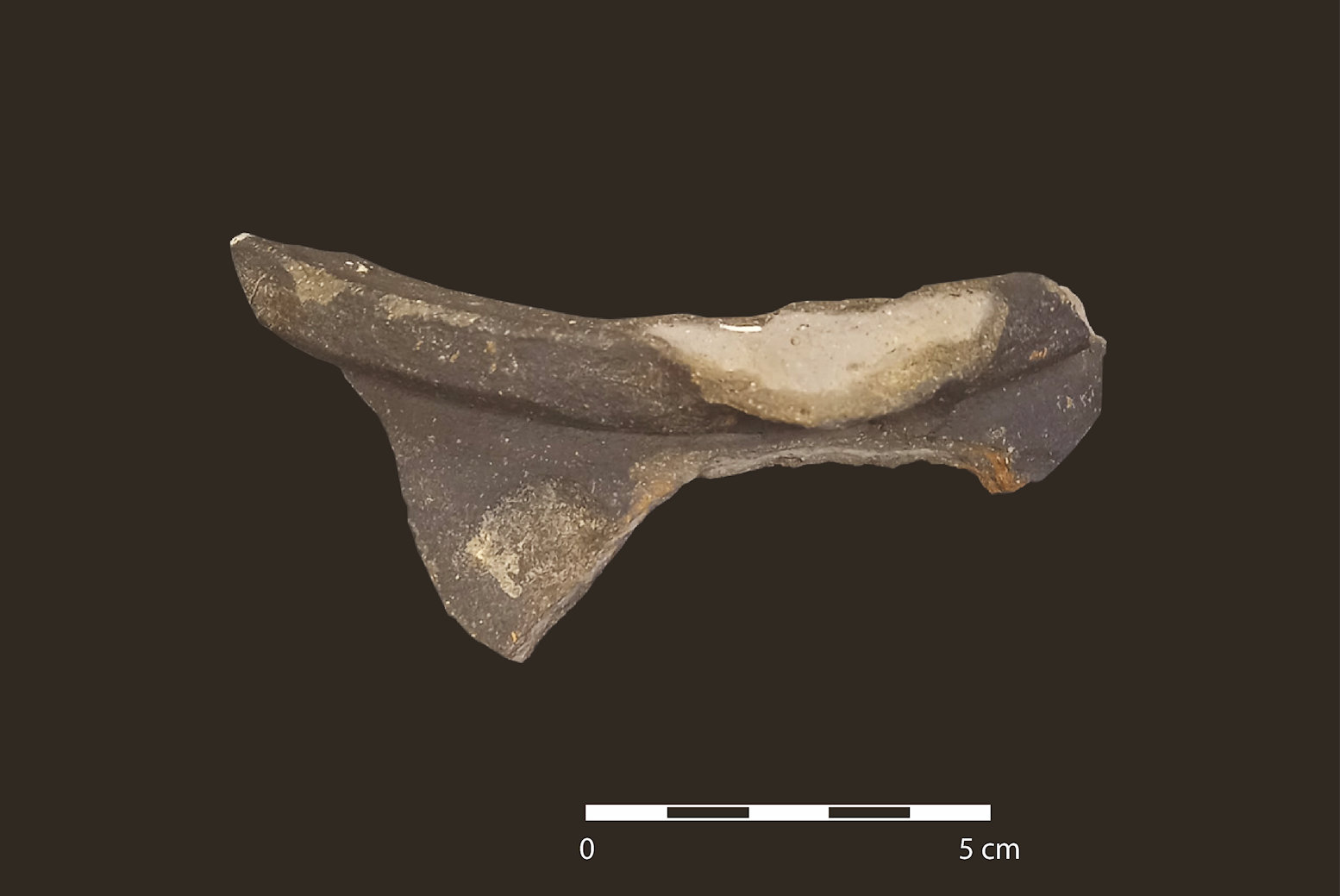
The minimum number (MNV) of Splashed ware pitchers from pit fill C3052 was calculated as 12 (MNV) and 712% or eight vessels by rims (see Table 16). The calculations carried out on the bases were 15 (MNV) and 934.5% or 10 vessels (EVES). This suggests that anywhere between eight and 15 pitchers may have been present in the pit.
Splashed ware jugs from pit fill C3052 could be estimated as anywhere between one and five as the MNV was 2 and 69% EVES by base, but there were no jug rims by either measure. There were no Splashed ware jars by base and 100% EVES and five MNV by rim.
Splashed ware jars from C3052 amounted to 100% EVES and five MNV by rim and no bases were present. An estimate of the number of Splashed ware jars could then be calculated as anywhere between one and five.
The data not only shows the limitations of these calculations but also shows that different parts of these vessels survived at different rates. This conclusion is confirmed by the weights of the body sherds which outstrip the weights of the rims and bases. Body sherds weigh 12.354kg, rims 2.653kg and bases 6.035kg (see Tables 14 and 15).
| Base No. | Fabric | Form | NOSH (No.) | Radius (mm) | EVES (%) | MNV (No.) | Weight (g) | Comments |
|---|---|---|---|---|---|---|---|---|
| 1 | Splashed ware | Pitcher | 4 | 90 | 62 | 1 | 380 | |
| 2 | Splashed ware | Pitcher | 6 | 90 | 90 | 1 | 796 | |
| 3 | Splashed ware | Pitcher | 10 | 85 | 80 | 1 | 691 | |
| 4 | Splashed ware | Pitcher | 8 | 90 | 83.5 | 1 | 554 | |
| 5 | Splashed ware | Pitcher | 9 | 90 | 110 | 2 | 474 | |
| 6 | Splashed ware | Pitcher | 12 | 90 | 14 | 1 | 278 | |
| 7 | Splashed ware | Pitcher | 13 | 80 | 144 | 2 | 654 | |
| 9 | Splashed ware | Pitcher | 5 | 90 | 127 | 1 | 756 | |
| 11 | Splashed ware | Pitcher | 15 | 90 | 91 | 1 | 551 | Heavily reduced core |
| 12 | Splashed ware | Pitcher | 4 | 70 | 49 | 1 | 63 | |
| 13 | Splashed ware | Pitcher | 4 | 70 | 47 | 1 | 180 | Overfired |
| 13 | Splashed ware | Pitcher | 1 | 80 | 17 | 1 | 118 | |
| 16 | Splashed ware | Pitcher | 1 | 80 | 20 | 1 | 102 | Over-heated base and lower wall |
| 8 | Splashed ware | Jug | 7 | 60 | 57 | 1 | 302 | |
| 10 | Splashed ware | Jug | 2 | 60 | 12 | 1 | 27 | |
| 14 | White Gritty | Jar | 3 | 80 | 32 | 1 | 119 | |
| 15 | Gritty | Jar | 3 | 100 | 87 | 1 | 98 | |
| 10 | Humber ware | Jug | 1 | 60 | 12 | 1 | 14 | |
| Totals | 108 | 1134.5 | 20 | 6157 | ||||
| Splashed Pitchers | 93 | 934.5 | 15 | 5597 | ||||
| Splashed Jugs | 9 | 69 | 2 | 329 | ||||
| Gritty Ware Jars | 6 | 119 | 2 | 217 | ||||
| Humber Jugs | 1 | 12 | 1 | 14 | ||||
| Totals | 108 | 1134.5 | 20 | 6157 |
| Base No. | Fabric | Form | NOSH (No.) | Radius (mm) | EVES (%) | MNV (No.) | Weight (g) | Comments |
|---|---|---|---|---|---|---|---|---|
| 17 | Splashed ware | Pitcher | 2 | 75 | 30 | 1 | 94 | Spouted |
| 9 | Splashed ware | Jar | 1 | 70 | 18 | 1 | 47 | Square rim lightly reduced core |
| 10 | Splashed ware | Jar | 5 | 65 | 55 | 1 | 61 | Everted rim. Glaze over break |
| 11 | Splashed ware | Jar | 1 | 80 | 9 | 1 | 17 | Bifid/square rim |
| 12 | Splashed ware | Jar | 1 | 80 | 8 | 1 | 16 | Short bifid/collar |
| 13 | Splashed ware | Jar | 13 | 60 | 10 | 1 | 10 | Flat top hammer head rim |
| 14 | 'd' ware | Jar | 1 | 70 | 15 | 1 | 8 | Residual |
| 14 | York ware | Jar | 2 | 90 | 9 | 1 | 28 | Residual |
| 14 | Buff Gritty ware | Jar | 1 | 90 | 9 | 1 | 19 | Residual |
| 15 | White Gritty ware | Jar | 4 | 85 | 11 | 1 | 78 | Square rim, slightly reduced core |
| Totals | 77 | 856 | 21 | 2653 | ||||
| Splashed ware Pitcher | Pitcher | 48 | 712 | 12 | 2369 | |||
| Splashed ware Jar | Pitcher | 21 | 100 | 5 | 151 | |||
| Other wares Jar | Pitcher | 8 | 44 | 4 | 133 | |||
| Totals | 77 | 856 | 21 | 2653 |
Guildhall assemblage
Most of the Splashed wares were oxidised, finely gritted pitchers and spouted pitchers. Many sherds were large and unabraded, joining other sherds within the same context. This suggests that they were smashed nearby before being dumped in the pit.
A small number of the Splashed ware sherds from the site were fused with glaze and some had glaze over their broken edges (Figure 69). These were mostly from pit fill C3052 and were either wasters or seconds. A few pieces of over-fired kiln material and a possible kiln prop were also found amongst the material from the pit. A piece of tile with part of a sherd of pottery adhering to it and surrounded by glaze was found in context C3102. One reconstructed pitcher rim shows a burnt, over-fired sherd joining a standard oxidised sherd. This suggests that the over-fired sherd was heated after it had been fired in the kiln. Why two such differently treated sherds should join so perfectly is not clear, but it does suggest that after breakage, the reduced sherd was heated to some considerable degree, perhaps in a fire on or near the Guildhall, before being discarded into the pit.
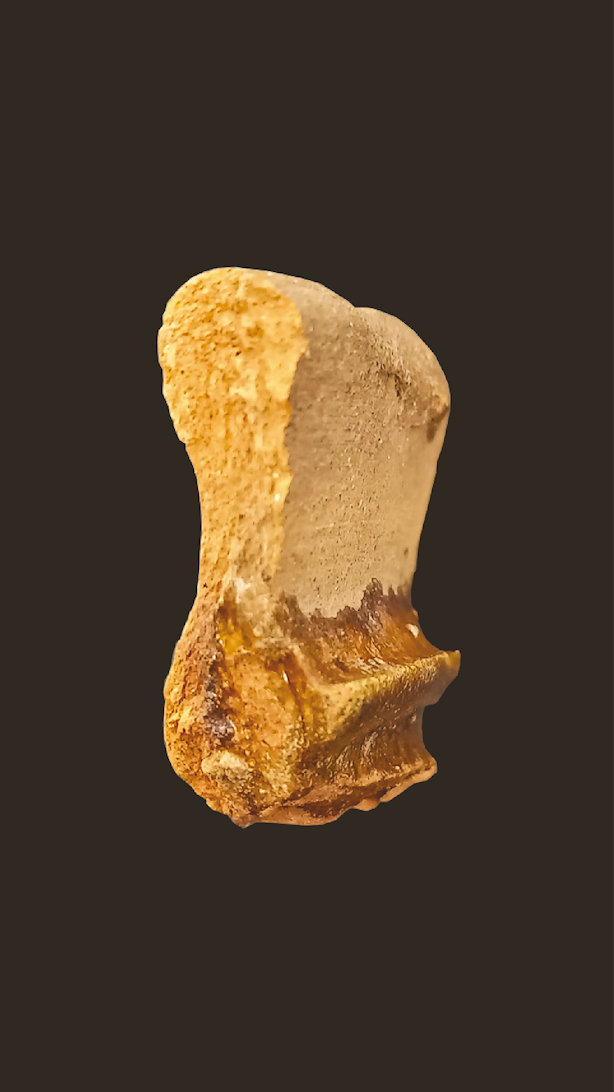
The few wasters/seconds and odd items that may have been used in a kiln are not sufficient to call this a kiln dump. When a number of wasters and seconds exist, it is easy to suggest that the pottery has not travelled far from the kiln site where it was made. However, their fabric and forms appear to be similar to those found in assemblages from excavations in Beverley, including Beverley wares from excavations at Lurk Lane (Watkins 1991), but also those from excavations carried out by YA at 65–69 Keldgate (Jenner 2022) and the former Grovehill Road Depot, Grovehill Road (Jenner 2023), as well as excavations carried out by Humber Field Archaeology at Capital Park (Didsbury 2021) in Beverley. Why this material was transported to York and dumped on the site is uncertain. It may have been bought cheaper due to its inferior quality or could have been brought onto site as ballast. Sharp traders could have hidden the inferior wares underneath a 'good' lot to make up the weight required by the purchaser. Equally, a fashion for jugs as opposed to pitchers may have caused their demise. There are two jug bases amongst the pit assemblage indicating that this form was coming into circulation at this time.
Comparanda
A number of different Splashed wares occur in assemblages from York, though few of them have ever been assigned to particular production centres (Mainman and Jenner 2013, 1186). Despite this, the white Splashed wares are thought to have been made in the vicinity of the Howardian Hills due to their similar chemical make-up to the later York Glazed wares from that area (Mainman and Jenner 2013, 1193). The red firing wares may have been made locally or come from other centres producing red-firing wares from across Yorkshire, including Beverley (Mainman and Jenner 2013, 1190). However, the distinctive feature of the pitchers from the Guildhall and Beverley is the inclusion of a chalk temper, suggesting the latter as the source of these vessels.
Beverley splashed ware pitchers were noted within the pottery assemblage from phase 5B at excavations at Lurk Lane, Beverley (Watkins 1991, 70, fig. 55). Phase 5B was given a date range of early/mid-11th century (Watkins 1991, 19). As it is in a context with mid-12th century pottery at the Guildhall, it could either be residual or have a date range of early to mid-11th to mid-12th century. Even so, the evidence from Lurk Lane is limited only to a few sherds, only one of which is from a splashed Beverley 1 ware (Watkins 1991, 65).
Gritty wares: late 11th/mid-13th century
Gritty wares were in currency during the same period as Splashed wares (Mainman and Jenner 2013, 1178–9) and were the main cooking vessel fabric at this time. White Gritty wares form a thin horizon in York's ceramic timeline in the late 11th and early 12th centuries. Buff Gritty wares then became dominant in York in the 12th century.
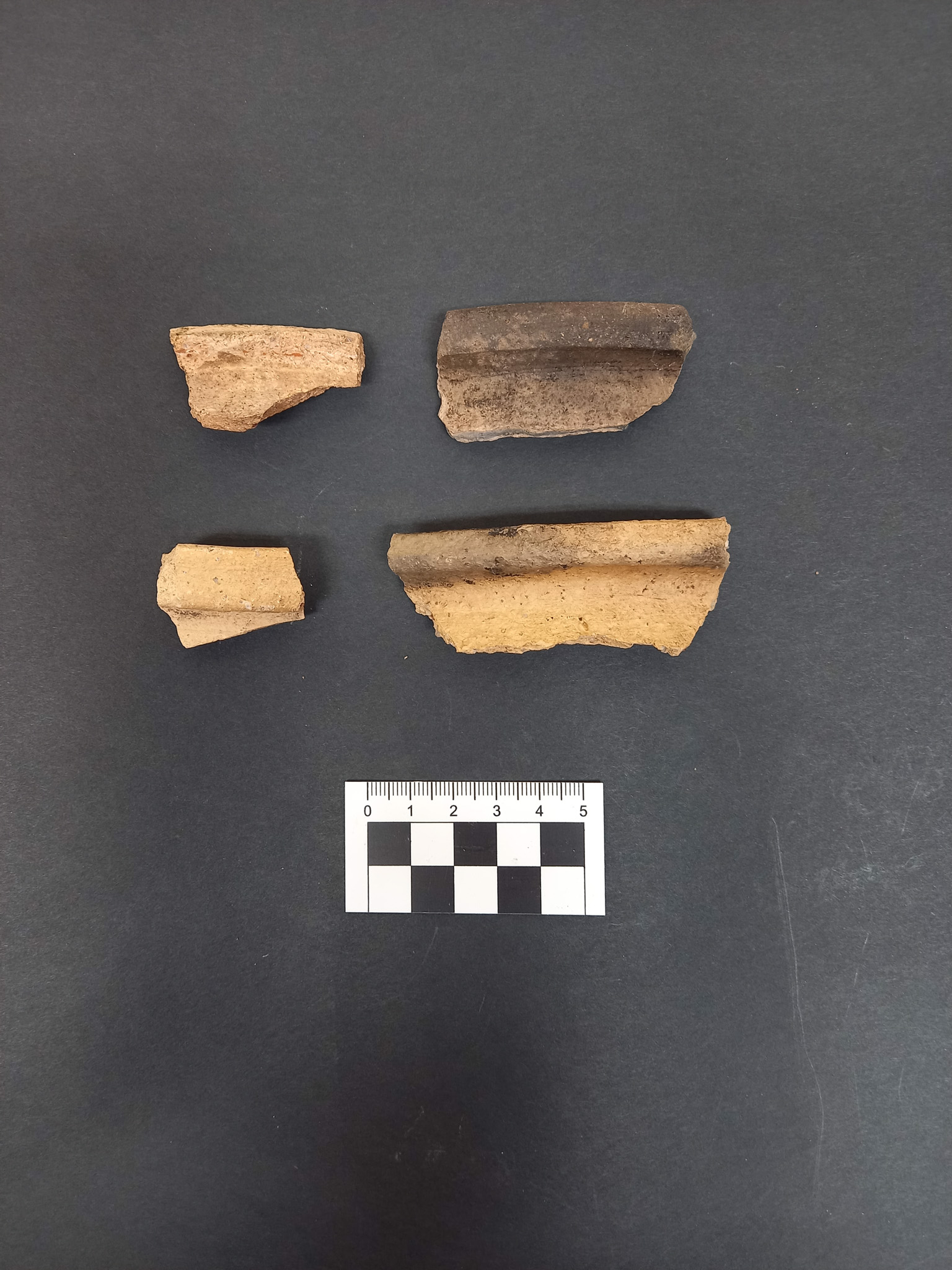
In the Guildhall assemblage, gritty ware sherds were the second most common medieval ware type (119 sherds formed 2.8% of the total assemblage). Most were buff-coloured shouldered jars similar to those most commonly found in York (Figure 70). Sherds from a White Gritty ware jar were the only other ware found in the same context as the majority of the Splashed wares (C3052). While the Splashed ware pitchers do not generally show signs of heating, the White Gritty ware jar is heavily sooted (Figure 71), suggesting that it was used for heating food or liquids. Its existence along with the Splashed wares suggests that they were discarded together and possibly used in conjunction with each other.
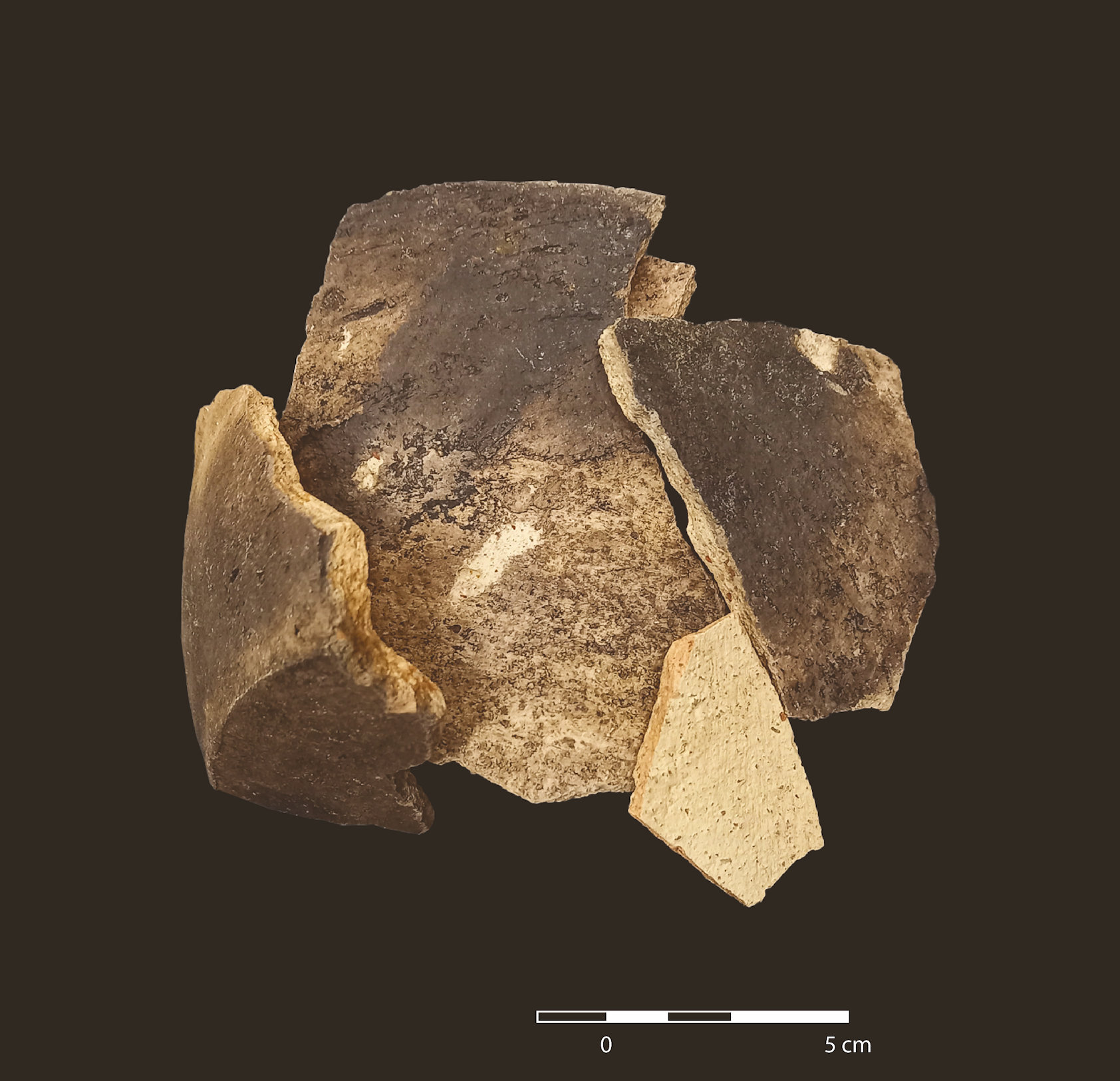
York Glazed Ware: mid-12th/mid-13th century
York Glazed ware appeared in York from the mid-12th to mid-13th century and is the third most dominant pottery type of this period (54 sherds/1.3%) in the Guildhall assemblage, although the sherd size was predominantly small and abraded compared to the Splashed wares. The assemblage of these wares is dominated by jugs, with a distinct straight-sided neck and thickened, flat topped or collared rim. Any large surviving sherds of this type had tubular spouts or rod handles, typical of earlier forms. Tubular spouts were longer and thinner than those of the Splashed wares and had a bridge of clay attaching them to the body of the vessel (Figure 72). A small sherd of decorated jug body was also recovered, with a vertical comb and dot decoration.
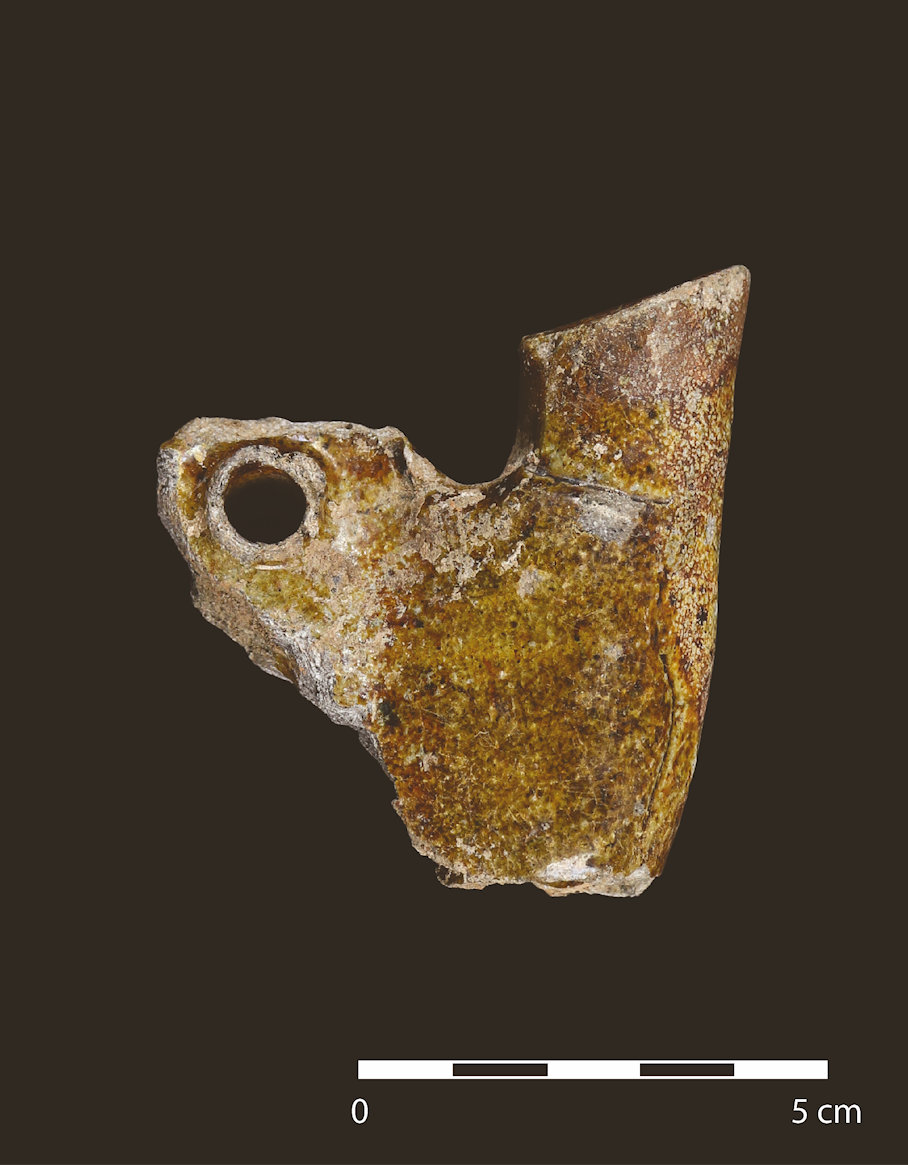
Brandsby-Type: mid-13th/mid-14th century
There was a small to moderate amount of Brandsby-type pottery in the Guildhall assemblage (44 sherds, amounting to 1% of the total number of sherds), and most of them were small sherds. This contrasts with other mid-13th to mid-14th century assemblages in York, in which Brandsby-type wares tend to dominate. It should, however, be noted that Brandsby-type wares succeeded the York Glazed wares with some overlapping. Due to this, vessels produced in the early years of Brandsby –type production are difficult to distinguish from York Glazed wares (Mainman and Jenner 2013, 1230).
Again, similar to the York Glazed wares, the handles were the sherds that survived most intact, with a small number of joining sherds. Forms were mostly jugs with rod handles, though a few bowl sherds were also represented.
Beverley-type 2: mid-13th/mid-14th century
A moderate number of finely to moderately gritted, oxidised wares both unglazed and glazed were attributed to Beverley-type wares in this assemblage (44 sherds; 1%). Most of the sherds were small to medium body and base sherds; consequently, the forms could not be determined, though they are thought likely to be jugs, jars and pitchers.
Humber ware: late 13th to late 15th century
The Humber ware from the Guildhall totals 11 sherds which are mostly from jugs, though too small to be certain of their form. Two production sites have also been noted in York itself: Museum Gardens and Blue Bridge Lane (Mainman and Jenner 2013, 1275–8). Glazes change from green in the earlier years of production, to a greenish-brown with amber edges in the 14th and 15th centuries. Later vessels can have a more vitrified purplish glaze, though none are present amongst the assemblage from the Guildhall.
Walmgate ware: late 13th to late 15th century
The clay body of this ware type is oxidised and rather like the Humber wares, though it has a sandier body. Vessels consist mainly of jugs, in particular drinking jugs, and one of the only two sherds of this ware found in the Guildhall assemblage was a jug handle dating to the mid-14th to late 15th century, perhaps from a drinking jug. There was only one other sherd of this ware, which altogether.
Sandy Red ware: late 13th to late 14th century
In York, this ware was never a dominant type, and this is also the case with the Guildhall assemblage where there are only two sherds, forming less than 0.1% of the total number of sherds.
Yorkshire Red ware: late 13th/early 14th century
Part of a Yorkshire Red ware jug with rilled neck and green glaze was present at the Guildhall site. Only one other sherd was present. These sherds amounted to less than 1% of the total number of sherds.
Reduced Green Glazed ware: late 12th to late 14th century
Almost all of the Reduced Green Glazed ware found within the assemblage from the Guildhall is of fabric types 1 to 3, fitting with a currency during the late 12th to late 13th century. They consist of 28 sherds making up 0.7% of the total of the Guildhall assemblage.
Hambleton ware: late 14th to early 15th century
Hambleton ware is so named as it is thought to have been made in and around the Hambleton Hills of North Yorkshire (Mainman and Jenner 2013, 1283–4). It is a white-firing ware which has two distinct fabrics. The most common fabric reflects the York Glazed wares in its openness and lightly reduced core, though it follows on from the late 13th/early 14th century Brandsby wares in the sequence of white wares from North Yorkshire. The six sherds of Hambleton ware from the Guildhall account for 0.1% of the assemblage.
Other wares
Other medieval wares include Red coloured and Oxidised wares that have not been allocated to a specific ware type. This is usually due to their size and abrasion which has made it difficult to be sure of their type.
Post-medieval wares
The post-medieval pottery from the Guildhall comprised 83 sherds weighing 2.546kg. Wares include English Stoneware, Post-medieval Earthenwares, Frechen, Pearl, Purple Glazed, Ryedale, Terracotta, Yellow Glazed, Cistercian, Tin Glazed and Slipware.
Cistercian ware: late 15th to late 16th century
Twenty sherds of Cistercian ware were present amongst the Guildhall assemblage, making a total of 0.5% of the assemblage. In York and North Yorkshire, it is hypothesised that it was made outside York and brought in for use at monastic and secular sites alike for religious festivals, which may be significant given the presence of the Augustinian friary on the site. The demise of this ware type in the 16th century is thought to have occurred in direct relation to the Dissolution.
Yellow Glazed: late 16th to late 17th century
Yellow glazed white ware is a less frequent type of post-medieval pottery. It has a fairly fine sandy fabric, often lightly oxidised and is from an unknown source. Just seven sherds of this type were present within the Guildhall assemblage, forming 0.2% of the total. Their size was insufficient to determine their form.
Purple Glazed ware: late 14th to 16th century
Purple glazes start to appear on green glazed pottery towards the end of the 14th century. Forms mainly include jugs and jars. There are a number of sources for this type of ware in the Humber region and South Yorkshire. Four sherds were retrieved from the Guildhall, amounting to only 1% of the total number of sherds.
Ryedale ware: late 16th to early 18th century
Ryedale wares are made from a red or buff firing clay and include a wider range of forms than their medieval predecessors. Jugs, jars, platters, pipkins, dishes, bowls and baskets are amongst the Ryedale potters' repertoire. Fifteen sherds of Ryedale ware were present in the Guildhall assemblage, making up only 0.4% of the total number of sherds.
Post-medieval Earthenwares: late 16th to 19th century
All of the wares described so far are, strictly speaking, earthenwares. This means that they have been fired to temperatures around 800 degrees centigrade. The relatively low temperatures cause them to have a more open, less dense and fused fabric than Stonewares (see below).
Post-medieval Earthenwares can be white, grey or red-firing and glazes vary from green to browns and black colours. This fabric was often used to make vessels used for storing and preparing foodstuffs and not necessarily for fine dining at table. Thirteen sherds of this type were retrieved from the Guildhall site. They amounted to 0.3% of the total number of sherds.
Stonewares
German Stonewares: Raeren – late 15th to late 16th century
Only one sherd of this type was found amongst the Guildhall assemblage. This amounts to less than 0.1% of the assemblage.
Frechen Stoneware – late 15th to mid-16th century
Only four pieces of this ware were present within the Guildhall assemblage and only one has a face (often present on this ware) on it. They amounted to 0.1% of the total number of sherds.
Tin Glazed ware: late 17th to early 18th century
Only one sherd of this type was present within the Guildhall assemblage.
Other post-medieval wares
Other late post-medieval wares included Pearl ware (three sherds), Terracotta (one sherd) and Slipware (two sherds). These and other later wares are of little significance to the interpretation of the site.
The wares discussed here provide evidence of considerable activity at the site from the immediate post-medieval period to the post-medieval period, predominantly from the immediate pre-Norman Conquest period to the medieval period. There was some residuality within the medieval deposits, with some Roman material present in contexts dating to the 12th and 13th centuries. A small amount of intrusive 11th and 12th century material was also found in Roman contexts.
Immediate post-Roman, Anglian and Anglo-Scandinavian period
There were no sherds of Anglian (5th to 9th century CE) pottery or other finds dated to this period from the site. However, a small amount of Anglo-Scandinavian pottery was recovered, all locally or regionally made, including from Yorkshire and Lincolnshire, or unknown local sources. In this period, York continued to be an important international trading hub, evidenced by finds from sites such as Fishergate and Coppergate, as well as the establishment of the ecclesiastical centres mentioned earlier. The limited evidence of the Anglian and Anglo-Scandinavian periods suggests that the Guildhall excavation site was an area of reduced activity during this time, possibly only of people traversing through the area to the aforementioned sites. Issues such as poor preservation and destruction by subsequent medieval and post-medieval activity may also explain the data.
Medieval
Medieval pottery from the site was the second largest group in the assemblage, after the Roman material. The largest quantity of medieval sherds appears to span the early 12th century. Splashed wares were the predominant fabric type in this assemblage from the medieval period. The most common form was the pitcher which was often spouted. The majority of these originated from a single context (C3052), the upper fill of a large pit close to the northern edge of the site. Their fabric, form and glaze are suggestive of a pre-mid-12th century date for their production and use. The assumption is based on evidence from excavations at Lurk Lane, Beverley that revealed that there was a change from pitchers to jugs and from splashed to suspension glazes in the mid-12th century (Watkins 1991, 81).
The pottery from context C3052 was unabraded, with only fresh breaks, and therefore was likely to be a primary deposit. Evidence of glaze over edges, over-firing, glaze slag and a fusing of two vessels show that there were also wasters from a kiln or a severe heating event after firing. The composition of the clay bodies and chalk temper of these pitchers suggest a source near Beverley. Added to this, their forms are remarkably similar to those from Lurk Lane (Watkins 1991, 82, fig. 66), though no spouted vessels are illustrated there. Trade between Beverley and York has been noted since the Archbishop of York was the sole Lord of Beverley from the mid-11th century (Armstrong et al. 1991, 1). It is, however, just possible that local red-firing clays were used and the chalk imported from the Wolds to temper a local product.
The evidence therefore suggests the import of finished pots or raw materials for making pots into York, before being deposited onto the site. The presence of wasters within this group of pottery also suggests this, as they could have been imported from Beverley as ballast in a vessel or included – unwanted – in a delivery.
The Splashed wares seen on this site are also of note because this ware type has not been seen previously in York, consisting of a combination with the specific pitcher form of a sagging base, wide mouth, short tubular spout and two or three strap handles. This form does, however, match examples from Lurk Lane Phase 5B, again perhaps pointing to a Beverley origin (Watkins 1991, 65), although the evidence at that site is even more limited.
The pitchers showed a relative lack of evidence for use, with no evidence of scratches or abrasions on their bases and only one vessel small patches of sooting inside the base and lower walls, but this may not have been related to its use for heating. This may suggest that the pitchers were brought onto the site for a one-off event and then discarded.
Further reasons for the demise of the pitcher at the Guildhall could have been that they were part of a faulty batch, quickly discarded into the pit without ever coming into use. But in this case, it is unclear why the pitchers would have been discarded alongside White Gritty wares that were clearly used for cooking (as they were covered in soot).
Another suggestion is that the pitchers and jars formed, along with the candlesticks, a discrete group of vessels which were intended to be used during some sort of repast or other domestic function as a unit, despite their faulty nature.
The sparsity of pottery from the end of the period of Roman occupation through the Anglo-Scandinavian period might be explained by the demise of the Roman fortress, river crossing and road in the area of the Guildhall. Instead, activity was focused further down the river towards the pre-existing crossing where the current Ouse Bridge stands.
The quantity of medieval pottery, in particular that of the pre-mid-12th century Splash Glazed pitchers from the pit fill (C3052), can be put down to an increase in activity on the site at this time. Later medieval wares of 13th, 14th and 15th century date were relatively sparse, and quantities of pottery do not reach the levels found in Roman and 12th century contexts. This may in part result from the nature of the archaeology from these periods, which comprises primary of structural evidence and graves, with a lack of features such as pits that might be used for rubbish disposal.
Roman Pottery | Post-Roman Pottery | Ceramic Building Material | Stone Building Materials | Mortar, Plaster and Painted Plaster | Daub and Opus Signinum | Small Finds | Roman Frit Objects | Roman Vessel Glass | Roman Window Glass | Coins | Worked Stone
A total of 300.809kg (2050 sherds) of CBM was recovered from the archaeological investigations at the Guildhall, including that collected by hand during the excavation process, from the observation of boreholes and piling cores, and from the analysis of soil samples. The CBM ranged in date from Roman to modern, though the majority of the collection was of medieval date.
The collection was recorded to a standard YA methodology (McComish 2020) whereby each sherd is individually recorded on a proforma sheet which details the project code, the context number, the weight in grams, the fabric type, the surviving complete dimensions (length, breadth, thickness, flange height), evidence of reuse, evidence of over-firing and any other relevant information (surface marks, glazes, unusual features etc). A question mark is placed after the form name if the identification is uncertain, for example 'Imbrex?', while the form of non-standardised sherds is listed as 'Other'. The fabric is determined by comparing the sherd to a York fabric reference collection held at YA.
In the text below an overall summary of the material from each period is given, followed by descriptions of each form present and of the fabrics present. The CBM is summarised by historical period in Table 17. The features present on the Roman CBM are summarised in Table 18, the Roman fabrics in Table 19, the features present on the medieval CBM in Table 20 and the medieval CBM fabrics in Table 21.
Roman
The Roman CBM accounted for 26% of the total volume of CBM from the site (Table 17). All of the forms of Roman CBM at the Guildhall site have been noted in York before, namely a circular bessalis, box flue tiles from hypocausts, tegulae and imbrices from roofing, a tessera and numerous fragments of indeterminate form which are classed as Roman brick.
| Period | Form | No. of sherds | Weight in grams | % of total weight |
|---|---|---|---|---|
| Roman | Bessalis | 1 | 100 | 0.03 |
| Brick | 306 | 54385 | 18.08 | |
| Flue | 17 | 2035 | 0.68 | |
| Imbrex | 58 | 7445 | 2.47 | |
| Other | 2 | 1825 | 0.61 | |
| Tegula | 52 | 12705 | 4.22 | |
| Tessera | 1 | 10 | 0 | |
| Medieval | Brick | 26 | 30320 | 10.08 |
| Curved | 36 | 5530 | 1.84 | |
| Crested | 6 | 1350 | 0.45 | |
| Decorated floor | 4 | 1425 | 0.47 | |
| Flange | 135 | 37245 | 12.38 | |
| Other | 3 | 1575 | 0.52 | |
| Peg | 101 | 26550 | 8.83 | |
| Plain | 438 | 71789 | 23.87 | |
| Plain glazed floor | 6 | 1750 | 0.58 | |
| Ridge | 104 | 14705 | 4.89 | |
| Post-medieval | Brick | 22 | 18865 | 6.27 |
| Pan | 1 | 175 | 0.06 | |
| Paver | 2 | 8000 | 2.66 | |
| Modern | Brick | 3 | 525 | 0.17 |
| Other | Unknown | 726 | 2500 | 0.83 |
Roman tiles and bricks were made using sanded moulds on a sanded workbench and consequently the sides and basal surfaces are coated with fine sand. If a tile stuck to the workbench a wire (similar to a cheese-wire) would be used to separate the tile from the bench, resulting in parallel lines on the base of the tile. Such lines were seen on a sherd of tegula and on three Romans brick sherds from the present site. Following moulding the tiles were air-dried to a leather-hard stage before being fired. Roman CBM is usually well-fired and of consistently high quality; some sherds have reduced cores, caused by the exclusion of oxygen during part of the firing process, or oxidised cores, caused by an increase in the level of oxygen during firing.
Tegulae and imbrices are always the commonest form of identifiable Roman CBM in York, and this is the case at the Guildhall site. The box flue tiles at the site show that some of the material originated from a hypocaust while the presence of a CBM tessera (in conjunction with the presence of stone tesserae at the site) suggests that a tessellated pavement was present somewhere in the vicinity. Small numbers of sherds in non-standard forms are known from sites across York (McComish 2012, 184–90) and there were two such unusual sherds at the Guildhall site. The first of these was a sherd with a vent cut out of the side of the tile, which may be part of a kiln floor, although the Guildhall is a long way from the known location of the legionary kilns (580m away in a direct line, but 734m if going around the outside of the legionary fortress). The second sherd had a small notch cut into the edge presumably to house a metal nail or clamp.
The Roman CBM was fragmented and the only sherd with complete surviving original dimensions was a tessera at 16 x 17 x 12mm in size. For the remaining sherds with identifiable forms the only surviving original dimensions were thicknesses and flange heights. The box flues fitted into the previously recorded range of thicknesses for York (McComish 2012, 157) while the tegulae, imbrices and bessalis conformed to previously recorded thickness for York, although one tegula had a flange 53mm wide which is larger than usual (McComish 2012, 143, 169, 221).
The range of surface features relating to manufacture on the Roman CBM are summarised in Table 18. All of these features have been noted on Roman CBM before, both in York and nationally. These included evidence of smoothing the upper surface of roofing tiles to improve surface tension and water resistance; the majority of the smoothing was done with a cloth lengthways along the tile, but there were also instances where the tile had been smoothed lengthways then widthways at the end (one sherd), or widthways at the end (one sherd). There was also one example of finger smoothing, while some tegulae had grooves by the flange caused when the flange was hand smoothed. A small number of sherds had evidence of knife trimming or being separated from the work bench with a wire.
| Bessalis | Box flue | Tegula | Imbrex | Brick | |
|---|---|---|---|---|---|
| Thickness range in mm | 49 | 13-21 | 15-35 | 13-27 | 14-67 |
| Smoothed with cloth | - | - | 4 | 26 | 2 |
| Smoothed with fingers | - | - | 1 | - | - |
| Thumb groove/grooves by flange | - | - | 7 | - | - |
| Knife trimmed arris/base | - | - | 4 | - | - |
| Wire trimmed base | - | - | 1 | - | 3 |
| Upper /lower cut away | - | - | 10 | - | - |
| Combed keying | - | 3 | - | - | 2 |
| Finger drawn keying | - | - | - | - | 2 |
| Grip marks | - | - | - | - | 2 |
| Vent | - | 5 | - | - | - |
| Pierced by firing holes | - | - | - | - | 1 |
| Indented border | - | - | - | - | 1 |
| Legionary stamp | - | - | - | 2 | - |
| Signature marks | - | - | - | - | 7 |
| Rain or hob nail boot marks on surface | - | - | - | - | 2 |
| Reduced | - | 2 | 5 | 10 | 61 |
| Oxidised | - | - | - | 1 | 1 |
| Vitrified/Blown/Overfired | - | - | - | 1 | 8 |
| Opus signinum/mortar on upper surface | - | - | - | - | 2 |
| Sooted from use | - | 3 | 1 | 2 | 2 |
| Evidence of reuse prior to deposition | - | - | 1 | 1 | 23 |
As would be expected, lower and upper cutaways were present on the tegulae, and in the case of the lower cutaways these were in forms A26 and B6 (following Warry's classification of 2006, 61). The single example in form A26 represents the first time this form has been recorded in York (McComish 2012, 83). Where keying existed on the box flues it was combed, which was the dominant type of keying in Roman York (McComish 2012, 162). Though some vents were present on the box flues these were all were partial survivals, so their original size is unknown. Grip marks for the tile being lifted when wet were present, as was an indented border where the tile mould was used to tamp down the edges of a tile once it was removed from the mould. A single brick was pierced by a firing hole, a feature occasionally seen on Roman bricks in York (McComish 2012, 418).
Two legionary stamps are present: one from the 9th Legion and one from the 6th Legion, the first of which could be matched to the national catalogue (stamp 2642.7; Collingwood and Wright 1993, 170) but the second was too badly preserved to enable identification. The 6th Legion stamp has to date to after c.120 CE but before the later 3rd century CE, when the practice of stamping had ceased (McComish 2012, 38); it was recovered from a context in Phase 14, which was dated by pottery to the mid-2nd to 3rd century CE so could have been up to 150 years old when deposited. The 9th Legion tile was even older when deposited; it must date to c. 70 to 120 CE when the legion was based in York, but it was recovered from Phase 16 which also dated to the mid-2nd to 3rd century CE, making the tile at least 200 years old when deposited.
Where they were complete enough to identify the form, the signature marks present matched examples previously seen in York (Types 1–3; Betts 1985, 194).
Rain and hob nail marks indicated that some tiles at least were laid on the ground to dry prior to firing. Some tiles were reduced or oxidised due to variations in oxygen in the kiln during firing and a small number were overfired. In general, the Roman CBM is well made, with few overfired sherds, which fits the pattern seen elsewhere in York (McComish 2012, 111).
A small number of sherds had features relating to use with either mortar or opus signinum on the upper surface, or soot on the reverse surface. In addition, a few sherds had evidence of reuse in the form of soot or mortar on broken surfaces, which must have occurred prior to deposition.
Tegulae
Tegulae are flat, rectangular tiles with a flange along the upper surface of each longer side, and they were laid in columns on a roof. Tegulae have an upper cut-away on the upper surface of the flange at the top end of the tile and a lower cut-away on the basal surface of the lower end of the flange. The cut-aways of adjacent tegulae were designed to interlock enabling the tiles to lie flat when placed on the roof.
The tegulae at the present site ranged from 15–35mm in thickness (32 examples), with flanges typically double the thickness of the tile at 34–67mm thick (19 examples). No other complete original dimensions survived. Tegulae show considerable variation in thickness nationally, usually ranging from 20–50mm thick, though a small number of examples are known, including in York, that are 9–19mm thick (Brodribb 1987, 13; Betts 1985, 170; McComish 2012, 222) and flanges are usually double the thickness of the tegula (Brodribb 1987, 13). The tegulae at the present site therefore lie within the ranges previously recorded, though one flange was 52mm wide, which is wider than average.
Tegulae (and imbrices) were smoothed with a cloth after moulding to increase surface tension, thereby making the tiles more water resistant. Smoothing lines parallel to the flange were present on four tegulae from the site. One sherd had been smoothed using the fingers parallel to the flange. Five sherds of tegulae had a pronounced thumb groove next to the flange caused by running the thumb along the side of the flange to smooth it, while one tegula had two finger grooves next to the flange and one tile had three finger grooves parallel to the flange. One tegula had a knife-trimmed base, one a wire-trimmed base, and three had been trimmed along an arris.
Nine lower cutaways were present which were in forms A26 (one example) and B6 (six examples), following the classification by Warry (2006, 61), while two were too badly preserved to determine the original form. Type B6 has been recorded in York previously, but not type A26 (McComish 2012, 83). Part of a single upper cutaway was present.
Five of the tegulae had reduced cores caused by a reduction in the quantity of oxygen during firing. One tegula had a sooted base resulting from use, while another sherd was sooted all over, including on the broken surfaces, indicative of reuse.
Imbrices
Imbrices are half-cylindrical tiles which taper slightly in width from bottom to top; these were laid over the joints between the columns of tegulae and mortared into place, with the narrow end of one imbrex slotting beneath the wider end of the imbrex above. The imbrices at the present site ranged in thickness from 13–27mm (54 examples), but no complete breadths or lengths were preserved. Nationally imbrices range from 14–30mm in thickness (Brodribb 1987, 26) so the imbrices from the present site fall within this range.
Smoothing lines parallel to the long edge were present on 24 imbrices, while one example had smoothing parallel to the long and then the short edge and one sherd had smoothing parallel to the short end of the tile. Two of the imbrices had partially preserved legionary stamps. The first had the letters HISP and was type 2642.7 (Collingwood and Wright 1993, 170) which has previously been recorded in York. This relates to the 9th Legion and therefore dates to c. 70 to 120 CE. A second Imbrex had a stamp had the letters GVI relating to the 6th Legion, but it was too faint to match to Collingwood and Wright's typology; this has to date to after c. 120 CE but before the later 3rd century CE when the practice of stamping had ceased (McComish 2012, 38). Ten sherds were reduced; one was oxidised and one vitrified. One sherd was covered in mortar suggesting reuse. Two sherds had sooted backs, again relating to use, while one had sooted broken surfaces relating to reuse.
Flue tiles
Box flue tiles are hollow rectangular or square cross-sectioned tiles, with sanded interior surfaces. They have vents in two opposing sides, while the other two sides are usually keyed. The keying can be incised, finger drawn, combed or relief-patterned. Box flues were made by wrapping a slab of clay around a sanded former then joining the edges of the clay together with a single seam, and the vents were cut out after the tile was removed from the former (Rudling et al. 1986, 204). Box flues were usually positioned in vertical columns around the sides of a hypocaust room to provide a lining, with the keyed surfaces facing towards the walling and the interior elevation of the room, and the vents abutting one another, thereby allowing air to circulate through the wall. The box-flues from the present site ranged in thickness from 13–21mm (16 examples), but no complete breadths or lengths were preserved. The previously recorded range of thicknesses for York is 11–36mm (McComish 2012, 157), so the Guildhall box flues fit within this range.
There were three keyed surfaces, all of which were combed. The surviving vents were circular (one example) and square (four examples) in shape, but no complete vent sizes were preserved. Two of the box flues were reduced and three had sooted interior surfaces resulting from use in conjunction with a heating system.
Tessera
Tesserae were used Roman mosaic flooring tiles which varied in size. The largest (10–15mm²) was used for tessellated pavements and for the borders of complex mosaic floors, while smaller tesserae (3–10mm²) were used for more detailed mosaic (opus musivium) floor designs, and the finest tesserae of all (2–8mm²) were used for the most elaborate mosaics and for emblemata, such flooring being termed opus vermiculatum (Adam 2005, 233–4). A single tessera cut from a sherd of CBM was present at the Guildhall; this was 16 x 17 x 12mm in size, indicating that it would have originated from a tessellated pavement.
Bessales
The remaining material recovered from the present site was too fragmented to determine the original form (such sherds are termed Roman brick). The brick sherds ranged from 14–67mm in thickness (160 sherds). No breadths or lengths survived.
Two of these brick sherds were in a fabric very like R11 but with a paler buff colour. Three sherds had a knife-trimmed arris, while three had wire marks on the base. One sherd was pierced by a firing-hole 14mm in diameter. Two sherds were smoothed on the upper surface parallel to the edge of the tile and one of these had an indented border where the tile mould had been used to tamp down the edge after the brick was removed from the mould. Two sherds had combed keying on the upper surface, while three had finger-drawn keying lines on the upper surface. One sherd had grip marks on the upper and basal surfaces from being lifted while wet. Seven sherds had signature marks on the upper surface, one a Betts type 1, two a Betts type 2 and two a Betts type 3 (Betts 1985, 194), while a further two signatures were insufficiently preserved to determine their original form. One sherd had rain marks on the upper surface from being dried outdoors. One sherd had a hob-nail boot impression on the upper surface from having been stood on while drying. The Roman brick sherds exhibited features relating to firing; 61 sherds had reduced cores, one sherd had an oxidised core, seven sherds were vitrified through over firing and one sherd had blown through over firing.
Some brick sherds showed features relating to their use, with two sherds having a sooted base, one having opus signinum adhering to the upper surface suggesting use in a floor, and one having mortar on the upper surface representing the attachment point for an adjacent brick. Two sherds had fragments of iron adhering to the upper surface which had occurred after the brick was deposited within the ground. Three sherds had sooted breaks indicative of reuse, and 18 sherds had mortar on broken surfaces, again indicative of reuse. Four sherds were abraded from post-depositional damage.
Non-standard forms
Two Roman sherds were in non-standard forms termed 'Other'. The first of these was 21mm thick and had a semi-circular vent at the edge of the tile; the original function of this tile is uncertain, but the closest match for this in terms of form is a floor tile from a kiln at Holt (Brodribb 1987, 96) where the vent allowed hot air to circulate within the kiln. The second sherd termed 'Other' was 49mm thick and had a deliberate small notch cut out of the edge of the tile. The most logical explanation for this is that it was designed to house a nail or metal clamp used to fix the brick into place. At 49mm thick this is would seem to be from a floor surface rather than a wall, but floors were not usually held by clamps so the precise function of this sherd is unclear.
Fabrics
The Roman CBM fabrics recorded (R1-R2, possibly R5, R9, R10–12 and R18; Table 19) had all been seen in York before with the exception of two sherds in a variant of R11 which were a pale buff colour (unlike the usual light orange colour). The bulk of the CBM was in fabric R11, followed by R9 and R10; these are the most commonly occurring fabrics in York but in the city as whole R11 accounts for 12.5% of the total volume of CBM while R10 and R11 each account for just over 24% of the total volume of CBM (McComish 2012, 288). The far higher than normal volume of R11 at the present site may imply that much of the CBM originated from a single major building constructed from CBM in fabric R11. The remaining fabrics R1, R2, R5, R12 and R18 collectively accounted for just 4% of the total volume of CBM at the site; these fabrics are typically minor components of the excavated CBM from sites (McComish 2012 288).
| Fabric | No. of sherds | Weight in g | % of total volume | Forms present |
|---|---|---|---|---|
| R1 | 5 | 1325 | 1.7 | Roman brick |
| R2 | 1 | 400 | 0.5 | Tegula |
| R5? | 1 | 300 | 0.4 | Roman brick |
| R9 | 136 | 18855 | 24.1 | Box flue, Imbrex, Roman brick, Tegula |
| R10 | 34 | 6445 | 8.2 | Box flue, Imbrex, Roman brick, Tessera |
| R11 | 247 | 49740 | 63.7 | Bessalis, Box flue, Imbrex, Other, Roman brick, Tegula |
| R12 | 3 | 550 | 0.7 | Roman brick, Tegula |
| R18 | 9 | 515 | 0.7 | Roman brick |
Medieval
Medieval CBM accounted for 64% of the total volume of CBM from the site. The medieval CBM can be split into three broad categories on the basis of date, the first being curved and flanged roofing tiles of late 11th/early 13th century date, the second being roofing tiles of 13–16th century date (peg, plain, crested ridge and ridge), and the third being bricks and floor tiles of 14–16th century date. The features present relating to manufacture and use on the various roofing tiles are summarised in Table 20, and as many of these features have already been explained with regards to the Roman material (such as smoothing lines) the explanations are not repeated here.
| Curved | Flanged | Peg/ plain | Crested | Ridge | |
|---|---|---|---|---|---|
| Thickness range in mm | 12-22 | 10-30 | 9-25 | 14-17 | 12-34 |
| Breadth range in mm | 116 | 232-276 | 195-202 | - | 136 |
| Flange height in mm | - | 20-43 | - | - | - |
| Smoothed with cloth lengthways | 15 | 71 | 176 | - | 37 |
| Soothed with a cloth lengthways the across the short end | 2 | 2 | 37 | 4 | - |
| Soothed with a cloth widthways at the upper end | - | - | 5 | - | 1 |
| Smoothed with a cloth lengthways then on a diagonal | - | 1 | 2 | - | - |
| Smoothed with a cloth random directions | - | - | 4 | 1 | - |
| Finger smoothing lengthways | - | 1 | - | - | - |
| Smoothed with cloth then fingers | - | - | 1 | - | - |
| Finger groove by flange | - | 3 | - | - | - |
| Peg/nail holes | 11 | 6 | - | - | - |
| 2 peg holes per tile | - | - | 3 | - | - |
| Mark left by hole punch handle around the peg-hole | - | - | 1 | - | - |
| Knife trimmed arris/base | - | 7 | 1 | - | - |
| Grip marks/thumb prints | - | - | 12 | - | 1 |
| Tally mark | - | - | 3 | - | - |
| Accidental surface marks | - | - | 5 | - | 1 |
| Indented border | - | - | 25 | - | - |
| Dog paw print | - | - | 5 | - | - |
| Glaze | 5 | 2 | 12 | 1 | 10 |
| Rain marks on surface | - | - | - | - | - |
| Reduced | 9 | 46 | 69 | - | 33 |
| Oxidised | - | - | - | - | 1 |
| Vitrified/Blown/Overfired | 2 | - | 21 | - | 8 |
| Wasters | - | - | 7 | - | 1 |
| Evidence of re-use | 2 | 7 | 53 | - | - |
Medieval tiles were made using a similar process to the Roman tiles, i.e. sanded moulds on a sanded workbench, followed by smoothing, then drying to a leather-hard stage and finally firing. The exceptions were floor tiles which were cut from a flat slab of clay with a knife, they therefore have knife-cut sides and sanded bases. The upper surfaces of roof tiles and bricks were usually smoothed with a cloth, creating fine smoothing lines on the upper surface, but in some instances the fingers were used to smooth the upper surface. Tiles could be either laid on the ground or placed in open-sided sheds to dry to a leather-hard stage prior to firing.
The Guildhall assemblage contained a larger-than-normal volume of curved and flanged tiles, and given that such tiles are widely thought have been associated with high status buildings the implication is that such a building was located nearby. The examples at the present site could have originated from the first Guildhall, which is mentioned in a charter of 1256 (RCHME 1981, 76) and is of exactly the right date to have had such a roof.
It is difficult to know how typical the dimensions of curved and flanged tiles were, as very few examples of such tiles with complete surviving lengths/breadths have been excavated in York. A search of the YA database on 22/08/2022 showed that 24 curved tiles had breadths of 92–184mm, while two flanged tiles had breadths of 211mm and 220mm respectively. This would make the curved tiles at the present site typical for York, but the flanged tiles are noticeably wider. One of the flanged tiles with a complete breadth had parallel sides, while the second had sides that tapered inwards. Again, a lack of excavated complete examples makes it difficult to assess if this is a commonly occurring feature of such tiles. The only other features of note were that one of the curved tiles had a blind nail hole (i.e. it did not fully pierce the tile) which was clearly a manufacturing error. Glaze was sometimes applied to the lower two thirds of such tiles, as the upper portion would be hidden by the tiles above. A search of the YA database (on 12/9/2022) showed that 66 glazed curved/flanged tiles have been found on 17 sites across York. The Guildhall site added another seven examples with clear glaze to that total. Two of the glazed curved tiles showed that the tile in question was stood on the upper end to dry to the leather hard stage, allowing the glaze to dribble down the unglazed portion towards the peg hole on the tile.
With regards to the later medieval roofing tiles the features of note were that three peg tiles must have had two peg-holes originally as the surviving peg-hole was close to the surviving corner of the tile. There were 71 square peg-holes, 21 circular peg-holes and five diamond shaped peg-holes, thereby conforming to the pattern for York as a whole, as indicated by a search of the YA database (on 22/08/2022. Four of the peg holes were blind. Three of the peg tiles had marks close to the peg-hole which are thought to possibly represent tally marks. Some of these tiles were glazed (with clear glaze or dark green glaze) and the pattern of glaze on some of the tiles again showed that the tile was stood on the upper end to dry to the leather hard stage, allowing the glaze to dribble down the unglazed portion towards the peg hole on the tile. Small numbers of glazed tiles are routinely found on excavations in York as confirmed by a search of the YA database (on 12/9/2022) which showed that 572 glazed 13th–16th century roof tile sherds have been recovered from 83 sites across the city; the Guildhall site has added another 39 sherds to that total. Some of the roof tiles had clearly been dried on the ground as opposed to in a shed as they had dog paw prints on the upper surface.
A document from 1327 shows that tiles in York were more expensive than other parts of England, and Salzman (1997, 230) suggested that this may reflect the use of larger-than-average tiles in York. A statute of 1477 aimed at standardising tile sizes stated that tiles should be 6¼” wide i.e. 160mm (Salzman 1997, 231). The four peg/plain tiles at this site with surviving breadths at the Guildhall were broader than the size indicated in the statute, which would seem to confirm Salzman's conclusions regarding the size of tile in York (this greater width has been noticed on other excavations in York, including Hungate).
The crested ridge tiles were very badly preserved, but three with an inverse trapezoid design and one with a trapezoid with concave ends in profile were present, and designs of this type have been seen in York before. The remainder were too badly preserved to determine their original form. Two of the crests were made by adding a strip of clay to the top of the tile and one by pinching up clay from the top of the tile. The crests were 70–71mm high (two examples, the height includes the thickness of the tiles) and 80–97mm in length. One of the crested ridge tile sherds was glazed with dark green glaze. The pattern within the glaze showed that it had been stacked on the shorter end to dry to the leather hard stage prior to firing.
Bricks of 14–16th century date were made in sanded moulds, resulting in a sanded base and edges (Betts 1985, 387). The medieval bricks at the Guildhall ranged in length from 240–264mm (7 examples), 104–129mm in breadth (12 examples) and from 27–52mm in thickness (21 examples). The range of sizes previously recorded for York is 34–51mm in thickness, 114-142mm in breadth and 247–292mm in length (Betts 1985, 454–7). The bricks at the present site therefore largely conform to the previously recorded measurements, though one is marginally thinner at 27mm and one is narrower at 104mm. Two bricks had rain marks on the upper surface indicating that they had been dried on the ground (as opposed to in a shed) prior to firing.
A small number of fragments of decorated floor tiles and plain-glazed floor tiles were present at the site. Floors of this type were of high status and largely confined to churches, with a few examples being known from secular sites (Stopford 2005, 193, 227 and 236). It is possible that the sherds at the site originated either from the Guildhall or from the adjacent Augustinian friary. Two were Huby-Percy type tiles dating to c. 1500, one was a Trans-Pennine type of late 15th century date, and one was a Nottinghamshire tile dating to 1325-1365, though the majority of production was after 1340 (Stopford 2005, 236, 241, 227–9; Eames 1980, Volume 1, 230; Eames 1980, Volume 2, Two-Colour Designs 1509–17). These tiles are of little help in dating the contexts concerned as three occurred residually in contexts of post-medieval or modern date and the fourth was intrusive into a deposit of late 11th to 13th century date.
Curved and flanged tiles
Curved and flanged tiles of late 11th to early 13th century date imitate Roman tegulae and imbrices but are smaller and thinner. Unlike the Roman roofing tiles, they were always nailed to the roof with a single nail hole present centrally near the top of the tile.
In terms of dimensions curved tiles in York range from 9–24mm thick, 105–137mm wide and 324–369mm long, while flanged tiles range from 12–29mm thick, 211–220mm wide and 348–357mm long, with flanges 16–56mm high (YA database searched 4/3/2020).
The flanged tiles at the present site ranged from 10–30mm in thickness (123 examples) with an average thickness of 18mm. The breadths were 276–232mm (two examples), but no lengths survived, while the flanges were 20–43mm high (124 examples). The flanges varied considerably in breadth ranging from 9–35mm (88 examples). One of the flange tiles at 10mm thick was slightly thinner than examples previously recorded in York and one at 25mm thick was marginally thicker, but the remaining sherds corresponded to the dimensions previously recorded in York. One of the examples with a complete breadth had parallel sides, while the second had sides that tapered inwards.
The curved tiles were 12–22mm thick (36 examples) and one was 116mm wide with a complete profile surviving, but no other dimensions survived. It should be noted that one of the thickest examples was overfired and blown, hence its greater thickness. The profile of one of the sherds suggested it was from the upper end of the tile (which is narrower than the basal end). The dimensions seen on the curved tiles conform to those previously recorded for York.
Both the curved and flanged tiles were smoothed lengthways (15 and 71 examples respectively). There were also two examples from the basal end of the curved tile showing that the tiles were smoothed lengthways first and then widthways at the ends of the tile. Two flanged tiles were smoothed parallel to the flange and then the upper edge, while one was smoothed parallel to the flange with occasional diagonal smoothing lines above. In addition, one flanged tile had finger-drawn smoothing lines parallel to the flange, while three had a finger groove by the flange resultant from smoothing the tile.
The nail holes from the present site (11 curved and six flanged) were 8–14mm in diameter. Fourteen of these holes were circular in shape and one was square, while too little of the remaining hole was preserved to determine the original shape. One of the nail holes on a curved tile was blind (i.e. it did not fully pierce the tile). Seven of the flanged tiles had been trimmed on the arris or base following removal from the mould.
Occasionally the lower two-thirds of such tiles were glazed (glaze was not placed on the upper portion as this would not be visible when laid on a roof). Glazing is known both within York and at other sites. For example, the fireback in the Norman keep of Scarborough castle is made from flanged tiles with a deep green glaze on the upper surface. Five examples of curved and two of flanged tiles at the present site had clear glaze on the upper surface. In the case of two curved tiles, it was clear from the pattern of dribbles within the glaze that the tile was stood on the upper end to dry to the leather hard stage, allowing the glaze to dribble down towards the peg hole on the tile.
Some of the curved and flanged tiles exhibited features relating to the firing process. Nine of the curved tiles and 46 of the flanged tiles had reduced cores; one curved tile was possibly a waster as it was slightly distorted along its length, while one had been overfired resulting in it blowing in places to 33mm in thickness. One sherd of curved tile had a clay lump on the reverse which had accidentally adhered during firing. Two sherds of curved tile and 7 sherds of flanged tile had either mortar or soot on broken surfaces indicative of reuse.
Peg tiles
Later medieval roofing tiles of 13th–16th century date were flat rectangles which could be fixed to the roof either by a projecting nib which hooked over the laths of the roof (nib tiles) or by a wooden peg or nail (peg tiles). Where the method of fixing is unclear due to the fragmentary nature of the material in question the tiles are termed plain tiles. These tiles were laid in overlapping courses on a roof in a pattern similar to that of 'stretcher bond' in brickwork, i.e. with the joints between individual tiles aligned with the centre of the tiles in the rows above and below.
The peg tiles examined ranged from 10–21mm in thickness (101 examples) and 195–202mm in breadth (3 examples), but no lengths survived. In three cases there must have been two peg holes originally as the surviving hole was located close to the corner of the tile.
In the case of York, peg-holes were usually square in shape, but circular and diamond shapes are also common. The present site had 71 square peg-holes, 21 circular peg-holes and five diamond shaped peg-holes, thereby conforming to the pattern for York as a whole. The peg holes ranged from 8–16mm in size, which is typical for York. The three examples with complete breadths and peg holes showed that one had the peg hole central to the tile (sometimes in York the peg holes can be decidedly off-centre; Garside Neville 1996, 296). Two of the circular peg holes, one of the square peg holes and one of the diamond peg holes were blind. In one case there was an accidental mark around the peg hole from the hole-punch handle.
Smoothing lines parallel to the long edge of the tile were present on 35 sherds, while a further 19 examples were smoothed parallel to the long then the top edge, five had smoothing lines parallel to the upper edge, one example had random smoothing lines and one had smoothing parallel to the long edge and then on a diagonal. In some cases, following removal from the mould, the edges of the tile would be tamped down using the side of the mould, resulting in indented borders (eight examples). Grip marks (where the tile had been lifted while wet) were present on four examples, with a thumb print visible on a further sherd. Three sherds had a diagonal line drawn adjacent to the peg-hole while the tile was wet; it is thought such marks could be tally marks. One sherd had accidental marks on the upper surface. A single sherd had knife trimming at the edge and one had an accidental indentation from the heel of the tiler's hand. A dog's paw print was present on one sherd, showing that this tile at least had been laid on the ground to dry prior to firing, as opposed to being dried in an open sided shed. A single sherd had splashes of clear glaze on the upper surface; small numbers of glazed sherds are often found in medieval deposits within York. Eight of the peg tile sherds had reduced cores and four sherds were overfired: one had slightly blown, one had a cracked upper surface, and one was vitrified. Three peg tiles had a sooted top which must have resulted from reuse, and a further two had sooted broken surfaces again indicative of reuse. Seven peg tiles had mortar on broken surfaces indicative of reuse.
Plain tiles
Plain tiles are sherds of roofing tile which are too fragmented to determine the original method by which they were fixed to a roof; these could be portions of either nib or peg tiles. Given that there were no nib tiles at the Guildhall site the plain tile sherds probably originated from peg tiles.
The plain tiles examined ranged from 9–25mm in thickness (424 examples), but the thickest tile at 25mm thick had blown during firing and three of the tiles at 21mm thick were wasters which accounts for their larger than average thickness. The only other dimension surviving was a single breadth of 200mm. Smoothing lines parallel to the edge of the tile were present on 141 plain tile sherds, while a further 18 examples had smoothing lines parallel to both edges, three examples had random smoothing lines, one had lines parallel to the edge then on a diagonal and one example had smoothing lines from both a cloth and the fingers. Two sherds had a finger-drawn groove close to the edge of the tile and there were two tiles with accidental grooves on the upper surface caused by grit being dragged over the tile during smoothing. One sherd had an accidental indentation on the upper surface.
Indented borders were present on 17 sherds, grip marks were present on six examples, and a thumb print was visible on a further sherd. Dog footprints were visible on four sherds (showing that the tiles were laid on the ground to dry prior to firing). Eleven sherds had clear glaze on the upper surface and eight sherds had green glaze on the upper surface. The pattern of the dribbles of glaze on one of these sherds showed that it was stacked on the unglazed upper end after it was glazed and prior to firing. Sixty-one of the plain tile sherds had reduced cores. Seventeen of the plain tiles were overfired, of which five were blown, five were warped and five were vitrified. Seven sherds were wasters of which one comprised a pot and tile fused together and covered in glaze, two had splashes of glaze on the upper surface, two had glaze on the broken surfaces indicating reuse and one was covered in some form of industrial residue and vitrified. Three tiles had kiln scars on the upper surface. A single tile had an iron nail adhering to the surface. Thirty-nine of the plain tiles were reused, being covered on the broken surfaces with either soot or mortar, while three sherds had a sooted edge resulting from use in a hearth.
Ridge
Ridge tiles were used along the apex of the roof, and in some cases these had ornamental crests running along the ridge line (crested tiles). In the case of the present site the ridge tiles were 12–24mm thick (94 examples), there was one surviving breadth at 136mm wide, but no lengths survived. There was evidence of smoothing on the upper surface parallel to the ridge line on 37 examples and one was smoothed parallel to the shorter end. Ten of the sherds had clear glaze, three had black-brown glaze and five had green glaze on surfaces; the glaze was usually on the upper surface but in one case was accidental splashes on the reverse side. One sherd had fingerprints on the upper surface and one had an accidental groove from when the tile was smoothed. Thirty-three of the ridge tiles had reduced cores and one an oxidised core. There were also eight sherds which were overfired, of which seven were blown and one was vitrified. One of these was a waster with kiln scars on one surface.
The examples of crested ridge tiles were 14–17mm thick (six examples) but no other dimensions survived. There was evidence of smoothing on the upper surface parallel to the ridge line on three examples, while a fourth had smoothing lines in multiple directions. The various designs of crest included three with an inverse trapezoid design and one with a trapezoid with concave ends in profile, and designs of this type have been seen in York before. The other crests were too damaged to determine the original design. Two of the crests were made by adding a strip of clay to the top of the tile and one by pinching up clay from the top of the tile. The crests were 70–71mm high (two examples; height includes the thickness of the tiles) and 80-97mm in length. One of the crested ridge tile sherds was glazed with dark green glaze. The pattern within the glaze showed that it had been stacked on the shorter end to dry to the leather hard stage prior to firing.
Floor tiles
Medieval floor tiles have knife cut edges which taper from top to base, so that the tiles could be laid edge to edge with no mortar visible between the tiles (as opposed to the modern preference for clear lines of grouting to be visible between tiles). There are many forms of such tiles, including plain mosaic, inlaid and plain-glazed (for definitions and descriptions of the methods of manufacture see Stopford 2005).
Four sherds of decorated floor tile were present at this site. The first two were line impressed of the same design, one was 113mm wide and 33mm thick with cream slip and a clear glaze on the top, while the second was 31mm thick (no other dimensions survived and had green glaze on the surface. The design matches Stopford's 24.33 (2005, 241), namely a Huby-Percy design which dates to c. 1500; other examples of this type have been found at York Minster and elsewhere in York (Stopford 2005, 236). The design comprised three lines crossing the tile on both diagonals, with half of a flower in each of the resultant triangular fields. The third decorated floor tile was a Trans-Pennine type tile of late 15th century date, which was 111mm wide and 27mm thick, in design 23.19 (Stopford 2005, 227–9); this has not previously been recorded in York. The fourth decorated floor tile is of Eames design 1512 (Eames 1980, Volume 2, Two-Colour Designs 1509–1517). This was a Nottinghamshire tile and production largely post-dated 1340 (Eames 1980, Volume 1, 230). Examples of the design have been found across the Midlands, for example at Dale Abbey, Lenton Priory and Beauvale Abbey (Eames 1980, Volume 1, 310 and 343), but it has not been previously recorded in York. The design comprises a shield within which are three couchant lions, and in the corners of the tile there are leaf and flower designs; heraldic designs were particularly popular on the Nottinghamshire tiles (Eames 1980, Volume 1, 232).
There were also six sherds of plain-glazed floor tile present which range in date from the 14th–16th century (Stopford 2005, 213). These ranged in thickness from 20–30mm (six examples) and the two surviving breadths were 118mm and 120mm respectively. Two of the tiles were coated with a thin cream slip and then a clear glaze giving rise to a cream-yellow colour, two had dark green glaze, while the glaze on the remaining two sherds had completely worn away. Four of the tiles had a steep bevel and two a slight bevel. Two of the tiles were reduced. Tiles of this type and size have previously been recorded in York (Stopford 2005, 215).
Brick
Bricks of 14th–16th century date were made in sanded moulds resulting in a sanded base and edges. The coarseness of the sand used could vary and at the present site there were examples with fine (13 examples), medium (five examples) and coarse sand (three examples). These bricks ranged in length from 240–264mm (7 examples), 104–129mm in breadth (12 examples) and in from 27–52mm in thickness (21 examples). The range of sizes previously recorded for York is 34–51mm in thickness, 114-142mm in breadth and 247–292mm in length (Betts 1985, 454–7). The bricks at the present site therefore largely conform to the previously recorded measurements, though one is marginally thinner at 27mm, one marginally thicker at 52mm, and one marginally narrower at 104mm. Two bricks had rain marks on the upper surface indicating that they had been dried on the ground (as opposed to in a shed) prior to firing. One of the sherds had a burnt stretcher which indicates proximity to a fire at some stage and another had soot all over indicative or reuse.
Non-standard forms
Three medieval sherds were of unusual forms, termed as 'Other'. The first has either accidental grip marks or an attempt at a pie crust decoration along the edge; the former seems the most likely explanation. The second sherd had tapered edges and a circular nail hole 10mm in diameter close to one side. The hole is clearly in the wrong place for a conventional roof tile, so the function of this sherd is unclear. The third sherd had a rebated edge, and again the original function is unclear.
Medieval fabrics
The medieval CBM fabrics recorded (Table 21) had all been seen in York before, with the exception of the floor tile of Eames design. The medieval fabric collection has been devised by observation using a x10 hand lens; it has not been subjected to thin-section analysis, and it is perfectly possible that many of the fabrics may simply represent minor variations of one another (for example by the inclusion of additional sand as an aggregate). In addition, there has never been any analysis of the fabrics on a citywide basis (which is in contrast to the Roman fabrics that were analysed by McComish in 2012). Without such citywide research it is impossible to know how typical the Guildhall fabrics are for the city as a whole. That said the dominant fabrics by far at the site were M1, M15 and M4 at 30%, 15% and 10% of the total volume of medieval CBM respectively. M1 and M4 are usually by far the commonest fabrics for medieval roofing tile, and the higher than usual proportion of M69 is a reflection of the many curved and flanged tiles at the site which were in this fabric.
The Nottingham floor tile was in Fabric F13, which exactly matches the fabrics of other Nottinghamshire tiles in the YA database, while the Huby-Percy tiles were in Fabric F11, which again matches other Huby-Percy tiles recorded by YAT. This helps confirm the identification of the tiles in question.
| Fabric | No. of sherds | Weight in g | % of total volume | Forms present |
|---|---|---|---|---|
| F3 | 2 | 750 | 0.39 | Plain glazed floor |
| F9 | 1 | 300 | 0.16 | Plain glazed floor |
| F10 | 2 | 475 | 0.25 | Plain glazed floor |
| F11 | 2 | 825 | 0.43 | Decorated floor |
| F13 | 1 | 125 | 0.07 | Decorated floor |
| F15? | 1 | 225 | 0.12 | Plain glazed floor |
| F18 | 1 | 475 | 0.25 | Decorated floor |
| M1 | 342 | 58690 | 30.53 | Crested, Curved, Flanged, Peg, Plain, Ridge |
| M2 | 72 | 14394 | 7.49 | Curved, Flanged, Peg, Plain, Ridge |
| M3 | 73 | 11640 | 6.05 | Crested, Curved, Flanged, Peg, Plain, Ridge |
| M4 | 106 | 19235 | 10.01 | Crested, Curved, Flanged, Peg, Plain, Ridge |
| M6 | 1 | 125 | 0.07 | Plain |
| M7 | 14 | 2840 | 1.48 | Flanged, Peg, Plain |
| M8 | 2 | 285 | 0.15 | Flanged, Plain |
| M9 | 12` | 1460 | 0.76 | Flanged, Peg, Plain, Ridge |
| M11 | 34 | 8190 | 4.26 | Other, Peg, Plain, Ridge |
| M12 | 3 | 535 | 0.28 | Flanged, Plain, Ridge |
| M13 | 3 | 475 | 0.25 | Plain, Ridge |
| M14 | 1 | 50 | 0.03 | Plain |
| M17 | 1 | 1350 | 0.7 | Medieval brick |
| M18 | 6 | 1355 | 0.7 | Peg, Plain |
| M21 | 1 | 50 | 0.03 | Peg |
| M22 | 2 | 3050 | 1.59 | Medieval brick |
| M25 | 1 | 310 | 0.16 | Medieval brick |
| M27 | 15 | 4405 | 2.29 | Peg, Plain |
| M28 | 7 | 740 | 0.38 | Plain, Ridge |
| M30 | 8 | 10375 | 5.4 | Medieval brick |
| M31 | 1 | 250 | 0.13 | Medieval brick |
| M35 | 1 | 2500 | 1.3 | Medieval brick |
| M37 | 6 | 2150 | 1.12 | Medieval brick |
| M39 | 1 | 75 | 0.04 | Ridge |
| M40 | 6 | 450 | 0.23 | Flanged, Peg, Plain |
| M41 | 2 | 600 | 0.31 | Peg |
| M42 | 1 | 100 | 0.05 | Plain |
| M43 | 3 | 7010 | 3.65 | Medieval brick |
| M46 | 1 | 2550 | 1.33 | Medieval brick |
| M50 | 1 | 100 | 0.05 | Plain |
| M54 | 4 | 805 | 0.42 | Plain, Ridge |
| M58 | 1 | 25 | 0.01 | Plain |
| M59 | 1 | 100 | 0.05 | Peg |
| M60 | 3 | 860 | 0.45 | Plain |
| M67 | 5 | 1640 | 0.85 | Peg, Plain |
| M68 | 1 | 75 | 0.04 | Peg |
| M69 | 103 | 29445 | 15.32 | Curved, Flanged, Other, Peg, Plain, Ridge |
| M70 | 2 | 775 | 0.4 | Medieval brick |
Post-medieval
Relatively few fragments of post-medieval building material were excavated at the site, representing just 6% of the total volume. The only CBM was a sherd of pan tile of 17th century or later date, 22 sherds of slop-moulded brick of 16th–18th century date and two pavers. While the pan tile and brick are forms commonly excavated in York the pavers are more unusual. Only 44 other pavers have been excavated by YA in York (database search of IADB undertaken on 18/08/2022) which range from 120–295mm in breadth/length (and where both dimensions survived, they were clearly more or less square in shape) and between 23–66mm thick. The two examples from the Guildhall measuring 231mm wide and 53mm thick, and 256 x 260 x 47mm in size fit comfortably within this range. There are too few examples known from York to be entirely sure of the date range, but a 17th–18th century date seems the most likely.
Brick
Bricks of 16th–18th century date were made in wetted moulds, a technique termed slop-moulding. There were 22 such sherds present. The examples at the site were 43–62mm in thickness (18 examples), 102–144mm in breadth (11 examples), and 235mm long (one example). Previously-recorded examples in York range from 43–63mm thick, 98–143mm wide and 212–238mm long (Betts 1985, 539, 543). The present site therefore conforms to the pattern seen elsewhere in the city. Three of the sherds had a turning mark on the base, a feature commonly seen on post-medieval bricks in York. One sherd had rain marks on the upper surface, while a second sherd had worm marks on the base and rain marks on the top resulting from being dried on the ground. In heavy rain worms come to the surface and imprints of worms are occasionally seen on the underside of bricks laid out on wet ground to dry. One sherd was distorted by overfiring and was almost vitrified. Four of the sherds had been reused having mortar on broken surfaces.
Pan tile
A single sherd of pan tile 14mm thick was present. Pan tiles have a shallow, S-shaped profile and a nib on the reverse for attaching the tile to a roof. These tiles were introduced into eastern Britain from the Netherlands and came into widespread use from the 17th century (Van Lemmen 2013, 8) largely replacing the earlier flat roof tiles.
Pavers
Pavers are post-medieval floor tiles. These are comparatively rare finds on most excavations within York with only 47 examples known (YA database search 4/3/2020) which were 17–66mm thick, 109–256mm wide and 130–230mm long. These were slop moulded and they were all almost square in shape, the difference between the length and breadth being a maximum of a couple of mm. The precise date range for such sherds is not currently known. Two sherds of pavers were present at the Guildhall. The first was 231mm wide and 53mm thick while the second was 256 x 260 x 47mm in size.
Modern
The modern material accounted for 3% of the total volume of CBM from the site. A single sherd of brick may represent a portion of a mid-18th to mid-19th century brick. Bricks of this period were made in the same way as post-medieval bricks, by slop moulding, but they were larger. This was as a response to the Brick Taxes of 1784 to 1850 which were initially levied per 1000 bricks, encouraging an increase in brick size to avoid the tax (Brunskill 1997, 38). The sherd in question lacked an original surviving thickness, but it was in excess of 57mm thick. Given that post-medieval bricks are up to 62mm in thickness this sherd could be either a post-medieval or a modern brick. There were two machine-made bricks of mid-19th century or later date. No maker's marks were present to identify the manufacturer or refine the date.
Unknown
A total of 1% of the CBM comprised small, unidentifiable fragments which came either from soil samples or from boreholes. Most of these sherds weighed less than 5 grams and they had no surviving surfaces to enable identification. The fabric was therefore recorded as '0' and the form as 'unknown'. Any of these which occur in Phases 2–17 must represent Roman material, while those from medieval deposits could be either residual Roman sherds or medieval sherds, those in post-medieval deposits could be Roman, medieval or post-medieval in date, and any in the modern deposits at the site could be of any date from Roman to the present day. These items have little if anything to contribute to the understanding of the use of CBM at the site.
Roman Pottery | Post-Roman Pottery | Ceramic Building Material | Stone Building Materials | Mortar, Plaster and Painted Plaster | Daub and Opus Signinum | Small Finds | Roman Frit Objects | Roman Vessel Glass | Roman Window Glass | Coins | Worked Stone
This assessment relates to a variety of stone building materials recovered from the site, including fragments that probably originated from stone roofing flags, tesserae, architectural fragments and several smaller stone items which did not merit recording as architectural fragments.
Within this text the term 'flag' is used for stone roofing and flooring, thereby avoiding any confusion created by the use of the word tile, which could imply the item is ceramic as opposed to being of stone.
A total of 5.27kg of Roman stone roofing and flooring fragments were examined (40 fragments). The forms present included tesserae and stone fragments which probably originated from stone roofing flags.
The stone roof and floor flags are recorded to a standard YA methodology (McComish 2020) whereby each fragment is individually recorded on a pro forma sheet which details the project code, the context number, the weight in grams, the stone type, the surviving complete dimensions (length, width, thickness) and any other relevant information (e.g. peg-hole size). A question mark is placed after the form name if the identification is uncertain, for example 'stone peg?'. It should be noted that the term 'stone peg' is used for all roofing flags of limestone and sandstone, while the term 'slate' is only used for roofing items of metamorphic rock (i.e. mid-19th century or later roofing material).
Tesserae were used for Roman mosaic flooring. Fourteen Roman tesserae were recovered from the present site, which ranged from 15 x 14 x 13mm to 37 x 23 x 22mm in size, suggesting that they would have originally been from tessellated pavements (Adam 2005, 233–4). Four were micaceous sandstone sourced from Elland near Leeds, one was oolitic limestone sourced near Malton and the remaining nine were of magnesian limestone from the Wetherby/Tadcaster/Knaresborough area (Gaunt and Buckland 2002, 135–6, 141). These stones have been used for tesserae elsewhere in York. The use of magnesian limestone, oolitic limestone and micaceous sandstone, coupled with a ceramic tessera, indicate a colour palette of cream-white, grey and red for the original pavement. The tesserae at the site could have originated from underlying Roman structures or could have been dumped at the site from elsewhere.
One fragment of a stone roof tile 19mm thick with a circular peg hole was present, and there were also 35 fragments of micaceous sandstone up to 23mm thick which probably originated from roof flags. Micaceous sandstone roof flags were widely used in Roman York, being sourced from the Elland area near Leeds (Buckland 1976, 36). The use of this stone for roofing became increasingly common in York from the late 2nd century CE onwards (McComish 2012, 90–1 and 256–8) and some idea of the scale of production is indicated by the widespread nature of such finds, with roofing flags of this type being recovered from Roman sites at Rudston and Harpham in East Yorkshire and Hibaldstow in North Lincolnshire (Buckland 1976, 41). The stone roof flags from the Guildhall were from Phase 12 and Phase 16 which were of mid-2nd/mid-3rd century CE and mid-3rd century CE date respectively. The items from Phase 12 are therefore at the earlier end of the date range normally expected for stone roofing in York.
It should be noted that in general ancient ceramic tiled roofs are assumed to have had a pitch of about 20°, which is the angle recommended by the architect Vitruvius in the 1st century BC (writing in the reign of Augustus, 27 BCE to 14 CE); this angle is seen on surviving Roman roofs at Herculaneum, the Maison Carré, the portico of the Pantheon and the Portico of Octavia (Rook 1979, 295). Roman stone roofs may have had a far steeper pitch. For example, at Meonstoke there was a stone flagged roof with a pitch of 47.5° (Warry 2006, 102). It is possible that the increasing use of stone roofing in later Roman York may have been in response to the British climate, the steeper pitch being better suited to shedding rainwater.
Fourteen architectural fragments (AF) were recovered from the site, which are catalogued in Table 22. They were all very badly damaged and none occurred in situ, having either been dumped or reused in later buildings. Thirteen were of medieval date and one was probably Victorian.
The collection was recorded to a standard YA methodology (McComish 2020) whereby the fragments are numbered in a sequence for the site, starting at 1. The numbered AFs are recorded on individual pro forma record sheets which detail the project code, the context number, AF number, the stone type, a simple keyword identifying the form (such as jamb or voussoir), the surviving dimensions (height, width and thickness), a free text description, a sketch (with any relevant measurements noted on the sketch) and any other relevant information. Rubbings of tool marks or 1:1 tracings of the profile are taken where necessary.
All of the medieval AFs were carved from magnesian limestone, the building stone used in medieval York. One (AF14) was a walling block with integral capital with a water leaf design (Figure 73). Waterleafs were used in late Norman and Early English architecture giving a date range of the 12th–13th century.
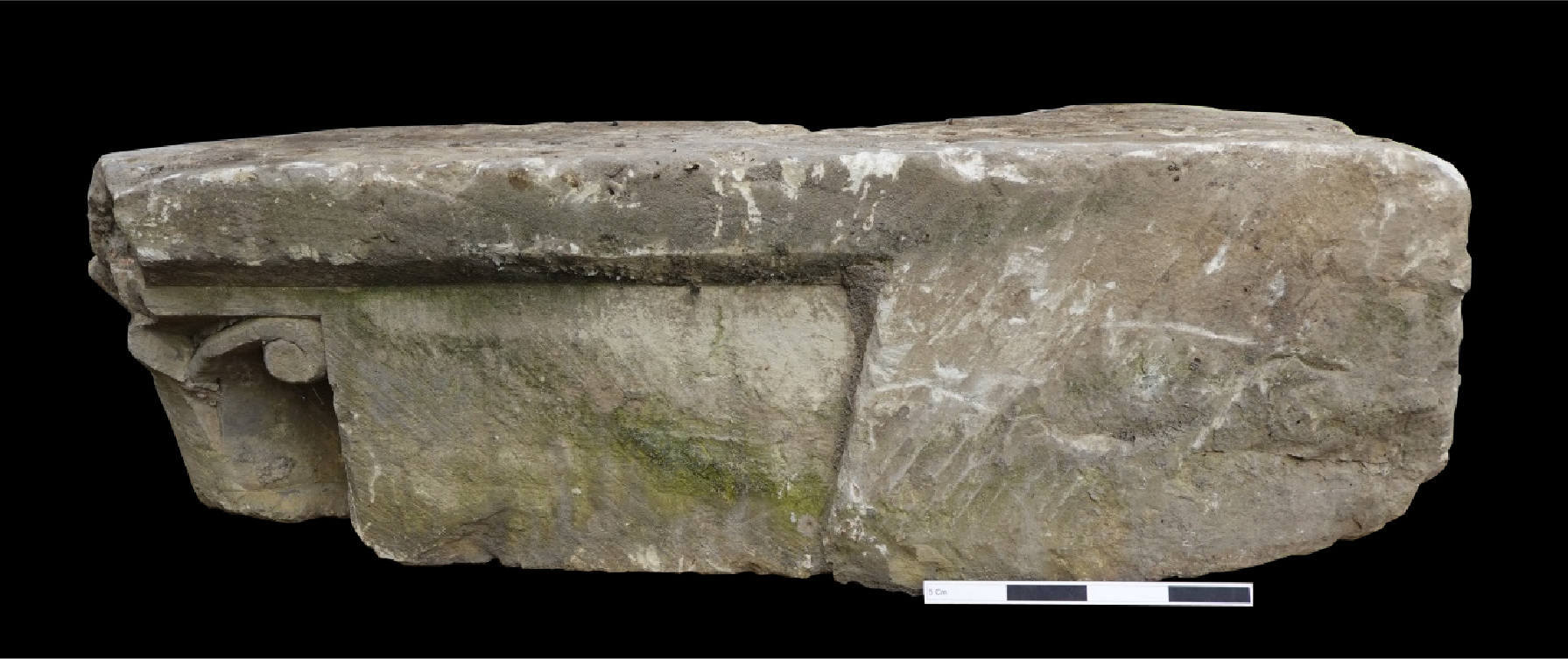
AF13 was in the Early English style giving a date of the 13th century and comprised a springer with part of a blind arcade. Two fragments of ashlar (AF1 and AF12) and a small fragment of indeterminate form (AF3) had claw tooling which in York came into use c. 1200 (Stocker 1999, 347); these three AFs could therefore be of any date from this point to the Dissolution of the Monasteries in the 1540s. A further two fragments, a plinth (AF11) and a voussoir (AF10), could be of any date from 1066 to the 1540s. Six of the AFs were in the perpendicular style dating to 1350–1540. These comprised four window mullions (AF4-6 and AF8), a fragment of tracery (AF9) and a springer (AF2).
Part of a very badly damaged sandstone architectural fragment (AF7) was part of a corbel or springer originally. Sandstone was not used for building purposes in medieval York, suggesting that this was a Victorian piece. This could have been discarded following WWII damage at the site.
| AF no. | Context | Dating | Description |
|---|---|---|---|
| 1 | 3001 | 1200+ | Magnesian limestone block. Four faces surviving (F1-4) other two sides broken off. F1 = interior elevation very smoothly dressed surface. F2 = exterior elevation with claw tooling all over, 2 teeth per 10mm in drafts diagonal to the bed. F2-3 = sides both with a quarter circular area of fine grooves as if worn or cut with a fine bladed saw. Rest of F2 very rough. F5 is a broken side, clearly reworked with occasional chisel or punch marks in random directions. Remaining side broken off and very rough. Small area of modern concrete on F2. Ashlar originally, clearly re-worked. |
| 2 | 3001 | 1350-1540 | Magnesian limestone block. Heavily moulded. Four faces surviving (F1-6). F1 = base with mortar adhering, unclear if mortar is original or later from re-use. F2 = top. F3-6 = side elevations. F3 heavily moulded with rebates, chamfers and a quirk. F5 = heavily moulded with chamfers, rolls and hollows. Clearly a springer as the mouldings splay out at the top to accommodate either another springer or the arch above. Fine drag tooling lines on the dressed surfaces. Thick mortar on F3 implies reuse. This should be retained |
| 3 | 3062 | 1200+ | Small fragment of magnesian limestone, part of one surface (F1) present with claw tooling, 5 teeth per 10mm. |
| 4 | 3000 | 1350-1540 | Magnesian limestone mullion. Two faces present (F1-2) representing the sides of the block, top and basal ends broken off. Each face has internal and external slightly hollow curves with a central slot for the glazing. Drag tooling on all surfaces. |
| 5 | 3043 | 1350-1540 | Magnesian limestone mullion. Part of 3 faces (F1-3) surviving, F1 is base or top, F2-3 the sides. Very fine claw tooling on F2-3 with 6 teeth per 10mm, coarser claw tooling on F1 with 3 teeth per 10mm. Traces of a socket to house the glazing on F2 |
| 6 | 3043 | 1350-1540 | Magnesian limestone mullion, 2 faces (F1-2) present all other surfaces broken off. Each face is a side of the block with a fillet and hollow curve. No tooling survives |
| 7 | 19000 | Victorian | Sandstone with occasional small flecks of mica. Highly complex design with multiple facets. Three original sides survive all of which have a pair of narrow ribs on the centre base of the block which spring outwards on a V shape to join the ribs of the adjacent side. The ribs were clearly originally faceted but this has largely eroded off. Very badly battered. Sandstone is rarely used in medieval York for carved decoration, which may suggest that this is a Victorian piece. Corbel/springer |
| 8 | 19022 | 1350-1540 | Magnesian limestone block, F1 = side, F2 = front elevation, F3 = side, F4 = top or base of block. Claw tooling on F1 and F3 with 4.5 teeth per 10mm. Very battered not worth retaining. Mullion |
| 9 | 19039 | 1350-1540 | Small Magnesian limestone fragment from the junction of a horizontal and vertical element of window tracery. Too small to merit retention. Tracery. |
| 10 | 8092 | medieval | Magnesian limestone block, four faces survive other sides broken off. F1 and F3 are opposing sides, F2 is the soffit, F4 = top. Reused with mortar on F1 F3 and broken surfaces. Striated tooling on all four surfaces. Voussoir. |
| 11 | 8092 | medieval | Magnesian limestone block, three faces survive other sides broken off. F1 was the base, F2 the chamfered external surface and F3 one end of the block. Both F1 and F3 would have been hidden from view when in sue, while F2 would have been an elevation. Striated tooling on all three surfaces. Reused with mortar on all three faces and broken surfaces. Plinth. |
| 12 | 3025 | 1200+ | Magnesian limestone block, four faces survive other sides broken off. F1 was the base or top, F2 the end, F3 the top or base and F4 the original elevation. F1-F3 would have been hidden from view when in sue, while F4 would have been an elevation. Claw tooling on all surfaces with 4 teeth per 10mm. Mason's mark on F4 in the shape of a St Julian Cross but horizontal/vertical as opposed to at 45 degrees. Ashlar. Unfortunately, this was broken when removed from site and was so damaged that it was not retained. |
| 13 | 3025 | 13th | Complex magnesian limestone block forming the basal springer block of a blind arcade. Portions of two adjacent arches being present. Eight sides survive, F1-2 are the side and back of the left-hand arch, F3-5 the remaining sides of this arch of which F3-4 continue the full surviving height of the block which F5 is a plan side above the point where the two arches diverge. F6 is the base, F7 the side of the right hand arch and F8 the top. F3-4 decorated with a series of quirks, rebates, rolls, fillets and hollow rolls, all deeply undercut. Exceptionally fine claw tooling on all surfaces, 5 teeth per 10mm. F8 also has striated tooling. Some chipping and damage. Clearly subjected to later damage with drilled holes all over (F1 with three F2 with one, F3 with five and F4 with one) ranging from 7mm -17mm in diameter. |
| 14 | 3025 | 12th to 13th | Large walling block with integral capital at one end. Five original faces survive, F1-2 are opposing sides, F3 an end, F4 the top and F5 the base. One end is broken off. Most of F1 has broken off. F1 has an integral rebated recess at one end which houses a waterleaf capital with a roll at the base. This capital forms the full width of F3 but is badly damaged here. F2 has a much deeper recess with a chamfer along the upper edge and a rebate at one end and the waterleaf capital at the opposing end of the recess. Striated tooling on F2, F4 and F5. Some mortar on the capital on F2. |
In addition to the architectural fragments, a small number of chips and fragments of magnesian limestone were recovered from the site, many from within boreholes and piling cores. These were too fragmentary to determine the original form, and they did not merit the allocation of AF numbers; these are summarised in Table 23.
This collection was recorded on a pro forma sheet detailing the project code, the context number, form, the weight in grams, the stone type, the surviving dimensions and any other relevant information (details of surviving surfaces etc.). Only the retained fragments (one of tufa and one of oolitic limestone) were added to the YAT's computerised database (IADB) as they were the only stone items to require a finds number for artefact management purposes.
Collectively the small fragments of stone weighed 6.2kg, the largest single fragment being 1335g in weight (though this item comprised two adjoining fragments).
Some of these were clearly of Roman date on the basis of their geology (one of coarse-grained sandstone, one of chalk, one of micaceous sandstone, eleven of oolitic limestone and two tufa fragments). The Romans used three principal buildings stones in York, namely coarse-grained sandstone, largely sourced from West Yorkshire (RCHME 1962, xcv), oolitic limestone from the Whitwell/Malton area north-east of York and Magnesian limestone from the Wetherby/Tadcaster/Knaresborough area (Gaunt and Buckland 2002, 135, 138 and 141). In addition, Elland flag (micaceous sandstone) was widely used for roof and floor flags (Gaunt and Buckland 2002, 135), while tufa was also used for vaulting (Gaunt and Buckland 2002, 141). Chalk was occasionally brought to York from the Yorkshire Wolds, and although it is harder than the chalk of Southern England it is still insufficiently resistant to be of much use for external walling; it was, however, easy to carve which made it useful for artefacts such as tesserae (Gaunt and Buckland 2002, 141). Other finer grained sandstones were also occasionally used in Roman York with outcrops known in the Vale of York (Gaunt and Buckland 2002, 138).
Some of the remaining magnesian limestone fragments could be dated as medieval on the basis of either their form or the tooling marks present: one from C3062 having claw tooling present which dates to sometime after 1200 (Stocker 1999, 347), while the second from C3110 probably represents a fragment of a moulded block of medieval date. Three fragments (two of which were adjoining) from C9652 were fragments of medieval column shafts 92mm in diameter, but these were too damaged to determine if they had originally been attached to the adjacent walling or not. Columns of this type were used throughout the medieval period as decorative features around windows and doorways. Three other fragments of limestone occurred in medieval contexts (C19126 and C19107) and a context of probable medieval date (8054); these fragments could represent either residual Roman fragments or medieval fragments. The final limestone fragment occurred residually in a 19th century context (C19020) and again could be either Roman or medieval in date.
| Context | Stone type | Date | Description |
|---|---|---|---|
| 3025 | FGSS (S7) | Roman | No original surfaces |
| 3025 | OOLS (S1) | Roman | Sliver of building stone, no original surfaces |
| 3025 | OOLS (S1) | Roman | Sliver of building stone, no original surfaces |
| 3043 | FGSS (S7) | Roman | Sliver of building stone, no original surfaces |
| 3055 | CGSS (S12) | Roman | Vey battered original form impossible to determine |
| 3062 | MGLS (S2) | Medieval | Magnesian limestone fragment, one face survives with very faint claw tooling |
| 3082 | Tufa | Roman | Small irregular fragment |
| 3082 | OOLS (S1) | Roman | Irregular fragment |
| 3082 | Tufa | Roman | Irregular fragment |
| 3082 | OOLS (S1) | Roman | Irregular fragment |
| 3082 | OOLS (S1) | Roman | Irregular fragment |
| 3110 | MGLS (S2) | Medieval | Magnesian limestone, small fragment with D shaped cross section, both ends and back broken off. Possibly a tiny portion of and architectural fragment |
| 3130 | MSS (S9) | Roman | Sliver of building stone, no original surfaces, very abraded |
| 8054 | MGLS (S2) | ? | Irregular fragment |
| 9604 | MGLS (S2) | Medieval | Irregular fragment. From 4.94m depth in BH1B. |
| 9631 | MGLS (S2) | Medieval | Irregular fragment |
| 9652 | MGLS (S2) | Medieval | Two adjoining badly battered column shaft fragments 92mm in diameter. Too battered to determine if attached originally. Too battered to merit AF number. 2-3m depth in BH5B |
| 9652 | MGLS (S2) | Medieval | Badly battered column shaft fragments 92mm in diameter. Too battered to determine if attached originally. Too battered to merit AF number. 2-3m depth in BH5B |
| 19020 | MGLS (S2) | ? | Irregular fragment |
| 19020 | OOLS (S1) | Roman | One original surface |
| 19031 | Chalk (S11) | Roman | Irregular fragment |
| 19035 | FGSS(S7) | Roman | Irregular fragment |
| 19035 | OOLS (S1) | Roman | Irregular fragment |
| 19035 | OOLS (S1) | Roman | Irregular fragment |
| 19055 | FGSS(S7) | Roman | Irregular fragment |
| 19104 | OOLS (S1) | Roman | One original surface |
| 19104 | OOLS (S1) | Roman | One original surface |
| 19107 | MGLS (S2) | ? | Irregular fragment |
| 19125 | FGSS(S7) | Roman | Irregular fragment |
| 19126 | FGSS(S7) | Roman | One original surface |
| 19126 | LS (S3) | ? | Irregular fragment |
| 19133 | OOLS (S1) | Roman | One original surface |
| 19148 | FGSS (S7) | Roman | One original surface |
Roman Pottery | Post-Roman Pottery | Ceramic Building Material | Stone Building Materials | Mortar, Plaster and Painted Plaster | Daub and Opus Signinum | Small Finds | Roman Frit Objects | Roman Vessel Glass | Roman Window Glass | Coins | Worked Stone
Numerous fragments of mortar, plaster and painted plaster were recovered from the Guildhall site (2658 fragments collectively weighing 56.741kg) which could be split into four broad categories:
Several types of mortar were present and given that any given type of mortar could have examples of fragments with no plaster, fragments with plaster and fragments with painted plaster it was clearly sensible to consider the mortar, plaster and painted plaster as a whole, rather than splitting the material in question into the separate categories of plaster, mortar, mortar with plaster and mortar with painted plaster.
The individual fragments were weighed and details entered on a pro forma sheet detailing the project code, context number, find number, material type, weight in grams, dimensions, the original thickness where this survived, and any other relevant information in a comments section (e.g. details of keying marks). Also included is information as to whether the fragment was retained or discarded. The fragments were allocated to various types at the time of the initial assessment based on the type of mortar present. The types were allocated in the order in which they were recorded and did not imply any form of chronological development.
Traditionally within YA mortar and plaster are recorded as bulk finds (BFs) while painted plaster is recorded as small finds (SFs). Any given BF or SF number can contain multiple fragments. In the case of this site there are several SFs which include both painted plaster and plain white plaster which is clearly related (this was to avoid bagging related items in two separate places; the plain plaster as a BF and the painted plaster as a SF). Three items of moulded mortar/plaster were collectively bagged as BF309.
The recorded data was typed into a Microsoft Excel table.
The mortars were named A-L and described in more detail (see Table 24). The overwhelming bulk of the mortar and plaster was clearly of Roman date (Mortars A–D and F), on the basis of both the forms seen and in relation to the site stratigraphy. The fragments in Mortars G–J were in medieval contexts and are probably of medieval date as they do not seem to be related to any of the Roman mortars present, while Mortar K was probably post-medieval, and Mortars E and L were clearly modern.
| Type | Description | Weight in grams | No of fragments | % of total |
|---|---|---|---|---|
| A | A very coarse grained off-white coloured lime mortar with very frequent coarse inclusion. The inclusions comprise pebbles up to 9x4mm in size and rounded quartz grains up to 4x3mm in size. | 18604 | 299 | 32.79 |
| B | A coarse lime mortar with pebble inclusions up to 9x2mm in size and coarse grains of rounded quartz up to 4x2mm in size. This is similar to the Mortar A, but lighter in colour and slightly less coarse with frequent as opposed to very frequent inclusions | 16698 | 321 | 29.43 |
| AB | A as basal layer with B above | 1925 | 7 | 3.39 |
| C | Sandy coarse light pink with occasional pebble inclusions up to 7x3mm in size and frequent smaller pebbles and rounded quartz. | 3299 | 27 | 5.81 |
| D | Slightly pink mortar backing with frequent rounded quartz inclusions and occasional pebble inclusions up to 2x2mm in size. | 515 | 13 | 0.91 |
| E | Fine lime-based mortar. Much finer than any other at the site Frequent exceptionally fine quartz and exceptionally fine black inclusions of uncertain type. | 50 | 1 | 0.09 |
| F | Grey-white coloured mortar, very soft and crumbly, with rare inclusions of rounded quartz up to 12x6mm in size and very frequent rounded quartz up to 2x2mm in size. | 2720 | 52 | 4.79 |
| G | Very hard white mortar, frequent very fine quartz and occasional small rounded pebbles up to 1mm across. One fragment of grog 12x10mm in size. | 1325 | 2 | 2.35 |
| H | White grey mortar with frequent very fine angular quartz. | 1040 | 4 | 1.83 |
| I/J | Mortar I. Pink mortar with occasional fragments of limestone up to 2x1mm, moderate fine rounded quartz. Mortar J similar but whiter mortar with occasional fragments of limestone up to 2x1mm, moderate fine rounded quartz. I and J were present as two superimposed layers on just one fragment | 45 | 1 | 0.08 |
| K | Slightly pink mortar with moderate fragments of limestone up to 3x15mm in size. No small inclusions. | 10 | 1 | 0.02 |
| L | Hard pale grey mortar with frequent exceptionally fine quartz inclusions. | |||
| ? | Recovered from boreholes and samples. These items were too small to accurately assess the mortar type. | 10350 | 1926 | 18.24 |
| Plaster | Plaster | 150 | 3 | 0.26 |
The types allocated in the original assessment report were subdivided (for example, Type 1 was split into Type 1a, Type 1b and Type 1c), and in some cases revised to take into account not just the composition of the mortar but also the shape of the original surfaces (whether they were flat or were keyed), whether plaster was present, whether or not the plaster was painted, and whether or not two clearly superimposed schemes of rendering were present. The original records were also enhanced with more detailed measurements of the thicknesses of the various layers of mortar and plaster seen. The revised types are summarised in Table 25.
| Type | Mortar | Plaster | No. of painted frags | Opposing Surfaces | Weight in grams | No of fragments | % of total volume |
|---|---|---|---|---|---|---|---|
| 1a | A | None | None | F/F | 13216 | 245 | 23.29 |
| 1b | A | None | None | F/C | 3020 | 25 | 5.32 |
| 1c | A | None | None | Missing | 2028 | 27 | 3.57 |
| 2a | B | Yes | None | F/F | 7052 | 190 | 12.43 |
| 2b | B | Yes | None | F/C | 3335 | 44 | 5.88 |
| 2c | B | Yes | None | Missing | 676 | 37 | 1.19 |
| 2d | B | Yes | None | F/F | 225 | 3 | 0.4 |
| 3a | B | None | None | F/F | 853 | 15 | 1.5 |
| 3b | B | None | None | F/C | 150 | 3 | 0.26 |
| 4a | A and B | Yes | None | F/C | 735 | 3 | 1.3 |
| 4b | A and B | None | None | C/F | 425 | 1 | 0.75 |
| 4c | A and B | Yes | None | F/F | 50 | 1 | 0.09 |
| 4d | A | Yes | None | C/F | 2315 | 12 | 4.08 |
| 4e | A and B | None | None | F/F | 100 | 1 | 0.18 |
| 4f | A and B | None | None | F/C | 340 | 2 | 0.6 |
| 5 | B | Yes | None | F/F | 412 | 3 | 0.73 |
| 6 | Plaster | Yes | None | Varies | 150 | 3 | 0.26 |
| 7a | B | Yes | 8 | F/F | 1285 | 8 | 2.26 |
| 7b | B | Yes | 8 | F/C | 910 | 7 | 1.6 |
| 7c | B | Yes | 1 | F?C | 125 | 1 | 0.22 |
| 8 | IJ | Yes | 1 | F/F | 45 | 1 | 0.08 |
| 9a | C | Yes | 5 | F/F | 1035 | 10 | 1.82 |
| 9b | C | Yes | 6 | F/F | 279 | 6 | 0.49 |
| 10 | C | Yes | 10 | F/F | 1985 | 11 | 3.5 |
| 11 | D | Yes | 5 | F/F | 515 | 13 | 0.91 |
| 12 | E | Yes | None | F/F | 50 | 1 | 0.09 |
| 13a | F | Yes | None | F/F | 2145 | 28 | 3.78 |
| 13b | F | No | None | F/F | 550 | 23 | 0.97 |
| 14 | G | No | None | ? | 1325 | 2 | 2.34 |
| 15 | H | No | None | ? | 1040 | 4 | 1.83 |
| 16 | K | No | 1 | ? | 10 | 1 | 0.02 |
| 17 | G | Yes | 1 | F/F | 10 | 1 | 0.02 |
| ? | ? | No | None | ? | 10020 | 1923 | 17.66 |
| Moulded plaster | D | Yes | None | Varies | 330 | 3 | 0.58 |
As some of the Roman types of mortar/plaster were clearly closely related they were allocated to Groups (see below). This section starts with an overall summary, followed by a description of each group and then the types within that group. The mortar/plaster is summarised by group in Table 26, and the painted plaster is summarised in Table 27.
The post-Roman material is simply dealt with by period as there is very little material of this date to discuss.
The use of mortar, plaster and paint to decorate rooms was widespread within the Roman Empire, both in military and civilian contexts. Interior mortar/plaster surfaces could be used on buildings constructed of wattle and daub, timber, brick or stone; and on all types of buildings from the relatively humble those of the highest status (Ling 1985, 5).
Roman interior wall renders were applied as a series of layers, each finer than the one before, with the final surface being of plaster which could be painted in the fresco technique. The Roman author Vitruvius (Book 7, Chapter III) recommended the use of three layers of mortar followed by three of finer mortar mixed with marble dust. The final coat of exceptionally thin white plaster, known as the intonaco, is essential for fresco painting (the method used in Roman times) as the plaster was painted while it was still wet, allowing the pigments to penetrate the plaster (Hostetter and Noble-Howe 1997, 197). In practice such an elaborate number of layers of superimposed mortar and plaster were rarely used in Roman Britain where the norm was to have two coats of mortar (a thick levelling coat followed by a finer surface coat) with the finishing coat being a mere skim (Davey and Ling 1982, 55). In the case of the Guildhall there were examples of exactly this type, but also of a single backing layer of mortar with a thicker layer of plaster above. There is no evidence at the site for superimposed layers of plaster.
Mortars were made using a mixture of lime and aggregate, usually sand, though no specific recommendations survive in ancient literature for the proportion of each to be used (Davey and Ling 1982, 54). Vitruvius recommended the use of quarried sand rather than sea sand as the latter would leach salt (Davey and Ling 1982, 53). The aggregate in some of the mortars at the Guildhall site was very coarse comprising tiny pebbles, and there was clear variation in the volume of sand used, with Mortar F being particularly crumbly due to the high sand content. Plaster was obtained by slaking lime, and there are many suitable sources of limestone within easy reach of York (as noted in section 2.3).
There was clearly some variation in the surface treatment of the mortars at the Guildhall. The majority of the fragments had two opposing flat surfaces, while others had one flat surface and one keyed surface, creating an almost corrugated appearance. It is known that sometimes the interior elevation surface of a backing-layer of mortar was deliberately keyed by the plasterer to aid the adhesion of the next mortar layer. The second layer of mortar was applied while the first was still wet to aid adhesion. The keying could be done by creating a herring-bone relief pattern of grooves or by scoring random grooves within the mortar (Adam 2005, 218, fig. 512–3). Alternatively, the interior elevation of the render could be pecked with a hammer to provide adhesion (Davey and Ling 1982, 55). The herring-bone pattern is present at the Guildhall site. Most of the keyed fragments from the Guildhall have parallel grooves of keying, but these fragments are so small they could easily have been part of a larger herringbone shaped keying pattern originally.
The Guildhall fragments often show a pattern of keying lines on the reverse side i.e. the side closest to the wall of the room in question (Figure 74). That they are the reverse side is clear from the presence of plaster or painted plaster on the opposing flat surface, which must therefore represent the interior room elevation. The keying lines on the reverse surfaces of these fragments must represent the mortar filling the grooves of the underlying keyed surface, thereby creating a mirror image of the underlying keying.
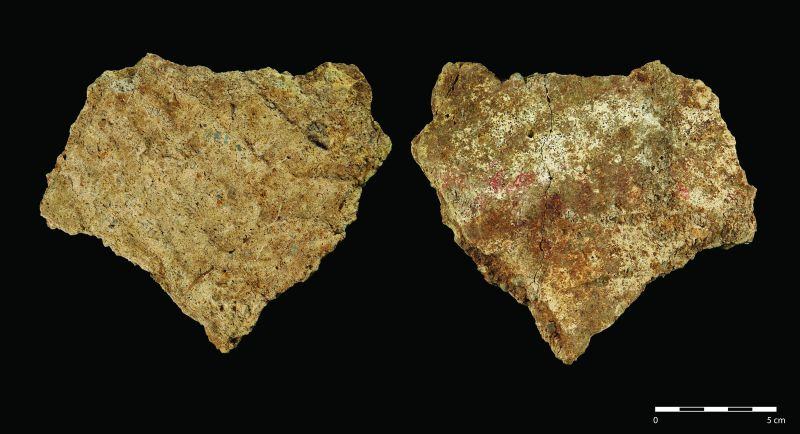
The reverse of a single fragment at the Guildhall had an impression of the underlying keyed surface on one portion, while the remainder was flat indicating the underlying mortar was not keyed. This suggests that any given wall could have underlying mortar that was only keyed in certain sections. Again, this practice of only keying a portion of the wall has been seen within the legionary fortress at York (Figure 75). It is also known that Roman rooms could be redecorated. Plasterers usually did not bother to remove the previous decoration, simply applying an additional layer above (Davey and Ling 1982, 56). Evidence for this was present at the Guildhall site.
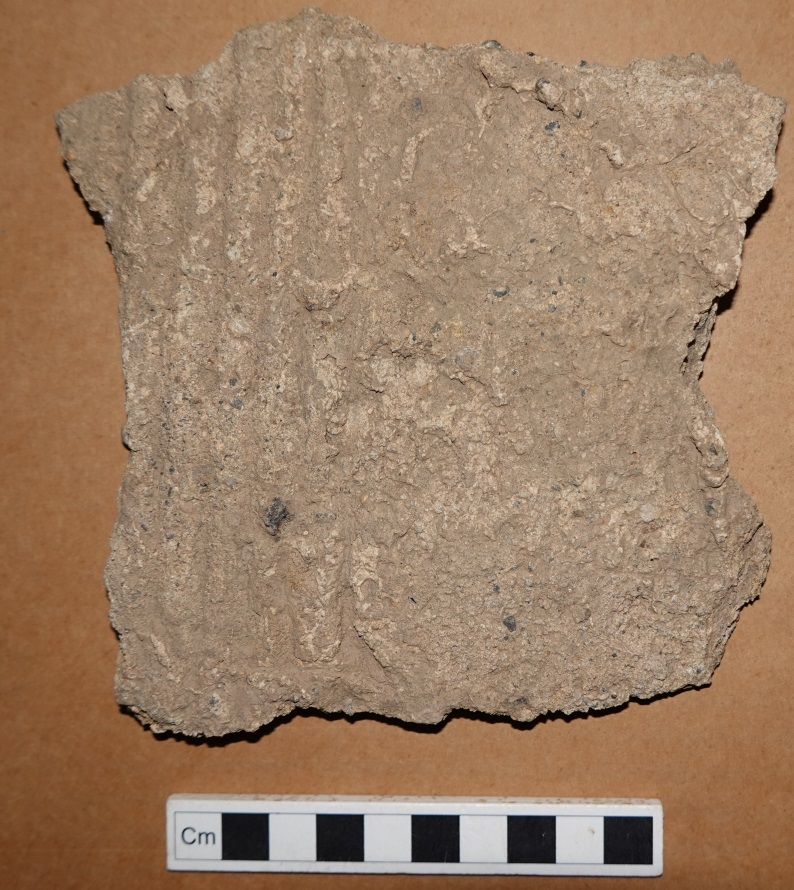
There were fragments from the Guildhall that had two clearly superimposed schemes of decoration surviving (Figure 76). Other sites in Britain, such as Catterick, have shown that the interior elevation of the first scheme of decoration was deliberately pecked to aid the adhesion of the replacement mortar/plaster (Davey and Ling 1982, 56). Similar interior elevation keying marks are known from other sites in York, a good example being shown on Figure 77; this fragment was far larger than any of the fragments from the Guildhall site and shows that the entire surface had been keyed in preparation for a new scheme of decoration (this fragment probably originated from within the Multangular Tower of the legionary fortress which was excavated as YAT project 0834). A similar triangular keying mark on the interior elevation surface was present at the Guildhall (Figure 78) indicating that a replacement layer was placed above, though this second layer did not survive.
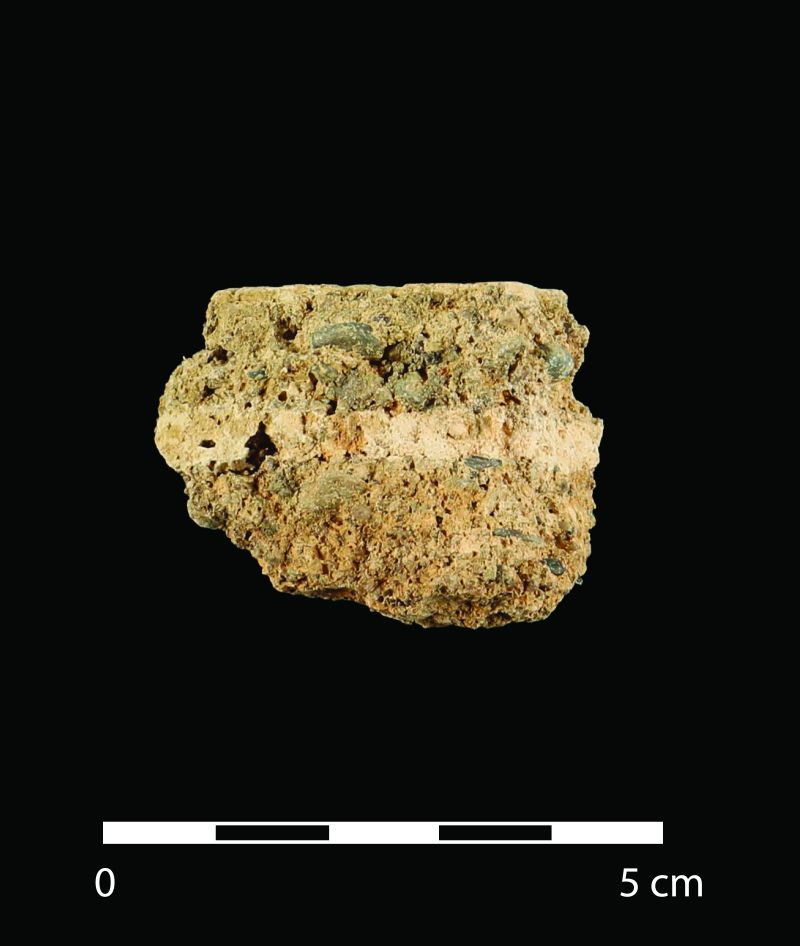
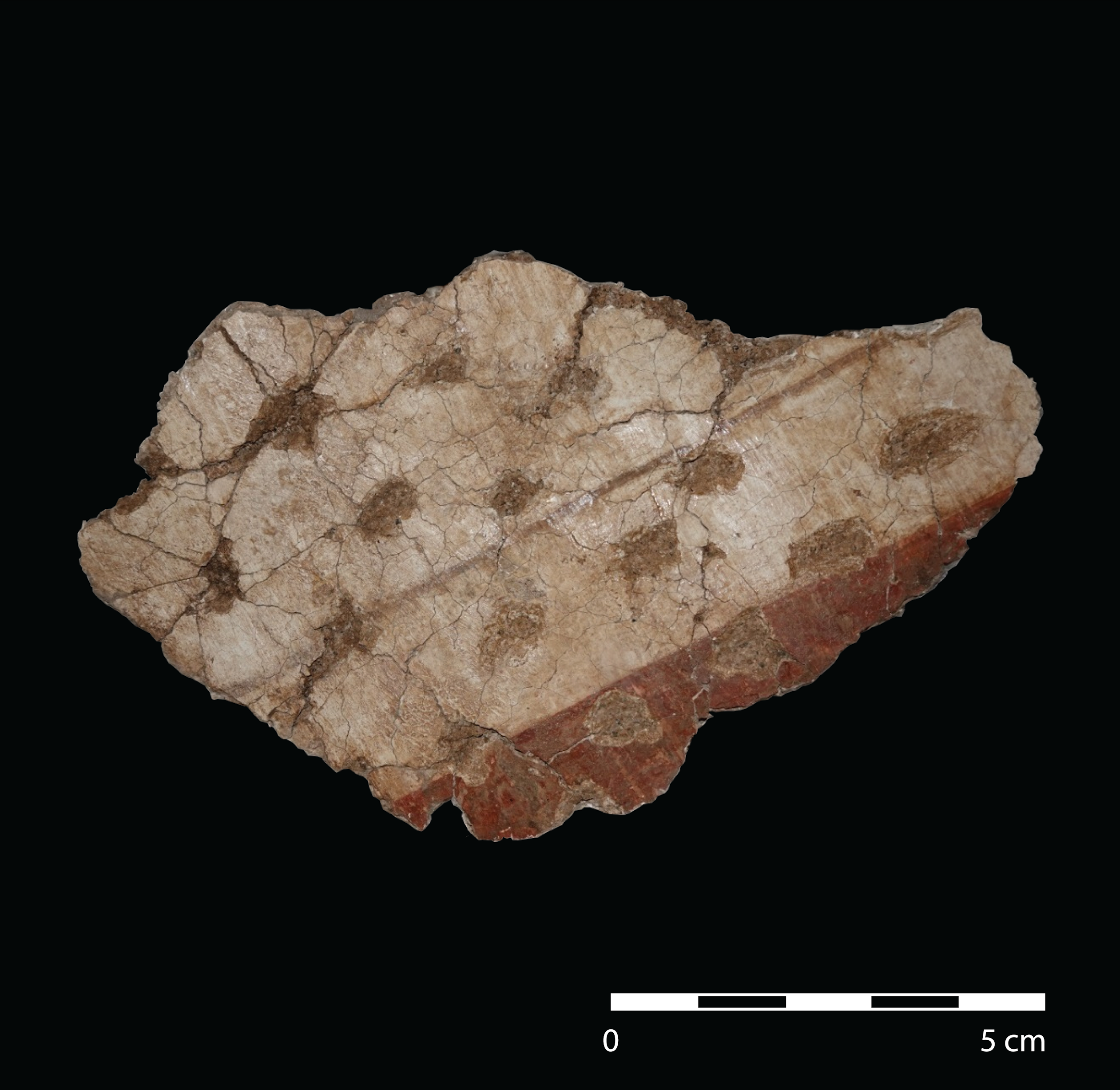
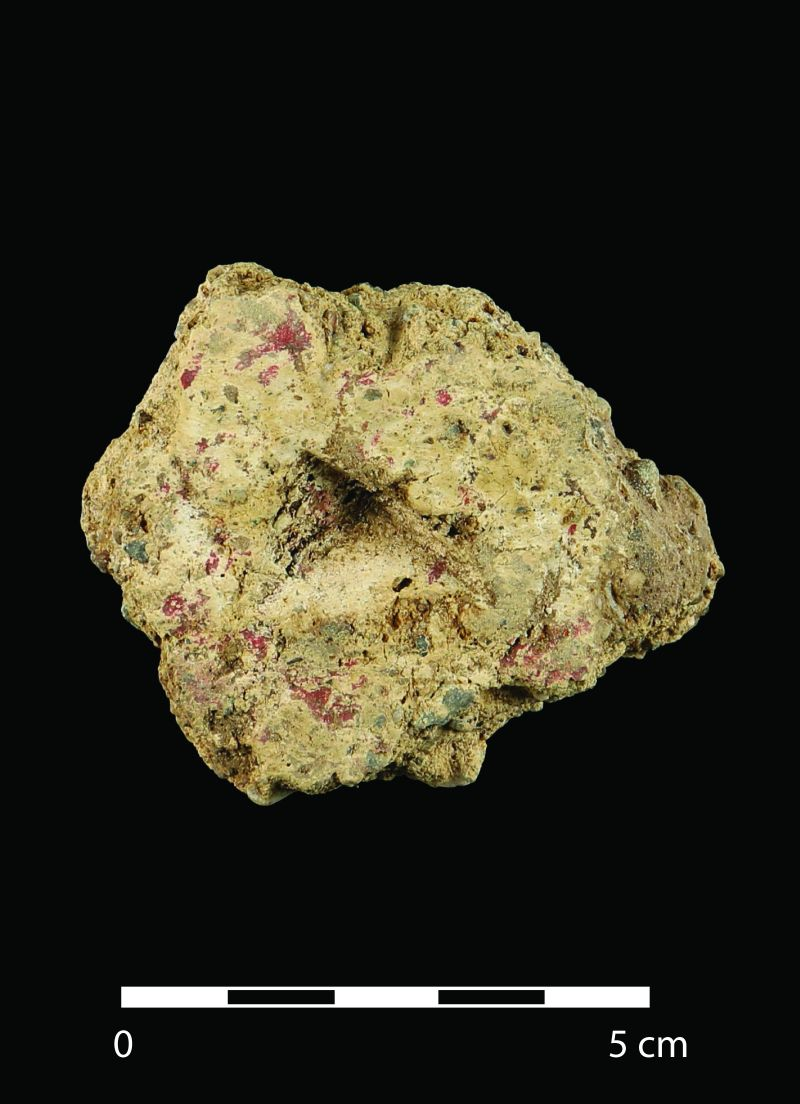
Most of the plaster surfaces at the Guildhall were simply whitewashed, though a small proportion of the plaster was painted, with just 38 fragments of Roman painted plaster present, compared to 351 fragments of plain white plaster.
In Roman architecture wall paintings usually consisted of three areas with a lower dado, above which was a central panel roughly three times the height of the dado, while at the top of the wall there was a frieze (Ling 1985, 16). The dado was typically a single colour (most commonly red) divided into fields by thin vertical lines, sometimes with lozenge shapes within the fields marked by the thin lines (Ling 1985, 22; Davey and Ling 1982, 35). The central panel could be decorated in a variety of ways: some were painted in a variety of colours to mimic stone veneers (Toynbee 1962, plate 201), others had panels of white surrounded by coloured borders with decorative motifs inside the panels (Ling 1985, figs. 6–7), some were painted with architectural motifs designed to give the illusion of depth as if looking out onto a vista beyond (Ling 1985, fig. 10) and others had figurative scenes (Toynbee 1962, plate 204). The commonest form of decoration seen throughout Britain is simple two-dimensional panels of colour, which is the only style known in Britain prior to the mid-2nd century, with more complex central panel designs appearing from the mid-second century onwards (Ling 1985, 21–2). The frieze was typically of simple stripes (Ling 1985, 22).
Plaster is fragile and often found in a badly fragmented form, making reconstruction of the original decoration schemes impossible. This was the case at the Guildhall, where the painted plaster fragments were too small to determine the overall design. That said, the earlier of the Group 1 schemes had a red stripe with a patch of grey above the stripe, and areas of grey and cream-ochre. This was replaced by a scheme with areas of red paint, cream/ochre paint, and a fragment with two splashes of green that could be portions of leaf designs. The largest fragment from Group 1 had a stripe of red paint in excess of 51mm wide, then a stripe of slightly pink paint 5mm wide above the straight edge of the red stripe. The area above the white stripe had an ochre background above which was a second red stripe, parallel to and 92mm away from the main area of red. The Group 2 scheme included areas of red and grey paint, a red stripe and a trellis and leaf design. Group 5 comprised a mixture of stripes in red and black, all of differing widths, areas of white with small splashes or patches of red above, and areas of red paint.
In all cases at the Guildhall the stripes could have been from the upper edge of the dado, from the frieze or from borders around plain white fields on the main panel. The solid blocks of colour averaged 55 x 43mm in area, with the two largest being 210 x 95mm and 250 x 110 x 80mm in area; with such small fragments it is difficult to know if they represent panels of a single colour as typically seen in a dado, or portions of wide stripes. The splashed effect may represent an attempt to imitate stone veneer. The leaf and trellis designs were presumably from the central portion of the decoration, which may have been designed to give the illusion of looking into a garden. This design is dated by the site stratigraphic sequence as 2nd century CE.
The colours used (white, black, red, ochre, green and grey) were all typical for Roman wall paintings, with black coming from charcoal, white from lime or chalk, and red and ochre from sandstones, while green could be derived from verdigris (a product of the corrosion of copper).
Quite how the various groups of mortar/plaster related to any buildings at the site is unclear. Groups 2 and 3 may be related as the mortars are broadly similar, while the plaster of Group 6 may relate to Group 5 as they were both from a single phase of activity at the site. It seems probable that Groups 1, 2/3, 4, 5/6 and 7 represent differing schemes of decoration on the basis of the mortars used. The groups are discussed in relation to the site phasing.
Group 1 Superimposed layers of Mortar C, painted plaster, Mortar C then painted plaster
Group 1 comprised fragments of sandy mortar with a flat back above which was a layer of painted plaster 3–7mm thick; this had then been replaced by a second scheme of decoration comprising a thinner layer of sandy mortar beneath painted plaster 0.5mm thick (Type 10; Figure 75). These layers had sometimes sheared apart during demolition. The thickness of the plaster on the surviving fragments with two superimposed layers suggests that Type 9a fragments were originally from the basal layer of render, while the Type 9b were from the second layer of render/painted plaster as this had far thinner plaster. Details of the paint are given in the Type descriptions below. Examples of the paint are given in Figures 79–85.
Type 9a. There were 10 fragments which had thick backing of Mortar C topped by a layer of off-white plaster 3–7mm thick. Five of the fragments had paint above the plaster, which in two cases was grey, one was ochre in colour, one had a cream background and a black stripe 23mm wide and one had a red surface with a small patch of grey (Figure 79). Where it survived, all of these fragments had a flat back.
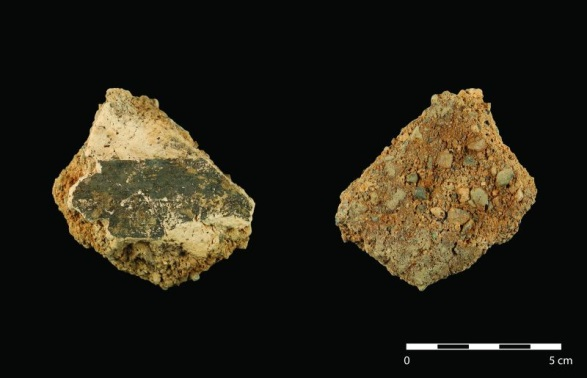
Type 9b. There were six fragments which had thin backing of Mortar C topped by a layer of off-white plaster 0.5mm thick. All these fragments had paint above the plaster, which in two cases were red, one was red with a grey stripe above and three cases were ochre in colour. Where it survived all of these fragments had a flat back.
Type 10. Eleven fragments had a layer of Mortar C with plaster 3–4.5mm thick above, then a second layer of Mortar C typically 9mm thick above topped by a 0.5mm thick layer of plaster and painted decoration. The painted fragments comprised one with a red surface (Figure 80), one red with a small patch of green above (Figure 81) one with two small areas of bright green possibly representing leaves (Figure 82), one with a 4mm wide red stripe (Figure 83), one with a 19mm wide red stripe and a group of five adjoining fragments with an area of red paint in excess of 51mm wide, then a stripe of slightly pink paint 5mm. The area above the white stripe had an ochre background above which was a second red stripe, parallel to and 92mm away from the main area of red (Figure 84).
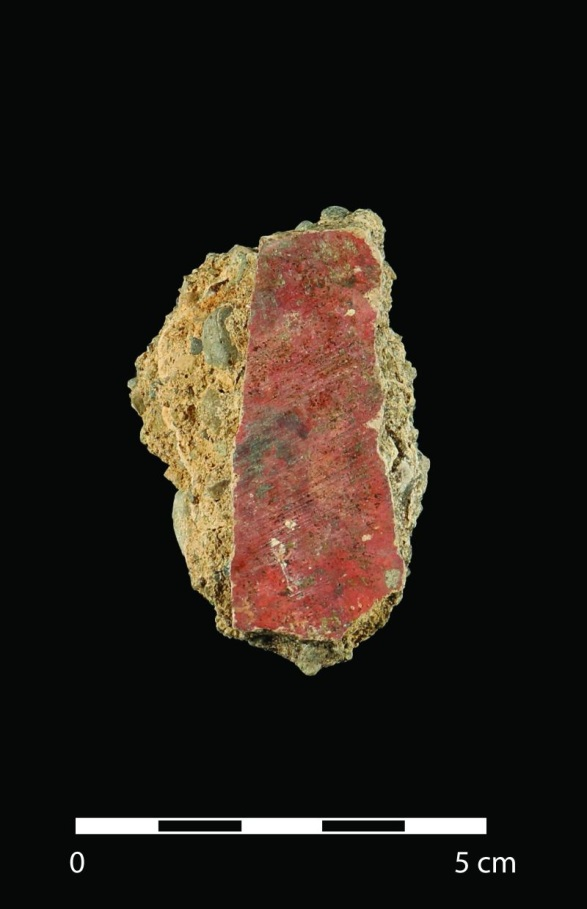
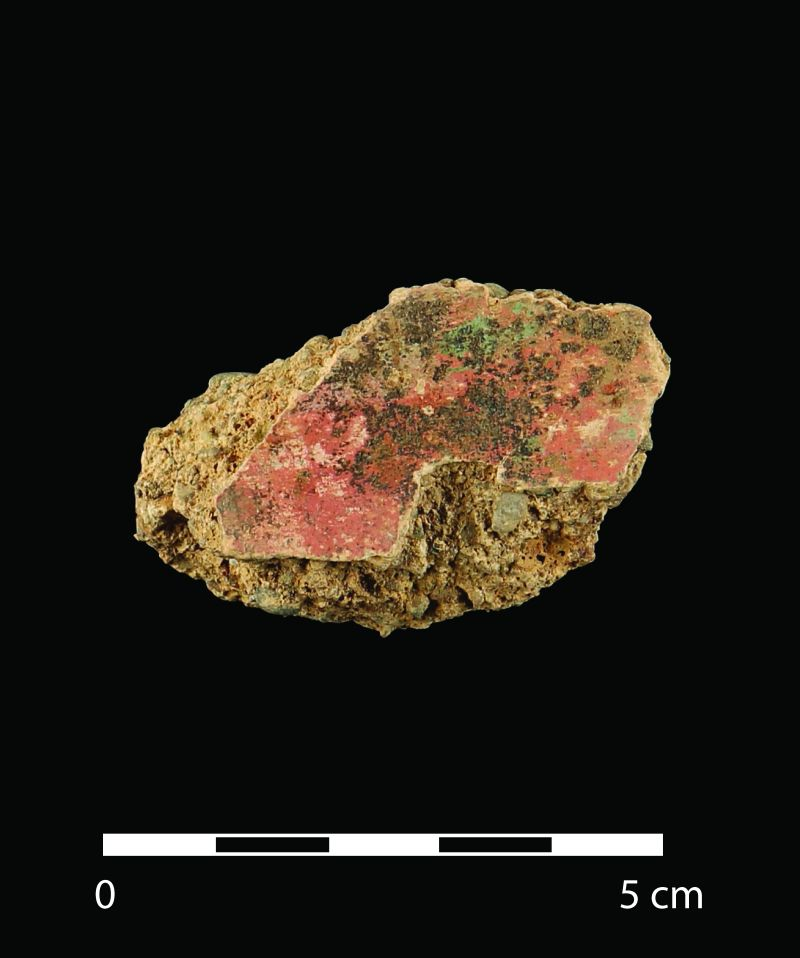
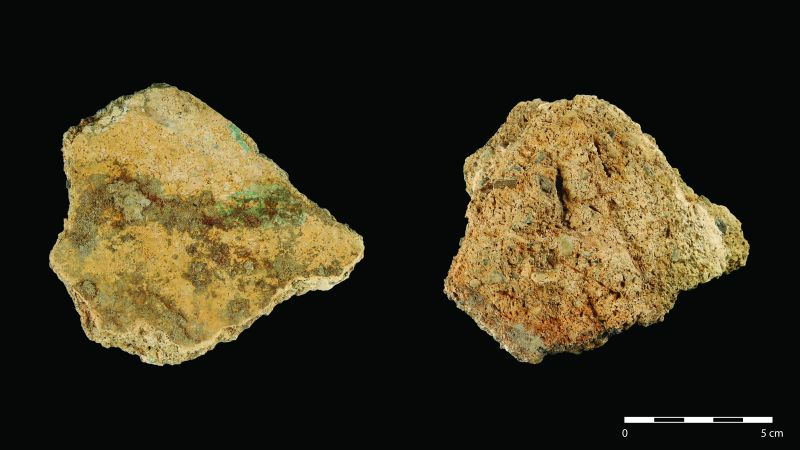
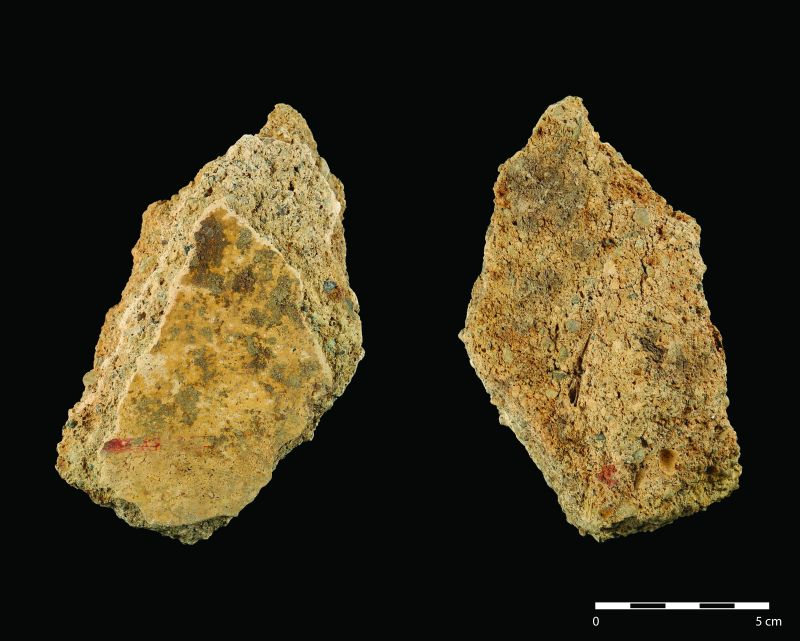
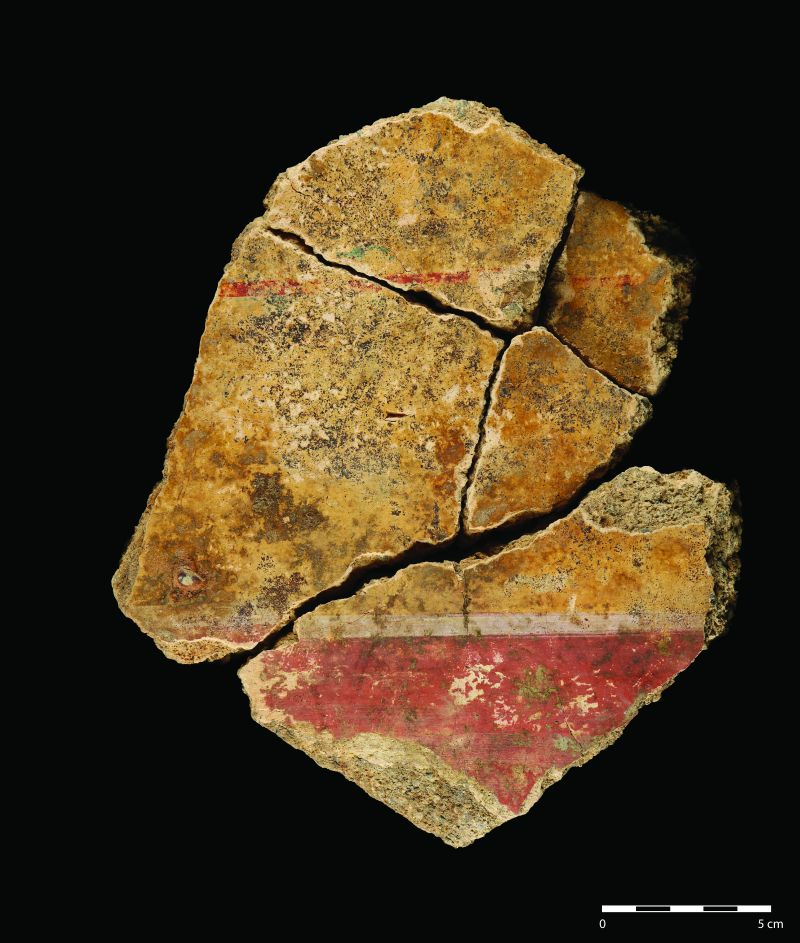
Group 2 Mortar D with painted plaster
Group 2 comprised a single type of mortar/plaster (Type 11) with painted plaster above. The 13 fragments ranged from 15–24mm thick and four were painted. One fragment had a red stripe 3mm wide and two had an area of grey paint. The fourth fragment had an elaborate painted trellis design comprising a border stripe of red 4mm wide to one side of which was a fret pattern of stripes 2–4mm wide. Above each junction of a stripe was a small black dot. This fragment was presumably from a central panel with architectural detailing, possibly designed to create the illusion of depth, with the viewer looking through the trellis to the vista beyond.
The Type 11 mortar/plaster is not an exact match for either Type 9a or 9b in Group 1, but they were all from Phase 8 which may suggest that they were related. It is difficult to be certain whether this group is in fact a variant of Group 1. The mortars are not quite the same (though different batches of mortar on a single wall could easily be slightly different if prepared by different plasterers). The underlying Group 2 mortar is of a similar thickness to that of Group 1 Type 9a, but the plaster above is 0.5mm thick as compared with the 3-7mm thick layer of plaster of Type 9a. Neither do the Group 2 fragments match Group 1 Type 9b for the mortar is far thicker, though the plaster is of a similar thickness. The possibility that the Group 1 and Group 2 fragments represent minor variations from within a single room should be noted.
Type 11. This had a slightly pink mortar with painted plaster above. The 13 fragments ranged from 15–24mm thick and four were painted. One fragment had a red stripe 3mm wide and two had an area of grey paint. The fourth fragment had an elaborate painted trellis design comprising a border stripe of red 4mm wide to one side of which was a fret pattern of stripes 2–4mm wide (Figure 85). Above each junction of a stripe was a small black dot. This fragment was presumably from a central panel with architectural detailing, possibly designed to create the illusion of depth, with the viewer looking through the trellis to the vista beyond.
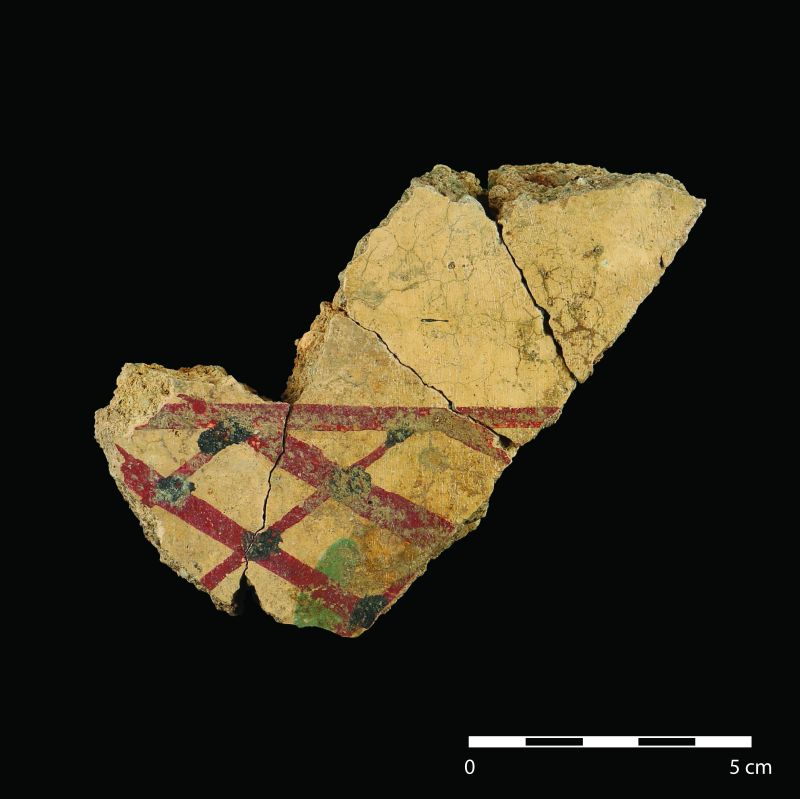
Group 3 Moulded plaster items
This group comprised four plaster fragments, three of which were moulded, which were recovered from the same phase as Groups 1–2, suggesting that they originated from the same building. The mortar in all cases was closest in composition to Mortar D and whiter in colour, though a little finer, suggesting that they related to the Group 2 scheme of decoration.
The first fragment weighing 100g had three original surfaces present, one of which was rebated, the rebate being 10mm deep. The rebated surface was coated with a layer of plaster 3mm thick (Figure 86).
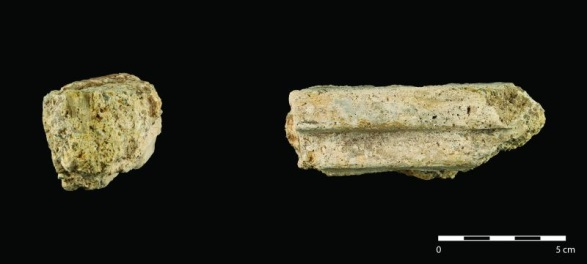
There was also a second fragment weighing 220g which comprised a plaster layer 2mm thick with part of a hollow curve on the surface (Figure 87).
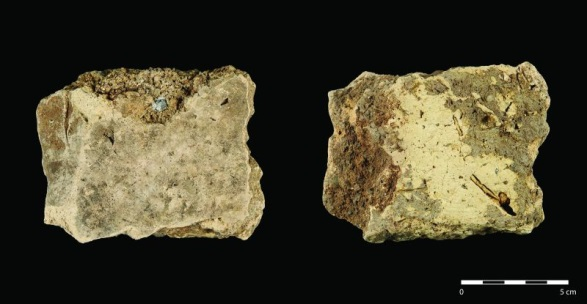
The third item weighed 10g and had a layer of mortar 24mm thick beneath plaster 1.3mm thick with a hollow curve on the upper surface. This probably relates to the preceding fragment (Figure 88).
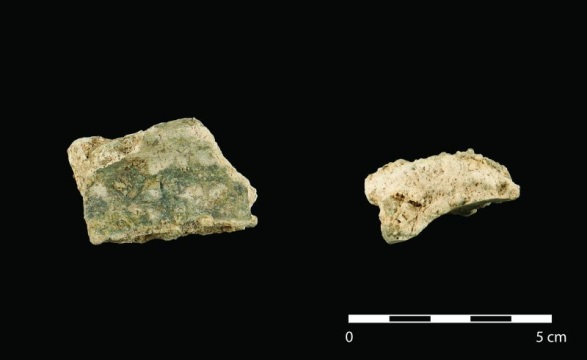
There was also a lump of plaster (Type 6) 49mm x 36mm x 26mm in size, with two opposing flat surfaces, which was recovered from an early phase at the site. This was too thick to have been a surface coating and must represent part of what was once a moulded fragment.
Group 4 Poor quality Mortar F
This group comprised 28 fragments of Mortar F, 23 of which had a layer of plaster up to 1mm thick on the external surface. Mortar F was notably crumblier and of poorer quality than the other mortars at the site. The fragments ranged from 12–40mm in thickness. The back surfaces were flat. All but one fragment had a plaster surface, but none were painted. The poor quality of the mortar suggests it may have been from a utilitarian room or structure.
It should be noted that Mortar F was divided into types 13a and 13b at the analysis stage, and that these types are in Groups 4 and 7 respectively. Type 13a usually had plaster on the upper surface, while Type 13b did not. In addition, the Type 13b fragments were even crumblier than those of Type 13a. When assessing the fragments in relation to the site stratigraphy it because clear that the Type 13a fragments were from an earlier phase than the Type 13b fragments, hence they were placed in separate groups.
Type 13a. This group comprised 27 fragments of Mortar F, 26 of which had a layer of plaster up to 1mm thick on the external surface. None were painted. Mortar F was crumblier and of poorer quality than the other mortars at the site (with the exception of Type 13b which was even softer). The fragments ranged from 12–40mm in thickness. The back surfaces were flat (in two cases the back did not survive).
Group 5 Mortar A with Mortar B and plaster (occasionally painted) above
This group comprises two types of mortar: Mortar A and B. Mortar A was thicker and slightly coarser than Mortar B. Mortar A was never plastered; in contrast Mortar B sometimes had surviving plaster, with a few fragments that had painted plaster. Where they occurred in combination Mortar A was clearly the backing-layer for Mortar B. In the majority of cases the various layers had sheared apart during demolition and subsequent dumping, leading to a variety of different combinations of mortar and plaster.
While most of the fragments of Mortar A had a flat interior elevation (Type 1a) there were some which were keyed (Type 1b). The reverse elevations of the Mortar B fragments with surviving plaster above were either flat (Type 2a) or carried an imprint of the keying from the underlying mortar (Type 2b). Three fragments of Mortar B had an irregular reverse surface. Sometimes the uppermost Mortar B layer survived without any plaster attached and these fragments could have opposing flat surfaces (Type 3a) while others had one surface which carried an imprint of the keying from the underlying mortar (Type 3b). There were also fragments of both Mortar A and Mortar B with no surviving thickness where it was impossible to know if they had ever been keyed (Types 1c and 2c respectively).
A small number of fragments had basal layers of Mortar A, then Mortar B and finally plaster above. Again there were several combinations, with Type 4a having flat surfaces on the reverse of both Mortar A and B, while Type 4b had a impressions of keying on the reverse of Mortar A (implying there had been another layer of mortar beneath originally), Type 4c had a layer of plaster, then of Mortar B, then plaster again indicating two successive schemes of decoration, Type 4d had a layer of Mortar A, then Mortar B with impressions of the underlying keying on the reverse of the Mortar B layer, and Type 4e had Mortar A beneath Mortar B but no surviving plaster. A small number of painted fragments were present of which Type 7a was Mortar B with a flat back, Type 7b was Mortar B with impressions of keying on the reverse surface and Type 7c was Mortar A beneath Mortar B beneath painted plaster.
There were also three fragments which had a coating of earth on the reverse surface. Two of these had a layer of mortar with plaster above (Type 5a) while the third lacked plaster (Type 5b). The earth presumably adhered accidentally post-deposition.
There are many possible combinations of the various types listed, and it is unclear how many buildings or rooms are represented. They have been grouped together on the basis of the similarity in the mortars used on both the keyed and non-keyed fragments. The small number of fragments of Types 4b, 4c and one fragment of Type 7b are suggestive of two superimposed schemes of decoration, but the remaining fragments could all have originated from a single scheme of decoration. Two of the Type 1a fragments clearly came from the corner of a room as they are L-shaped in cross-section. The three fragments with earth adhering (Type 5) are probably the result of post-depositional changes.
Type 1a. The majority of the fragments (245 examples) were Mortar A with two opposing original flat surfaces. The majority ranged from 9–25mm in thickness with just 21 examples being thicker, the thickest two fragments being 41mm and 45mm thick respectively. Among the Type 1a mortar fragments were two with a roughly L-shaped cross-sectional shape, with two original elevation surfaces present at right angles to one another, indicating that they originally covered the corner of a room. Six of the Type 1a fragments had a ridge on the reverse surface where the mortar had adhered into the cracks between the brickwork/masonry of the underlying structure.
Type 1b. There were twenty-five fragments of Mortar A which were 13–30mm thick with one smooth elevation while there were distinct keying ridges on the opposing internal elevation surface giving an almost corrugated appearance. The keying ridges were all in the region of 7–10mm wide and the hollows 7–11mm wide. Most of these consisted of parallel linear ridges, but in two cases there was a herring-bone pattern present, with a central ridge then parallel ridges to either side on opposing diagonals (Figure 89).
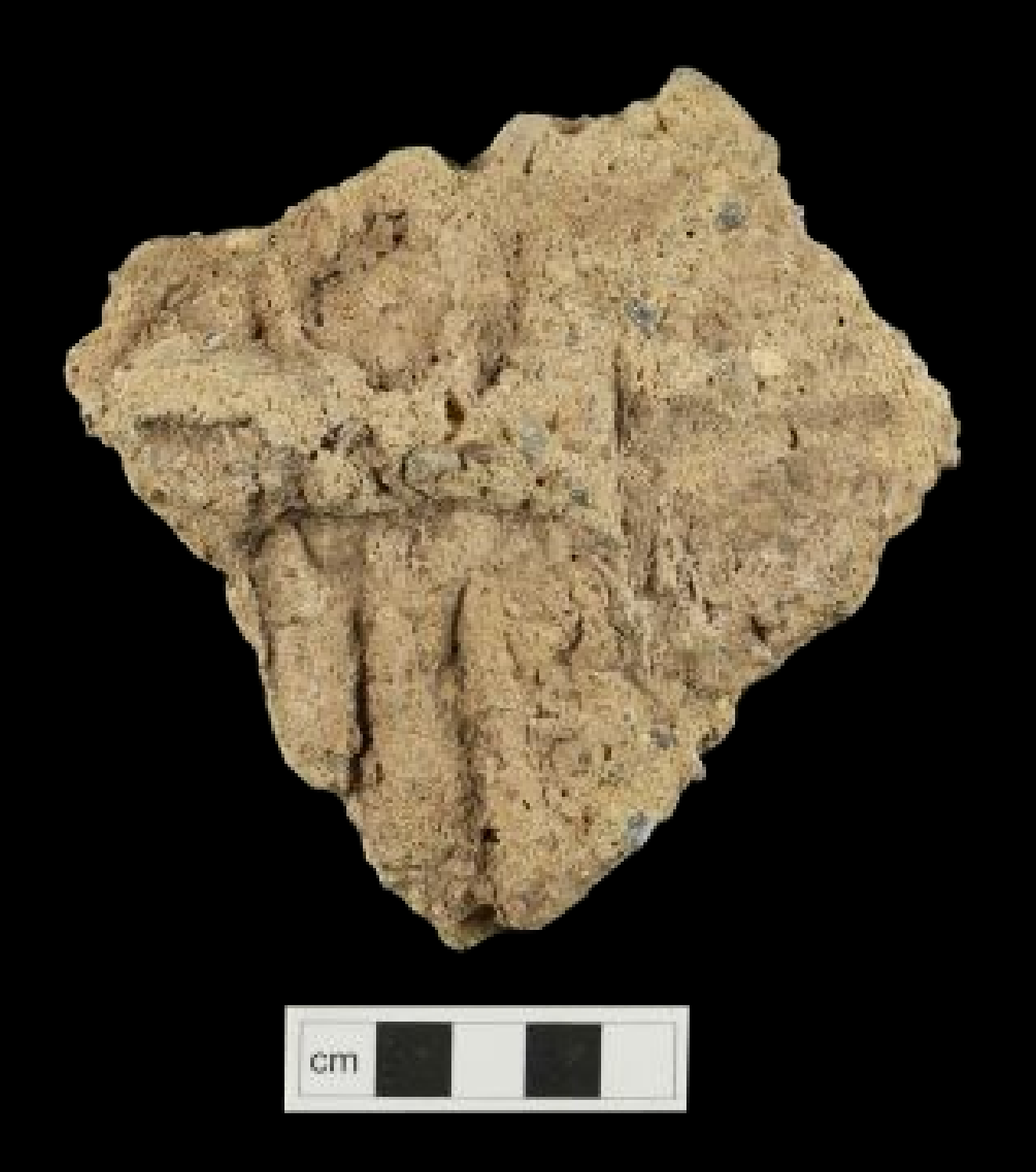
Type 1c. Twenty-seven fragments were similar to Mortar A but the original thickness did not survive. It is therefore impossible to determine whether the surviving flat surface adhered to the wall or represented the internal elevation.
Type 2a. There were 190 fragments of Mortar B which had two opposing surfaces both of which were smooth. These fragments were between 9 and 35mm thick. Smoothing lines were clearly visible within the plaster on 2 fragments, the plaster on a third was streaky. One fragment had faint grooves in the plaster, possibly keying lines.
Type 2b. Forty-four fragments of Mortar B between 8 and 27mm thick had a smooth exterior surface and there were impressions of the underlying keying ridges on the reverse surface giving an almost corrugated appearance. The ridges were all in the region of 7–10mm wide and the hollows 7–11mm wide. Most of these consisted of parallel linear ridges, but in one case there was a herringbone pattern. The plaster was streaky on five fragments, while smoothing lines were present within the plaster on a further two fragments.
Type 2c. Thirty-seven fragments of Mortar B had only one original surface with plaster present, so the original thickness of the mortar is unknown. It is impossible to determine if these originally had a flat reverse surface or whether they carried the impression of underlying keying.
Type 2d. This comprised three fragments of Mortar B with one flat and one opposing irregular surface. They ranged in thickness from 12 to 23mm. The plaster on one fragment was streaky.
Type 3a. There were 15 fragments of Mortar B with a flat back, which lacked any surviving plaster. They ranged from 11 to 34mm in thickness.
Type 3b. Three fragments of Mortar B were 15–19m thick with impressions of the underlying keying on the reverse; these lacked any surviving plaster on the internal elevation.
Type 4a. Three of the fragments had a basal layer of Mortar A from 17–25mm thick with a flat back, then a layer of Mortar B from 7-14mm thick above. Usually, a layer of plaster 0.5mm thick was present, though in two cases the plaster was missing, while on the third fragment the uppermost layer of mortar together with the plaster was flaking off, and this fragment had faint impressions of keying lines on the reverse.
Type 4b. In one case there was a basal layer of Mortar A measuring 42mm thick, with impressions of the underlying keying ridges on the reverse surface and flat upper surface, beneath a layer of Mortar B 7mm thick with plaster 0.5mm thick above.
Type 4c. One fragment had a layer of plaster up to 1mm thick, which was beneath a layer of Mortar B measuring 7mm thick, topped by plaster 0.5mm thick.
Type 4d. These had fragmentary remains of Mortar A often in the form of ridges, then a layer of Mortar B with impressions of the underlying keying ridges on the reverse surface, and a layer of plaster 0.5mm thick on the internal elevation.
Type 4e. These had a layer of Mortar A with a flat back, then a layer of Mortar B but no surviving plaster.
Type 5. Three fragments of Mortar B, two with a layer of plaster above, and one without. What distinguished these from the other Mortar B fragments was that the reverse surface was coated with a thin layer of earth. The earth would seem to have adhered accidentally post-deposition.
Type 7a. Eight of the fragments had a backing of Mortar B with painted plaster above, and these ranged from 12 to 30mm in thickness. The painted fragments comprised: a fragment with a red surface, one with streaky red paint, one with a red stripe in excess of 45mm wide, one with a small area of red paint, one with a thin black stripe and two areas of black (possibly a stripe originally), one with a splash of red paint, one with a broad stripe of faded red and one with a red strip and adjacent splashes of red paint (Figure 90).
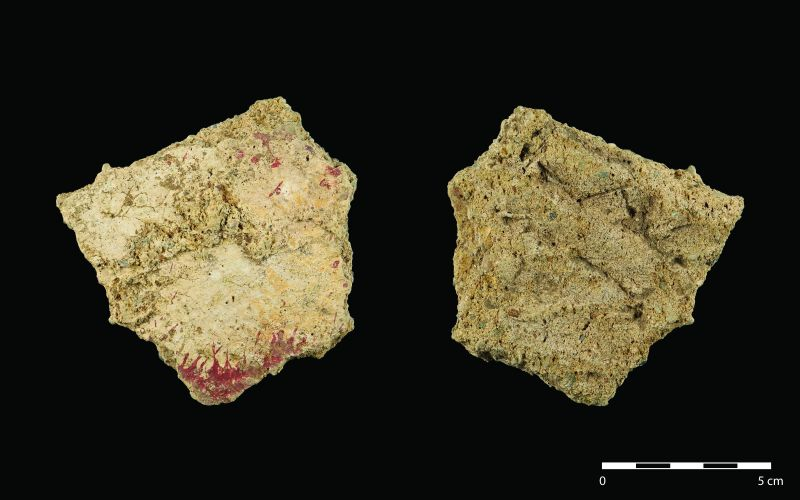
Type 7b. Six of the fragments, which ranged from 13 to 20mm, were of Mortar B with impressions of the underlying keying ridges on the reverse surfaces, which in two cases were in a herringbone pattern. The interior elevation had painted plaster. One fragment had a ridge in the underlying Mortar A on the reverse and a deep triangular keying mark on the upper surface to facilitate the adherence of a further coat of mortar.
Type 7c. These had fragments of mortar A beneath Mortar B with a corrugated back, topped with white plaster with a thin red stripe.
Group 6 Plaster probably associated with Group 5
A single fragment of plaster 75mm x 55mm x 34mm in size was recovered from a Phase 12 context (the same phase as Group 5). This had one smooth surface, but the remaining surfaces were irregular or broken. It may originally have been a fragment of moulded plaster, or simply waste.
Group 7 Poor quality Mortar F
This group comprised 23 fragments of Mortar F, none of which had plaster. The mortar was even crumblier than that of Group 4, being of such poor quality that 11 fragments had no surviving original thickness. Where both original surfaces survived, they were flat with no evidence for keying. The poor quality of the mortar suggests that it may have been from a utilitarian room or structure.
Type 13b. This group comprised 23 fragments of Mortar F, three of which had a layer of plaster up to 1mm thick on the external surface. Eleven items were too fragmentary for the original thickness to survive, but the remaining fragments ranged from 10–40mm in thickness. The back surfaces were flat.
| Group | Sequence of mortars/plasters | Types | Weight in grams | No. of fragments |
|---|---|---|---|---|
| 1 | C, plaster + paint, C, plaster + paint | 9a, 9b, 10 | 3299 | 27 |
| 2 | D, plaster +paint | 11 | 515 | 13 |
| 3 | Plaster | 355 | 4 | |
| 4 | F, plaster | 13a | 2145 | 28 |
| 5 | A, B, plaster +paint (plus variations) | 1a, 1b, 1c, 2a, 2b, 2c, 2d, 3a, 3b, 4a, 4b, 4c, 4d, 4e, 5, 7a, 7b, 7c | 37252 | 628 |
| 6 | Plaster | 6 | 50 | 1 |
| 7 | F | 13b | 550 | 23 |
| Type | Description of the paint | No. of Frags |
|---|---|---|
| 7a | Red paint over the whole surface, which in one case is streaky. | 2 |
| White background, a red stripe in excess of 9mm wide above and splashes of red paint. | 1 | |
| A black stripe 4.8mm wide above a white background with splashes of black paint (possibly originally have been additional stripes at 90 degrees) on the white background. | 1 | |
| A broad streaky red stripe in excess of 45mm wide above a white background. | 1 | |
| A white background with a small area of red paint above. | 1 | |
| A splash or red paint on a white background. | 1 | |
| A faded red stripe 21mm wide on a white background. | 1 | |
| 7b | A stripe of red paint in excess of 15mm wide on a white background. | 1 |
| A stripe of red paint in excess of 20mm wide on a white background. | 1 | |
| Two small area of red, one possibly a stripe in excess of 4mm wide, the other a splash of red 3x1.5mm in size (2 adjoining fragments). | 1 | |
| Small areas of red paint above a white background. | 4 | |
| 7c | White background and a stripe of red paint in excess of 47mm wide above. | 1 |
| 9a | Red with a small stripe of grey above the red. | 1 |
| Cream/ochre colour. | 1 | |
| An area of grey paint. | 2 | |
| A black stripe 23mm wide. | 1 | |
| 9b | Red surface | 3 |
| Cream/ochre colour. | 3 | |
| 10 | Cream/ochre background with a thin red stripe 4mm wide. | 1 |
| Five adjoining fragments with a stripe of red paint in excess of 51mm wide, then a stripe of white paint 5mm wide above the straight edge of the red stripe. The area above the white stripe had an ochre background above which was a second red stripe, parallel to and 92mm away from the main area of red. A small patch of green 6mm away from the thin red stripe. Another non-adjoining fragment was clearly part of this design. | 2 | |
| Red paint over the whole surface. | 1 | |
| Cream/ochre background with two small areas of bright green, possibly leaves | 1 | |
| 11 | Creamy-white plaster with part of a red stripe 3mm wide above. | 1 |
| Grey paint above creamy-white plaster. | 1 | |
| Three adjoining fragments. Creamy-white plaster with a green leaf design present. Above the leaf is a trellis design above. The trellis has a straight border in red 4mm wide, beneath which is a diagonal grid pattern with three surviving red stripes 2mm wide in one direction and two red stripes 4mm wide on the opposing diagonal. At the junction of each stripe is a black dot. | 1 | |
| Creamy-white plaster possibly a small area of grey paint above. | 1 |
A few fragments of mortar were recovered from medieval contexts which were clearly different in composition to the Roman mortars already described, which suggests that they were of medieval date, rather than representing residual Roman fragments. In addition, there was a lump of plaster in a medieval context 69mm x 57mm x 6mm in size with one original surface present, the other sides being broken off. This could represent either residual Roman plaster or medieval plaster.
Type 8. There was one fragment with a backing layer of Mortar I, 17mm thick, beneath a layer of plaster 0.5mm thick, then a layer of Mortar J, 3mm thick, and finally plaster 1mm thick with patchy red paint above.
Type 14. Two fragments of Mortar G were in excess of 53mm and 60mm thick respectively, but the original thicknesses did not survive.
Type 15. Four fragments of Mortar H of which three were irregular lumps in excess of 45mm, 52mm and 60mm thick respectively, while the fourth fragment was 60mm thick.
A single fragment which occurred in a post-medieval deposit was unlike the Roman mortars from the site. It is interpreted as being of post-medieval date.
Type 16. There was a single fragment of Mortar K backing 12mm thick with a 4mm thick mortar above topped with white plaster.
Two fragments were present in modern contexts with mortar that was so fine it was suggestive of mechanised production, i.e. a modern date.
Type 12. A fragment of very fine lime-based mortar (Mortar E) with whitewash on the external surface, then a layer of fine render 1mm thick then a second layer of limewash less than 1mm thick. The mortar was far finer than any of the Roman mortars at the site and is suggestive of mechanised production, i.e. a modern date.
Type 17. This single fragment from a modern context was of Mortar L with a thin layer of white plaster painted blue-green (Figure 91).
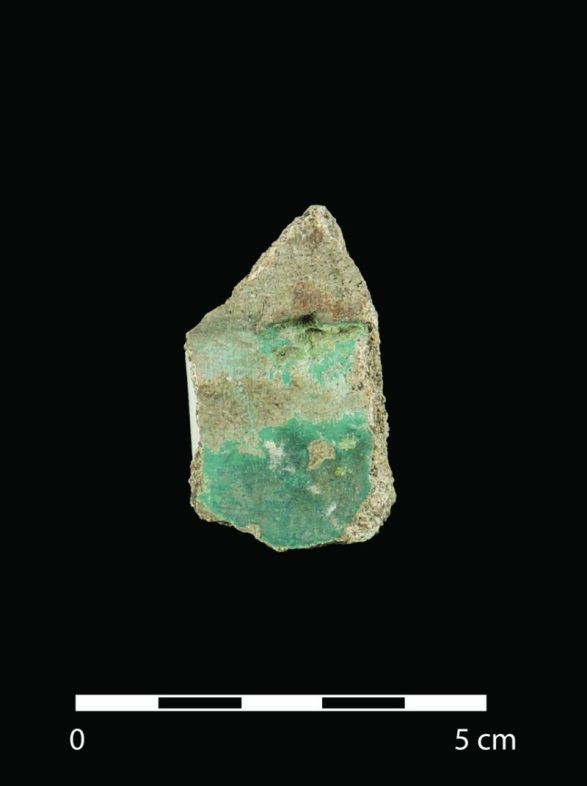
A total of 9.8kg of mortar was recovered from environmental samples with an additional 220g (106 fragments) being recovered from boreholes at the site. The average weight of the fragments was 5g and they were too small to match to the categories listed above. These fragments were recorded on the relevant Excel table in relation to the context and sample from which they came, e.g. BF858 comprised all the fragments from Sample 46 in C19122, while BF898 was all the mortar from Borehole 1c, Sample 191, C9607.
Roman Pottery | Post-Roman Pottery | Ceramic Building Material | Stone Building Materials | Mortar, Plaster and Painted Plaster | Daub and Opus Signinum | Small Finds | Roman Frit Objects | Roman Vessel Glass | Roman Window Glass | Coins | Worked Stone
A small quantity of daub and opus signinum was recovered from the Guildhall site.
This collection was recorded as Bulk Finds by context. As each Bulk Find can contain multiple fragments, the individual fragments were weighed and details entered on a pro forma sheet detailing the project code, the context number, material type, the weight in grams, the dimensions and any other relevant information (details of surviving surfaces etc.). This data was typed into a Microsoft Excel table then transferred into the YAT database (IADB) under the relevant project code. Entries for each BF number allocated were placed on the YAT computer database (the IADB).
Daub
A total of 700g of daub was recovered (67 fragments), much of which consists of small fragments with an average weight of 8g per fragment from environmental samples (taken from contexts C7012, C7013, C9195, C19075, C19134, C19136, C19200 and C19201) or in one case from Borehole 3 context C9628. Two larger fragments were recovered by hand during the excavation process: the first in C3052 weighed 100g while the second in C19104 weighed 100g. The impression of a wattle 12mm in diameter was present on the fragment from C3052.
Wattle and daub panels were used during the Roman period and throughout the medieval period. Nine fragments were from contexts of Roman date, and there were 44 fragments from contexts of medieval date which could represent either residual Roman daub or medieval daub. The remaining fragments occurred residually in contexts of modern date.
Opus signinum
Opus signinum is a Roman building material comprising a mixture of mortar and crushed ceramics. This material had impervious properties and was used in structures requiring waterproofing such as coverings of cisterns and in the suspended floors of baths, though it could also be used in any floor, even those which did not require its waterproof properties (Malacrino 2010, 71–2).
There were 31 small fragments of opus signinum at the Guildhall site which collectively weighed 1.238kg. These came from contexts C3031, C3057, C3094, C3110 (three fragments), C3116 (five fragments), C3142, C19001, C19054, C19061, C19093, C19096, C19112 (five fragments), C19115, C19133 (three fragments), C19139, C19151, C19155 and C19172. Two different colours were present with two fragments being very dark pink in colour and the remainder being pale pink. Most fragments were badly damaged and only nine fragments had one original surviving surface, while two of the pale pink fragments had a complete thickness surviving which were 11mm and 16mm thick respectively.
Roman Pottery | Post-Roman Pottery | Ceramic Building Material | Stone Building Materials | Mortar, Plaster and Painted Plaster | Daub and Opus Signinum | Small Finds | Roman Frit Objects | Roman Vessel Glass | Roman Window Glass | Coins | Worked Stone
None of the building material recovered from the Guildhall was in its original in situ position within a building; everything was material resulting from the dumping of demolition-derived waste. Logically there would be a time-lag between the use of an item of building material within a building and its disposal following the demolition or repair of the building in question. It is usually impossible to determine how long the original building was in use before it was renovated or demolished, with the resulting debris being dumped or reused; the dating of demolition derived material can therefore be problematic.
The interpretation of the Roman buildings at the Guildhall was particularly problematic for several reasons. Firstly, the small size of the area of excavated Roman deposits meant that no complete building ground-plan or even room-plan was present within the excavated area. It was not even possible to determine whether structural remains in Excavation Areas 1 and 2 were parts of a single building or not. Secondly, it was difficult to determine where the demolition material dumped in the Roman period had originated: logically it was probably derived from nearby buildings, but it could represent dumping from further afield, notably from within the legionary fortress. Medieval robbing had undoubtedly also caused great damage to any surviving Roman structures and may explain why no Roman stonework was present at the site.
That said, the 2nd to early 3rd century CE (Phases 6–8) at the Guildhall site saw the construction of at least one building, which was in use for a sufficient period that it was replastered internally prior to its demolition. A second phase of building at the site appears to have been relatively short lived, with construction, use and then demolition all occurring between the mid-2nd to early 3rd centuries CE (Phases 10–12). That the buildings at the site seem to have been relatively short lived may say something of their status or function; the implication is that these were not major public buildings designed to stand the test of time. The poor quality of the mortar of Groups 4 and 7 is also probably an indication of utilitarian buildings or rooms.
The painted decoration on the Phase 6–8 plaster fragments was more elaborate than that on the Phase 10–12 fragments, but the number of painted fragments was low, suggesting that any buildings in the vicinity, irrespective of the period of construction, were usually internally decorated with whitewash.
In the case of the medieval period, the building materials at the Guildhall site mainly comprised roof tile fragments and a few discarded architectural fragments. The late 11th to early 13th century roof tile is of particular interest as it suggests that the earliest version of the Guildhall had a tiled roof. Roof tile was relatively rare in this period and is often interpreted as having only been used on buildings of the highest status; its presence at the Guildhall (a high-status building) offers some confirmation of this interpretation. The AFs at the site include a couple of items that may relate to the early Guildhall, but insufficient pieces are present to speculate as to the overall design; these AFs suggest that that there was a blind arcade and a wall with integral capitals, but it should be noted that these AFs could equally have originated from the adjacent Augustinian friary. The same could be said for the very small number of medieval floor tiles; they could have come from either the Guildhall or the friary.
With regards to the 15th century rebuild of the Guildhall, there are several architectural fragments that could relate to the structure (AFs 2, 4–6 and 8–9), which include a springer and five fragments from a window with mullions and tracery. There are too few fragments to make any detailed assessment of the form of the 15th century Guildhall, and again, it must be remembered that the fragments concerned (which occurred residually in context of post-medieval date) could have originated from the adjoining friary.
So little post-medieval and modern building material was present at the site it is of little use for interpretative purposes.
The pottery dating suggests that the earliest activity at the site consisted of late 1st to 2nd century CE ground preparation deposits (Phases 3–5) which included a stony surface. The quantity of building materials recovered from these phases is very small, comprising a single fragment of opus signinum in Phase 3, while in Phase 5 there were two fragments of daub, two fragments of mortar and 15 sherds of CBM including a bessalis, roofing tiles and fragments of indeterminate form. The quantity is too small to be suggestive of the construction or demolition of buildings in the immediate vicinity at this stage, indeed there is no evidence at the site for structures at this time. The most likely origin for the building materials in these phases is the general dumping of waste from within the fortress. The bessalis was probably from a hypocaust, which suggests that bathhouse was present at a very early stage within the fortress.
Above these were the remains of a 2nd century CE building (Phase 6) comprising levelling deposits and a floor surface (no related walls or structures were present within the excavated area). Eight sherds of discarded CBM were present within the levelling deposits (one imbrex and seven Roman brick) but no building materials were present within the floor. The lack of building materials present is probably simply a reflection of the time lag between the construction and use of the building and its subsequent demolition; only during demolition would the materials used in the building be discarded.
Phase 7 was also of 2nd century CE date and represents dumping located to the south-east of the Phase 6 building. Just three small fragments of brick, a fragment of mortar and one of plaster were present within these dumps. This may again simply represent the disposal of waste from within the fortress.
Directly above the Phase 6 floor were a group of dumps of demolition-derived material, so clearly this building had been demolished at this stage; similar dumps located to the south-east were interpreted as being related (Phase 8). These were sealed by further dumps that included demolition waste (Phase 9). There were 148 sherds of CBM from Phases 8–9, but the majority of these were tiny fragments recovered from soil samples or were fragments of indeterminate form. The only identifiable sherds comprised five sherds of roof tile, a single sherd of box flue from a hypocaust and a sherd of unusual form which had a deliberate notch cut into the edge, possibly to accommodate a nail or clamp.
Mortar from Groups 1–5 was also present in Phases 8–9. Virtually all of the Phase 8 mortar and plaster was recovered from C3103, which was located directly above the Phase 6 clay floor. It seems logical to assume that the C3013 plaster was derived from the demolition of this building. The plaster concerned was primarily of Groups 1–3, but there were five fragments of Group 5 Mortar B. The remaining Phase 8 and Phase 9 contexts were from Excavation Area 2 and the mortar/plaster from this area was primarily of Group 4, with a single fragment of Group 1 and Group 5. The Group 4 mortar/plaster was very poor-quality mortar with plain whitewash. The six fragments of Group 5 Mortar B from these phases may represent a small quantity of material from another room/building in the vicinity, or residual material from the general area. It is notable that there is no Mortar A in Phases 8–9, which indicates that it is of a later date.
What do the building materials tell us about the Period 3 (P6) buildings?
As the area of excavation was very small, and the remains were seen in two totally separate trenches the remains are difficult to interpret. The ground plan of the Phase 6 building is unknown as no walls were uncovered within the excavated area; indeed, the only structural remains were a clay floor. It is difficult to determine how any walls relating to the Phase 6 floor were constructed. There is no building stone and almost no brick within the Phase 8 demolition dumps which could suggest that the buildings in question had organic walls (timber and wattle and daub), however, brick and stone were routinely recycled so their absence may not be significant. That so little ceramic roofing material was present may indicate that the Phase 6 building was roofed with organic materials such as straw or thatch; logically there would have been more broken roof tiles present within these demolition dumps had the Phase 6 building been roofed with CBM, but again, tiles could be recycled. The mortar /plaster suggests that there were two rooms in the Phase 6 building, one decorated with Group 1 mortar/painted plaster, which had two superimposed schemes of painted decoration, and a second room with Group 2/3 mortar, painted plaster and moulded plaster which probably originated from the cornice. In contrast, the Group 4 mortar from Excavation Area 2 was of poorer quality suggesting that it originated from a more utilitarian building or room within the Phase 6 building. All of this is highly speculative given the small area which was excavated.
Phase 10 was mid-2nd-early 3rd century CE in date and comprised thick levelling deposits; the only building materials within these were seven sherds of discarded CBM which could have been dumped from anywhere within the vicinity. Above these was a clay floor from a building. No CBM was recovered from the floor. Again, this floor was only seen in a limited area, and none of the surviving walling lay within the excavated area. Any building materials from this structure would be found in the layers relating to its demolition (see Phase 12 below).
To the south-east was a second structure, Phase 11, which was also of late 2nd to early 3rd century CE date. This comprised a limestone footing and associated mortar surface above which were thin occupation derived deposits that yielded a small volume of discarded CBM including a box flue tile which must have originated from a hypocaust, two sherds of tegulae and nine of brick (five of which were tiny fragments recovered from a sample). These occupation deposits contained two residual Group 1 mortar fragments, but most of the mortar/plaster comprised Group 5 fragments, including fragments of Mortar A. This is the first time Mortar A was present at the site, which suggests that it originated from a different building to that seen in Phases 7–9 (which lacked Mortar A). The presence of wall renders within deposits interpreted as relating to the occupation of the Phase 11 building implies either that some disposal of waste was taking place within the building, or that the deposits concerned represent the abandonment of the building.
Phase 12, which was 2nd to 3rd century CE in date, saw the dumping of demolition material above both the Phase 10 and Phase 11 structures, indicating that they had both been demolished by this stage, and were the likely source of the building materials dumped in Phase 12. A small quantity of CBM was recovered (which included three intrusive sherds of medieval roof tile), together with a single fragment that probably originated from a stone roofing flag, a fragment of opus signinum and five small fragments of discarded building stone (three of oolitic limestone and two of tufa). Tufa weighs less than most stones and as such was of value in the construction of vaulted roofing which could imply that a vaulted roof was present in the vicinity. Opus signinum was often used in baths, so this may imply a bath was located nearby, but this is highly speculative given that just a single fragment is present. As noted above, the use of this stone for roofing became increasingly common in York from the late 2nd century CE onwards (McComish 2012, 90–1 and 256–8) so the Phase 12 stone roofing is at the earlier end of the date range normally expected for such items in York.
Abundant discarded mortar and plaster was present within Phase 12; indeed 71% of all the mortar/plaster from the site was from this phase, with over 60% coming from a single context (C3082). The mortar/plaster from C3082 was mainly from Group 5 and this was probably related to a fragment of plaster (Group 6) which was probably originally from some sort of moulding. The Group 5 mortar/plaster is a complex group: due to fragmentation there are numerous different combinations of surfaces (keyed and un-keyed), mortar, plaster and painted plaster. A single fragment had the impressions of keying lines on the reverse of the basal Mortar A layer, then a layer of Mortar B implying that there must have been three backing layers of mortar originally. A single fragment had a layer of plaster beneath a thin layer of Mortar B then a second layer of plaster above indicating that a second scheme of decoration was originally present. A single fragment had evidence for both keyed and non-keyed areas of backing mortar, which suggests that the keying was intermittent. The quantity of painted plaster present was very small, suggesting that the bulk of the walling was painted white. The various types of Group 5 mortar fragments are shown on Figure 92. The C3082 mortar and plaster probably originated from the Phase 10 building.
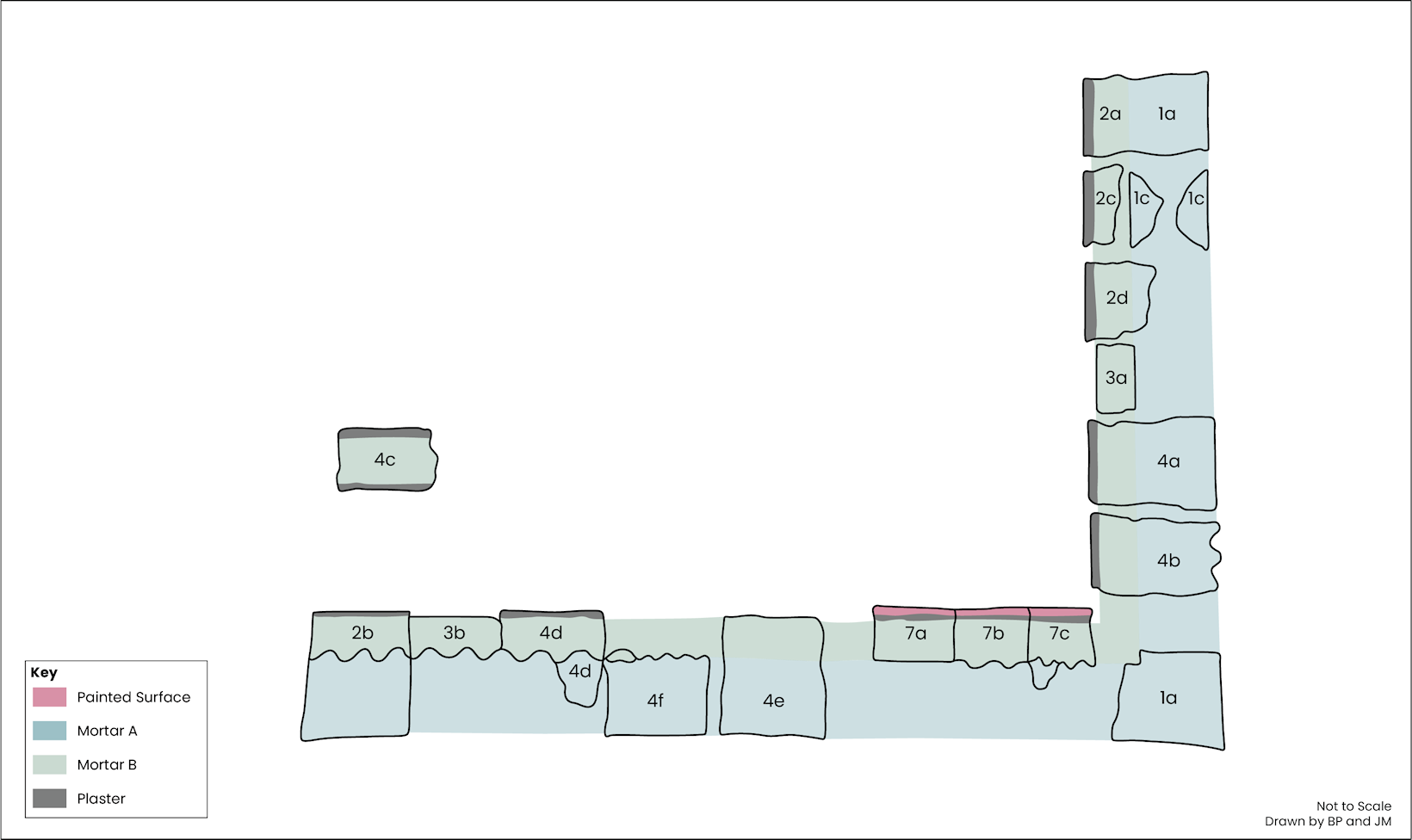
The remaining Phase 12 mortar and plaster came from C8072 and C19172, which were located above, and therefore presumably originated from the Phase 11 building. These contexts yielded some Group 5 fragments, which may simply represent material spread from C3082, but most of the fragments were Group 7 mortar/plaster. As the Group 7 mortar was of poor quality this could imply that the Phase 11 building or room had a utilitarian function or was of lower status than that of Phase 10.
The next phase (Phase 13), which was also dated as late 2nd to 3rd century CE date, saw the deliberate raising of the ground level and the various deposits concerned included discarded CBM roofing and brick sherds, a single fragment of fine-grained sandstone and two fragments of opus signinum, together with a small quantity of minute mortar fragments recovered from soil samples. All this material could have been residual from earlier Roman phases. No further mortar was present in the Roman phases, which suggests that no further building in the area had internal renders.
In the 3rd century CE, a structure was built at the site (Phase 14) comprising a wall foundation of clay and cobbles which also incorporated 60 sherds of reused CBM including roof tiles, sherds of brick of indeterminate form and two sherds of box flue from a hypocaust, together with a fragment of opus signinum. The CBM included an imbrex with a 6th Legion stamp dating to between c. 120 CE (when this legion arrived in York) and the mid-3rd century CE when the practice of stamping tiles declined (McComish 2012, 38). The imbrex in question could, therefore, have been up to 100 years old at the time of deposition. This tile also shows that military-produced tiles were present outside the fortress, though whether this implies military control of the area between the fortress and the River Ouse, or simply represents the disposal of waste from the fortress is impossible to determine. No mortar, plaster or painted plaster was recovered from this phase.
Phases 15–17 comprised a cobble surface and stony levelling deposits that have been dated by pottery to the mid-2nd to 4th century CE, but no building materials (CBM, building stone, mortar/plaster, opus signinum or daub) were recovered from these phases. Phase 16 consisted of stony levelling deposits which incorporated 10 sherds of reused CBM including a box flue tile, imbrices and sherds of brick of indeterminate form and a fragment of stone which probably originated from a roof flag. A 9th Legion stamped imbrex dating to before c. 120 CE (when the legion left York), was clearly residual within this phase. Phase 17 represents activity in Trench 3, but no building materials were recovered from this phase.
In addition to the closely phased items above there were a small number of other items that are clearly of Roman date but cannot be phased; these were mainly from boreholes and soil samples.
The phases post-dating the Norman Conquest up to the mid-13th century are considered together for the following reasons.
Phases 18–23 fall into this date range, but no building materials were recovered from Phase 23. The dominant roofing tile form throughout this time was curved and flanged tiles, with flat-pegged roof tiles only coming into use in the 13th century.
Robbing of the earlier Roman structures at the site occurred sometime between the late 11th to early 13th centuries (Phase 18) and unsurprisingly most of the building materials from this phase were residual Roman material. There was a single ridge tile sherd and a single peg tile sherd which were contemporaneous with the date of the phase. As the date range for peg tiles is 13th to 16th century, the Phase 18 example would represent an early example of this form.
Phase 19 was characterised by dumping which contained CBM and two fragments of magnesian limestone. The overwhelming bulk of the CBM from this phase was residual Roman material, with just three fragments of flanged tile, one of peg tile and five of plain tile that were contemporaneous with the date of the phase. With regards to the residual material a group of Roman stone tesserae were present; no stone tesserae were present in the Roman contexts at the site, so it is unclear if these represent material that originated from a Roman building in the immediate vicinity or were dumped here from further afield. Curved and flanged tiles are thought to be associated with high status buildings; it is possible that the Guildhall mentioned in a charter of 1256 (RCHME 1981, 76) was the source of these tiles, though equally the sherds in question could have been brought from elsewhere in York for dumping. The two small fragments of limestone could represent either residual Roman material or medieval building waste.
The next phase in the sequence comprised pit digging (Phase 20) and again the bulk of the building materials recovered were residual Roman items, presumably moved from earlier levels disturbed when the pits were excavated. The daub in this phase could be residual Roman material or medieval in date. Just four plain tile sherds were present that were contemporaneous with the dating of the phase. Phase 21 represented a period of ground consolidation, and all of the building materials present were residual Roman items.
Above this were demolition deposits (Phase 22) which contained CBM and AFs. In addition, there was a small fragment of limestone which could be of either Roman or medieval date. The CBM comprised a mixture of residual sherds, 40 roofing tile sherds contemporaneous with the pottery dating for the phase (one curved tile, two flange tiles, 10 peg tiles and 25 plain), and three intrusive sherds (one decorated floor tile, one post-med brick and one medieval brick). Clearly roofs of both curved/flanged tiles and flat roof tiles were present in the vicinity at this stage. Within Phase 22 there were three discarded AFs (AFs 12–14). AFs 13–14 are of the right date to relate to the earlier Guildhall building; they show that there was a blind arcade and a wall with integral capitals.
The remaining medieval phases roughly correspond to the periods of Decorated and Perpendicular architecture, ending with the Reformation and the Dissolution of the Monasteries. By this stage any curved or flanged roof tiles were residual, as this style of roof had been replaced with flat pegged roof tiles. This period also saw the introduction of brick, though it was still relatively rare and prestigious as a building material, largely being used for ecclesiastical buildings or the houses of the rich (see Brunskill's survey of medieval and Tudor brickwork; 1997, 114–39). In addition, brick was used in hearths/chimney stacks due to its fire-resistant qualities. The 14th century also saw the introduction of both inlaid and plain glazed floor tiles. These were also high-status materials largely confined to churches but occasionally used on the houses of the wealthy such as Epworth Manor in North Lincolnshire or Barley Hall in York (Stopford 2005, figs. 4.3 and 5.4).
Levelling deposits were dumped at the site (Phase 24) which contained some residual building material (two imbrex, two Roman brick sherds, two Roman roof flag fragments, two fragments of opus signinum, a sliver of micaceous sandstone of Roman date, 14 sherds of curved and flanged tiles). The building materials contemporaneous with the pottery dating for the phase were 41 sherds of later medieval roofing tiles (plain/peg/ridge tiles) and one sherd of an unusual form which is probably an excessive grip-mark from lifting the tile while wet, i.e. a manufacturing error. Given the date of the phase, the curved and flanged tile present may have originated from the first Guildhall building. Phase 24 was truncated by a cut (Phase 25) which contained just two sherds, one of residual Roman brick and one of plain tile.
Phase 26 comprised levelling deposits within which were 13 sherds of residual Roman CBM, one fragment of residual Roman mortar, one of opus signinum and 29 sherds of residual curved and flanged tiles which probably originated form the first scheme of roofing at the Guildhall. The remaining CBM in this phase was roof tiles of 13th to 16th century date. The presence of two plain glazed floor tiles may indicate that the Guildhall had a tiled floor in the 14th century. The use of plain glazed tiles on the prestigious Guildhall would be consistent with the use of such tiles on other sites in York which include York Minster's Consistory Court and the Crypt, St Mary's Abbey, St Mary Bishophill Senior church, St Mary's Hospital in the Horsefair, and at Barley Hall, which was the house of a wealthy citizen (Stopford 2005, 213–14). Both of the Guildhall tiles were so worn that the colour of the original glaze is unknown. A single fragment of mortar/plaster was present which was of a type unrelated to the earlier Roman mortars and was therefore interpreted as being of medieval date. It comprised a layer of mortar topped by plaster, then a second superimposed layer of mortar topped by plaster.
Phase 27 comprised a hearth and associated features. All of the CBM from this phase (brick, peg and plain tiles) was contemporaneous with the dating for the phase. The use of roofing tiles in hearths is common in the medieval period; the fireproof qualities of both roofing tile and brick made it highly suitable for such a purpose.
A period of dumping and levelling (Phase 28) contained some residual Roman material (a sherd of Roman brick and some Roman mortar/plaster) and one plain tile sherd contemporaneous with the pottery dating for the phase.
This was followed by a phase of refuse disposal (Phase 29), from which abundant building materials were recovered which included residual Roman material and residual curved and flanged tiles. One context in particular, C3052, produced a very large volume of CBM (59.874kg) accounting for 19% of all of the CBM excavated at the site. This included an exceptionally large group of curved and flanged tile, with many large sherds present. This would seem to suggest that a roof of this type was being demolished nearby in the 14th century. The most obvious suggestion is that the 13th century Guildhall was roofed with curved and flanged tiles, and that in the 14th century these were disposed of when the Guildhall was demolished and rebuilt. Context 3052 also contained abundant 13th to 16th century roof tile fragments, so clearly a peg tile roof was also being disposed of at this time. A second context, C3062, produced 13.395g of CBM, accounting for 4.5% of the total volume excavated at the site, but this contained only one curved tile with all the other material being of 13th to 16th century date with the exception of one brick fragment of 14th to 16th century date. A single AF was also present (AF3) which occurred residually in a pit backfill deposit that was dated by pottery to the mid-13th/14th century.
None of the remaining medieval phases contained anything like the volume of building materials seen in Phase 29. Phase 30 comprised features interpreted as relating to land division and associated structures. Few building materials were associated with the phase, there being two residual CBM sherds and eight sherds of 13th to 16th century plain roof tile. The medieval graveyard deposits of Phase 31 contained some residual Roman CBM, a small fragment of Roman building stone, a fragment of plaster and 19 roof tile sherds of 13th to 16th century date.
The friary buildings of Phase 32 comprised a wall foundation and part of a sub-floor structure; these contexts yielded just 19 sherds of CBM: three were residual and three were medieval brick of 14th to 16th century date, while the remainder were roofing tiles of 13th to 16th century date.
Later alterations to the friary building (Phase 33) had just nine sherds of CBM, including seven roof tile sherds of 13th to 16th century date and one of post-medieval brick which could be contemporaneous with the dating of the phase, but only if the contexts in question (C8016–17) had occurred in the first half of the 16th century. There was also an intrusive sherd of modern brick. Two of the AFs (AF10–11) represent material reused within a wall foundation, indeed both these AFs showed clear signs of reuse (it was common in the medieval period for stonework discarded during alterations or demolition to be recycled in this way).
Although none of the phases listed above are dated later than the 14th century it should be noted that the early 15th century saw the rebuilding of the Guildhall. It is possible the decision to rebuild the Guildhall was taken as early as 1433/4, and elections for the Mayor in 1445 and 1448 were held in the Franciscan Friary which may imply that the Guildhall was not useable. Thomas Carr left money in his will of 1444 towards the fabric of the new Guildhall (RCHME 1981, 77). In 1445 the Mayor and Commonality of York agreed to build a new Guildhall in Coney Street. Work on the building structure was sufficiently complete for a council meeting to be held there in May 1459, but the internal works had not been finished in 1503 when the council was seeking wainscots to line the walls (VCH 1961, 542–4). Most of the AFs from the site (recovered in post-medieval contexts) are of a date that would fit with this rebuilding (AFs 2, 4–6 and 8–9) and include a springer and five fragments from a window with mullions and tracery.
In addition to the phases described above there were some building materials that could only be assigned to the medieval period; these were small fragments of CBM and mortar from boreholes and soil samples.
These phases are not discussed in any detail because the overwhelming bulk of the building materials present were clearly residually occurring, including AF5-6 and AF 8-9. These were recovered from 16th to 17th and 16th to 18th build-up, levelling or demolition deposits, but all of these were of a style in keeping with the rebuilt 15th century Guildhall and probably originated from it. The only post-medieval material consisted of nine sherds of post-medieval brick, two pavers (the precise date range for this form is unclear but they are clearly post-medieval) and a fragment of mortar interpreted as being of post-medieval date.
Virtually everything from Phases 40–41 represented residual material. The only material that was contemporaneous with the date of the phase was a fragment of machine-made brick, a single sherd of pan tile that could be of any date after the 17th century (including the modern period) and two fragments of mortar. The AFs within this phase probably represent material discarded from the Guildhall (AF1–2 and AF4) but there was also one Victorian fragment.
While some of the building materials recovered cannot be closely dated (such as daub), or occurred in such low quantities that discussions of residuality would be meaningless (the architectural fragments and stone tesserae), other forms present can be assessed in terms of the levels of residuality, namely the Roman CBM, Roman mortar/plaster, Roman stone fragments, Roman stone roofing, opus signinum, curved and flanged tiles of late 11th to early 13th century date, 13th to 16th century roof tiles, 14th to 16th century bricks and post-medieval brick. Tables 28 and 29 summarise the residual material present by weight and as a percentage of the total volume of these selected forms in relation to the various historical periods at the site. It is clear from these tables that the volume of residual material varies considerably among differing material types.
| Roman | L11-M13th | M13-16th | Post-medieval | Modern | Total volume | |
|---|---|---|---|---|---|---|
| Roman CBM | 39425 | 19600^ | 9130^ | 7845^ | 4385^ | 80385^ |
| Roman stone frags. | 675 | 1200^ | 595^ | 175^ | 0^ | 2645^ |
| Roman stone roofing | 100 | 3230^ | 1110^ | 15^ | 660^ | 5115^ |
| Roman mortar/plaster | 52432 | 779^ | 730^ | 20^ | 0^ | 53961^ |
| Opus signinum | 340 | 775^ | 23^ | 75^ | 25^ | 1238^ |
| Curved and Flanged | 1495 | 39905^ | 800^ | 475^ | 42675^ | |
| 13-16th CBM | 7525 | 105824^ | 28475^ | 7130^ | 148954^ | |
| 14-16th brick | 325* | 11310 | 7225^ | 600^ | 19460^ | |
| Post-medieval brick | 19895^ | 6595^ | 26490^ |
| Roman | L11-M13th | M13-16th | Post-medieval | Modern | Total % | |
|---|---|---|---|---|---|---|
| Roman CBM | 49 | 24.4* | 11.4* | 9.8* | 5.5* | 100* |
| Roman stone fragments | 25.5 | 45.4* | 22.5* | 6.6* | 0* | 100* |
| Roman stone roofing | 2 | 63.1* | 21.7* | 0.3* | 12.9* | 100* |
| Roman mortar/plaster | 97.17 | 1.44* | 1.35* | 0.04* | 0* | 100* |
| Opus signinum | 27.5 | 62.6* | 1.9* | 6.1* | 2* | 100* |
| Curved and Flanged | 3.5 | 93.5* | 1.9* | 1.1* | 100* | |
| 13-16th CBM | 5 | 71* | 19* | 5* | 100* | |
| 14-16th brick | 1.6** | 58.1* | 37.1* | 3.1* | 100* | |
| Post-medieval brick | 75* | 25* | 100* |
The Roman mortar and plaster largely occur within the Roman contexts at the site, with relatively little occurring residually. This is largely because the mortar rich deposits occurred within the Roman period, and they were sealed by later Roman deposits. Just 2% of the Roman stone roofing flags were in contexts of Roman date, comprising just two fragments of roofing stone. There were only 24 fragments of Roman stone roofing in the post-Roman contexts at the site. Given that stone roofing became increasingly common from the late 2nd century CE onwards this may indicate that there were no major buildings in the area in the later Roman period and that the few fragments present were dumped at the site from elsewhere.
Both the Roman stone fragments and opus signinum occur in roughly similar amounts in contexts of Roman date (25.5% and 27.5% respectively). Again, more of these items were present in the contexts of late 11th to mid-13th century date (45.5% and 62.6% respectively) which included deposits resulting from the robbing of Roman buildings. In the case of the Roman CBM while 49% occurred within deposits of Roman date, 24.4% came from deposits of late 11th to mid-13th century date, again resulting from the disposal of robbed out materials.
That some of the curved and flanged tile was in contexts of late 11th to mid-13th century date helps to confirm the date at which such tiles were introduced. The overwhelming bulk of the curved and flanged tiles (93.5% of the total) occur in contexts of mid-13th to 16th century date, which reflects the time lag between its use on a building, and their disposal once the roof was demolished.
The bulk of both the 13th to 16th century roof tile and 14th to 16th century brick was in contexts of mid-13th to 16th century date, while the bulk of the post-medieval brick was found in contexts of that date.
Roman Pottery | Post-Roman Pottery | Ceramic Building Material | Stone Building Materials | Mortar, Plaster and Painted Plaster | Daub and Opus Signinum | Small Finds | Roman Frit Objects | Roman Vessel Glass | Roman Window Glass | Coins | Worked Stone
A little over 300 objects of copper alloy, iron, jet or shale, bone and lead alloy are considered here. This total excludes the iron hobnails, which have not been counted individually, but does include the iron nails, which represent just under half of the total. The small finds include a small quantity of Roman objects and a series of medieval to early post-medieval objects. In general, the Roman finds are stratified in Roman deposits and the medieval finds in deposits spanning the medieval period, with a few residual Roman items occurring in contexts of a later date. Almost all of the objects are stratified. Small find numbers are provided here in brackets.
The copper alloy objects generally survive in quite poor condition and are often fragmentary, but a number of pieces can be identified. Dress accessories include a copper alloy buckle plate (SF51 — C3026; P12) and a glass stud set in a mount, possibly part of a ring, now distorted in shape (SF53 — C3026; P12). The same context also produced part of a copper alloy chain and a large, hollow-domed stud (SF50 — C3026; P12). A rectangular copper alloy buckle plate (SF213 — C19187; P20) is more elaborate and includes cast decoration, and a jet or shale finger ring (SF244 — C19151; P13, Figure 93) is complete and survives in good condition. A bone pin (SF22 — C3103; P8, Figure 94) is also complete and is a comparatively rare type, showing a hand in profile, set above a series of mouldings. There are no brooches of copper alloy, but a possible iron bow brooch (SF73 — C3026; P12) came from a stratified context of Roman date. A hooked suspension mount (SF215 — C19200; P5) came from a stratified context and may originally have been attached to a belt. A silver coin (SF221 — C19174; P38) provides useful dating evidence for this period.
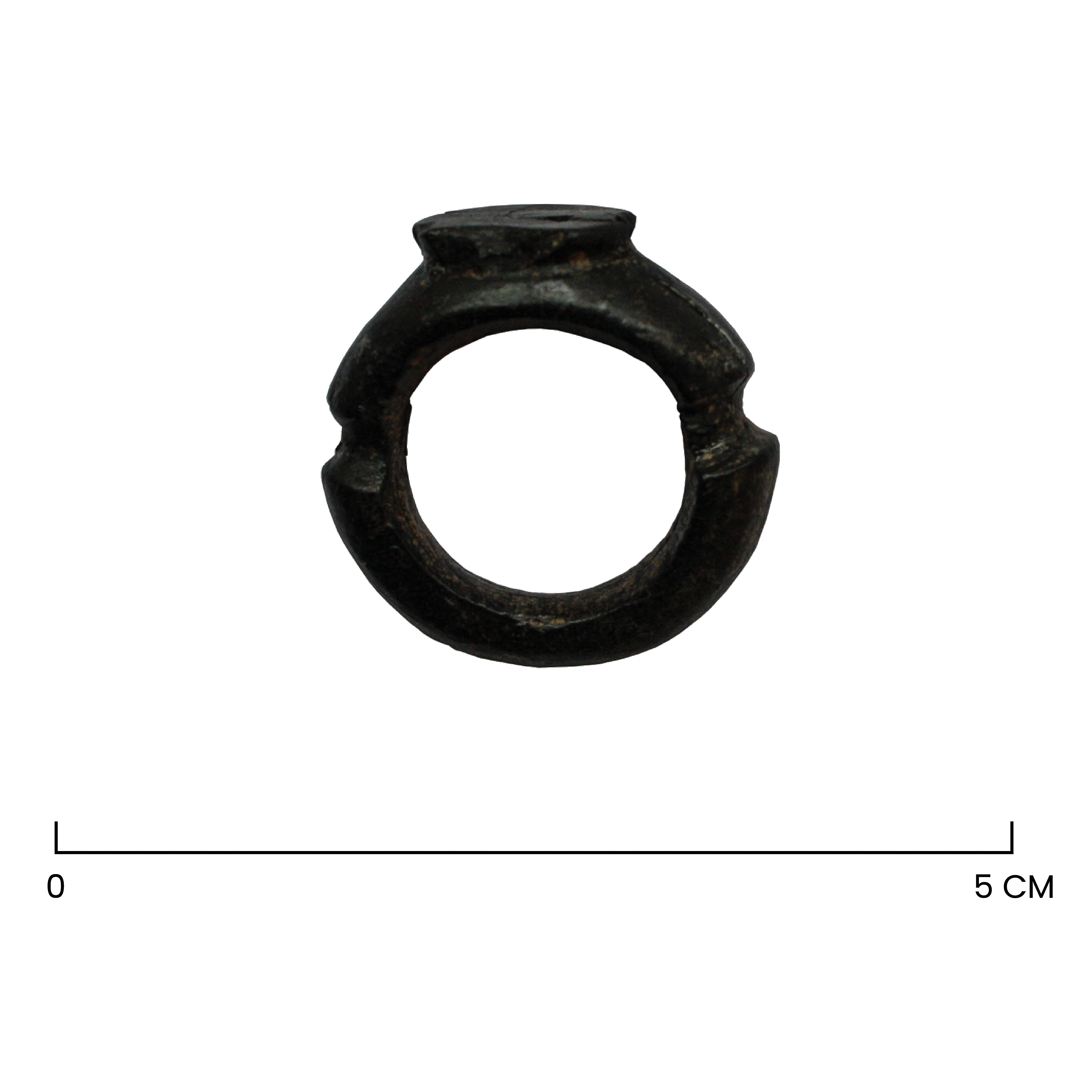
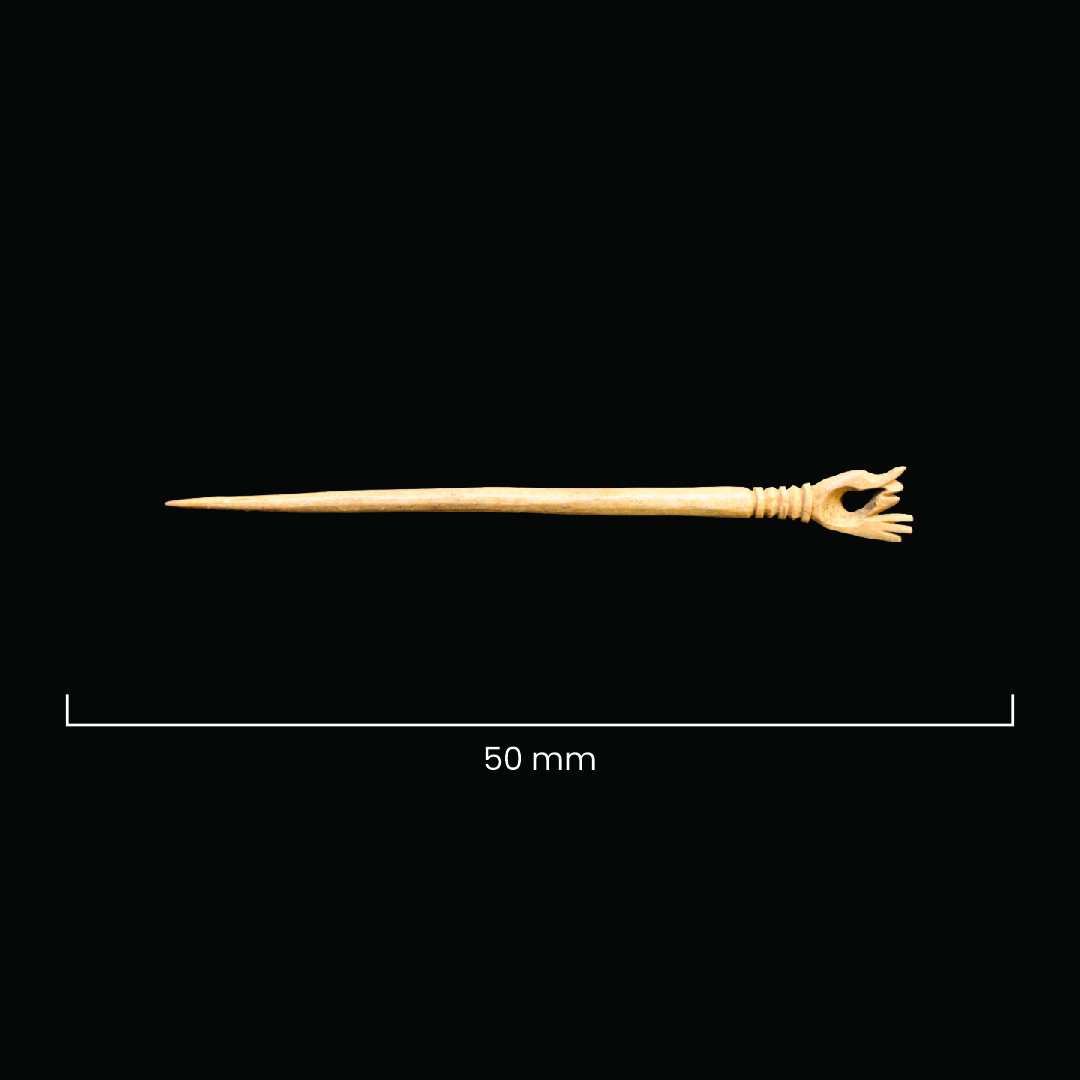
Beyond dress accessories, fragments of a mirror (SF68 — C3112; P6) were associated with a vessel. A copper alloy ear scoop (SF43 — C3132; P5) is complete and survives in reasonable condition. It is possible to recognise a small cast key (SF65 — C3100; P9) and the fragment of the end of a handle (SF195 — C8075; P8) from a second key, whilst a copper alloy object (SF61 — C3092; P10) appears to be a vessel repair for a pot. A fragment of copper alloy (SF62 — C3092; P10) is oval in shape with the remains of a loop at one end and may be part of a seal box lid.
The iron objects consist largely of nails, amounting to just under 40 examples altogether, alongside several clench bolts (SF71 and SF72 — C3026; P12) that may, however, be of a later date, given that they are not normally recovered from Roman contexts. A large, fragmentary piece of iron (SF100 — C3100; P10) includes a perpendicular stem at the tapered end and it could be part of a shovel (Humphreys 2021, pl 55). A small tool (SF162 — C19170; P13) is probably a punch, whilst a fragmentary object (SF194 — C8072; P12) could be the front part of a knife blade. A series of hobnails (SF179, SF180, SF182, SF187, SF191, SF284, SF286, SF289, SF290, SF291, SF292, SF299, SF306, SF307 and SF308) were recovered from thirteen contexts, seven of Roman date (in phases P8, P11 and P13) and six of medieval date (in phases P18, P19 and P20). The hobnails from medieval contexts can be assumed to be residual. Most of them are complete, although some of the heads are now separate from the shafts. In several cases groups of hobnails are accreted together.
Two copper alloy coins (SF209 — C19135; P19 and SF216 — C19202; P31) are likely to be of Roman date, their size suggesting that they may belong to the earlier part of the period.
Two of the most important objects from the site belong to a period that is not well-represented in York. A cast copper alloy buckle plate (SF45 — C3053; P16) is rectangular in shape with square lugs on the inner edge and two loops for the buckle, which is now missing. The upper surface consists of a series of triangular, square and rectangular cells that have been infilled with yellow, blue and red enamel (Figure 95, Figure 96). Enamelled buckle plates are a particular feature of northern Britain. Bateson separated them into three groups on the basis of the shape of the buckle plate and this example belongs to Group 1, where blunt integral tangs are present on the reverse and the enamel covers most of the upper surface (Bateson 1981, 54–5). Dating evidence for the group is sparse but 2nd century CE examples are known from Caerleon; this example came from a 3rd century CE context. There are strong associations with military sites for all three of the buckle groups. This dating was echoed by Hoss, who developed Bateson's typology and placed enamelled rectangular buckle plates into several groups, with this example belonging to her type B6 (Hoss 2014, 125 and taf 42). The type is defined by the presence of enamel in geometric patterns, spanning three or more horizontal rows. Buckles with this decoration occur in Britain and are distributed along the Rhine and Danube. A second copper alloy buckle plate (SF213 — C19187; P11) is a 2nd to 3rd century CE Roman military buckle plate.
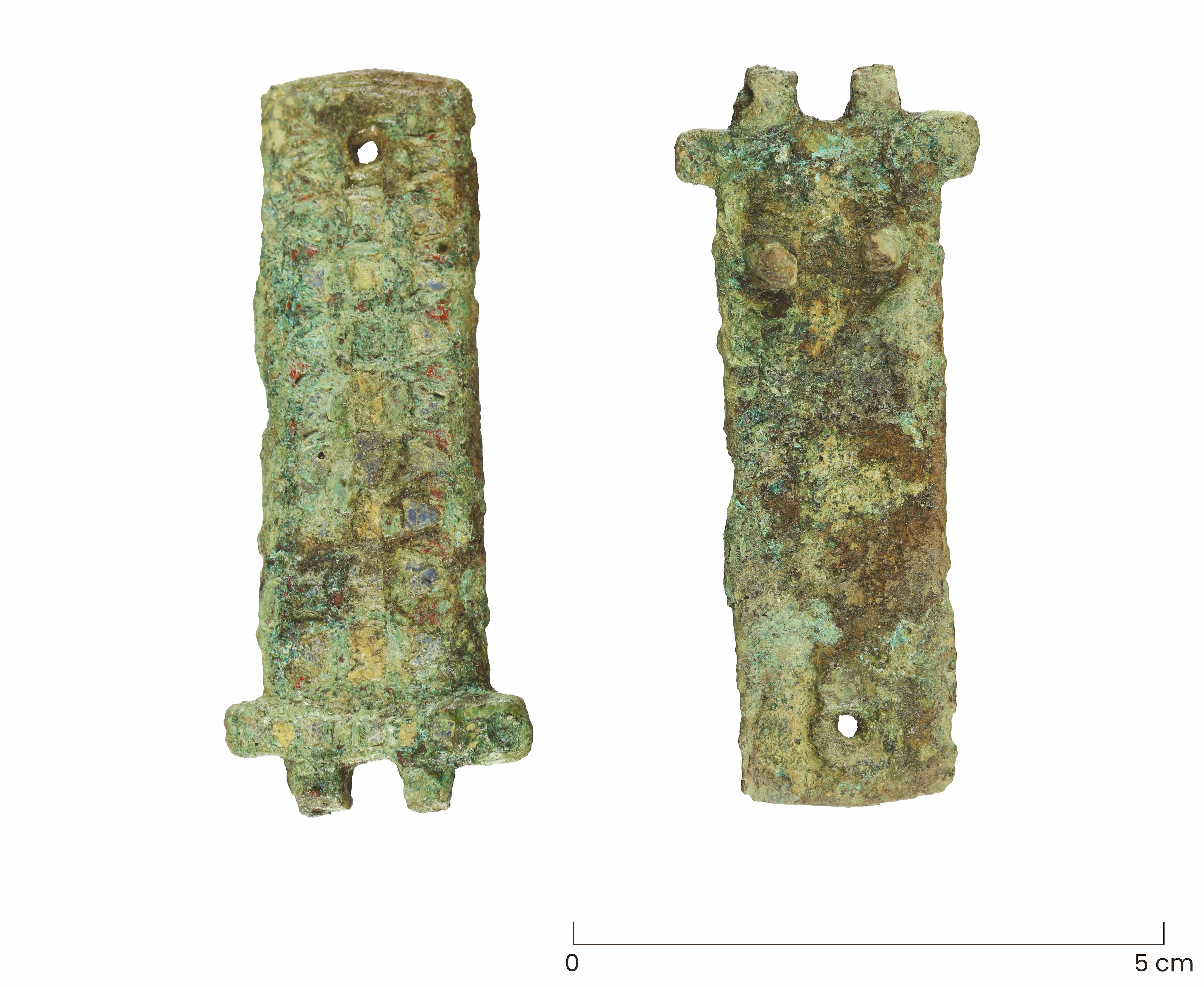
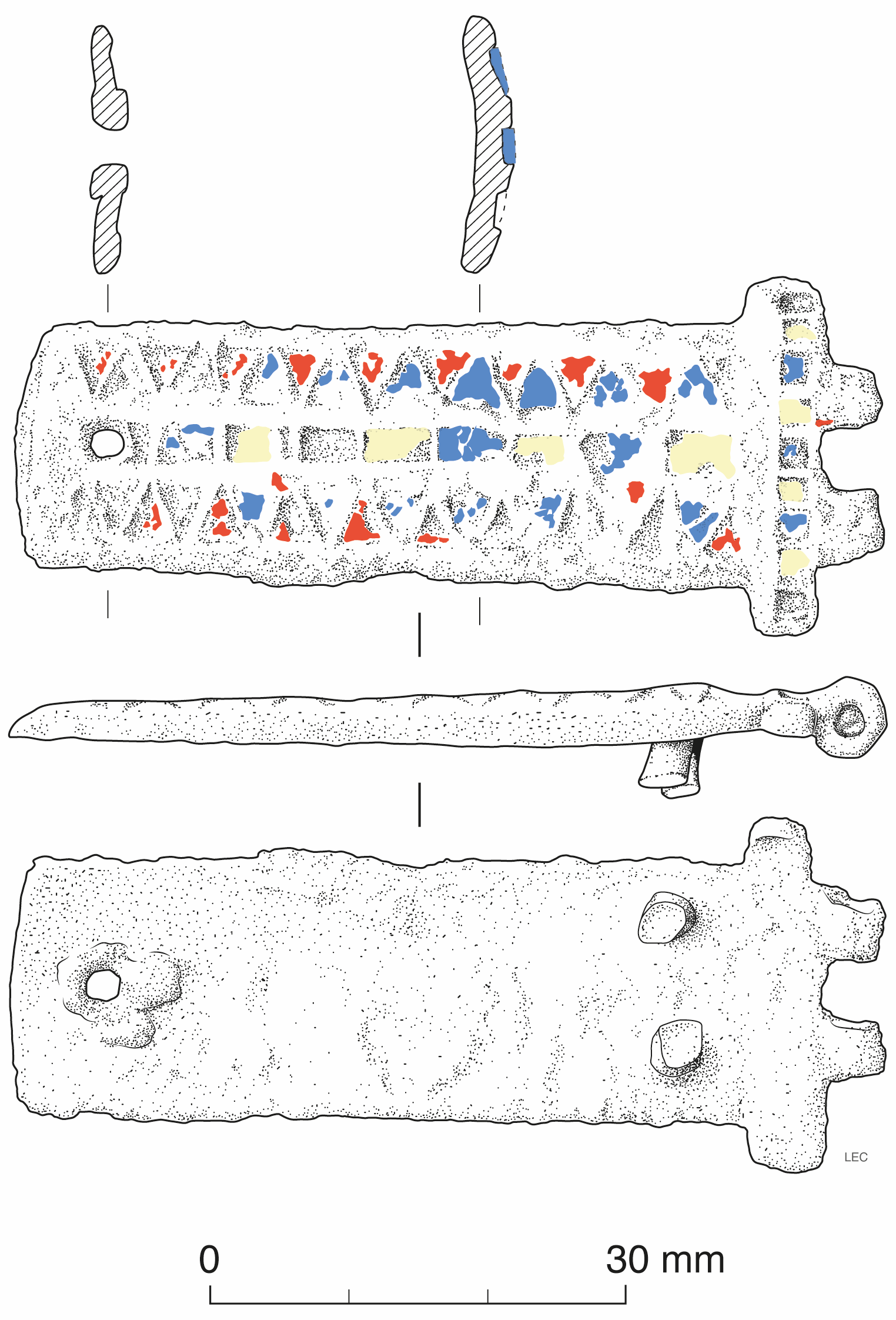
A segment of antler of oval section with lightly curved sides (SF239 — C19187; P11) falls into the broad category of 'toggles' (Figure 97). Four examples from Glastonbury Lake Village were described as 'toggle-like fasteners' and they have retained that name to the present day (Bulleid and Gray 1917, 460–3; Hunter and Gibson 2013, 295–6). They occur from the Late Bronze Age onwards, with the latest examples coming from Roman contexts, largely of the 1st and 2nd centuries CE (Greep 1983, 471). Their distribution is focused on sites lying to the north of the Thames and they are well-represented in northern England. Most of them have rectangular slots at the centre, although some of them veer towards the oval shape seen here. Greep followed Dobiat's suggestion that they may have been used with a horse harness, the slot accommodating a leather strap that was looped over, sometimes resulting in wear traces in that area, particularly on one side of the object (Greep 1983, 467; Dobiat 1979). Recent authors have been less convinced by this suggestion, noting that where they occur in burials it is not in association with any horse harness and referring to them instead as 'toggles, strap- or belt-fasteners' (Hunter and Gibson 2013, 295).
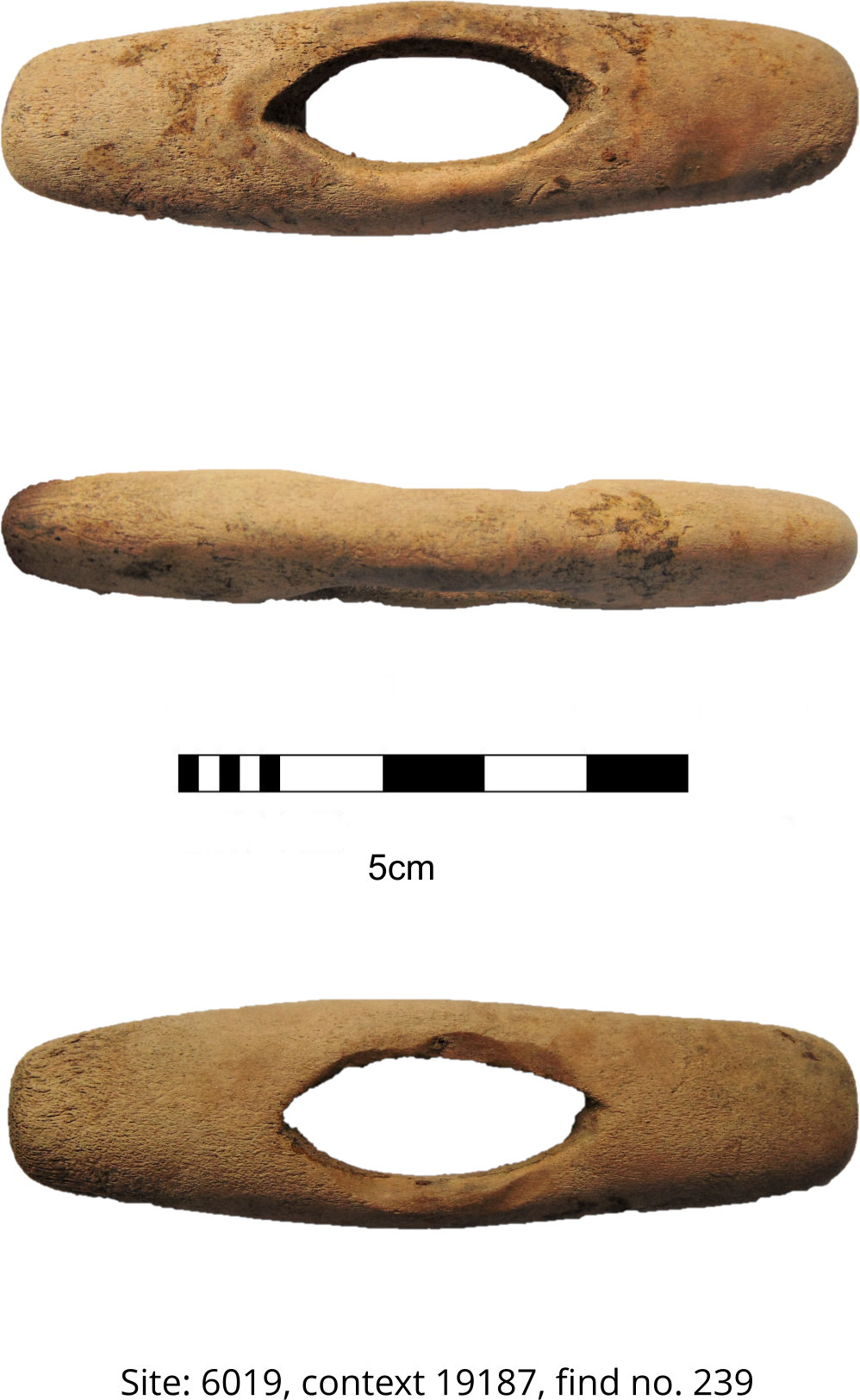
A fragmentary segment of bone (SF23 — C3057; P26) includes parts of two sides of an object that was originally square or rectangular in shape. One side includes a raised longitudinal moulding whilst the other side has two incised lines. The object has been neatly sawn at both ends and has been cut at one end to reduce its width. Its shape is similar to several handles from Avenches, including one that is similarly waisted at one end (Schenk 2008, 46 and fig.109.391–3). A close parallel is provided by a fragmentary bone handle from Castleford, as well as an earlier discovery of a handle from York (Greep 1998, fig. 121.148; Cool et al. 1995, fig.756.6423). These handles belong to small knives of early Roman date.
The medieval small finds generally survive in slightly better condition than many of the Roman finds. Note that these include a few post-medieval objects.
Antler Waste
Eighteen fragments of red deer antler waste, weighing just over 4.5kg, were recovered from eleven medieval contexts and two contexts of post-medieval date. At least two working episodes can be identified, the first spanning six contexts assigned to Phases 19–22 and the second based on five contexts largely from Phase 29. The two post-medieval pieces are likely to be residual finds, stemming from these earlier production episodes.
The waste includes three antler burrs, all of which are naturally shed. They are small burrs, perhaps shed by young animals. They can be compared for their sizes with a large sample of contemporary burrs from the High Street at medieval Dublin, as well as a smaller group from 11th to 12th century contexts at Ipswich. Comparisons can be made with circumference measurements and with a measurement taken across the coronet of each burr. With both measurements Ipswich provides the largest material, Dublin is second and York is third. The small sample of four burrs from late Saxon Southampton also has larger burr circumferences than this assemblage (Riddler and Trzaska-Nartowski 2003, 67).
Given that the size of deer increases in archaeological samples eastwards across Europe, the Ipswich, Southampton and Dublin measurements are ranked as expected, whilst the York averages should really be larger, suggesting that the red deer antler that was worked was relatively small. The sample itself is a small one, but it is consistent for both measurements.
Beyond the burrs, the antler includes six segments of tines, three beam/tine junctions, three surface segments from tine or beam, one fragment from a crown and several pieces that allow finished objects to be identified. This material can be grouped by manufacturing stage for each assemblage. The three burrs can be placed in the initial stage of working, where the antler is sawn into its constituent parts and the burr, beam, crown and tines are separated from each other (Riddler et al. 2023). In the second stage the tines are further worked, with their ends sawn away and usually discarded. The crown was treated in a similar way, with some of the tines removed and the remainder of the upper part of the antler discarded. Just two offcuts (SF27 — C3029; P29 and SF121 — C3109; P19) can be assigned to this stage and most of the waste has been further worked.
The third stage of working is the point at which it is sometimes possible to see what the finished objects might have been and there are several clues within the assemblage. Twelve of the eighteen offcuts can be assigned to this stage, including the six sections of tine, sawn at their ends and split along their length, as well as three pieces of surface tissue, which may stem from the beam or from tines. The three beam/tine junctions (SF31 — C3116; P19, SF228 — C19071; P31 and SF229 — C19074; P20) can also be placed in this stage. In each case they show a combination of sawing of the antler at one end and fracturing the antler with a blade at the other end. It is not clear why each piece was not cleanly sawn throughout and the two methods of dismemberment are not necessarily contemporary: the material may have been sawn roughly to size, and then further worked subsequently with a blade, rather than a saw.
Amidst the tines, a lightly-curved segment (SF25 — C3025; P22) has been sawn at both ends and partially hollowed, and it represents waste from the manufacture of handles. In producing whittle tang handles a section of antler tine would first be hollowed and then sawn to the requisite length. The resulting offcuts, like this example, were discarded at this point and are often partially hollowed. A small fragment of waste (SF30 — C3107; P27) has been sawn at one end and roughly faceted to shape. The opposite end was worked more carefully to a circular section and the offcut can be identified as waste from the production of antler pegs. A number of pegs could be cut from a single strip of antler. They had two main functions, serving either as rivets for composite combs or as pegs to secure bone or antler plates to wooden caskets. It is interesting to note that both of these object types, the composite comb and the casket decorated with bone or antler strips, were going out of use in the early 13th century. Comb manufacture is also attested by a fragment of waste (SF28 — C3050; P29) sawn away during the manufacture of a tooth segment for a composite comb.
Although this is only a small assemblage of red deer antler, representing several production episodes, it is significant because it belongs to the period at which the working of red deer antler was coming to an end in medieval England. Increased restrictions on the availability of the raw material led to the adoption of alternative materials at a time when craft workers were joining guilds and specialising in object manufacture, rather than working with specific raw materials. Equally, ivory was being worked in some quantity at a number of European centres, particularly in Paris, and this also affected the demand for red deer antler, accelerating the shift towards the working of other materials.
Dress Accessories
The dress accessories are all made of copper alloy. A small, thin finger ring of D-shaped section (SF47 — C3050; P29) consists merely of a narrow band, a simple form that occurs sporadically across the medieval period, particularly in the eleventh and twelfth centuries (Legros 2015, 169–71). Two copper alloy sheet metal lace tags (SF52 — C3025; P22) taper lightly to one end with a seam along their length. They belong to Margeson's type 2; a common form previously considered to be largely confined to the post-medieval period (Margeson 1993, 22). Its origins, however, may go back to the late medieval period (Riddler 2001, 274) and this pair of tags came from a medieval context. Three fragments of copper alloy (SF60 — C3069; P29) belong to a finger ring, which survives in poor condition.
Amongst other dress accessories are a good example of a complete annular brooch (SF196 — C19009; P39) and a crescentic belt fitting (SF197 — C19009; P39), both found in the same medieval grave, while a mount with a fleur-de-lys terminal (SF198 — C19011; P20), possibly from a strap-end, was recovered from a 12th to 13th century deposit into which graves had been cut. A small iron pin (SF177 — C19096; P19) is contemporary with the series of bone pins that span the late 11th to 12th century, and it appears to be of similar dimensions, with a swollen lower shaft. There are also two bone pin or needle shafts (SF24 — C3029; P29 and SF238 — C19181; P20) from medieval contexts.
Three copper alloy pins came from two contexts of early post-medieval date. The longest example (SF49 — C3031; P36) lacks its head, whilst the pair of smaller pins from C3043 (SF48 — C3043; P36) include one with a globular head and another with a crimped wire-wound head. Small wire pins of this type are very common in late medieval and early post-medieval contexts and hundreds of examples have been found on sites in York (Ottaway and Rogers 2002, 2915). They are at their most common in 15th to 16th century contexts, as is the case here. Two principal head forms have been identified for pins of this type from contemporary sites, which are either solid and globular in shape, or formed of wound wire (Biddle 1990, 560–71; Egan and Pritchard 1991, 297–304; Rogers 2004, 39–42). Pins with wire-wound heads outnumber other types at York (Rogers 2004 40).
Personal Possessions
The only object that can be placed in this functional category is an incomplete cast copper alloy chape (SF46 — C3052; P29), which has been cast to an openwork form with a fleur-de-lys design at the centre on one side, rising up from the flattened knop at the base. It belongs to the earlier form defined by Ward Perkins (1954, 280) for London and, as a cast example, it is more elaborate than the later series of sheet metal chapes from York (Ottaway and Rogers 2002, 2904).
Craftworking Implements
Very few medieval tools were found on the site, but a tapering bar of rectangular section (SF84 — C3048; P26) appears to be part of a cold chisel, with a burred apex. The lower part of the chisel has fractured away. Its small size suggests that it was a blacksmith's chisel, rather than an implement of a stonemason or carpenter (Goodall 2011, 9). Several chisels have come from previous excavations in York and most of them are larger than this implement (Ottaway and Rogers 2002, 2723).
A small assemblage of copper alloy sewing pins with wound wire heads (48, 200–2, 210 and 212) were retrieved from five separate contexts. Most of them are complete and they can be identified to type. They have been recovered in large numbers from sites in York and extend in date from the 13th century to the 16th century (Ottaway and Rogers 2002, 2915–6).
Household Equipment
Items that can be associated with the household include both structural materials and possessions. The former are represented here by a copper alloy ring and an iron wall hook, whilst the latter consists of a fragment of a stone mortar.
A small copper alloy ring (SF44 — C3102; P24) has an uneven circumference, probably the consequence of considerable use. It retains organic material in one area, which has been identified as textile. This suggests that it may either have been worn on a textile belt as a simple suspension device, or it was used to suspend textiles (and drapes in particular) within a medieval household, as suggested for London (Egan 1998, 62).
A small iron wall hook (SF108 — C3110; P19) is rectangular in section and tapers to a point. It has fractured at the junction with its lower shank, which originally projected beyond the curve of the hook and would have allowed it to be hammered into a wall (Ottaway and Rogers 2002, 2836).
A fragmentary iron auger or spoon bit (SF175 — C19070; P20) lacks the upper part of its tang. It could be of medieval date and can be compared with similar objects from York from that period (Ottaway and Rogers 2002, 2756–7); it came from a medieval context, C19075.
The front part of a knife blade (SF171 — C19035; P37) can be identified as an example of Ottaway's type A (Ottaway 1992, 561–4). The type is not well-dated, unfortunately. It occurs in late Roman contexts and was extensively used from the later 6th century CE onwards. The latest examples are found in contexts of 13th century date, which is probably the more relevant date here, although this fragment was recovered from a post-medieval context. A second knife blade (SF182 — C19093; P20) lacks the front end and is not readily identifiable to type. A rectangular binding strip of iron (SF155 — C19107; P19) may have been associated with a chest and retains part of its hinge.
A fragment of a stone mortar (SF128 — CC3043; P36) has been cut and shaped from Permian Lower Magnesian limestone, in common with most of the medieval mortars from York (Ottaway and Rogers 2002, 2800). It includes a flat rim, from which a simple lug, with a runnel, projects outwards. Tool marks are visible on the outer surface. Medieval mortars were produced locally for York from the 13th century onwards in a variety of shapes and sizes, usually with two lugs and two handles projecting from the rim. This mortar includes a solid lug, the lower part bevelled inwards with traces of a triangular projection at the base. The presence of lime mortar on the inner surface suggests that after it fractured and was no longer used, it was adapted as building material. Dunning (1977, 336–44) produced a useful typology of the stone mortars from Kings Lynn but it relies on the presence of the handles, as well as the lugs, and insufficient survives of this fragment to assign it to a specific type.
Literacy
A complete cast copper alloy stylus (SF42 —C3150; P33) represents a rare and unusual find, recovered from late alterations to the medieval friary. From the late medieval period onwards the common form of stylus was made from lathe-turned bone, with a metal point and, on occasion, embellishment with a silver collar or point (Riddler 1998; Egan 2005, 123). This stylus is of similar dimensions to the bone series and follows the same design, with a rounded knop at the apex. The shaft, however, is hexagonal in section. Late medieval to early post-medieval styli tend to be shorter than medieval examples, which are occasionally made of copper alloy, as with an example from Winchester (Biddle 1990, fig. 211.2283).
Structural Ironwork
Just over 80 iron nails were recovered from contexts of medieval date. The majority of them have tapering shafts of square section and flat, or near-flat, discoidal heads. Complete shafts vary in length from 48mm to 85mm, a similar range to that established for plated nails from medieval contexts elsewhere in York (Ottaway and Rogers 2002, 2828). They would have been hammered into thicker segments of wood than the clench bolts from the site, which are described below, although in one case (SF93) the shaft of a nail had been bent over after passing through wood 21mm in thickness.
Eighteen iron clench bolts were found in ten separate contexts of medieval date; one example was unstratified. A small number of clench bolts were also found in Roman contexts. Post-Roman clench bolts consist of a shaft, usually of square or circular section, cast integrally with a discoidal head at one end, with a lozengiform rove added to the opposite end and secured by clenching the shaft. Brookes has suggested that early and middle Anglo-Saxon clench bolts tend to have circular shafts, whilst those of late Saxon date are square (Brookes 2007, 9). The shafts of clench bolts from Coppergate at York were rectangular or rounded rectangular in section and, where the shafts could be examined for the Guildhall assemblage, they are square to rectangular in section, suggesting that medieval examples have shafts of a similar section to those of late Saxon date (Ottaway 1992, 615).
The clench bolts from the Guildhall site vary in overall length from 53mm to 63.5mm and clenched either one or two pieces of wood between 31mm and 39mm in thickness. Most of the Late Saxon clench bolts from Coppergate in York were 27mm to 45mm in length and the medieval examples appear to have been more substantial than these earlier examples. This is reflected also in the spacing between the head and the rove, which was 26mm to 36mm at Coppergate but 31mm to 39mm here (Ottaway 1992, 616). The range was wider, at 20mm to 50mm for clench bolts from Fishergate, some of which came from middle Saxon contexts, whilst others were late Saxon (Rogers 1993, 1410–12). The wider spacing seen here strongly suggests that timbers were clenched in a simple constructional technique and there is no obvious connection with reused boat timbers. A similar argument has been made for the extensive collection of clench bolts from medieval Townwall Street at Dover, where over 300 clench bolts secured wood between 15mm and 44mm in thickness. A series of clench bolts appeared to have been utilised there on a porch at the front of one structure (Riddler 2006, 309).
Thus, in terms of the Guildhall and Anglo-Saxon and medieval York, there is no particular requirement to view them either as stemming from sections of boats, or as showing any Scandinavian influence. They have been found in both middle and late Saxon contexts in York, where it was noted that their principal use lay in securing overlapping timbers together (Ottaway 1992, 615–8).
Roman Pottery | Post-Roman Pottery | Ceramic Building Material | Stone Building Materials | Mortar, Plaster and Painted Plaster | Daub and Opus Signinum | Small Finds | Roman Frit Objects | Roman Vessel Glass | Roman Window Glass | Coins | Worked Stone
Frit melon beads were a very common artefact type being made and used in quantity in the 1st century to mid-2nd centuries CE. They were especially popular on military sites where they are frequently found in large numbers. They are regular finds on sites excavated in York (see for example Cool et al. 1995, 1661 nos. 6254–9, 1669 nos. 6472–9, 1672 no. 6524). The recovery of two from the Guildhall excavations is thus to be expected. The complete example SF21 had clearly seen considerable use before it was incorporated into levelling deposit C3092 below the late 2nd to early 3rd century CE Phase 10 clay floor in Trench 2 (Table 30).
| Small Find number | Context | Phase | Description | Weight (g) |
|---|---|---|---|---|
| SF21 | 3092 | 10 | Melon bead. Shallow gadroons; cylindrical perforation deformed at one end. Retaining small patches of turquoise glaze but otherwise much abraded. Length 9mm, diameter 12mm, perforation diameter 5mm. | 1 |
| SF20 | 3048 | 26 | Melon bead; approximately one quarter extant. Regular gadroons; interior of perforation has concavity. Retains very small traces of turquoise glaze. Length 17mm. | - |
Roman Pottery | Post-Roman Pottery | Ceramic Building Material | Stone Building Materials | Mortar, Plaster and Painted Plaster | Daub and Opus Signinum | Small Finds | Roman Frit Objects | Roman Vessel Glass | Roman Window Glass | Coins | Worked Stone
A small assemblage of Roman vessel glass weighing 122g was recovered from the site. Of this, just under half (54g) was found residually. The range of forms that can be identified belong to the 1st to 2nd centuries CE and to the 4th century CE. Diagnostic forms of the later 2nd and 3rd centuries CE, which are normally common on sites in York, are absent. As the assemblage is so small, this is probably not significant, though the virtual absence of colourless glass amongst body fragments tells the same story. They accounted for less than 1g of the total weight as opposed to the 112g of blue/green glass (Table 31).
| Small Find number | Context | Phase | Description | Weight (g) |
|---|---|---|---|---|
| SF16 | 3026 | 12 | Body fragments (2). Mould blown. Blue/green. Largest fragment retaining one rice grain pellet, broken at edge of two other curved mouldings, one possibly parallel, other at an angle. Second fragment retains part of two rice grain pellets set at angle to each other and edges of two other mouldings between them. Dimensions 18 x 7mm, 13 x 8mm, wall thickness 1.5mm. | 3.8 |
| SF13 | 3029 | 19 | Jug or jar; lower body and base fragment. Deep blue. Lower body sloping into open pushed-in base ring. Inner part of base ring and base missing. Base diameter 60mm, wall thickness 3mm, present height 20mm. | 4.8 |
| SF11 | 3055 | 29 | Jug or jar (?); two joining lower body fragments (?). Blue/green. Convex, curved side broken at edge (?) of open pushed in base ring. Dimensions 37 x 26mm, wall thickness 1.5mm. | 3.3 |
| SF259 | 19181 | 20 | Body fragment. Mid yellow/brown. Slightly convex-curved; one rib. Dimensions 22 x 21mm, wall thickness 1.5mm. | 1.9 |
| SF32 | 3102 | 24 | Base fragment. Blue/green. Solid base ring; base missing; side grozed; some probably deliberate chipping on the underside of the base. Base diameter c. 55mm. | 1.9 |
| SF17 | 3050 | 29 | Bottle; rim and neck fragment. Blue/green. Rim bent out, up, in and flattened; cylindrical neck. Rim diameter 50mm, present height 15mm. | 9.8 |
| SF254 | 19101 | 38 | Hemispherical cup; rim and side fragment. Pale green; small bubbles; strain cracks. Straight rim, edge cracked off and not ground; Slightly convex-curved side. Abraded band below rim edge and three bands on upper body. Dimensions 27 x 24mm, wall thickness 1.5mm, present height c. 25mm. Weight 1.5g. | 1.5 |
| SF255 | 19135 | 19 | Conical beaker; rim and side fragment. Pale green; small bubbles. Curved rim, edge cracked off and not ground; straight side sloping in. Rim diameter c. 80mm, wall thickness 1mm, present height 15mm. | 0.6 |
One find (SF16 — C3026; P12) is of especial interest. It is mould blown and hitherto the range of mould-blown glass in use from the Claudian to Flavian periods (Price 1991) has been a rare find in York. Ribbed cups of the earlier part of the production are known from Blake Street (Cool et al. 1995, 1651 no. 5894, fig. 736) and St Mary's Abbey (Cool 1998, 304, no. 4, fig. 2). A fragment from a Flavian beaker retaining part of a meander pattern came from the excavations at the Minster (Price 1995, 355 no. 13, fig.142). There are also two items in the Yorkshire Museum which are without provenance but which are probably antiquarian finds from within the city. One is a fragment from a chariot cup, a form commonest in the Neronian period, and the other is a fragment from a Flavian almond knob beaker (Harden 1962, 136 fig.88 nos. HG 273 and a). The scarcity of mould-blown glass from York has always been a slightly unusual phenomenon given its occupation date, so the recovery of SF16 is a useful addition to the known corpus.
The fragments were found in a build-up layer associated with the late 2nd century CE demolition of Phase 12 where they were clearly residual. The very small size makes reconstruction of the pattern difficult, especially as they clearly do not come from one of the more common patterns of mould-blown glass. Both have small narrow pellets resembling rice grains. They are smaller than the oval bosses seen on almond knob beakers and were clearly not regularly set out in quincunx as is the custom on those vessels. Trios of similar pellets set out in a radiating pattern were present on a cylindrical beaker from Kingsholm, Gloucester (Price and Cool 1985, 46 no. 16, fig.18). That beaker is unusual within the corpus of 1st century CE mould-blown vessels but seems to fall within the broader family of conical beakers that includes the almond knob variety. Some of those combine meander, boss, pelta and other designs (see for example Price 1991, pls. XVIII b–c, XIX c–d). The fragment from the Guildhall excavations would have come from a beaker of this sort. The juxtaposition of motifs of different shapes would allow for the range of differently shaped motifs hinted at by the broken edges on the fragments that make up SF16. If this is correct then the beaker they came from would have been made during the late Neronian and Flavian period and would probably have been in use originally in the later 1st century CE.
The other fragments call for little detailed comment as they are all common forms that have frequently been found in York before. All, for example, can be paralleled within the large assemblage from 9, Blake Street (Cool et al. 1995, 1559–88).
The earliest fragment is the deep blue base fragment (SF13 — C3029; P29). It would have come from either a jug or jar belonging to the range which was very common from the mid-1st to mid-2nd centuries CE (Isings Forms 52, 55 and 67c; Price and Cottam 1998, 137–8, 150–7). In the case of SF13, the strong colour points to a 1st century CE date. The other fragments which are probably from the same range of vessels (SF11 — C3055; P29 and SF259 — C19181; P11) cannot be closely dated within the overall date range.
Square and prismatic bottle fragments dominate the assemblage by weight (73g) as they normally do for any 1st to 3rd century CE assemblage (Isings Form 50; Price and Cottam 1998, 194–200). The rim fragment SF17 (C3050; P29) would have come from a bottle of this type. The rest of the bottle assemblage consists of body fragments, and neither the rim nor the body fragments can be more closely dated within the later 1st to 3rd century CE period.
Fourth-century CE glass is represented by SF254 (C19101; P38) and SF255 (C19135; P19) and one other body fragment. All were found residually. Hemispherical cups like SF254 and conical beakers like SF255 were the commonest vessels forms in use at that time (Isings Forms 96 and 106; Price and Cottam 1998, 117–23).
The base ring fragment SF17 (C3050; P29) is of some interest as the side has been deliberately grozed, so this vessel would have had a second life as a disc after it was broken. The colour indicates that the vessel would have been made during the 1st to 3rd centuries CE. Making glass bases into discs was a common form of reuse within the Roman period so, though it was found in a Phase 29 pit fill of mid-13th to mid-14th century date, the modification had probably been made much earlier.
Roman Pottery | Post-Roman Pottery | Ceramic Building Material | Stone Building Materials | Mortar, Plaster and Painted Plaster | Daub and Opus Signinum | Small Finds | Roman Frit Objects | Roman Vessel Glass | Roman Window Glass | Coins | Worked Stone
Both of the Roman window glass fragments were found residually in C19034, a post-medieval levelling deposit below a cobble surface. They are of the type conventionally known as cast matt/glossy which was the dominant type in use during the 1st to 3rd centuries CE (Table 32).
| Small Find number | Context | Phase | Description | Weight (g) |
|---|---|---|---|---|
| SF6 | 3109 | 19 | Fragment. Light green, Cast matt/glossy. Two edges grozed to meet at 90°, one curved. Dimensions 31 x 29mm, area 8cm2. | 6.2 |
| SF14 | 3048 | 26 | Two joining fragments. Blue/green. Cast matt/glossy. 12cm2. | 12.7 |
Roman Pottery | Post-Roman Pottery | Ceramic Building Material | Stone Building Materials | Mortar, Plaster and Painted Plaster | Daub and Opus Signinum | Small Finds | Roman Frit Objects | Roman Vessel Glass | Roman Window Glass | Coins | Worked Stone
The Roman coins are common finds for Roman sites in Britain. All were residual in medieval and later contexts (Table 33). The Nuremburg jettons are likewise relatively common finds, here in 16th century demolition and post-medieval deposits.
| Small Find Number | Context | Ruler/ Denomination | Catalogue Reference | Description | Legend | Date of issue |
|---|---|---|---|---|---|---|
| SF2 | 7009 | Hadrian silver denarius | RIC 118b | Diam: 18mm Wt: 1.6g Axis: 7 Wear: W/W | Obv: IMP CAESAR TRAIAN HADRIANVS AVG Rev: PM TRP [COS III] Concordia seated left, holding patera and resting left elbow on statue of Spes, cornucopia beneath seat | AD119-122 |
| SF37 | 3055 | Ae3 | Diam: 20mm Wt: 2.8g Axis: - Wear: EW/EW | Illegible ?radiate bust | C3 | |
| SF38 | 3052 | Divus Constantius I Ae4 | RIC VII Trier 206 | Diam: 15mm Wt: 1.2g Axis: 12 Wear: W/W | Obv: [DIVO CONSTANTINO OPT IMP] laureate veiled bust Rev: [REQVIES] OPT MER emperor seated left on curule chair | 318 |
| SF39 | 3043 | Nuremberg Jetton | as Mitchiner 1988: nos. 1070, 1072 | Diam: 24mm Wt: 1.3g Axis: - Wear: VW/VW | Obv: Shield of France with three fleurs de lis, surmounted by crown Rev: Imperial orb within a tressure of three arches and three angles fictitious legends...BOVERB../...BVERB.... | 1500–25 |
| SF40 | 3051 | Valens Ae3 | as LRBC II 82 | Diam: 17mm Wt: 2.3g Axis: 11 Wear: VW/VW | Obv: DN VALEN [S PF AVG] Rev: S]ECVRITAS REIPVBLI[CAE | 365–378 |
| SF41 | 3029 | William I silver penny | Spink1256; North 847 | Diam: 23mm Wt: 1.0g Axis: 1 Wear: W/W | Obv: +WILLELM REX Rev: +WILFRED ON CNTLI Profile right, cross and trefoils Canterbury mint | 1080–83 |
| SF67 | 3110 | House of Constantine Ae4 | - | Diam: 14mm Wt: 0.9g Axis: Wear: VW/VW | Obv: Rev: [gloria exercitvs] | c330–337 |
| SF209 | 19135 | Valerian Antoninianus | as e.g. RIC74 | Diam: 20mm Wt: 2.2g Axis: 1 Wear: VW/VW | Obv: IMP CP LIC VALER[IANUS AVG] Rev: personification Radiate bust | 253–257 |
| SF216 | 19202 | House of Valentinian Ae3 | - | Diam: 17mm Wt: 2.6g Axis: 12 Wear: W/W | Obv: Rev: victory walking l with wreath and palm | 365–75 |
| SF221 | 19027 | Hans Krauwinckel II Nuremberg Jetton | as Mitchiner 1988: no. 1545 | Diam: 21mm Wt: 1.1g Axis: 1 Wear: W/W | Obv: HANNS KRAVWINCKEL IN NVR Rev: GOTES REICH BLEIBT EWICK | 1586–1635 |
The silver penny of William I is less common, this example minted by the moneyer Wilfred at the mint at Canterbury in 1080–83 (Figure 98). Recovered from the primary fill of mid-13th to mid-14th century refuse pit, C3029, it is also clearly residual.
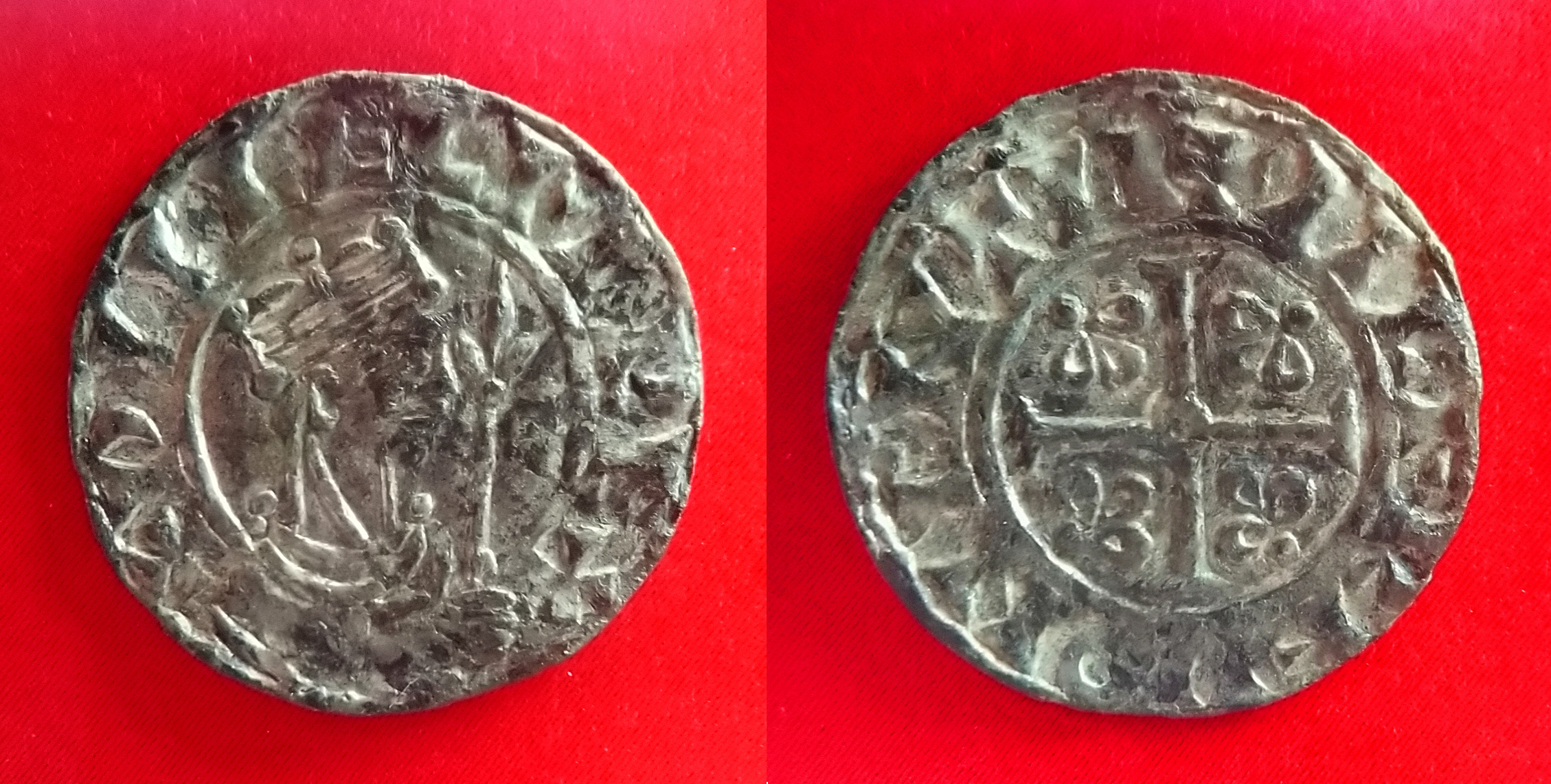
Roman Pottery | Post-Roman Pottery | Ceramic Building Material | Stone Building Materials | Mortar, Plaster and Painted Plaster | Daub and Opus Signinum | Small Finds | Roman Frit Objects | Roman Vessel Glass | Roman Window Glass | Coins | Worked Stone
In total, six worked stone objects were recovered from the Guildhall site. Of these, five can be categorised as hone stones, with one spindle whorl. All objects were well-preserved.
Each worked stone object was examined using a hand lens with x20 magnification and tested for the presence of carbonates using dilute hydrochloric acid. Geological descriptions for each stone object were produced based on these observations and identifications given where possible. Measurements relevant to the use and wear of the stone objects were taken and each item was subsequently weighed. The hones were described and categorised using the methodology applied in Allen's (2014) study of the hones from Silchester, and Banfield's (forthcoming) analysis of the hones from Roman London. The spindle whorl has been described and classified using the methods outlined by Alberti (2017).
The hones
SF233, C19178; P21. A portable bar-shaped hone of pale grey fine-grained slightly micaceous laminated sandstone with calcite cement. Identified macroscopically as possible Weald Clay Formation Sandstone. There is no remaining evidence that the hone was manufactured, though the surviving dimensions correlate with the size of Roman period manufactured bar-shaped hones. The two sides and the upper surface are smooth, while the lower surface has broken off along the bedding plane. Both ends of the stone are also broken, and these are irregularly shaped. The stone measures 62mm in length, 29mm in width, 11mm in thickness and weighs 45g. The upper surface of the stone is slightly concave, giving an indication of wear.
SF116, C3142; P24. A portable bar-shaped hone comprised of a quartz mica schist, identified as Norwegian Ragstone. The stone measures 35mm in length, 38mm in width, 17mm in thickness, and weighs 49g. The sides and the upper surface of the hone are intact, while part of the lower surface has split and broken off. Both ends have also been broken. The smoothed sides and upper surface show signs of wear.
SF230, C8072; P12. A semi-portable block-shaped hone comprised of pale grey fine-grained slightly micaceous laminated sandstone. The stone appears to have been roughly shaped with some possible evidence that chiselling was used. However, subsequent wear on the surfaces has removed any means of confirming the presence of tool marks. The stone measures 120mm in length, 43mm in width, 36mm in thickness and weighs 372g. Both ends are broken and irregular, with one end being slightly smoothed from wear. The side edges are roughly shaped, also with some smoothing, while both upper and lower surfaces showing the most significant signs of wear. The thickness of the stone narrows towards one end and was likely used more prominently in this area.
SF234, C19197; P8. A portable bar-shaped hone of medium-grained laminated ferruginous quartz sandstone with occasional mica and silica cement. The dimensions of the stone suggest that it could be a reused floor or roof tile reshaped from its original tabular form. The stone is 91.6mm long, 25mm wide and 25mm thick. It weighs 114g. The sides and ends of the stone are irregularly shaped with some signs of smooth wear on each of the ends. The lower surface of the stone is uneven, with a very flat and smooth upper surface.
SF232, C19070; P20. A portable rod-shaped hone that may have originally been a bar shape and worn into a more rounded shape. The sides are all convex, but there is a sub-square profile to the shape that does not correspond fully with the fully rounded profile of a rod-shaped hone. The stone is formed from a fine-grained grey-brown laminated glauconitic sandstone with occasional mica and carbonate cement. The stone has been identified macroscopically as probable Weald Clay Formation Sandstone. The stone is 96mm long, 29mm wide, 30mm thick and weighs 189.3g.
The spindle whorl
SF231, C19004; P30. A domed spindle whorl made from a pale grey fine-grained carbonate sandstone. The exterior surface of the whorl has been worked to produce a very smooth rounded surface. The thickness of the object is 22mm, while the diameter at the widest point is 31mm. The central hole appears to have been drilled/worked from both sides and is 11mm in diameter. One side of the whorl is domed and rounded, while the other side is flattened. The flattened side has been worn smooth. The whorl weighs 21.4g.
The worked stone assemblage from the site at Guildhall provides some insight into the possible craft and domestic activities that may have taken place there over the period of its occupation. The hone assemblage comprises three bar, one block, and one rod-shaped hone. The latter may have begun life as a bar-shaped hone and become rounded through wear as it does not resemble those deliberately fashioned to be of this form (see examples in Thiébaux et al. 2016, 576–9). A range of different stone types were present across the hone group, with one sandstone being of a considerably coarser grain than the others. The variety in form and fabric across the assemblage suggests that different sharpening activities took place at the site and that these may have involved different types of blades. The block-shaped hone could be indicative of craft activity related to metal working, while the fine-grained sandstone hones and the Norwegian Ragstone may have been used for a variety of purposes, including domestic everyday sharpening.
Hone stones are difficult to date, though the stone type used to make them can sometimes be indicative of their first date of use if exploitation of specific stone types is known to have commenced/peaked during a certain period. Two, SF230 and SF234, are from 2nd/3rd century CE deposits, all the others were found in medieval contexts in Period 6. However, as potentially long-lived objects, a wide date range is probable, while building stone or other stone objects reused for sharpening can further complicate dating attempts. The Guildhall assemblage has yielded one identifiable stone type, with two other probable identifications. The hone identified as Norwegian Ragstone (SF116) can be dated to the medieval period or later as this stone type is not known to exist in British contexts predating this period. Both SF233 and SF232 have been identified macroscopically as probable Weald Clay Formation Sandstone. This was a common stone type used to manufacture predominantly bar-shaped hones during the Roman period (Allen 2014; 2017). Hones made from this stone type were very popular in the Roman period and were widely distributed. Analysis of the hones from Roman London suggests that the Weald Clay Formation Sandstone hones are likely to have been redistributed from London, and possibly even manufactured there (Banfield forthcoming). Examples have also been identified from Roman period Belgic-Gaul, indicating that these were exported as utilitarian stone objects (Reniere et al. 2018). It is not surprising to find this hone type in York as the city would have been well-connected to London via multiple exchange routes. Further to this, the Roman population of York would have experienced similar issues to their counterparts in London, in that there was a dearth of locally-available stone sources that could be used for sharpening or processing activities (Pearson 2006, 120–8).
This lack of local stone sources for sharpening is also a factor in the presence of a possible reused floor or roof tile as a hone (SF234). The occurrence of stone being reused for processing or sharpening activities is very common in areas where a lack of suitable stone was an issue. The Roman period hone assemblages from London (Banfield forthcoming) and Silchester (Allen 2014) have shown the scale of this reuse in the Roman period, but such reuse continued throughout other periods and is common in urban contexts.
The spindle whorl is also an indicator of craft or domestic activity being carried out at the site. It is difficult to date spindle whorls, as a wide variety of materials and forms are known, and none are specific to a particular period. Whorls made of stone were common in the Iron Age, but in the Roman period they occur less frequently than the ceramic versions that appear to have been more popular. In the medieval and later periods, stone whorls occur synonymously with those of other material types. The diameter of the perforation is large when compared to most Roman and Iron Age examples, as these tend to measure in the range of c. 4–8mm. Although this is not definitive, larger perforations tend to manifest on examples dating to the early medieval period onwards (Walton Rogers 2007, 23–24). The use of sandstone for SF231 is common for stone whorls, as it is a material that is relatively light in weight compared with other stone types. The weight is important when it comes to spinning as this helps give the spindle momentum in the twisting, or spinning, of fibres into yarn. With a weight of 21g, it is likely that this whorl was used to spin wool or another moderately heavy material (Margeson 1993, 184).
Overall, the worked stone assemblage from Guildhall provides an interesting view of the possible craft activities that took place there. Whetting, honing and spinning may have occurred at the site or close by, though the portability of all the stone objects means that deposition and redeposition away from craft activity areas is likely. The hones are of varying coarseness and the presence of a block-shaped example suggests that sharpening may have included a more varied range of blades and stages of sharpening than might be expected from everyday domestic activities. However, there is little evidence to suggest commercial or large-scale craft pursuits. The reuse of a possible stone tile as a hone is a regular occurrence in urban contexts and shows how disused building material could be strategically exploited to broach the deficit in suitable local stone sources. Few of the objects can be precisely dated and the period of their primary use cannot be identified. A hone from a stone source that is known to have been exploited solely in the Roman period has been tentatively identified (SF233), while hone SF116 would have been used from the medieval period onwards. The spindle whorl is likely to date from the early medieval period onwards.
Internet Archaeology is an open access journal based in the Department of Archaeology, University of York. Except where otherwise noted, content from this work may be used under the terms of the Creative Commons Attribution 3.0 (CC BY) Unported licence, which permits unrestricted use, distribution, and reproduction in any medium, provided that attribution to the author(s), the title of the work, the Internet Archaeology journal and the relevant URL/DOI are given.
Terms and Conditions | Legal Statements | Privacy Policy | Cookies Policy | Citing Internet Archaeology
Internet Archaeology content is preserved for the long term with the Archaeology Data Service (ROR). Help sustain and support open access publication by donating to our Open Access Archaeology Fund.
 Home
Home